The Restaurant of 2030 Answers Its Own Phone, Staffs Its Own Shifts and Never Over-Orders
⚡ Expert Summary: Four years from now, the average independent restaurant will run on four systems that each do one job completely: a voice agent that answers every call and takes the full order, a scheduling engine that fills and refills shifts without a manager on the phone, a forecasting layer that orders food against actual covers instead of par levels, and a back-office agent that reconciles invoices as they arrive. None of them is the POS, and that is the part most owners still have wrong. The POS becomes the ledger everything reports into, not the brain. The operators who get to 2030 in good shape are the ones who stop asking which AI tool to buy and start asking which jobs they should stop doing by hand.
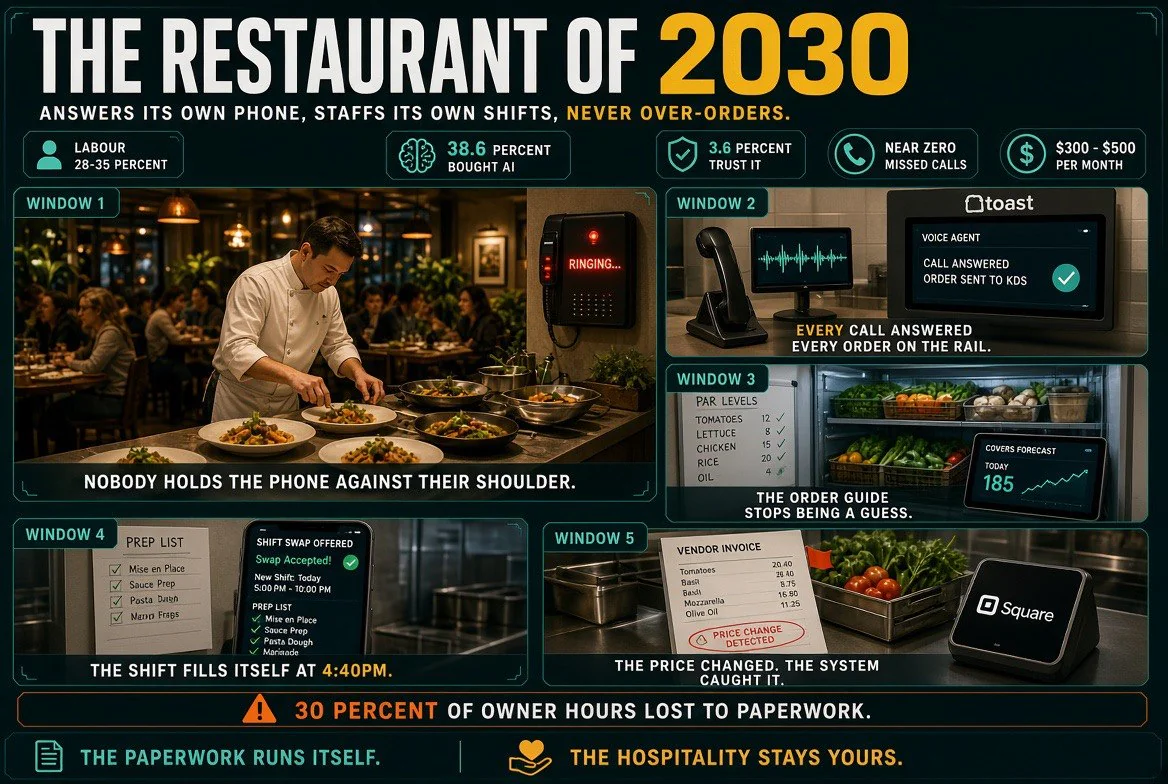
Walk into a mid-volume independent restaurant on a Tuesday in 2030 and the first thing you notice is what is not happening. Nobody is holding a phone against their shoulder while carrying plates. Nobody is texting a line cook at 4:40pm asking if he can cover a shift that starts in twenty minutes. Nobody is standing in the walk-in at close with a clipboard, guessing how much chicken to order for a weekend that might be busy.
Those three jobs are the ones that eat a restaurant from the inside. Not the cooking. Not the service. The phone, the schedule, and the order guide — the administrative load that lands on the owner because there is nobody else to take it.
By 2030, those three jobs will be handled by software that already exists in early form today. This is not a prediction about robots in the kitchen or a fully automated dining room. It is a specific forecast about four tools replacing four manual jobs, with the numbers and the names attached.
Job One: The Phone Gets Answered Every Time
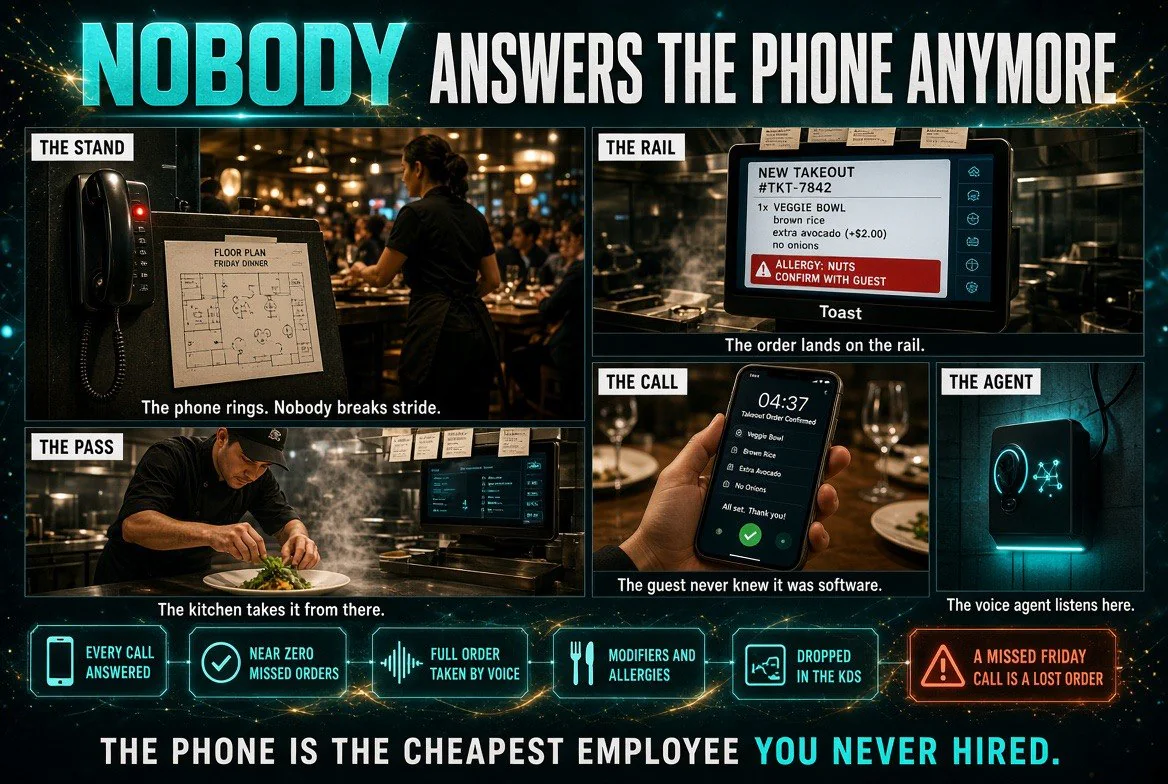
The phone is the most expensive unpaid labour in the restaurant. An unanswered call during a Friday rush is not a neutral event — it is a customer ordering somewhere else. Industry research has tracked missed calls as a direct revenue leak for years, and the number that matters is the conversion: a meaningful share of calls to an independent restaurant are orders, and every one that rings out converts to zero.
The 2030 version is not a phone tree. It is a voice agent that holds a conversation, handles modifiers, answers “is the patio open,” takes a full order, and pushes it into the kitchen display with no human in the loop. Early versions of exactly this exist now — Slang.ai and Maple both answer calls and take orders today, and Toast and Square have both pushed voice into their POS surfaces.
What changes between now and 2030 is the failure rate. Today, a voice agent still misfires on a noisy line or a customer with a heavy accent, and the operator keeps a human nearby as insurance. By 2030 the exception handling is the product, not the demo — because four years of real restaurant audio is exactly what these models need to get there.
Job Two: The Schedule Fills Itself
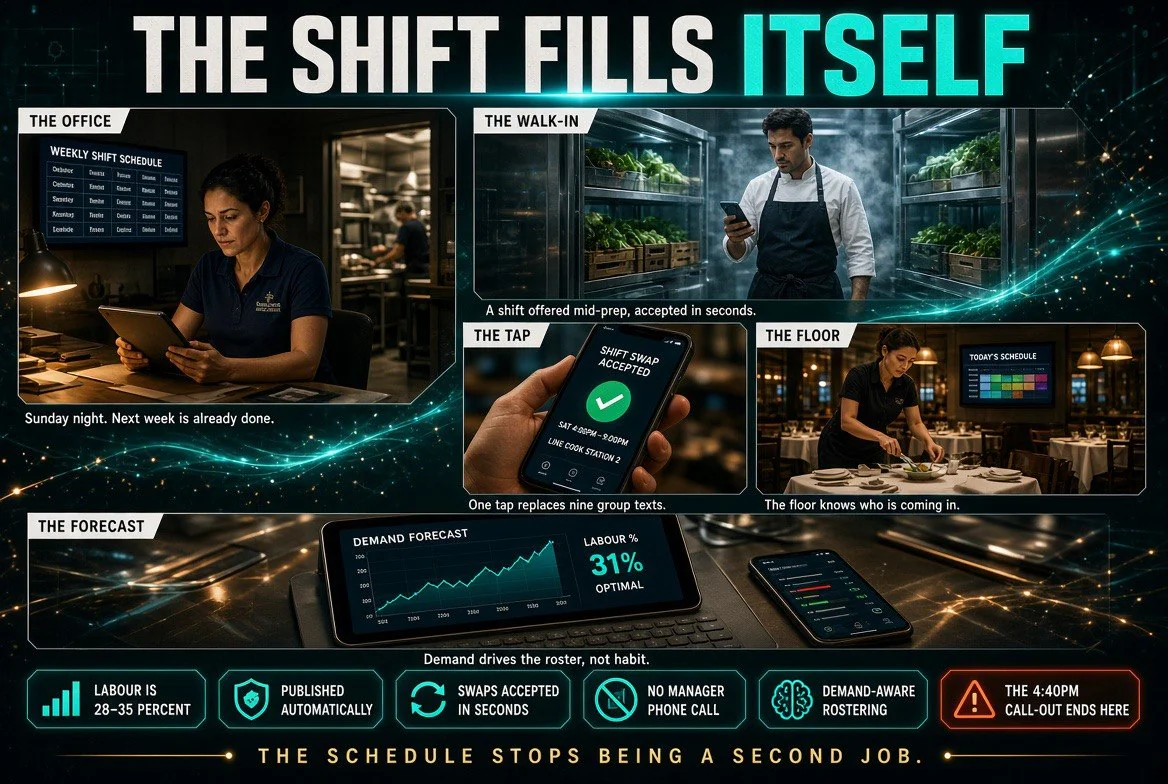
Labour is 28 to 35 percent of revenue for a typical independent, which makes the schedule the single largest controllable cost in the building. It is also the task most owners do badly, at 11pm, from memory, with a spreadsheet that has never once accounted for the fact that one server always calls out on Sundays.
The 2030 version is a scheduling engine that knows three things the owner does not have time to model: who is available, who actually performs on which shift, and how demand on a given night compares to the forecast. It publishes the schedule, absorbs the call-outs, and offers the shift to the person most likely to take it — automatically, at 4:40pm, without a group text.
This one is closest to solved today. Scheduling tools already exist with availability and swap logic. What 2030 adds is the demand side: instead of scheduling against a template week, the system schedules against what the forecasting layer expects for that specific Thursday.
Job Three: The Order Guide Stops Being a Guess
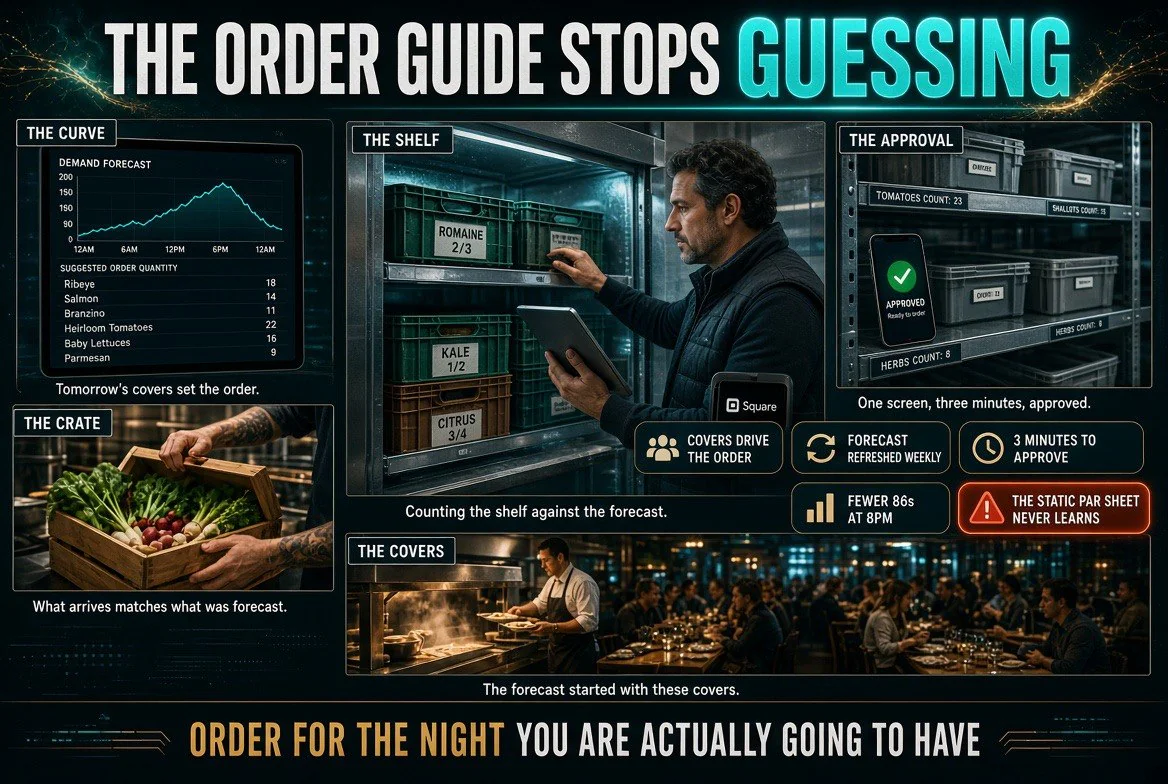
Food waste is where restaurants quietly lose more money than they lose on labour. Over-order and you throw product away. Under-order and you 86 a dish at 8pm on a Saturday, which costs you the customer, not just the plate.
The 2030 version ties ordering to actual covers. The forecasting layer reads reservations, historical covers by day and weather, and the current menu mix, then generates a par level per item and reconciles it against what is actually on the shelf. The owner approves or adjusts — one screen, three minutes, before the deadline.
The critical difference from today’s par sheets is the loop. A static par level is a guess made once and never revisited. A forecast loop corrects itself every week, so a dish that quietly stopped selling stops being ordered at Tuesday’s volume.
The Four Systems, Compared
Here is what each of the four jobs looks like across the timeline — what is available now, what is emerging, and what 2030 requires.
| Job | Available now | Emerging | What 2030 requires |
|---|---|---|---|
| Phone | Answering with order-taking on major POS | Modifier and allergy handling | Fewer than 1 in 100 calls needing a human |
| Schedule | Availability, swaps, published shifts | Demand-aware rostering | Auto-fill with performance weighting |
| Ordering | Static par sheets, invoice capture | Sales-based par suggestions | Covers-linked forecasting with shelf count |
| Back office | Invoice OCR into accounting | Price-change detection | Auto-reconcile with vendor dispute flags |
| POS role | The system of record | A data source | The ledger everything reports into |
Read the bottom row twice. The most common mistake operators make when they imagine the future is assuming the POS becomes smarter. It does not. The POS becomes quieter — the place where transactions land and from which every other system pulls data. The intelligence moves to the four tools around it.
What This Actually Costs an Independent
The question every operator asks is the price. The honest answer for 2030 is that the four tools cost roughly what one part-time administrator costs, and that the comparison is not close once you count what the manual version really costs.
| Approach | Monthly cost | Owner hours | Missed calls |
|---|---|---|---|
| Manual today | $0 software, real labour cost | 15-25 per week | Every rush, every close |
| Voice agent only | From roughly $85 | 2-3 per week | Near zero |
| Voice + scheduling | $150-$250 | 4-6 per week | Near zero |
| All four in 2030 | $300-$500 | 2-4 per week, mostly approvals | Near zero |
| Part-time admin hire | $1,800-$2,600 | 6-10 per week managing them | Still happens on their days off |
The admin comparison is the one that decides it for most owners. A part-time hire does not remove the work — it converts the work into management, and management is the thing an owner has least of. The software stack is cheaper and it does not call out sick.
What it also does not do is make judgment calls. It will not know that the Friday regular who spends $400 a month should get the table he wants even though the system says it is held. That is still your job in 2030, and it is the job worth keeping.
The Trap: 38.6 Percent Bought AI and 3.2 Percent Trust It
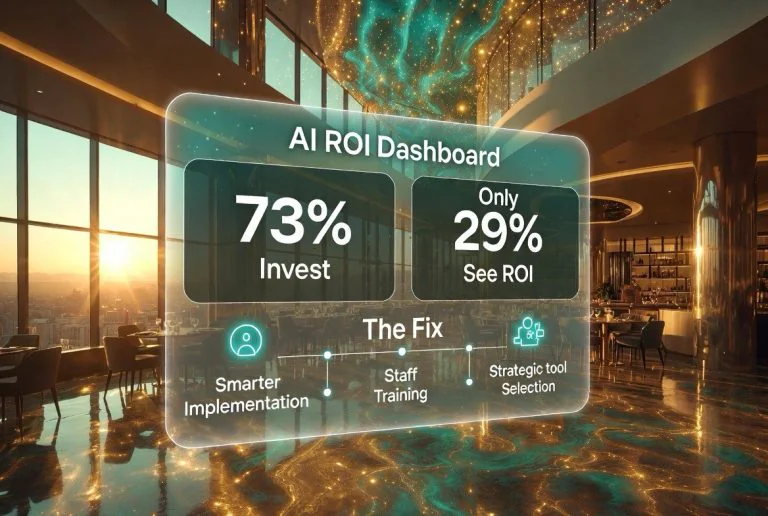
There is a number from this year that should sit in front of every operator planning for 2030. Research published this month found 38.6 percent of restaurants have bought AI, and 3.2 percent actually trust it. That gap is the whole story of the next four years.
The gap exists because most operators buy tools before they change process. They bolt a voice agent onto a phone system nobody answers, and the agent inherits the same dead-end routing. They buy a forecasting tool and keep ordering from the same clipboard. The tool arrives, the job does not change, and trust never builds.
Getting to 2030 in good shape means doing the opposite: pick the one job that is genuinely painful, hand it over completely, and measure it for a month before adding the next. One job, one tool, one number that proves it worked. That is how 3.2 percent becomes a majority.
What Has to Be True by 2030
Three conditions have to hold for this forecast to land, and operators should judge their vendors against them.
First, the tools have to talk to each other. A voice agent that cannot see the reservation book will promise a table that does not exist. A forecasting tool that cannot see the schedule will order for a night with half a team. Integration is not a feature; it is the whole value.
Second, the exception has to be visible. Every automated system fails sometimes, and the good ones surface the failure loudly instead of silently guessing. If a voice agent mishears an order, the operator needs to see it before the food goes out, not after the customer complains.
Third, the data has to stay yours. Four years of covers, labour and pricing data is the most valuable asset an independent has. Any contract that prevents you from taking that data with you when you leave a vendor is a contract that owns your restaurant’s future.
Frequently Asked Questions
Will restaurants actually run themselves by 2030?
No. Four administrative jobs will be automated — phone, schedule, ordering and invoice reconciliation. Cooking, hospitality, menu decisions and the judgment calls stay human. The restaurant does not run itself; the paperwork does.
Do I need to replace my POS to get there?
No, and you probably should not. The POS becomes the system of record that the four AI tools pull from. Replacing it is an expensive way to solve a problem the integration layer already solves.
What should an independent do first?
Automate the phone. It is the highest-cost manual job in the building, the tools are mature, and the result is measurable in captured orders within a month.
Is a voice agent good enough to take orders today?
On major POS platforms, yes for the majority of calls, with a human handling exceptions. By 2030 the exception rate is the number to judge vendors on, not the demo.
How much should this cost an independent restaurant?
Roughly $300 to $500 a month for all four systems by 2030, against $1,800 to $2,600 for a part-time admin who still needs managing.
What is the biggest mistake operators make with restaurant AI?
Buying a tool without changing the job. That is how you get 38.6 percent adoption and 3.2 percent trust.

About Barak Schurr
Barak Schurr built and exited a major ticketing platform, ran global operations at Eventbrite, and now focuses on one question: which AI tools actually help independent restaurant owners run leaner and grow faster. He writes from the operator’s perspective — no vendor spin, no theory, just what’s real in 2026.
Email: [email protected]
More Resources for Restaurant Operators