.post-navigation { display: none !important; }
.entry-tags { display: none !important; }
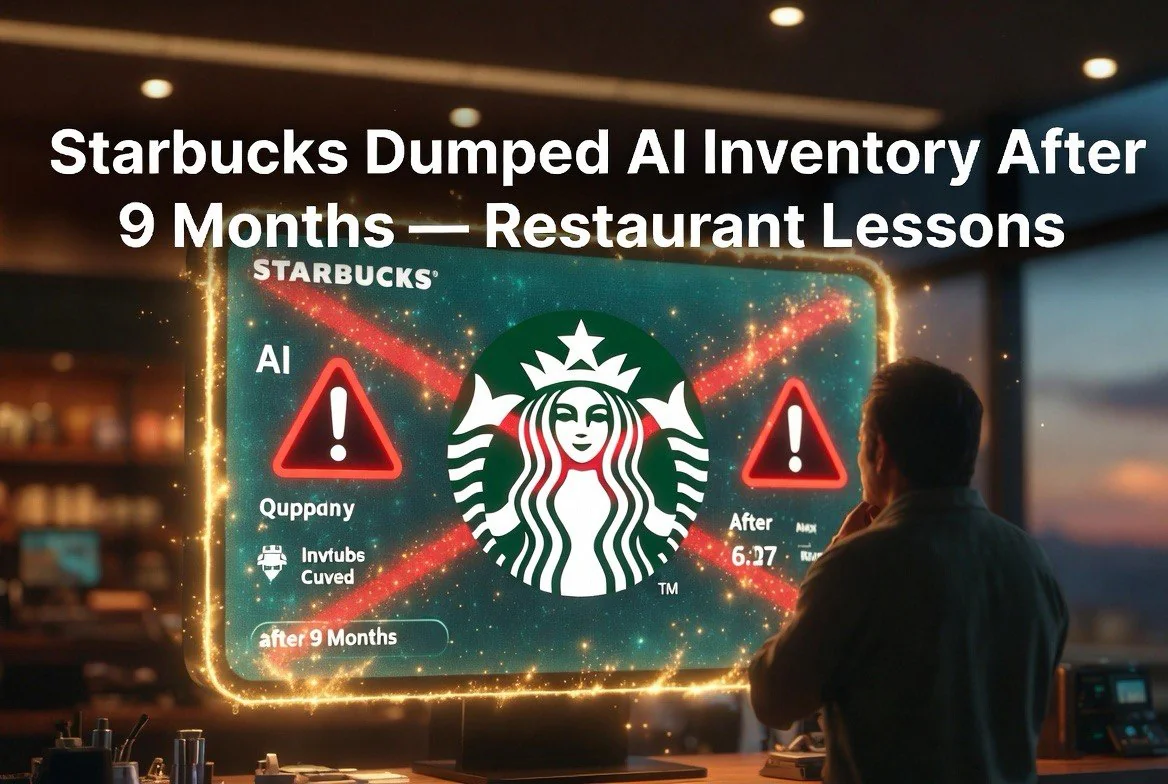
⚡ Expert Summary: Starbucks scrapped its computer vision AI inventory counting system after roughly nine months, returning to manual stock-keeping methods. Employees called the tool “unreliable.” For independent restaurant owners watching big chains test AI — this is the real story: even with billions in revenue and top engineers, AI doesn’t always deliver. The lesson isn’t to avoid AI. It’s to test harder, pilot smaller, and know when automation doesn’t add value.
Starbucks deployed a computer vision AI inventory system in September 2025. It was supposed to simplify record-keeping, prevent stockouts, and reduce the labour burden on store teams.
By May 2026, it was gone.
Reuters broke the story on May 21: Starbucks eliminated the AI inventory tool across its North American locations. Employee comments obtained by the company called it “unreliable spatial recognition.” Baristas and shift supervisors were grateful their feedback was heard.
The world’s largest coffee chain spent nine months piloting an AI system from one of the most capitalized technology sectors on the planet. And then it went back to manual counts.
This is not a failure story. This is a learning story — and independent restaurant owners need to hear it.
What Actually Happened at Starbucks
Starbucks announced the computer vision inventory tool in September 2025. The system used cameras and AI to track inventory levels for certain items, aiming to reduce the manual labor of counting stock and prevent the out-of-stock situations that had been frustrating customers.
CEO Brian Niccol had identified stockouts as a key problem. At an investor day in early 2026, he said customers felt like they were “rolling the dice” on whether key menu items would be available. The AI tool was supposed to fix that.
Instead, employees reported that the system miscounted and mislabeled items. One internal employee comment, shared by Starbucks itself, read: “Thank you for trusting the partners over unreliable spatial recognition to handle these counts.”
The company’s official statement was diplomatic: “We will continue to invest in technology and refine our tools over time.”
But the action spoke louder. The AI system was removed. Manual counts returned.
This Isn’t Just a Starbucks Problem
Starbucks isn’t alone in pulling back from AI that didn’t deliver.
McDonald’s ended its drive-thru voice AI test with IBM in 2024. Taco Bell slowed deployment of similar voice AI technology last year. A major Pizza Hut franchisee recently claimed the brand’s AI ordering system resulted in $100 million in lost sales.
The pattern is consistent: big chains with massive R&D budgets try AI, find it doesn’t work as advertised, and revert to human-operated systems.
Meanwhile, 44% of US restaurants now use some form of AI according to Popmenu’s 2026 survey. The adoption is real. But the success rate is uneven.
The independent restaurant owner reading this should feel validated, not discouraged. If Starbucks can’t make computer vision inventory work, you’re not behind for sticking with what works.
What Independent Restaurants Should Actually Learn
There are five concrete lessons from Starbucks’ AI inventory failure that apply to any restaurant operator.
First, pilot before you commit. Starbucks deployed this system across North America. A smaller test in 10 to 20 locations would have revealed the same problems without the cost and disruption of a chain-wide rollout.
Second, listen to your team. The employees using the tool every day knew it wasn’t working. Starbucks’ internal comments showed staff were frustrated. The company eventually listened — but only after months of unreliable performance.
Third, know where AI adds value and where it doesn’t. Computer vision for inventory counting sounds impressive. But if a human can count stock faster and more accurately with a clipboard and a pen, the technology isn’t solving a real problem.
Fourth, don’t trust vendor demos. Every AI inventory vendor will show you perfect footage of their system working in a controlled environment. Reality on a busy Friday night in a 60-person cafe is different.
Fifth, the cost of bad AI isn’t just the subscription. It’s the lost trust from your team, the errors that compound across your supply chain, and the time spent working around a system that doesn’t work.
Where AI Actually Works in Restaurants Today
This cautionary tale doesn’t mean AI has no place in restaurants. It means the application matters.
AI that works well in restaurants in 2026 includes:
– Predictive ordering and demand forecasting (cutting food waste by 22-35% in documented cases)
– Voice agents for reservation management and phone call handling
– Dynamic pricing and menu optimization
– Labour scheduling based on traffic patterns
– Personalized marketing and loyalty program targeting
What’s not working as well: physical automation that replaces human senses — computer vision for inventory, automated cooking systems, and drive-thru voice ordering in complex environments.
The distinction is important. Software AI that analyzes data and makes recommendations is mature. Physical AI that needs to operate reliably in the chaotic environment of a restaurant kitchen or front counter is not.
How to Evaluate AI for Your Restaurant
Before you sign up for any AI tool, ask these questions:
Does this solve a problem I actually have, or a problem the vendor assumes I have? Starbucks’ inventory system seemed necessary because stockouts were a known issue. But the solution created new problems that were worse than the original.
Can I test this in one location before committing? Any vendor that requires a multi-location commitment before you see results is selling hype, not a solution.
What happens when it fails? If the AI miscounts your inventory on a Friday before a holiday weekend, what’s the backup plan? If there isn’t one, you don’t have a system — you have a liability.
Is the ROI measurable against my current method? AI inventory management for restaurants claims to cut waste by 30%. But if your current waste is already well-managed, the improvement may not justify the cost and complexity.
The Starbucks case proves that even the biggest operators get this wrong. Independent owners don’t have the margin for that mistake. Vet harder. Pilot smaller. Trust your team’s feedback.
What This Means for the Future of Restaurant AI
Starbucks hasn’t abandoned technology. CEO Brian Niccol announced daily replenishment by the end of 2026, moving from weekly supply deliveries to daily ones to ensure stock availability. That’s a supply chain fix, not a technology fix.
The lesson for the restaurant industry: AI is a tool, not a strategy. The operators who win with AI will be the ones who deploy it surgically — targeting specific, measurable problems — not the ones who install the most systems.
Starbucks, McDonald’s, and Taco Bell all pulled back from AI deployments that didn’t work. They’re still industry leaders. The difference is they had the resources to absorb the failed experiment.
Independent restaurant owners don’t have that luxury. Learn from their mistakes while they’re still paying for them.
Why Computer Vision Fails in Restaurant Kitchens
Computer vision works well in controlled environments. Factory floors with consistent lighting. Warehouse shelves with uniform packaging. Retail stores with standardized shelf layouts.
Restaurant kitchens are none of these things.
The lighting changes throughout the day. Morning prep is dim. Lunch service is bright and chaotic. Evening cleanup is uneven. Ingredients come in different shapes, sizes, and packaging. A case of tomatoes looks different every delivery. A half-used bag of flour doesn’t look like a full one.
Starbucks’ spatial recognition system tried to track inventory in this environment. Cameras mounted to read shelf levels, identify products, and count stock. In theory, it eliminates human counting time. In practice, it introduced errors that required human verification anyway.
The employee comment that Starbucks itself shared says it all: “Thank you for trusting the partners over unreliable spatial recognition.”
The partners — human employees — were more reliable than the AI. That’s the fundamental test any restaurant technology has to pass: does it help your team do their job better, or does it create more work for them?
The Real Cost of AI That Doesn’t Work
The direct cost of Starbucks’ failed AI inventory system is tiny for a company worth over $100 billion. But for an independent restaurant, the calculus is different. A $500 monthly AI subscription that doesn’t deliver measurable improvement is $6,000 a year. Over three years, that’s $18,000 — the equivalent of a new commercial refrigeration unit, three months of payroll for a line cook, or a complete POS upgrade.
Beyond the direct cost, there’s the opportunity cost. Every hour your team spends working around a broken AI tool is an hour they’re not serving customers, cleaning the kitchen, or prepping for the next service. For an independent restaurant running on 3-5% margins, that time matters.
And there’s the trust cost. When you deploy a tool that doesn’t work, your team’s skepticism of the next technology investment grows. They’ve seen the hype cycle before. The next genuinely useful tool you bring in faces an uphill battle because the last one wasted their time.
This is why the Starbucks case matters for independent operators, not just big chains. The stakes are different when every dollar and every hour counts.
Resources for Smarter AI Adoption
For restaurant owners who want to approach AI intelligently, start with our restaurant AI resource hub. The category covers practical tools, operator reviews, and honest assessments of what works on the floor and what doesn’t.
The key is to read case studies like this Starbucks one alongside success stories. AI adoption isn’t binary — it’s not “all AI works” or “all AI is hype.” The restaurants that win are the ones that can distinguish between the two.
Starbucks, Popmenu, McDonald’s, and Taco Bell are all data points pointing in the same direction. AI in restaurants is real. It’s growing. But it needs to be deployed with discipline.
The question is whether you read this Starbucks story as a warning to avoid AI entirely, or as guidance on how to deploy it better.
The right answer is the second one.
Frequently Asked Questions
Why did Starbucks scrap its AI inventory system?
Starbucks pulled its computer vision AI inventory counting system after nine months because it proved unreliable at accurately tracking stock levels across 4,000 US stores. The AI was trained to count inventory through camera feeds but could not handle the complexity of Starbucks’ menu — over 170,000 possible drink combinations created demand signals the AI was never designed to interpret. Employees called the tool unreliable, and the company returned to manual stock-counting methods.
Should independent restaurants still use AI inventory after Starbucks’ failure?
Yes. The failure at Starbucks was driven by scale and complexity that does not exist for an independent restaurant. Starbucks tried to manage 170,000 menu combinations across 4,000 stores with legacy supply chain infrastructure. An independent operator with a 40-item menu, a single location, and a modern POS system like Toast or Square faces none of those constraints. Tools like MarketMan and XtraChef are built for this complexity level and deliver 15-25% waste reduction according to operator case studies.
How much does AI inventory management cost for a small restaurant?
AI inventory tools for independent restaurants cost $50-99 per month depending on the platform. MarketMan provides full AI demand forecasting and inventory tracking at $99/month. XtraChef focuses on recipe costing and waste analysis at $79/month. For restaurants already on Toast POS, the Toast Inventory add-on costs $50/month. The Deloitte 2026 restaurant report found that operators using these tools reduced food waste by an average of 18% and improved gross margins by 3-5 percentage points.
What is the ROI for AI inventory in an independent restaurant?
For a restaurant spending $50,000/month on food costs, a 15% waste reduction saves $7,500/month. Against a software cost of $50-99/month, the ROI is immediate — typically within the first month. The National Restaurant Association reports that the average US independent restaurant loses $25,000-50,000 per year to food waste. AI tools that cut that by 15-25% return $3,750 to $12,500 annually to the bottom line.
How should I implement AI inventory in my restaurant?
Start with a 30-day manual waste audit to identify your biggest loss categories. Deploy AI on one category first — produce or protein — and run it in recommendation-only mode for 60 days before enabling automated ordering. The Intouch Insight 2026 study found that operators who used this phased approach reported 40% fewer system errors and 25% higher satisfaction with the tool.

About Barak Schurr
Barak Schurr built and exited a major ticketing platform, ran global operations at Eventbrite, and now focuses on one question: which AI tools actually help independent restaurant owners run leaner and grow faster. He writes from the operator’s perspective — no vendor spin, no theory, just what’s real in 2026.
Email: [email protected]
More AI Resources