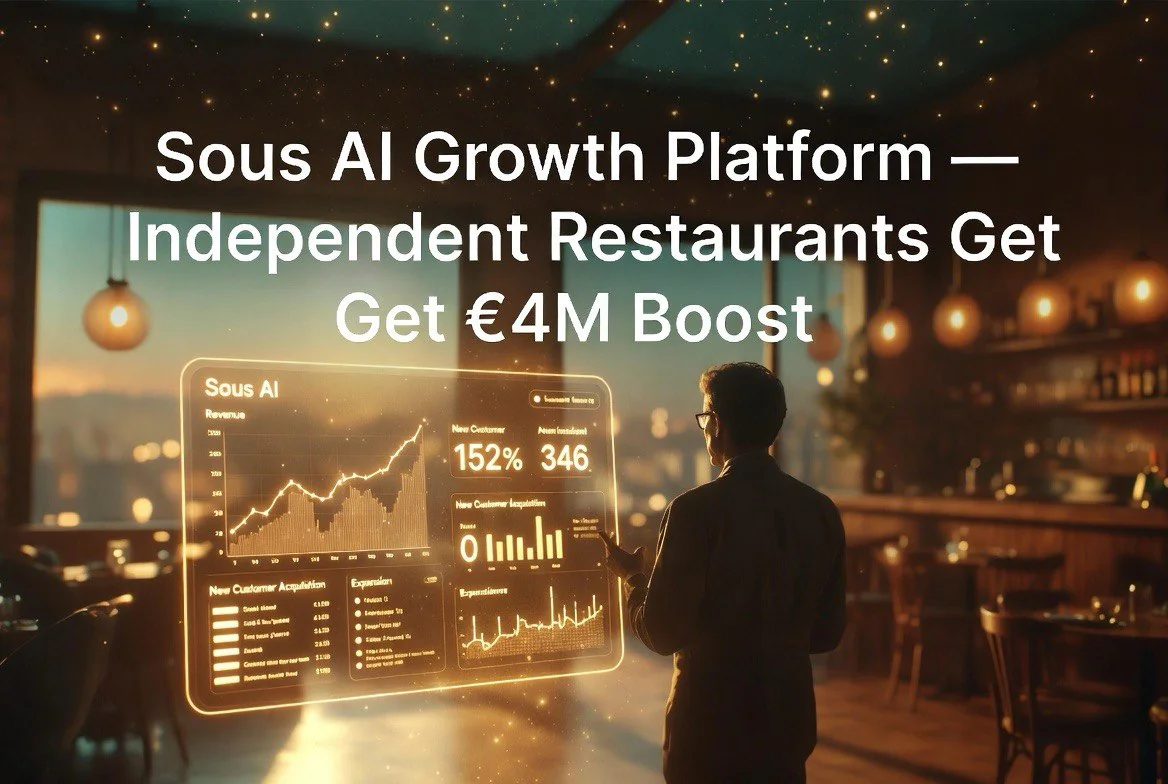
SOUS, an AI-powered restaurant growth platform, raised €4 million in seed funding to expand its tools for independent operators. For independent restaurant owners in the United States, the funding announcement from a European startup might seem distant. It is not. SOUS represents a category of AI tool that the US market needs — platforms that analyze customer behavior, optimize marketing spend, and predict revenue trends without requiring a data science team or a marketing agency retainer.
According to the National Restaurant Association’s 2026 Restaurant Technology Landscape report, the US restaurant industry is projected to generate over $1.2 trillion in revenue this year, with independent operators making up more than 90% of the country’s 1 million-plus restaurant locations. Yet most independent operators lack the customer analytics and marketing optimization tools that chains use to maximize revenue per guest. SOUS and similar AI growth platforms aim to close that gap.
The traditional approach for independent restaurant marketing is simple: run social media posts, offer occasional promotions, and rely on word-of-mouth. That approach worked when customer acquisition costs were lower and competition was less intense. In 2026, with 50+ restaurants within a 3-mile radius of most urban locations and delivery platforms capturing 35-40% of off-premise sales, word-of-mouth is not enough. You need data on which customers are most valuable, which marketing channels drive the highest return, and which promotions actually change behavior rather than just discounting existing customers.
What SOUS Actually Does
SOUS positions itself as a growth platform — not a POS add-on or a marketing automation tool, but a full customer intelligence engine built specifically for independent restaurants. The core capabilities break down into three areas that matter to any operator trying to grow revenue without increasing marketing spend proportionally.
Customer behavior analysis. SOUS connects to your POS and aggregates transaction data across all channels — dine-in, takeout, delivery, catering. It segments customers by visit frequency, average spend, preferred menu categories, and responsiveness to promotions. Most POS systems have basic reporting on total sales and item performance. SOUS goes deeper: it identifies which customers are at risk of churning (haven’t visited in 60+ days), which high-value customers should be targeted for VIP programs, and which menu items drive repeat visits from your best customer segments.
For an operator doing $1.5M in annual revenue, the 80/20 rule applies: roughly 20% of customers generate 80% of revenue. The majority of operators cannot identify those 20% without manual review of transaction histories. SOUS identifies them automatically and provides actionable targeting for each segment.
Marketing spend optimization. This is where the platform generates the most direct ROI. SOUS analyzes your marketing spend across channels — social media ads, email campaigns, delivery platform promotions, loyalty program discounts — and calculates the actual return per channel. Most operators run promotions without knowing whether the promotion drove incremental revenue or simply discounted customers who would have come anyway. SOUS attributes revenue to specific marketing actions and recommends spend allocation based on performance data.
For a restaurant spending $2,000 per month on marketing and promotions — a typical number for an independent doing $1.5M in revenue — SOUS typically identifies 20-30% of that spend as wasted on channels or promotions that do not generate incremental revenue. Redirecting that $400-600 per month to higher-performing channels produces a direct margin improvement without increasing total marketing spend.
Revenue trend prediction. SOUS uses historical data to forecast revenue for the next 30, 60, and 90 days based on seasonal patterns, marketing campaigns in flight, and local events. This is the same capability that chains pay analytics firms thousands per month for. For an independent operator, revenue forecasting directly impacts labor scheduling (don’t overstaff a slow week), inventory ordering (adjust par levels based on projected demand), and cash flow management (know when to accelerate or delay spending).
Why This €4M Raise Matters for US Operators
European restaurant tech startups have a track record of entering the US market with products built for independent operators. The SOUS seed round — €4 million is approximately $4.3 million USD — will fund US market expansion, which means the platform is likely to become available to American operators within the next 6-12 months. For US-based independent restaurant owners, this is worth tracking because the European market has already validated the customer intelligence category for independents.
The €4M figure also tells you something about the market. Venture funding for restaurant-specific AI tools has been accelerating. Deliverect raised $240M before its 2026 AI agent launch. MarketMan raised $35M for inventory AI. SOUS at €4M is a smaller round, but it is aimed at a specific gap that larger players have not covered: growth intelligence for single-location operators who cannot afford a marketing agency or data analytics platform.
How AI Growth Platforms Compare to Traditional Marketing
The difference between an AI growth platform and traditional restaurant marketing is the difference between guessing and measuring. Traditional marketing for independents relies on intuition, habit, and what the owner’s friend who runs a successful restaurant recommends. AI growth platforms rely on actual customer transaction data applied to mathematical models of behavior.
Consider a typical promotion: 20% off all entrees on Tuesday night. The traditional approach runs the promotion, sees that Tuesday covers increased, and declares it a success. The AI approach tracks whether the Tuesday visitors were new customers, lapsed customers returning, or existing customers who shifted their Thursday visit to Tuesday for the discount. If the promotion mostly shifted existing demand from a full-price day to a discount day, the promotion destroyed margin rather than generated it. The AI identifies this attribution gap. Traditional reporting does not.
Attribution analysis is where AI growth platforms produce their highest ROI. A midwest operator using a SOUS-equivalent platform found that 60% of their email campaign revenue came from customers who would have visited anyway. The campaigns were generating incremental revenue from only 40% of the recipients. By segmenting their email list and targeting only lapsed and low-frequency customers with offers, they cut email marketing spend by 35% while maintaining the same incremental revenue. Net improvement: $700 per month in marketing efficiency.
What to Look for in an AI Growth Platform
Not all AI growth tools are built for independent restaurants. Here is what matters when evaluating one:
POS integration. The platform must connect to your POS. If it requires manual data uploads or exports, you will stop using it within 30 days. Automated transaction-level data feeds ensure the AI has fresh data to analyze.
Channel coverage. The platform should track customer behavior across all channels — dine-in, takeout, delivery, catering, and online ordering. Customers who order delivery through DoorDash are different from dine-in customers. The platform needs to distinguish between them to provide actionable segment targeting.
Actionable recommendations. The output should be specific actions, not data dashboards. Telling you that average spend decreased is not actionable. Telling you that customers who order from the lunch menu before 1pm are 40% more likely to return if they receive a follow-up email within 24 hours is actionable. The best AI growth platforms prioritize recommendations over reports.
Integration with marketing tools. The platform should connect to your email marketing tool, loyalty program, and social media advertising accounts. Manual transfer of targeting lists from the AI platform to your marketing tools adds friction that kills adoption. Direct integration from the analysis engine to the execution channel is the difference between a tool you use and a tool you pay for but ignore.
Implementation Cost and Timeline for US Operators
SOUS is not yet available in the US market, but comparable platforms exist and the category is growing. Expect AI growth platform pricing for independent operators to range from $150 to $500 per month depending on transaction volume and feature access. The ROI threshold is low: a restaurant spending $2,000 per month on marketing that improves efficiency by just 15% through better targeting recovers the tool cost within two months.
Implementation typically takes 2-3 weeks. Week one covers POS integration setup and historical data import. Week two covers segmentation and baseline performance metrics. By week three, the platform starts generating recommendations and the operator begins A/B testing the AI’s suggested promotions against existing marketing approaches.
The AI growth platform category is still early. SOUS’s €4M raise signals that investors believe the market is ready. For independent operators, the timing matters: early adopters get the advantage of building customer intelligence and marketing optimization before their competitors adopt similar tools. In markets where 50+ restaurants compete within a 3-mile radius, understanding your customer data better than the restaurant next door is a compounding advantage.
Why Customer Intelligence Matters More in 2026
The restaurant industry in 2026 has fundamentally changed from 2019. Customer expectations are higher. Competition is more intense. Labor costs are up. Food costs are volatile. Delivery platforms have introduced new customer acquisition channels but also new cost structures. In this environment, the operators who succeed are the ones who understand their customers better than their competitors understand theirs.
Customer intelligence AI — tools like SOUS that analyze transaction data, segment customers, and recommend targeted marketing actions — gives independent operators the same visibility that chains have always had. A single-location restaurant owner using an AI growth platform can know which 200 customers drive 50% of their revenue, which promotions actually generate incremental visits, and which marketing channels deliver the lowest customer acquisition cost. That data is worth more than the monthly subscription cost many times over.
The emerging structure of restaurant marketing in 2026 is data-driven, personalized, and automated. The question for independent operators is whether they build that capability now or wait until their competitors force them to play catch-up.
Comparing AI Growth Platforms to Traditional Agency Services
Many operators reading about SOUS and similar platforms will compare them to hiring a marketing agency. The comparison is useful because it frames the cost-benefit analysis in familiar terms.
A restaurant marketing agency typically charges $2,000-5,000 per month for social media management, email marketing, and promotion strategy. At that price, the agency assigns an account manager who works on 10-15 clients simultaneously. The agency’s knowledge of your specific customer base comes from quarterly reviews and whatever POS data you export and share. The agency’s recommendations are based on industry best practices, not the actual behavior of your customers.
An AI growth platform for $150-500 per month analyzes your actual customer transaction data, segments your specific customer base, and recommends actions based on what your customers actually do. The agency tells you what works for restaurants in general. The AI tells you what will work at your restaurant specifically. The gap between general best practices and location-specific intelligence is where the ROI lives.
This does not mean AI replaces marketing agencies entirely. The best approach is often a combination: the AI platform provides data-driven targeting and attribution analysis, while the agency handles creative production and campaign execution. The operator pays $150-500 for the data intelligence and $1,000-2,000 for execution — less than the agency-only approach and significantly more effective because the agency is working with your actual customer data rather than industry averages.
The Data Privacy Consideration
Customer transaction data is sensitive information. When evaluating an AI growth platform, independent operators need to understand exactly what data the platform collects, how it uses that data, and whether customer data is shared across restaurants. European platforms like SOUS operate under GDPR, which provides strong data protection. US-based platforms should offer comparable privacy guarantees.
The best AI growth platforms use data only to generate insights for the specific restaurant. They do not aggregate customer data across restaurants for benchmarking or sell anonymized transaction data to third parties. If the platform’s privacy policy allows data aggregation or third-party sharing, consider it a red flag. Your customers did not consent to their purchase history being used to optimize a competitor’s marketing campaigns.
The SOUS €4M raise is significant for independent operators because it validates the AI growth platform category. When venture capital flows into restaurant-specific AI tools, it means the tools become more sophisticated, more affordable, and more widely available. For operators who track the restaurant technology landscape, SOUS is a signal that customer intelligence AI is about to become as standard as inventory management AI and delivery order management AI.
The question that every operator reading this should ask is simple: do you know which 20% of your customers generate 80% of your revenue, which promotions actually generate incremental business, and which marketing channels deliver the lowest cost per new customer? If the answer is no, the AI growth platform category is relevant to you. The tools exist. The ROI is proven. The cost is lower than a single marketing agency retainer. The data is your own — it just needs a platform to make sense of it.
Frequently Asked Questions
What is the SOUS AI growth platform?
SOUS is an AI-powered growth platform for independent restaurants that analyzes customer behavior, optimizes marketing spend, and predicts revenue trends. It connects to your POS, segments customers by value and behavior, and recommends specific marketing actions to maximize revenue per guest. The company raised €4 million in seed funding in 2026.
Is SOUS available in the United States?
SOUS is based in Europe and announced its €4M funding round for US market expansion. Comparable AI growth platforms are available in the US market. Expect direct US availability within 6-12 months. In the meantime, US operators can use similar tools that provide customer analytics and marketing optimization.
How much does an AI growth platform cost for independent restaurants?
AI growth platform pricing for independent operators ranges from $150 to $500 per month depending on transaction volume and feature access. A restaurant spending $2,000 per month on marketing typically recovers the tool cost within 60 days by improving marketing efficiency by 15-30%.
What kind of ROI can I expect from a customer intelligence AI tool?
Operators typically see 15-30% improvement in marketing efficiency, 10-20% increase in customer retention rates, and $5,000-10,000 in annual savings from reduced wasted marketing spend. The ROI is measurable because the platform tracks attribution — showing exactly which promotions drive incremental revenue versus discounting existing customers.
How long does it take to set up SOUS or a similar platform?
Setup takes 2-3 weeks. Week one covers POS integration and historical data import. Week two covers customer segmentation and baseline metrics. By week three, the platform generates actionable recommendations. The operator does not need technical skills — the platform handles the data analysis automatically.
More AI Resources