I’ve been covering restaurant technology long enough to remember when “restaurant AI” meant a digital menu board that cycled through three photos. We’ve come a long way — and the data finally proves it’s not hype. The Popmenu 2026 Restaurant Trends Report (based on a January 2026 survey of 328 restaurant owners and 1,000 consumers) is the most recent comprehensive look at how operators are actually using AI. The headline number — 44% — is the highest adoption rate I’ve seen from any credible survey this year. Let me walk through what the data means for your operation. When Popmenu asked 328 restaurant owners what they’re using AI for, the responses broke down into three main categories: Marketing and content (55% of AI users): This is the biggest bucket. AI-generated social media posts, email campaigns, menu descriptions, and website copy. Restaurant operators who previously outsourced marketing to agencies or ran it themselves in off-hours are shifting to AI-first content generation. The technology is good enough now that a human review pass is all that’s needed. Operations and automation (42% planning to automate more): AI-driven scheduling, inventory forecasting, order routing, and kitchen display optimization. This category overlaps with traditional automation but is increasingly AI-native — systems that learn from your specific traffic patterns rather than applying generic rules. Front-of-house AI (growing segment): Voice AI for phone orders, AI concierge for reservation management, and digital ordering that learns customer preferences. This is the newest category and the fastest growing. The National Restaurant Association’s 2026 State of the Industry report found lower overall AI adoption (closer to 26% for front-of-house applications) but confirmed the trajectory: AI adoption in restaurants grew 40% year-over-year across all categories. Here’s the part that matters for your bottom line. Popmenu’s consumer survey of 1,000 U.S. adults found that dining out spending has dropped. The average is now $90 per week, down $25 from June 2025. That’s a 22% decline in 12 months. Operators feel this. Margins are thinner. Labor costs are up. No-show rates remain stubborn at 15-20% for weekend reservations. The response among the 44% of AI-adopting operators: use automation to cut costs while maintaining or improving experience quality. Hostie’s AI concierge deployment (covered in an earlier AITR post) drove a 150% increase in phone bookings while reducing front-of-house labor during off-peak hours. Sweetgreen’s AI-driven inventory and scheduling (another AITR post) reduced food waste by 18% across its locations. These aren’t theoretical — they’re deployed systems producing measurable results. To make this data useful, here’s what the “44%” are actually running in their operations right now: Marketing AI: Popmenu’s own platform (used by thousands of operators) bakes AI into website generation, menu display, email campaigns, and social media scheduling. Toast also offers AI-powered marketing and email campaigns through its platform. Square’s AI menu and marketing tools are bundled with their POS subscription. Voice AI for ordering: ConverseNow and Slang handle phone orders with AI. OpenCity-backed voice AI is deployed across Taco Bell, McDonald’s, and Checkers drive-thrus. Dairy Queen rolled out voice AI in April 2026. These systems handle 80-90% of orders without human intervention, with a human monitoring station for edge cases. AI scheduling and labor management: 7shifts and KBC use AI to predict traffic patterns and schedule staff accordingly. The systems learn from your sales history, weather data, local events, and seasonal patterns. Operators report 5-15% labor cost reduction after the first two months. AI inventory and ordering: MarketMan and BevSpot use AI to track usage patterns and generate order suggestions. Sweetgreen’s custom system (covered in a previous AITR post) integrates AI inventory with AI scheduling for a closed-loop operations model. AI reservation and concierge: Hostie (AI answer/call handling) drove a 150% increase in phone bookings for early adopters. SeatAI manages floor assignments and table turns without kiosks. These tools are popular with fine dining operators who don’t want kiosks in their front-of-house. The question every operator asks me is whether the subscription cost justifies itself. Here’s the math based on real deployments: Marketing AI ($30-200/month): Replaces a freelance copywriter or the owner’s time writing social posts. If you’re spending 5+ hours a week on marketing content, the ROI is immediate. Voice AI ordering ($0.50-2.00/order or monthly subscription): Reduces front-of-house labor by 1-2 shifts per day during peak hours. At $15-20/hour, a single shift saved covers the subscription cost. This is why chains adopted first — the math works at scale. AI scheduling ($50-200/month): The 5-15% labor cost savings typically exceed the subscription cost in the first month for any restaurant with 10+ employees. Combined platforms (Toast, Square, Popmenu all-in): $200-1,000/month depending on feature set. The consolidated ROI window is 2-4 months for most operators. The Popmenu data showing 42% of operators planning to automate more functions suggests that the early adopters are seeing returns and scaling up. The second wave is just starting. I’ve been watching restaurant AI adoption data since 2023. Here’s what’s changed: 2023-2024: Experimentation phase. Early adopters tested AI for specific pain points. Surveys showed 15-20% adoption, mostly among larger chains. 2024-2025: Validation phase. Early results came in. McDonald’s, Taco Bell, and Sweetgreen proved AI drive-thru could work. The 2025 Intouch Insight Drive-Thru Study showed that AI-assisted lanes were matching or exceeding human accuracy on order accuracy metrics. 2025-2026: Infrastructure phase. AI is no longer experimental. The Popmenu data shows 44% adoption. The National Restaurant Association confirms the trend. The conversation has shifted from “should we use AI?” to “which tools should we use and how do we train staff?” The difference between 2026 and previous years isn’t the technology. It’s the mindset. Operators who were skeptical in 2024 are now asking for recommendations. In early June 2026, Paris-based Innovorder raised €20 million ($23.2 million) in a funding round led by UL Invest. Innovorder provides an AI-first restaurant operations platform — order management, kitchen display, multi-channel ordering, and AI analytics — serving KFC, Quick, and Elior across thousands of locations. The company has been profitable since 2024, growing ~40% annually, and projects €15 million in 2026 revenue. This isn’t a startup burning cash for growth. This is a profitable, scaled platform attracting capital to expand AI capabilities across Europe. The Restaurant Technology News coverage noted the funds are earmarked for “deeper AI investments and targeted acquisitions.” When profitable restaurant tech companies with existing chain partnerships raise money specifically for AI, it’s not a bet. It’s a signal that the AI infrastructure layer is becoming mandatory. To know whether the 44% figure is an outlier, I cross-referenced it against other 2026 industry surveys. The National Restaurant Association’s State of the Industry 2026 (published January 2026) surveyed 1,000+ operators and found approximately 26% using AI in front-of-house roles specifically. The gap between 44% and 26% makes sense:Popmenu asked about AI use broadly (including back-of-house, marketing, and operations), while NRA asked about guest-facing AI specifically. The Toast 2026 Restaurant Technology Report (April 2026) found that 35% of independent restaurants (Toast customers) use at least one AI-powered feature on the platform. The Popmenu figure of 44% is the highest because it’s the most inclusive — covering marketing AI, which is the most common entry point. All three surveys agree on the direction: AI adoption accelerated sharply between July 2025 and January 2026, and it’s still accelerating. If you trust NRA’s more conservative 26%, the implications are the same: one in four competitors already has AI working. One in two will within 18 months. If you’re an independent operator reading this and wondering where to start, here’s my advice: Start with marketing AI. This is the lowest-risk entry point. Tools like Popmenu’s own platform (which powers websites, online ordering, and marketing for thousands of restaurants) now include AI features as standard. Generate your social posts, email campaigns, and menu updates. Review and customize. The time savings are immediate. Add operations AI next. AI scheduling (7shifts, KBC), AI inventory (BevSpot, MarketMan), or an integrated platform like Toast or Square if you’re on legacy POS. The ROI here takes 2-3 months to appear, then compounds. Consider front-of-house AI. Voice AI for phone orders (Slang, ConverseNow). AI concierge for reservations (Hostie, SeatAI). The technology is mature. The question is whether your customer base is comfortable with it. Test it on a limited basis before rolling out. I want to add something that often gets overlooked in these reports: employee perception. The Popmenu survey focuses on operator data. But the National Restaurant Association’s 2026 workforce report adds a staff-side view: 62% of restaurant employees say they’d prefer to work at an establishment using modern technology (including AI) over one that doesn’t. Among employees under 30, that number rises to 78%. This flips the conventional narrative. Operators often worry that staff will resist AI. In practice, younger workers — who are the majority of restaurant staff — see modern tools as a reason to stay. AI reduces repetitive tasks, simplifies scheduling, and makes the job less frustrating. The operators who treat AI as a retention tool alongside an efficiency tool are seeing lower turnover among tech-competent staff. The Popmenu 2026 Trends Report confirms what many operators suspect: AI in restaurants isn’t coming. It’s here. 44% of your competitors are already using it. Another 25% plan to join them this year. Consumers are spending less on dining out. Margins are tighter. The operators who survive the next 24 months will be those who use AI and automation to protect their margins without degrading the guest experience. The data is clear. The tools are ready. The question is whether you start now or wait until you’re forced to. Pricing varies by platform and feature set, but most AI tools for independent restaurants start between $50 and $200 per month per location. Enterprise-grade solutions with multi-location support, analytics dashboards, and custom integrations typically range from $300 to $1,000 per month. No. Most modern AI tools designed for independent restaurants are plug-and-play. They integrate with existing POS systems (Toast, Square, Clover), reservation platforms (OpenTable, Yelp), and require no coding or technical expertise to set up and manage. Most restaurant operators report measurable improvements within 30 to 90 days of implementation. Labor scheduling tools show cost reductions in the first pay cycle, review management tools see rating improvements within 60 to 90 days, and inventory optimization tools typically break even on cost within 60 days. The average US independent restaurant operates on a 3-6% profit margin, making menu optimization one of the highest-ROI changes an operator can make. ROI varies by tool type. Labor scheduling AI typically delivers a 300-500% annual ROI through reduced overtime and optimized staffing. Inventory management AI cuts food waste by 15-40%. Review management AI improves customer ratings by 0.5-1.3 stars, directly correlating to 5-9% revenue increases. About Barak Schurr Barak Schurr built and exited a major ticketing platform, ran global operations at Eventbrite, and now focuses on one question: which AI tools actually help independent restaurant owners run leaner and grow faster. He writes from the operator’s perspective — no vendor spin, no theory, just what’s real in 2026. More AI Resources
.post-navigation { display: none !important; }
.entry-tags { display: none !important; }
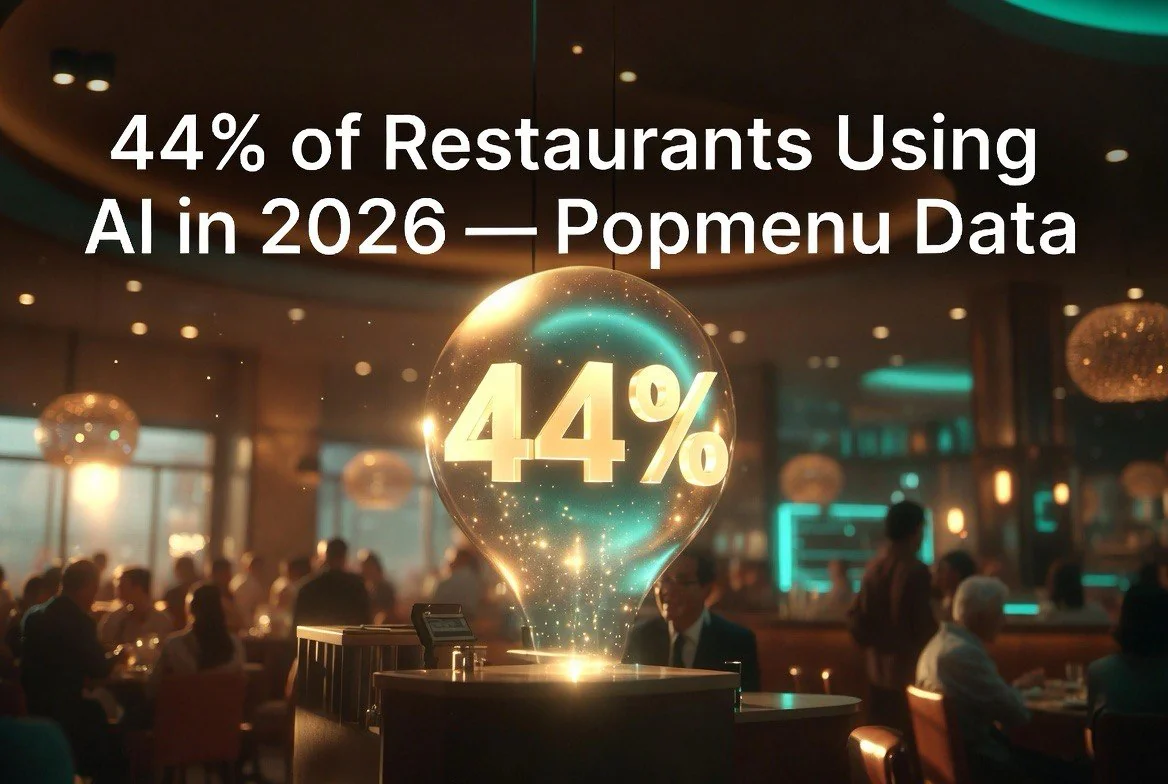
44% of Restaurants Are Using AI Right Now — Here’s What the 2026 Data Actually Says
The 44%: What Operators Are Actually Doing
The Consumer Side: Spending Down, Expectations Up
The Specific AI Tools Restaurants Are Using
The Cost Side: Where AI Saves Money
Why This Year Is Different
The $23 Million Signal: Innovorder
How Popmenu’s Data Compares to Other Surveys
What Operators Should Do With This Data
One More Data Point: What Staff Think
The Bottom Line
Frequently Asked Questions
How much does AI [topic] software cost for a restaurant?
Do I need technical skills to implement AI in my restaurant?
How quickly does AI software show results for restaurants?
Can AI tools replace my restaurant staff?
What is the ROI of AI tools for independent restaurants?

Email: [email protected]
⚡ Expert Summary: Popmenu’s 2026 Restaurant Trends Report surveyed 328 U.S. restaurant owners and 1,000 consumers (January 2026). Key findings: 44% of operators already use AI tools, another 25% plan to adopt this year. 55% use AI specifically for marketing content. Meanwhile, consumers cut dining spend by $25/week year-over-year — down to $90/week average. Operators are turning to AI and automation not as experiments but as essential margin protection. The National Restaurant Association reports lower current usage but confirms the trend direction. AI in restaurants has crossed from optional to infrastructure.