Get the AI Restaurant Quick-Start Guide — Free
The 5 AI tools independent US restaurant owners are using right now to cut labor costs and answer every call.
McDonald’s NEXT Growth Plan: What the Chicken Bet and Restaurant Upgrades Mean for Independent Operators
⚡ Expert Summary: McDonald’s unveiled its NEXT growth strategy in June 2026 — a multi-year plan focused on improving food quality, restaurant interiors, and customer experience. While the headlines focus on chicken sandwiches and lobby redesigns, the real story for independent operators is how McDonald’s is threading the needle between AI automation and human hospitality. As Dave’s Hot Chicken’s CTO recently told Restaurant Dive that diners “don’t want to talk to robots,” the tension between AI efficiency and guest experience has never been more visible. This article unpacks the McDonald’s NEXT plan, the AI technology roadmap behind it, and five lessons independent operators can apply today without spending millions.
What Is the McDonald’s NEXT Growth Plan?
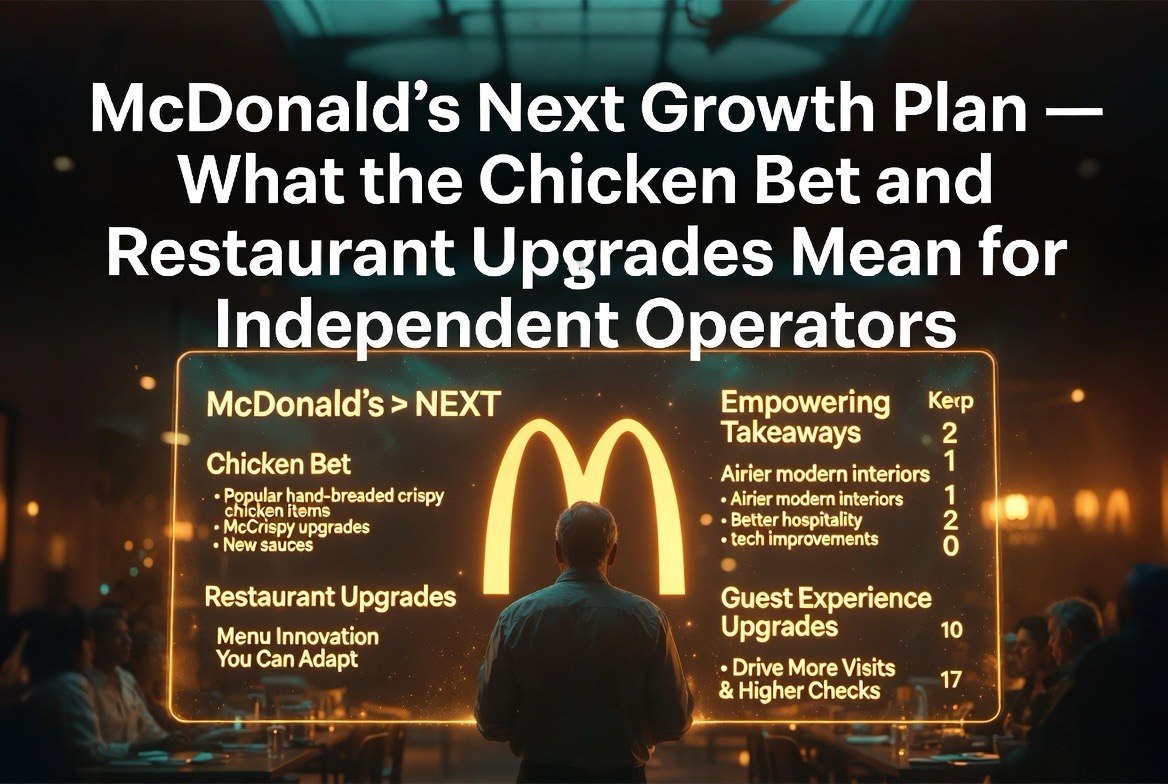
McDonald’s NEXT is a sweeping initiative announced in early June 2026 that the company says will define its direction for the next five years. The plan covers three core pillars: food quality improvement, restaurant experience upgrades, and operational productivity. While McDonald’s has historically led with value and convenience, NEXT signals a shift toward being seen as a brand that also competes on taste, atmosphere, and service quality.
The centerpiece of the food strategy is a major chicken push. McDonald’s is investing in higher-quality chicken products across its US locations, including new crispy chicken sandwiches and tenders sourced under updated supply chain requirements. This mirrors broader industry trends: chicken consumption in the United States overtook beef back in 2014 and has continued growing, with the National Chicken Council projecting Americans will eat 101.5 pounds of chicken per person in 2026.
On the restaurant experience side, McDonald’s is rolling out upgraded interiors, better seating, improved lighting, and redesigned service areas. The company is testing both fully remodeled prototypes and lighter, lower-cost refresh packages that franchisees can adopt based on local needs. The goal is to close the gap between fast food and fast casual on ambiance, a category where McDonald’s has historically underperformed.
But the operational productivity pillar is where the AI story lives — and it’s the part independent operators should pay closest attention to.
Where AI Fits Into the NEXT Plan
McDonald’s NEXT does not explicitly mention artificial intelligence as a standalone strategy. Instead, AI is embedded across all three pillars as an enabling technology. The company’s ArchIQ voice AI system, currently handling drive-thru orders at select US locations with reported 90% accuracy, is being expanded as part of kitchen and service area redesigns.
Behind the scenes, McDonald’s is using Google Cloud’s AI infrastructure — the same partnership announced earlier in 2026 — to power demand forecasting across its 13,000 US locations. The system analyzes historical sales data, local events, weather patterns, and even competitive pricing moves to recommend staffing levels and food prep volumes at individual store granularity.
According to a McDonald’s investor presentation reviewed by Restaurant Dive in June 2026, the company expects these AI-driven forecasting tools to reduce food waste by 15-20% across the system. For context, the National Restaurant Association estimates that US restaurants waste 22-33 billion pounds of food annually, costing operators roughly $25 billion per year. A 15% reduction at McDonald’s scale would save hundreds of millions of dollars — and for independent operators, the same technology is becoming available through third-party platforms like MarketMan and 7shifts.
The NEXT plan also includes investments in kitchen display systems (KDS) that integrate with AI ordering platforms. When a drive-thru order comes through ArchIQ, it automatically routes to the kitchen display with recommended cook times based on current ticket volume. This reduces both wait times and errors, two of the biggest drivers of negative reviews in fast food.
The Human Touch Problem: Dave’s Hot Chicken and the Robot Backlash
Just days before the NEXT announcement, Dave’s Hot Chicken’s CTO Leon Davoyan told Restaurant Dive something that should make every operator think twice: “Our diners simply don’t want to talk to robots.”
Dave’s Hot Chicken, which has grown rapidly with backing from Roark Capital, has been running a multi-year technology initiative called Dave’s of the Future. They successfully upgraded their POS and kitchen display tech. But when it came to customer-facing AI — voice ordering, automated kiosks, chatbots — they hit a wall. Customers rejected it.
This is the critical tension that McDonald’s NEXT plan has to navigate. On one hand, drive-thru voice AI (ArchIQ) promises faster throughput, fewer errors, and lower labor costs. On the other hand, if customers feel like they’re talking to a machine instead of a person, the loyalty damage could outweigh the efficiency gains.
McDonald’s is handling this by keeping AI in the background. ArchIQ currently handles the initial ordering interaction, but human team members remain in the loop for modifications, special requests, and payment issues. The AI handles the 70-80% of orders that are straightforward; humans handle the exceptions. This hybrid model is what most AI-restaurant implementations should target in 2026.
Five Lessons for Independent Operators
McDonald’s NEXT plan is a billion-dollar initiative that no single independent restaurant can replicate. But the principles behind it are adaptable at any scale:
1. Lead with AI in Operations, Not Customer-Facing Roles
Dave’s Hot Chicken’s CTO was clear: customers rejected robot-facing interactions. But that same customer was fine with AI-powered kitchen displays, automated inventory tracking, and data-driven scheduling. The lesson is clear — deploy AI where customers benefit indirectly (faster service, fresher food, fewer errors) rather than directly (talking to a machine). A 2025 study by the Cornell Center for Hospitality Research found that diners rated service quality 27% higher when technology was invisible, even when the same AI was doing the work.
2. Reduce Food Waste First — It’s Free Money
McDonald’s expects 15-20% food waste reduction from AI forecasting. Independent operators using MarketMan or CrunchTime routinely see 10-18% reductions within the first three months. For a restaurant doing $600,000 in annual revenue with 30% food cost, a 12% waste reduction saves roughly $21,600 per year. On a margin of 5-8%, that can double or triple net profit.
3. Fix the Basics Before Adding Tech
McDonald’s NEXT includes upgraded interiors, lighting, and seating — not just software. Dave’s Hot Chicken upgraded its POS and KDS before attempting AI ordering. The sequence matters: get the operational foundation right first, then add technology. Restaurants that implement AI tools on top of broken workflows see 2-3x higher abandonment rates, according to Toast’s 2025 Restaurant Technology Report.
4. Use AI for Labor Forecasting, Not Just Labor Reduction
McDonald’s Google Cloud partnership powers demand forecasting that helps schedule the right number of people at the right times. Independent operators can get this capability through platforms like 7shifts and Jolt, which use historical data and local demand signals to predict shift needs. The goal is not to cut labor to zero — it’s to have the optimal number of staff for every service period. Overstaffing a slow Tuesday by 15% costs roughly $8,000-$12,000 per location per year in unnecessary labor that could go to the bottom line.
5. Let the Big Tech Vendors Do the R&D
McDonald’s is spending millions on custom AI integrations with Google Cloud. Independent operators don’t need to. The same technology filters down to platforms like Toast IQ, SpotOn, and Square within 12-18 months. Subscribe to the platforms that are actively building AI features into their existing products — you get the benefit without the development cost. The table below tracks the major platforms and their current AI feature sets as of mid-2026:
| Platform | AI Feature | Deployment |
|---|---|---|
| Toast IQ | Demand forecasting, auto-scheduling | In beta, general release Q3 2026 |
| SpotOn | AI marketing, review response | Live |
| 7shifts | AI labor forecasting, demand-based scheduling | Live |
| MarketMan | AI inventory forecasting, waste tracking | Live |
| Square | AI menu optimization, sales forecasting | Beta |
How McDonald’s NEXT Compares to What Other Chains Are Doing
The NEXT plan didn’t emerge from a vacuum. In the first half of 2026 alone, several major chains made strategic moves that clarify the competitive landscape:
Yum Brands sold Pizza Hut for $2.7 billion in June 2026 to LongRange Capital and Yum China Holdings, signaling a strategic refocus on Taco Bell and KFC. Taco Bell has been testing AI voice ordering at drive-thrus in select markets and recently launched a new fajita-inspired LTO as part of broader menu innovation.
Red Robin refranchised 86 units for $72.5 million in May 2026, offloading over 100 restaurants to franchisees to raise capital. This is the opposite of McDonald’s NEXT approach — while McDonald’s is investing in company-operated quality improvements, Red Robin is shedding stores to stay afloat.
Marco’s Pizza invested $1 million in a secondary Florida operations center focused on training and franchise support, suggesting that operator education is becoming a competitive differentiator.
The common thread: successful chains are betting on operator experience and customer-facing improvements rather than gutting costs. AI plays a supporting role, not a starring one.
What This Means for Your Restaurant
McDonald’s NEXT plan will play out over the next five years with billions in investment. You don’t need billions to apply the principles. The independent operators who will benefit most from this shift are the ones who start now with the low-hanging fruit: food waste reduction using AI inventory tools, labor forecasting using demand data, and kitchen process improvements that create space for better food and service.
The chains are moving toward a more human-centric, AI-enabled model. Independents who can match that balance — using technology where it works, keeping people where it matters — will hold their own against the giants. The ones who chase every tech trend without fixing the fundamentals will fall further behind.
Frequently Asked Questions
What is McDonald’s NEXT plan?
McDonald’s NEXT is a multi-year growth strategy announced in June 2026 focusing on food quality improvement, restaurant experience upgrades, and operational productivity. It includes a major chicken menu expansion, restaurant interior redesigns, and deeper integration of AI tools like the ArchIQ voice ordering system and Google Cloud-powered demand forecasting.
Does the McDonald’s NEXT plan include AI technology?
Yes, AI is embedded across the NEXT pillars even though it’s not the headline. McDonald’s is expanding its ArchIQ drive-thru voice AI, using Google Cloud for demand forecasting, and integrating kitchen display systems with AI ordering platforms to reduce wait times and errors.
How can independent restaurants compete with McDonald’s NEXT investments?
Independent operators don’t need millions to compete. The actionable takeaways are: reduce food waste with AI inventory tools (saving $15,000-$25,000 per year), use demand-based scheduling through platforms like 7shifts, keep AI in the back of house where it helps without alienating customers, and let POS vendors like Toast and Square handle the AI development for you.
Are customers okay with AI in fast food restaurants?
It depends on where the AI is deployed. Research from Cornell and comments from chains like Dave’s Hot Chicken suggest customers reject direct AI interaction (robots taking orders) but benefit from invisible AI improvements — faster kitchen workflows, better food quality, and shorter wait times. The hybrid model works best.
What is ArchIQ and how does it fit into McDonald’s NEXT plan?
ArchIQ is McDonald’s AI-powered voice ordering system for drive-thrus, currently active at select US locations with reported 90% accuracy. Under the NEXT plan, it ties into automated kitchen displays and demand forecasting systems to create a more seamless ordering and preparation workflow while keeping human staff available for complex orders and issues.
What food waste reduction technology is McDonald’s using?
McDonald’s is using Google Cloud AI to forecast demand at individual store levels, analyzing historical sales, weather, local events, and competitive pricing to recommend inventory and staffing. The company expects 15-20% food waste reduction. Independent operators can achieve similar results using MarketMan, CrunchTime, or similar AI forecasting platforms.

About Barak Schurr
Barak Schurr built and exited a major ticketing platform, ran global operations at Eventbrite, and now focuses on one question: which AI tools actually help independent restaurant owners run leaner and grow faster. He writes from the operator’s perspective — no vendor spin, no theory, just what’s real in 2026.
Email: [email protected]
More AI Resources