Get the AI Restaurant Quick-Start Guide — Free
The 5 AI tools independent US restaurant owners are using right now to cut labor costs and answer every call.
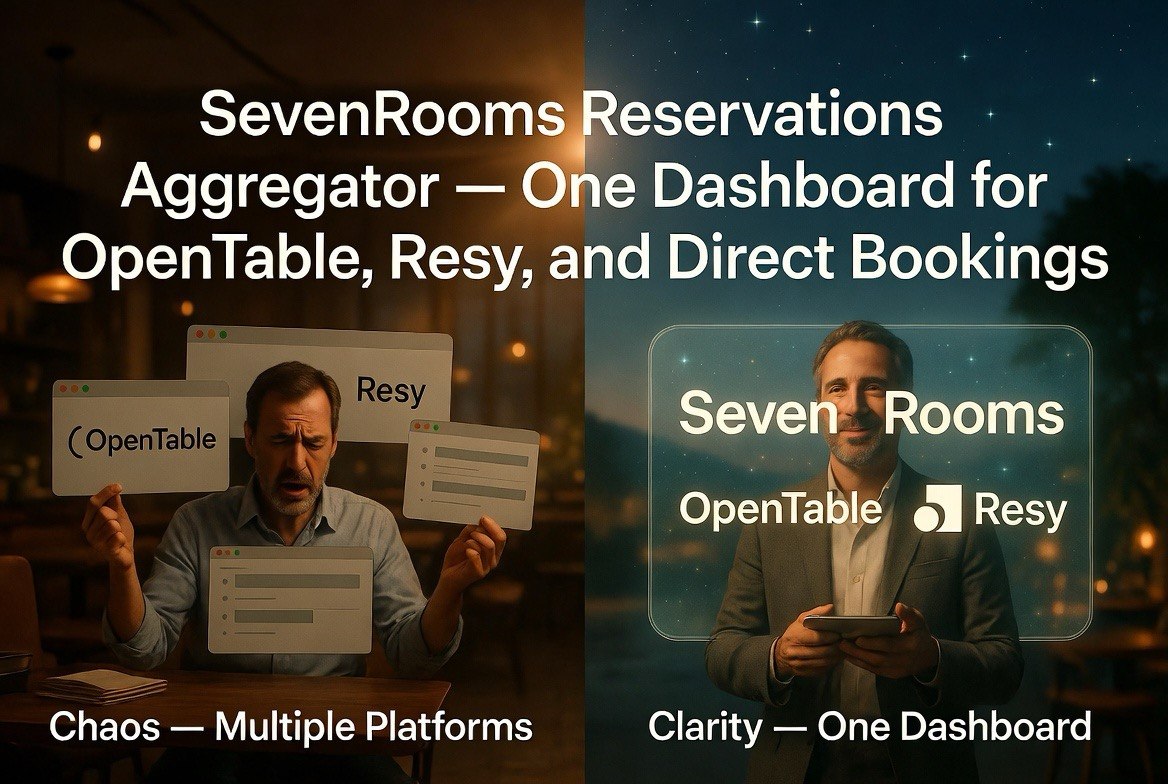
SevenRooms Reservations Aggregator: One Dashboard for OpenTable, Resy, and Direct Bookings
⚡ Expert Summary: SevenRooms launched a reservations aggregator in June 2026 that pulls bookings from OpenTable, Resy, and direct website reservations into a single dashboard. For independent operators managing fragmented reservation sources across multiple platforms, this is the first tool that gives a unified view without requiring guests to change how they book. This article breaks down what the aggregator does, how it compares to existing reservation management tools, and whether it solves the real problem — or just adds another layer to the stack.
Why a Reservations Aggregator Matters Now
The average independent restaurant in the United States lists availability on 2.3 reservation platforms according to a 2025 survey by the National Restaurant Association. A neighborhood spot might take direct bookings through its website (powered by SevenRooms or a similar tool), appear on OpenTable for discovery, and maintain a Resy presence for a younger demographic. Each platform has its own dashboard, its own rules, and its own data.
For the operator, this means checking three different systems to understand whether the Saturday 7:30 PM slot is actually full. It means double-bookings when a couple reserves through OpenTable while the manager marks the same table as available in the direct system. It means diners showing up to restaurants that don’t have their reservation because it was made on a different platform than the one the host checked.
SevenRooms, the reservation and guest management platform that competes directly with OpenTable and Resy, launched a reservations aggregator on June 17, 2026 to solve exactly this problem. The feature pulls reservations from all connected platforms — OpenTable, Resy, and direct — into a single SevenRooms dashboard. The host sees every booking for the night in one view, regardless of where the guest originally made it.
How the SevenRooms Aggregator Works
The aggregator is built into the existing SevenRooms platform, not a separate product. Restaurants that already use SevenRooms for direct reservations can connect their OpenTable and Resy accounts through a setup flow. Once connected, all incoming reservations stream into the same floorplan view that the host already uses for direct bookings.
The key technical detail: the aggregator operates as an API-level integration, not screen-scraping. This means changes to reservations (cancellations, time modifications, party size changes) sync bidirectionally in near-real time. If a guest cancels on OpenTable, the slot opens in SevenRooms immediately. If a host moves a Resy reservation to a different table in SevenRooms, that change reflects in the Resy system.
This bidirectional sync is what differentiates a real aggregator from a simple feed reader. Several third-party tools over the years have attempted to pull reservation data into a single view, but most used one-way syncs that created as many problems as they solved. A host could see that a reservation existed, but modifying it in the aggregator meant the original platform was out of sync. The new SevenRooms implementation solves that by writing changes back to the source.
What This Means for Independent Operators
For independent restaurants running on multiple reservation platforms, the aggregator removes what operators consistently rank as their top administrative headache: reservation fragmentation. A 2026 survey by Toast found that 41% of independent operators who use multiple booking channels reported double-bookings at least once per month, and 23% said it happened weekly.
The aggregator addresses this directly. But it also raises a strategic question: if you can see all reservations in one dashboard, do you still need to maintain a presence on multiple platforms?
The answer, for most operators, is yes — at least for now. OpenTable still drives the majority of discovery bookings in most US markets. Resy has a concentrated following in metropolitan areas like New York, Los Angeles, and San Francisco. Dropping off these platforms means losing the discovery traffic they generate. But with the aggregator, the operational headache of managing multiple platforms is dramatically reduced, which means operators can keep their full discovery footprint without the administrative drag.
SevenRooms vs. OpenTable vs. Resy: Where the Aggregator Changes the Game
| Capability | SevenRooms + Aggregator | OpenTable Standalone | Resy Standalone |
|---|---|---|---|
| Single dashboard for all reservations | ✅ Yes | ❌ Own platform only | ❌ Own platform only |
| Bidirectional sync | ✅ Yes | ❌ | ❌ |
| Guest profile unification | ✅ Yes | ❌ Platform-specific only | ❌ Platform-specific only |
| Floorplan management | ✅ Yes | ✅ Yes | ✅ Yes |
| AI guest profiles + personalization | ✅ Included | Limited | Limited |
| Average monthly cost (independent) | $150-300 | $129-399 + per-cover fees | $249 + per-cover fees |
The table above shows where the aggregator creates genuine differentiation. SevenRooms was already competitive on pricing and guest profile management. The aggregator adds the one feature that neither OpenTable nor Resy offers on their own: the ability to manage all your reservations from a single interface regardless of where they originated.
The AI Behind the Aggregation
Beyond the sync mechanics, SevenRooms is layering its existing AI guest intelligence tools on top of the unified reservation view. When a guest books through OpenTable but has dined at the restaurant before through a Resy reservation, the aggregator recognizes them as the same person — provided their profile data matches — and surfaces their full history: favorite table, past orders, dietary preferences, and visit frequency.
This is where the aggregator becomes more than a convenience tool. For restaurants doing high volumes, guest recognition is one of the strongest drivers of repeat visits. A study by Deloitte in 2025 found that hospitality environments that used unified guest profiles saw a 17-23% increase in return visitation rates compared to those that relied on platform-specific data alone. The reason is intuitive: when a host can greet a returning guest by name and remember their preferred table, the experience feels personal in a way that generic hospitality cannot replicate.
The AI layer also powers recommendations. SevenRooms’ system analyzes booking patterns to suggest optimal table configurations — when to open more two-tops versus four-tops, how to stagger reservations to balance kitchen load, and which time slots are underperforming and need dynamic pricing or special offers.
Implementation Considerations
The aggregator requires that the restaurant already uses SevenRooms as its direct reservation system. It is not a standalone tool that can aggregate reservations without SevenRooms being the hub. This means restaurants running on OpenTable as their primary PMS would need to either switch to SevenRooms or add it as an additional platform — increasing monthly software costs, at least initially.
For restaurants already on SevenRooms, the aggregator is a meaningful upgrade that solves a real operational pain point. The setup process involves authorizing API connections to OpenTable and Resy, which takes roughly 15 minutes per connection according to SevenRooms’ documentation. Once connected, the unified view is immediate.
Restaurants that operate on a single reservation platform will see less benefit. The aggregator is specifically built for operators who have chosen — or been forced by market dynamics — to maintain a presence on multiple booking channels. For single-platform restaurants, the existing SevenRooms dashboard already does everything the aggregator does.
Pricing and Availability
The aggregator is included in SevenRooms’ existing subscription tiers at no additional cost. The company announced the feature as a native upgrade rather than a premium add-on, which is a strategic play to make the platform stickier for existing customers and more attractive to restaurants evaluating reservation systems. SevenRooms pricing for independent restaurants ranges from approximately $150 to $300 per month depending on features and volume, with no per-cover fees — a key differentiator compared to OpenTable and Resy, both of which charge per-reservation fees that can add $500-$2,000 per month for busy independent restaurants.
How the Aggregator Changes the Guest Experience
Reservation fragmentation does more than frustrate operators — it directly impacts the guest experience. A diner who books through OpenTable, calls to modify the time, and then shows up to a host who has no record of the change has experienced failure at three different touchpoints before they even sit down. According to data from Intouch Insight’s 2025 guest experience study, reservation-related friction is the third most common source of negative reviews on Yelp and Google, behind only wait times and food quality complaints.
The SevenRooms aggregator addresses this by ensuring that the host has the single source of truth regardless of where or when the guest modified their booking. For the guest, the experience is invisible — they book however they prefer, modify however they prefer, and the restaurant sees the correct information every time. The technology disappears, which is exactly what good restaurant technology should do.
There is also a subtler guest loyalty angle. When the aggregator unifies guest profiles across platforms, regulars who sometimes book through OpenTable and sometimes through Resy stop being treated as two different customers. The host can see that this guest has dined 12 times in the past year, prefers a quiet corner table, and always orders the cacio e pepe. That level of recognition, delivered consistently, is what turns occasional diners into regulars.
How It Compares to Alternative Approaches
Before the SevenRooms aggregator, operators had three options for managing multi-platform reservations, none of which were satisfactory:
Manual reconciliation. The host checks all three dashboards before the shift, writes the combined availability on a physical or digital whiteboard, and manually updates all systems when changes happen. This works for restaurants doing fewer than 30 covers per night but collapses under any real volume. Human error rates in manual multi-platform reconciliation run at approximately 8-12% according to operations research from the Cornell Center for Hospitality Research.
Single-platform exclusivity. Some operators choose to list only on one platform, accepting lower discovery in exchange for operational simplicity. This is a legitimate strategy for high-demand restaurants that don’t need OpenTable’s discovery traffic, but for the majority of independents, dropping a platform means a measurable revenue hit. The NRA estimates that restaurants listing on two or more reservation platforms average 22% more booked covers than single-platform operators.
Middleware integration tools. A small ecosystem of middleware tools has attempted to bridge reservation platforms, but most use one-way sync or screen-scraping that produces inconsistent results. These tools also add another monthly subscription ($50-$200 per month) and require technical setup that many independent operators lack the time or expertise to manage.
The SevenRooms aggregator solves the problem at the platform level, not through a third-party bridge. That means fewer points of failure, no extra vendors to manage, and professional-grade API integration rather than scraping. For operators already in the SevenRooms ecosystem, it is clearly the best option available. For operators on other platforms, it becomes a significant reason to evaluate a switch.
Frequently Asked Questions
What is the SevenRooms reservations aggregator?
The SevenRooms reservations aggregator is a feature launched in June 2026 that pulls reservations from OpenTable, Resy, and direct website bookings into a single SevenRooms dashboard. It provides bidirectional sync so changes made in any platform update across all connected systems.
Do I need SevenRooms to use the aggregator?
Yes, the aggregator is built into the SevenRooms platform. It requires SevenRooms as the hub. Restaurants using OpenTable or Resy as their primary system would need to add SevenRooms to use the aggregator.
Does the aggregator work with all reservation platforms?
At launch in June 2026, the aggregator supports OpenTable, Resy, and SevenRooms direct reservations. SevenRooms has indicated additional platform support is planned but has not announced specific timelines or platforms.
Does the aggregator sync changes both ways?
Yes, the aggregator uses API-level integration for bidirectional sync. Changes made on any platform — cancellations, time changes, table assignments — sync in near-real time across all connected systems.
How much does the SevenRooms aggregator cost?
The aggregator is included in SevenRooms’ existing subscription tiers at no additional cost. SevenRooms pricing for independent restaurants typically ranges from $150-$300 per month with no per-cover fees.
Will the aggregator reduce double-bookings?
Yes, this is the primary use case. By showing all reservations from all platforms in a single dashboard with real-time sync, the aggregator virtually eliminates the double-booking problem that 41% of multi-platform independent operators report experiencing at least monthly.

About Barak Schurr
Barak Schurr built and exited a major ticketing platform, ran global operations at Eventbrite, and now focuses on one question: which AI tools actually help independent restaurant owners run leaner and grow faster. He writes from the operator’s perspective — no vendor spin, no theory, just what’s real in 2026.
Email: [email protected]
More AI Resources