Get the AI Restaurant Quick-Start Guide — Free
The 5 AI tools independent US restaurant owners are using right now to cut labor costs and answer every call.
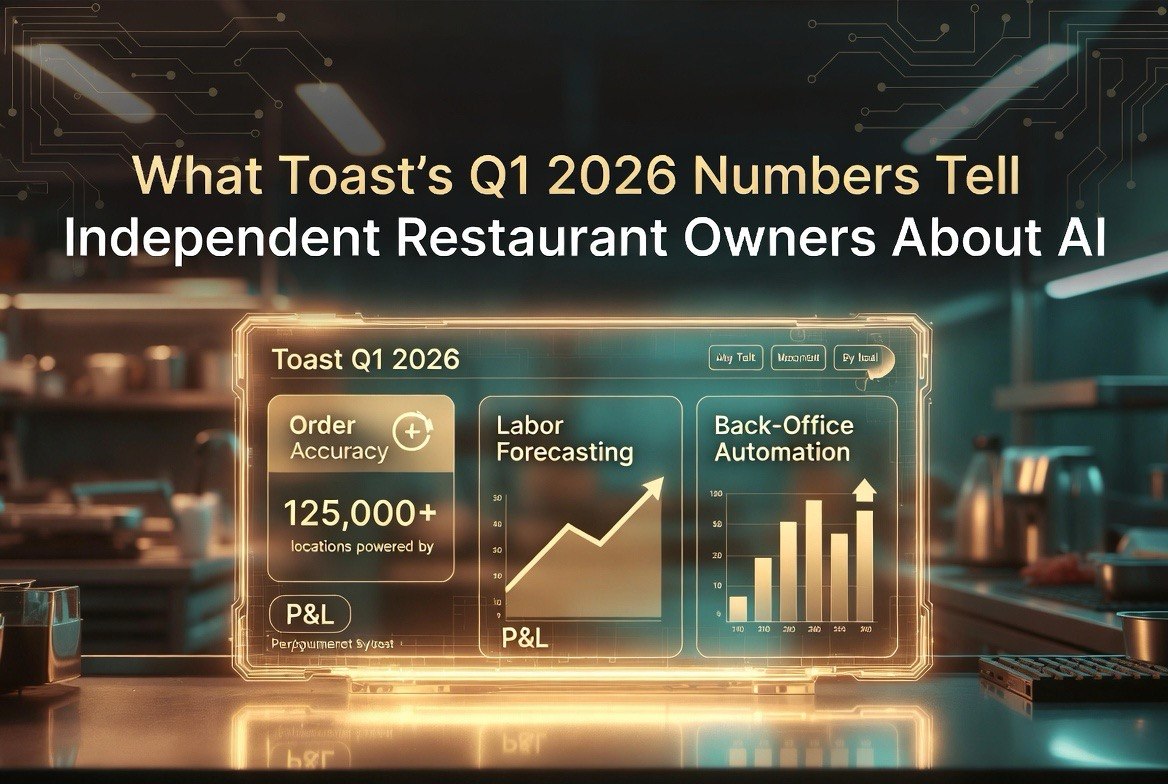
What Toast’s Q1 2026 Numbers Tell Independent Restaurant Owners About AI
⚡ Expert Summary: Toast’s Q1 2026 results show the point-of-sale giant serving over 125,000 restaurant locations — and in the process, revealing where real restaurants actually see return from AI. The signal isn’t in flashy features; it’s in the operational areas where Toast’s data shows adoption sticking: order accuracy, labor management, and AI-assisted phone ordering. For independent operators, the takeaway is practical: the AI that shows up in a POS giant’s quarterly data is the AI that’s proven to move money, not just demo well. This post breaks down what those numbers mean for a single-unit owner deciding where to put attention — and budget — in 2026.
When a company the size of Toast reports its quarterly numbers, the details are easy to skim past. But buried in those figures is one of the most useful signals an independent operator can read: where AI is actually delivering return in real restaurants, at massive scale, over millions of transactions.
Toast’s platform now runs well past 125,000 locations across the US, Canada, and the UK. That’s not a pilot program or a handful of early adopters — that’s the mainstream of independent and mid-market dining. When the company highlights specific AI-backed features alongside that scale, it’s telling you, with real data, which automation is surviving contact with actual operating days.
This matters to you because it cuts through the noise. Every month there’s a new “AI for restaurants” headline. Most of it is vaporware or niche. Toast’s numbers let you see what a huge slice of the market has already voted for with their subscription dollars. Let me break down what actually showed up and what it means for a single-unit owner.
The Signal Is in the Operations, Not the Hype
The most telling part of Toast’s recent reporting isn’t a single product launch — it’s the pattern of where adoption is concentrating. Three operational areas keep surfacing in the data:
- AI-assisted ordering: order accuracy improvements and increased throughput from AI-backed ordering flows, including phone answerers and self-order channels that reduce friction.
- Labor tools: AI-driven forecasting and scheduling that help operators align staffing to demand rather than guessing, cutting both overstaffing and coverage gaps.
- Back-office efficiency: automation in reporting and cost tracking that gives operators clearer P&L visibility without adding admin hours.
Notice what’s missing from that list: no autonomous robot line cooks, no AI menu written by a chatbot, no gimmicks. The AI that’s earning its place in Toast’s data is the boring, money-facing kind — the automation that touches order accuracy, labor cost, and the numbers you review every week.
Why Order Accuracy Is the Quiet Winner
Restaurateurs often think of AI adoption in terms of grand transformation. But in real operations, the biggest near-term return comes from something far more mundane: getting orders right.
When AI-assisted phone ordering and self-order flows reduce misinterpreted orders, the effect compounds. Fewer re-makes means less food waste, faster table turnaround, and fewer comped meals. A mistake on a $30 entree that has to be remade costs you the ingredients, the labor, and the customer’s goodwill — and those costs add up across thousands of covers.
Toast’s emphasis on order accuracy in its operational reporting tracks with what independent operators tell peers: the first AI win to feel in the P&L is usually the one that stops errors, not the one that writes better marketing copy.
Labor Forecasting That Actually Matches Demand
Labor is typically the second-biggest line item in a restaurant’s costs, after food. It’s also the hardest to manage well, because demand swings by day, hour, and weather in ways that are hard to predict by gut.
AI-driven labor forecasting changes that calculation. Instead of a manager eyeballing last year’s “same weekend,” the system models demand against booking data, historical patterns, and local signals — then recommends a schedule that fits. For an independent operator, that’s the difference between paying someone to stand around on a slow Tuesday and being caught short on a busy Friday.
The reason this shows up in a POS giant’s quarterly numbers is simple: it delivers measurable cost reduction that operators can see on their weekly reports. That’s the kind of automation that renews itself, because the savings are visible and repeatable.
What These Numbers Mean for a Single-Unit Owner
Let me translate the big-company data into what you can actually do, whether you run one location or a small group.
1. Prioritize order-accuracy AI first
If you’re going to add one AI capability this year, make it the one that reduces order errors. Whether it’s a better phone-ordering flow, a self-order QR system with AI-backed item suggestions, or a kitchen display that catches mistakes earlier — the ROI is direct and easy to measure.
2. Let AI schedule, don’t let AI run the floor
Use AI forecasting for the labor plan, but keep human judgment on the floor. The best operators I’ve seen treat AI scheduling as a strong starting point, then layer in their own knowledge of the staff and the neighborhood. The tool removes the guesswork; the owner still makes the call.
3. Watch your P&L, not the announcements
Don’t chase every vendor’s AI feature. Watch your own numbers — order-error cost, labor percentage, food cost — and adopt the tools that move those specific lines. If a feature doesn’t show up in your monthly P&L, it’s not doing its job.
The Real State of Restaurant AI, Per the Data
| Where AI shows ROI | What it fixes | Owner action |
|---|---|---|
| AI-assisted ordering | Order errors, wasted re-makes | Adopt error-reducing order flows |
| Labor forecasting | Over/understaffing, labor % | Use AI schedules, keep human judgment |
| Back-office reporting | Admin time, unclear P&L | Automate reports, track your lines |
| Bottom line | AI that touches money sticks | Adopt what shows up in your P&L |
The pattern across Toast’s operational reporting is consistent: the AI that survives at scale is the AI that visibly improves order accuracy, labor efficiency, and back-office clarity. It is not the AI that impresses at a conference demo and then disappears in week three of real service.
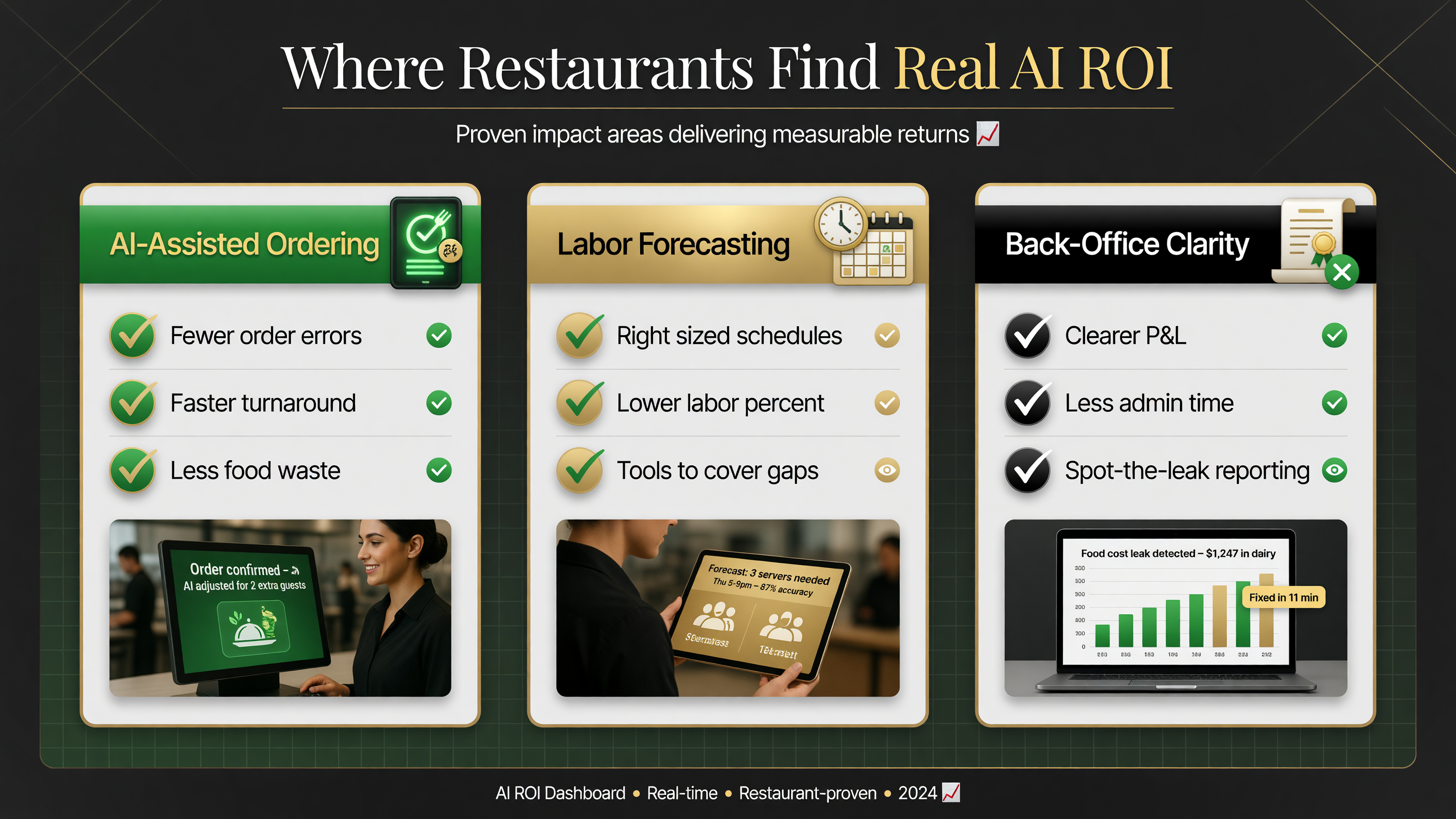
Across Toast’s platform data, the AI that survives at scale is the operational kind — order accuracy, labor scheduling, and P&L visibility — not flashy customer-facing gimmicks.
How to Read a Restaurant Tech Company’s Numbers
There’s a skill to reading platform-company earnings that most operators never pick up, and it’s worth learning because vendors will keep throwing numbers at you. The metric that matters most is customer adoption of a specific feature, not total revenue or total locations. A company can grow revenue by raising prices, and it can grow locations by acquiring smaller competitors — neither of which tells you whether the AI they’re selling actually works in a kitchen.
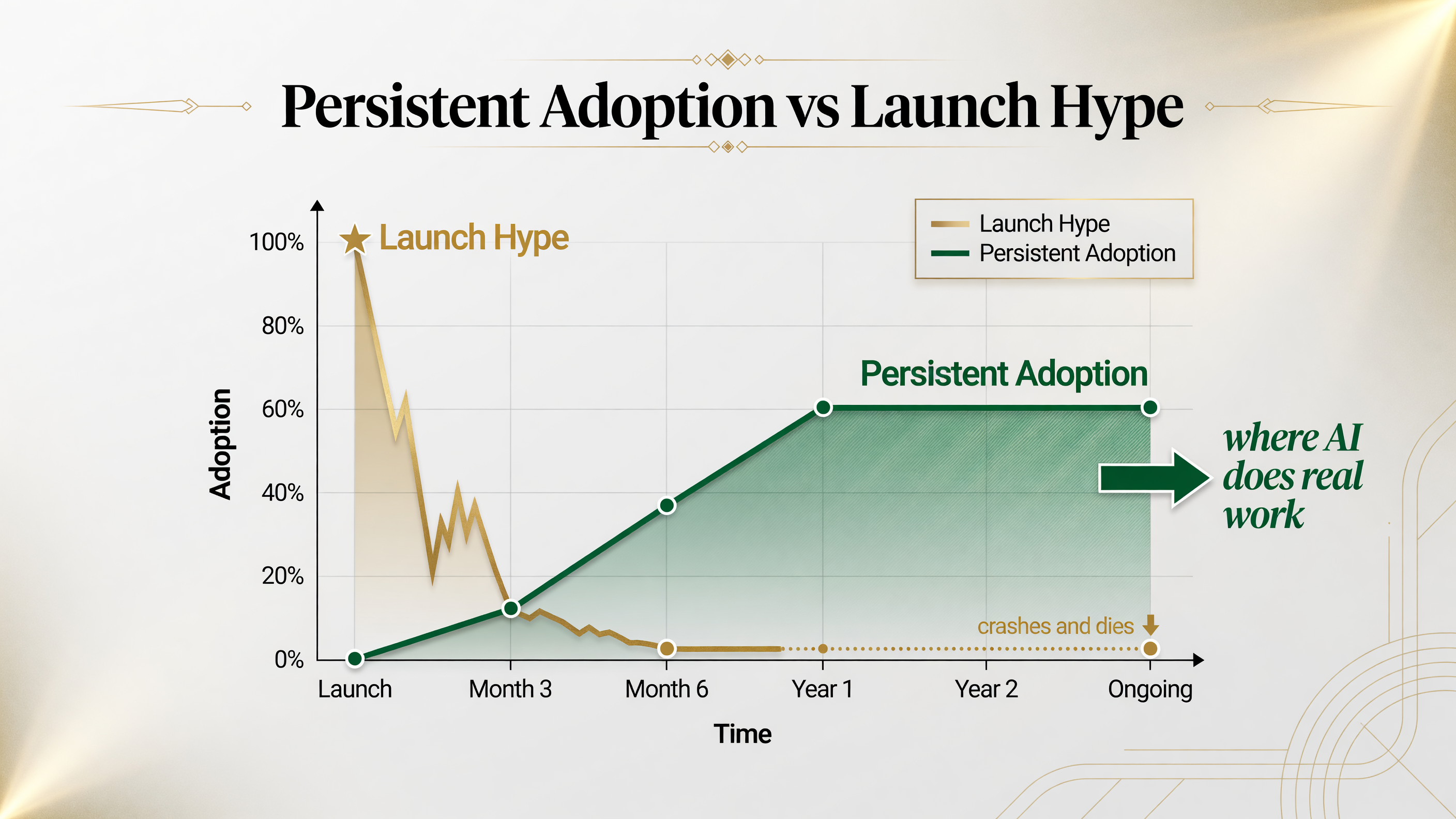
Launch-week hype spikes and fades; the AI worth adopting is the kind that settles into a persistent, durable base of daily use.
What you want to see is the company voluntarily calling out an operational feature in its results, because that means a meaningful share of its existing base is paying for and using it. When a POS giant highlights AI order accuracy or labor forecasting in the same breath as its subscriber numbers, it’s signaling that these features are pulling real subscription growth — not just generating press releases.
For an American independent operator, this matters because your vendor decisions compound. Pick the platform whose AI features are proven across a huge base, and you benefit from years of real-world tuning and bug fixes. Pick the one whose AI is still a slideware promise, and you become the unpaid test kitchen. Reading the numbers the right way is how you tell the difference before you sign.
It also helps to separate persistent adoption from launch-week hype. Almost every restaurant AI feature posts a spike at launch, fades through a dip, and then either flattens to a durable base or dies. The features that survive to that durable base — the ones that make it into a company’s quarterly operational narrative — are the ones doing real work day in and day out. That’s the bar worth paying attention to.
Practical Advice Before You Buy
Before you add any AI tool to your stack, run it through these three filters:
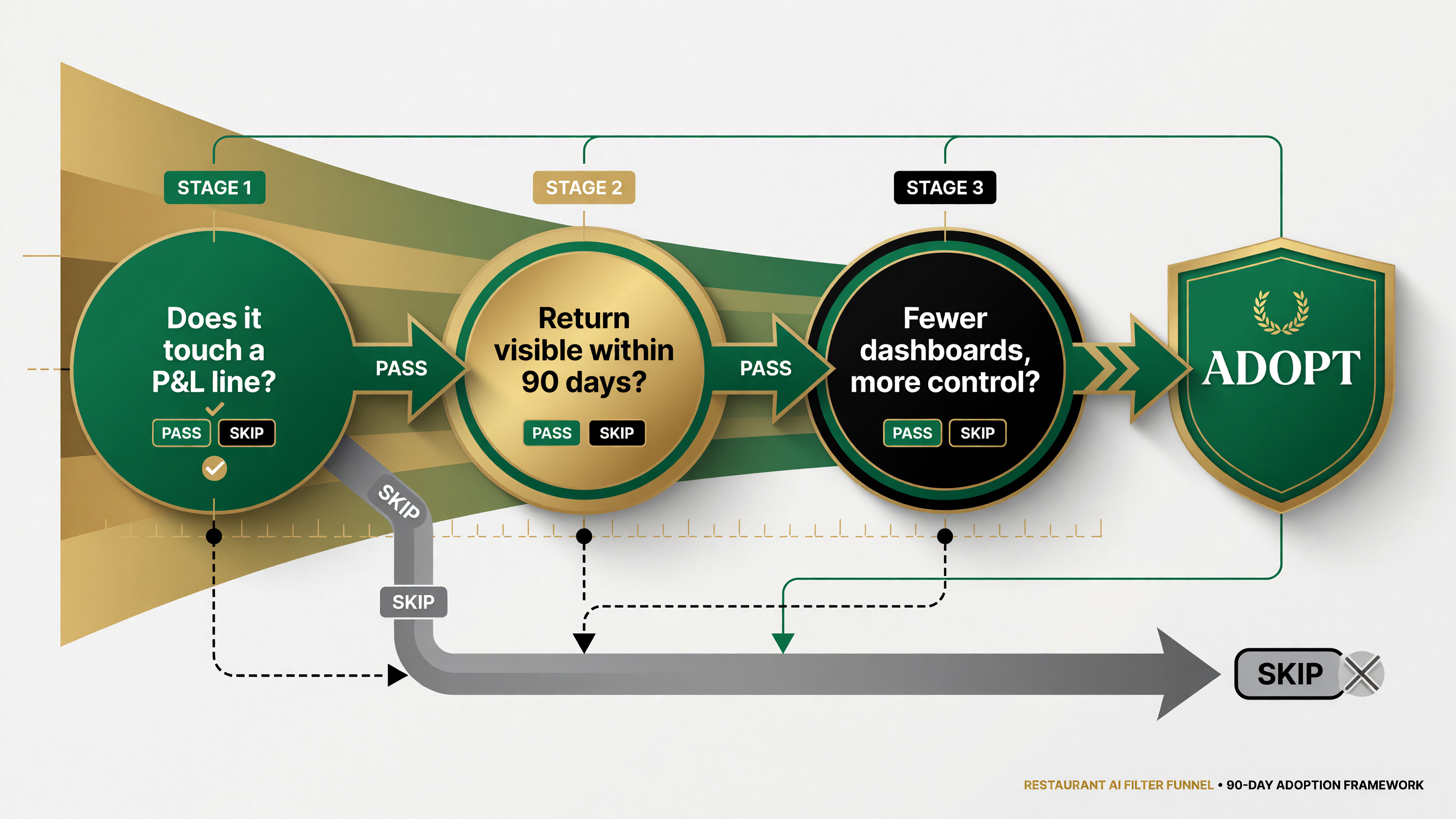
A tool has to touch a P&L line, show return within a quarter, and reduce your dashboard count — otherwise it’s adding work, not removing it.
- Does it touch a line on my P&L? Order errors, labor, food cost — if it doesn’t improve one of these, it’s a distraction.
- Can I see the return within a quarter? If the savings aren’t visible within 90 days, the tool is creating work, not removing it.
- Does it put me back in control, or add another dashboard? The right tool reduces the number of places you check, not increases it.
If a tool passes all three, it’s worth a pilot. If it fails any of them, skip it regardless of how impressive the marketing is.
Bottom Line
Toast’s Q1 2026 numbers are useful not because they’re impressive — 125,000 locations is — but because they show where a huge share of the market has found AI that actually works. It’s in order accuracy, labor forecasting, and back-office efficiency. Not in gimmicks.
For an independent operator, that’s a grounded roadmap. Put your attention and budget where the data shows return: stop the errors, right-size the labor, and keep your numbers clear. The AI that earns its place on a 125,000-location platform is the AI that will earn its place in your single-unit operation.
Frequently Asked Questions
How many locations does Toast serve?
Toast’s platform serves more than 125,000 restaurant locations across the US, Canada, and the UK, making it one of the most widely adopted restaurant technology platforms for independent and mid-market operators.
What AI features is Toast actually using?
Toast’s operational reporting highlights AI-backed order accuracy improvements, labor forecasting and scheduling, and back-office reporting — the operational areas where it says restaurants see measurable return.
What restaurant AI delivers the best ROI for independent owners?
Based on adoption data, the highest-return AI for independents is order-accuracy technology (reducing re-makes and errors), labor forecasting (right-sizing schedules), and back-office automation (clearer P&L visibility) — not flashy customer-facing features.
How can a single-unit owner test AI without much risk?
Start with tools that directly affect order accuracy, labor cost, or food cost, run a 90-day pilot, and check whether the improvement shows up in your monthly financials before scaling.
Should I replace my POS to get better AI?
Not necessarily. Focus on whether the AI capabilities you need are available in your current stack or as add-ons, and switch only if a genuine, measurable operational need is unmet.

About Barak Schurr
Barak Schurr built and exited a major ticketing platform, ran global operations at Eventbrite, and now focuses on one question: which AI tools actually help independent restaurant owners run leaner and grow faster. He writes from the operator’s perspective — no vendor spin, no theory, just what’s real in 2026.
Email: [email protected]
More Resources for Restaurant Operators