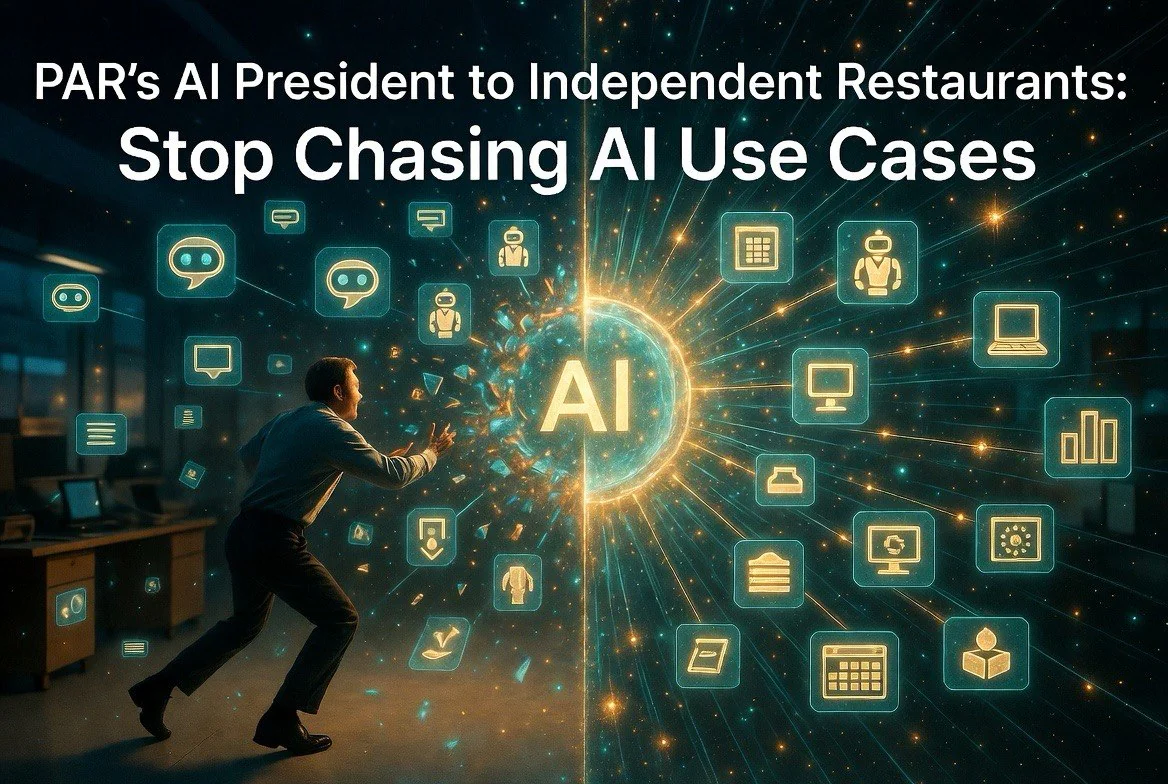
PAR’s AI President to Independent Restaurants: Stop Chasing AI Use Cases
⚡ Expert Summary: Oliver Ostertag, president of growth and AI at PAR Technology, sat down with Restaurant Dive on July 14, 2026 to explain why most restaurant AI implementations fail — and what actually works. His core argument: “Use case is important, but it’s really a question of whether or not the technology is enterprise-grade, whether it’s proven and how deep the data is.” For independent operators running on disconnected systems, this is the most important AI lesson of 2026.
The Setback Narrative Isn’t the Full Story
If you follow restaurant tech news, you’ve seen the headlines. Starbucks abandoned its AI-powered inventory counting system after less than nine months. McDonald’s pulled back on voice AI testing. Pizza Hut’s AI order management system allegedly cost one franchisee $100 million in lost sales.
It’s easy to read these stories and conclude that AI isn’t ready for restaurants. Oliver Ostertag, the president of growth and AI at PAR Technology — the company powering point-of-sale, payments, and back-office systems for chains like Burger King and Shake Shack — says that conclusion is wrong.
“Obviously there have been some high-profile flops,” Ostertag told Restaurant Dive in a July 14 interview. “I wouldn’t look at this as AI being too early for restaurants. I don’t think that’s the case. With Starbucks specifically, it was a very early use case of a technology. Because of how early that specific technology was there were some gaps. New technology being used at enterprise scale is really hard” (Restaurant Dive, July 2026).
The real issue isn’t the technology — it’s how the technology connects to the rest of the operation.
Why Independent Operators Have an Advantage
Ostertag’s framework hinges on “context equity” — the depth and breadth of data an AI system can access. His argument: the most successful restaurant AI deployments are those that sit on unified platforms covering point-of-sale, payments, back-office operations, labor scheduling, inventory management, loyalty programs, and online ordering. The AI layer performs well because it understands the full picture — not just one data point in isolation.
“[Such platforms] understand as a consequence the full operations of a restaurant, in-store and above-store,” Ostertag said. “You can have a platform provider that doesn’t have the full 360-degree view of a restaurant — maybe it’s just the back-office piece — but as long as a platform covers multiple dimensions over an extended period you can actually have great results with AI.”
For independent operators, this is actually good news. You don’t need a massive enterprise data warehouse. You need a platform that connects the pieces you already have — your POS, your scheduling system, your inventory tracker. Many modern restaurant management platforms (Toast, PAR, Square) offer this integration natively. The operators winning with AI are the ones using these unified platforms effectively.
The Three AI Applications That Work Right Now
Ostertag broke down the use cases where AI is delivering real results for restaurants today:
Natural-language analytics. Instead of waiting for a report from your corporate team, you ask: “Which stores perform best and why?” or “Where am I seeing the largest amount of wastage and why?” The AI answers because it sits on unified operational data. For an independent operator with one or two locations, this means instant insight without needing a data analyst.
Automated action agents. Beyond passive analytics, AI agents can take action. An “offers agent” that sets up promotions based on current inventory levels — automatically discounting overstocked items before they expire. A “fraud agent” that proactively identifies where cash is leaking — flagging patterns in voids, comps, and refunds that a busy manager might miss.
Back-office optimization. “The easiest application of AI will always be on the back-office side,” Ostertag said. Labor scheduling that accounts for historical demand patterns, weather forecasts, and local events. Inventory ordering that predicts usage and avoids both shortages and waste. These produce immediate, measurable ROI without the risk of customer-facing AI missteps.
What Sets Back the Restaurants That Fail With AI
The failed implementations share a common pattern: they were isolated technologies applied to single problems without connecting to the broader operational data. Starbucks’ inventory AI, for example, was a computer vision system that couldn’t integrate deeply with the company’s broader supply chain data. McDonald’s voice AI couldn’t handle the complexity of real-world drive-thru environments because it lacked context about menu complexity, regional accents, and ambient noise patterns.
“If you don’t have full context equity, AI cannot solve the challenges that operators are facing,” Ostertag warned. “You’re only as good as the underlying tech stack, and if integrations are not great, it’s really hard to have that 360 approach.”
For independent operators, the risk is lower — you’re not deploying at 14,000 locations — but the principle holds. An AI tool that only looks at your labor data without understanding your sales data, menu mix, and upcoming events will make worse predictions than one that sees the full picture.
What “Context Equity” Means for Your Restaurant
Ostertag defined context equity with a specific example that every operator will recognize. The ideal system knows not just that an order was placed, but:
- Where the order came from (dine-in, takeout, delivery, online)
- Where it was routed (which station, which cook, which shift)
- The component-level contents of every item (not just “cheeseburger” but the bun, patty, cheese, toppings, and their individual costs)
- Current inventory levels for every component
- Current pricing for every component, updated in real time
- Historical demand patterns for that item on that day of the week
An AI sitting on this level of data can answer questions no single tool can: “Should I run a lunch special on burgers this Thursday based on my current beef inventory and forecasted traffic?” That’s actionable intelligence — not a chatbot answering basic menu questions.
The Token Cost Reality for Restaurant Operators
Ostertag acknowledged that AI costs are rising. PAR tracks its token spend “very closely” and has seen it climb month over month. But he made a critical point for independent operators worried about costs: “As long as the relative efficiency gains are climbing in excess of the rising token cost, you don’t have much of a problem.”
He also predicted that token prices will drop as the market becomes more competitive. For a single-location restaurant, the cost of AI-powered analytics through an integrated platform is already negligible compared to the labor and food cost savings it can generate. The operators who should be worried aren’t the ones using AI — they’re the ones not using it while their competitors cut costs and improve margins.
How to Apply This Framework to Your Restaurant Today
Ostertag’s interview provides a practical roadmap for independent operators who want to use AI effectively without repeating the mistakes of the big chains. Here’s how to apply it in your operation this week:
Audit your data integration. Make a list of every system in your restaurant — POS, payroll, inventory, scheduling, online ordering, loyalty, accounting. Count how many of them share data automatically. If you’re manually exporting CSV files and reimporting them into spreadsheets, your AI tools will underperform. The first step to better AI isn’t buying a new tool — it’s connecting the ones you already have.
Choose platforms over point solutions. Ostertag’s argument for “platform-based” AI is clear: the most effective tools are those that sit on systems covering “point of sale, payments, back-office functionality, including labor, including inventory, as well as engagement products, loyalty products and online ordering.” For independent operators, this means choosing a primary platform that handles multiple functions rather than stitching together five separate tools. The integration is built in, and the AI layer works out of the box.
Start with back-office, not customer-facing. “The easiest application of AI will always be on the back-office side,” Ostertag said. Start with labor scheduling AI that predicts optimal staffing based on historical data and local events. Then add inventory AI that forecasts ordering needs and reduces waste. Only after those are producing measurable ROI should you consider customer-facing AI like voice ordering or personalized recommendations. The upside is lower, the risk is lower, and the data foundation is already in place.
Measure ROI in efficiency, not revenue. Ostertag was candid that directly attributing revenue growth to AI is still early. “It still needs to be proven out that you are seeing those results,” he said. But efficiency gains — labor cost reduction, waste reduction, manager time saved on reporting — are measurable today. Track those first. If your AI tool is saving you hours of manager time per week and cutting food cost by a measurable percentage, the revenue impact will follow.
FAQ
Why do some restaurant AI implementations fail?
What is the most effective AI application for restaurants right now?
Can independent restaurants benefit from AI without enterprise budgets?
What did PAR Technology’s AI president say about AI use cases?
What is “context equity” in restaurant AI?
How much does restaurant AI cost in 2026?

About Barak Schurr
Barak Schurr built and exited a major ticketing platform, ran global operations at Eventbrite, and now focuses on one question: which AI tools actually help independent restaurant owners run leaner and grow faster. He writes from the operator’s perspective — no vendor spin, no theory, just what’s real in 2026.
Email: [email protected]
More AI Resources