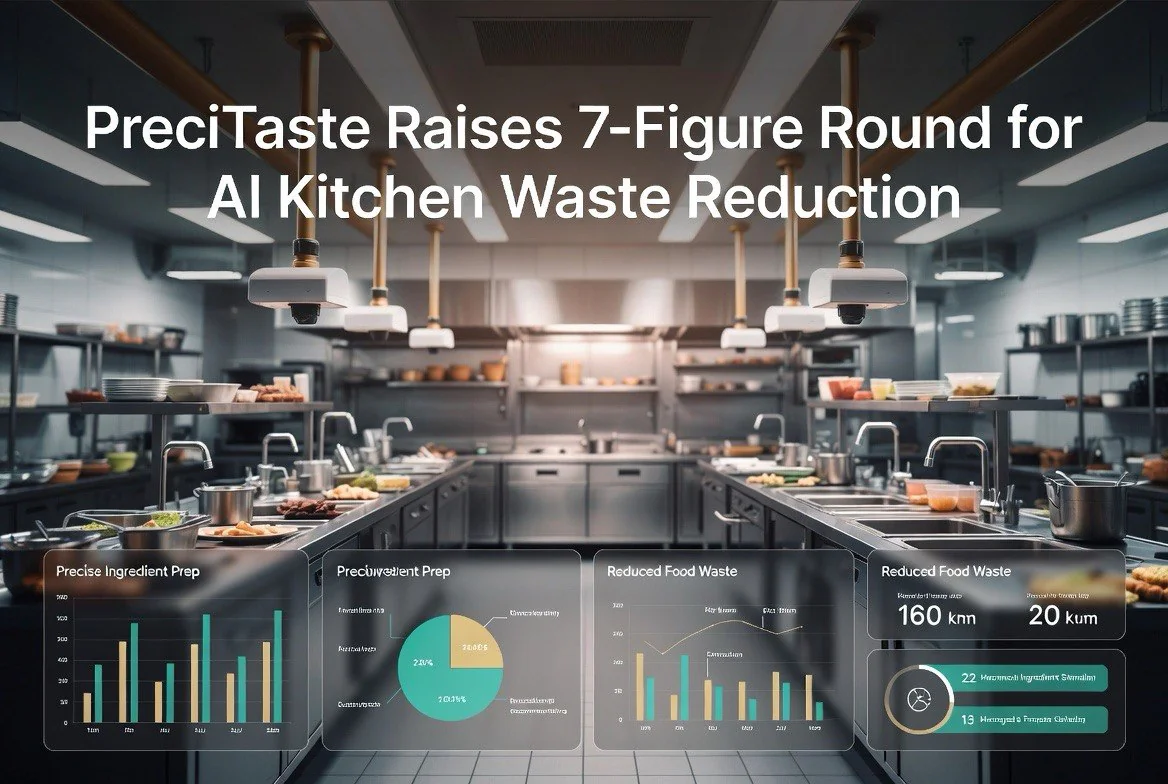
PreciTaste Raises 7-Figure Round for AI Kitchen Waste Reduction
⚡ Expert Summary: PreciTaste, an AI-powered kitchen management platform with 7,000+ deployments across 50+ restaurant chains, closed a seven-figure revenue-based financing round led by Round2 Capital in July 2026. The company’s computer vision and predictive AI systems help restaurants reduce food waste, cut labor costs by an average of 7%, and save up to 4 hours of management time per store per day.
If you run a kitchen, you know exactly where your margin disappears: overprepped food that gets thrown out, underprepped ingredients that force emergency mid-service adjustments, and the manager hours spent walking the line, checking inventory, and guessing how much to prepare for tomorrow.
PreciTaste is a New York-based company that builds AI systems specifically for back-of-house kitchen operations. On July 14, 2026, the company announced it had closed a seven-figure revenue-based financing round led by Round2 Capital. The funding will accelerate the rollout of the company’s AI-powered kitchen management platform across more restaurant chains in the United States and Europe.
What PreciTaste Actually Does
PreciTaste installs computer vision cameras and edge computing devices in restaurant kitchens that track food preparation in real time. The system watches what is being prepped, how much is being made, what is being thrown away, and how long items sit before they are sold. It then uses predictive AI to tell kitchen managers exactly how much to prepare, when to prepare it, and what to adjust based on current sales velocity.
The system runs entirely on edge devices, meaning the cameras and processing hardware operate independently of cloud connectivity. This is an important detail for restaurant kitchens where internet reliability can be inconsistent. The AI models process video locally and only send aggregated data to the cloud for reporting. The system is also GDPR and ISO compliant, addressing the data privacy requirements that are increasingly relevant for restaurant technology vendors.
The company reports average savings of approximately 7% on food and labor costs across its 7,000+ deployments. For a restaurant doing $1.2 million in annual revenue, that translates to roughly $84,000 per year in improved margin. The system also claims up to 24% uplift in sales for some locations by ensuring high-margin items remain in stock during peak periods and by reducing the waste that directly impacts profitability.
How Computer Vision Transforms Kitchen Operations
The core technology behind PreciTaste is computer vision applied to food preparation. Cameras above prep stations track what ingredients are used, in what quantities, and at what times. The AI models learn the visual signatures of different food items and can distinguish between similar ingredients. Over time, the system builds a granular understanding of each kitchen’s patterns: which menu items sell fastest on Friday nights, how much waste a particular station generates during lunch service, which prep schedules lead to the most overproduction.
This level of visibility is essentially impossible to achieve with manual processes. Even the most diligent kitchen manager cannot track every ingredient leaving every prep station in real time during a busy service. PreciTaste creates a continuous, objective record of kitchen operations that surfaces patterns human observation would miss.
The management time savings are particularly significant for independent restaurant operators. PreciTaste claims its system saves up to 4 hours per store per day in management time. That is time that was previously spent on manual inventory checks, counting prep levels, reconciling orders, and filling out waste logs. Converted, that is roughly half a shift per day that the manager can spend on guests, training, menu development, or simply going home earlier.
| Metric | PreciTaste Average | Impact on $1.2M Restaurant |
|---|---|---|
| Food and labor cost reduction | ~7% | $84,000/year |
| Management time saved | 4 hours/day | ~$36,000/year in labor |
| Sales uplift (select locations) | Up to 24% | Variable |
| Deployments | 7,000+ | 50+ chains |
| Patents | 44+ | Hardware + software |
Revenue-Based Financing: What the Funding Round Means
The seven-figure revenue-based financing from Round2 Capital is notable because it is structured differently from traditional venture capital. Revenue-based financing ties repayment to the company’s revenue, meaning PreciTaste pays back the investment as a percentage of its ongoing revenue rather than on a fixed schedule. This structure is increasingly popular for companies with strong recurring revenue that want to avoid diluting equity. Round2 Capital specializes in this model, and the deal signals confidence in PreciTaste’s growth trajectory and unit economics.
The funding is specifically earmarked for accelerating rollout of the platform to more restaurant chains and expanding operations in Europe, where the company already has a presence through partnerships with global restaurant brands. The fact that PreciTaste has 44+ patents covering its hardware and software systems also suggests a defensible technology position that makes the company attractive for this type of growth financing.
PreciTaste previously raised a $24 million Series A in 2022 led by Safar Partners, so the company has been building this technology for several years. The July 2026 financing represents a growth-stage capital injection for a company that has already validated its product across thousands of locations.
Why This Matters for Independent Operators
PreciTaste’s technology is currently deployed primarily in chain restaurants with the resources and scale to justify dedicated kitchen management systems. But the trends it represents are directly relevant to independent operators. The same AI capabilities that drive savings for large chains are becoming available in more accessible formats for smaller operations.
The core insight from PreciTaste’s results is that computer vision and predictive AI can deliver measurable, consistent improvements in kitchen efficiency. The 7% average cost reduction is not a theoretical projection from a marketing document. It is an aggregate number drawn from 7,000 real-world deployments across 50 chains. The technology works at scale, and as the underlying hardware costs continue to decline and the software becomes more standardized, these capabilities will inevitably reach independent restaurants.
For the independent operator reading this today, the practical takeaway is not that you need to install computer vision cameras in your kitchen immediately. It is that the data-driven approach to kitchen management is becoming the standard, and the tools to achieve it are rapidly becoming more affordable. If a chain competitor is using AI to reduce food costs by 7%, that margin advantage compounds into pricing flexibility, menu investment capacity, and ultimately market share.
Practical Alternatives for Independent Kitchens Today
While PreciTaste’s full computer vision system targets larger operations, independent operators can capture some of the same benefits with accessible alternatives:
Digital inventory management. Platforms like MarketMan and BlueCart use AI to forecast inventory needs and track usage patterns. They require manual data entry rather than automatic computer vision, but they deliver the same predictive benefit at a fraction of the cost.
Waste tracking apps. Simple weekly waste logs entered into an AI-powered system will surface patterns that manual observation misses. Knowing that Tuesday prep consistently produces 15% more waste than Wednesday prep is actionable intelligence that does not require cameras.
POS data analysis combined with inventory data to identify margin leakage. Tools like restaurant365 and Toast’s analytics suite can connect sales data to ingredient costs and highlight which menu items are actually profitable after factoring in waste.
How PreciTaste Integrates With Existing Systems
A common concern for restaurant operators evaluating AI kitchen tools is whether the new system will require ripping out existing equipment or workflows. PreciTaste is designed to integrate with existing POS systems and kitchen equipment rather than replacing them. The computer vision hardware sits above existing prep stations and connects wirelessly to the internet for configuration and reporting. The AI layer analyzes the data the kitchen already generates and adds the predictive intelligence layer on top.
The company holds 44+ patents covering both the hardware design and the AI models, which suggests a level of technical sophistication that goes beyond simple off-the-shelf camera systems. The edge computing architecture means the system continues to function during internet outages, an important reliability factor for back-of-house operations where consistent uptime is non-negotiable.
Restaurant chains using PreciTaste report that the system pays for itself within the first year of deployment. For a multi-location operator, the economics are straightforward: reduce waste by 7%, save four hours of manager time per location per day, and the unit economics work regardless of the specific menu or concept. The fact that the company has 7,000+ active deployments with 50+ chains suggests the ROI is holding up across a diverse range of operations.
The European Expansion Strategy
The Round2 Capital deal is specifically structured to support PreciTaste’s expansion in Europe, where the company already has an established presence. European restaurant operators face similar cost pressures to their U.S. counterparts, with additional regulatory requirements around food waste reporting that make AI-powered tracking even more valuable. Several European countries have implemented mandatory food waste reporting requirements for commercial kitchens, creating a compliance driver for systems that automatically track and document waste reduction.
This combination of cost savings and regulatory compliance makes the European market particularly attractive for PreciTaste. The revenue-based financing structure allows the company to expand aggressively without diluting equity, and the existing technology platform can be deployed in international markets with minimal modification since it works with any cuisine type and any kitchen configuration.
Frequently Asked Questions
FAQ
What is PreciTaste?
PreciTaste is an AI-powered kitchen management platform that uses computer vision and edge computing to track food preparation in real time. It helps restaurants reduce waste, optimize prep levels, and cut food and labor costs by an average of 7%.
How much did PreciTaste raise in July 2026?
PreciTaste closed a seven-figure revenue-based financing round led by Round2 Capital on July 14, 2026. The funding will accelerate rollout of its AI kitchen platform across more chains in the United States and Europe.
How does PreciTaste work in a restaurant kitchen?
Cameras above prep stations track what ingredients are used and in what quantities. Predictive AI tells kitchen managers exactly how much to prepare based on real-time sales velocity. The system runs on edge devices, not cloud-dependent.
How much can PreciTaste save on restaurant costs?
PreciTaste reports average savings of approximately 7% on food and labor costs across its 7,000+ deployments. The system also saves up to 4 hours of management time per store per day.
Is PreciTaste available for independent restaurants?
PreciTaste currently targets larger chains with its full computer vision system. Independent operators can capture similar benefits using AI-powered inventory platforms like MarketMan or BlueCart that require manual data entry.

About Barak Schurr
Barak Schurr built and exited a major ticketing platform, ran global operations at Eventbrite, and now focuses on one question: which AI tools actually help independent restaurant owners run leaner and grow faster. He writes from the operator’s perspective — no vendor spin, no theory, just what’s real in 2026.
Email: [email protected]
More AI Resources