Chowly AI Agents Now Auto-Update Restaurant Websites — What Owners Need to Know
⚡ Expert Summary: Chowly has launched AI agents that automatically update restaurant websites, ads, and online listings. Combined with Marqii MCP’s integration with ChatGPT and Claude for review and menu management, the landscape of restaurant digital presence management is shifting from manual maintenance to AI-driven continuous optimization.
Every independent restaurant owner knows the pain of keeping their online presence accurate. You change your hours for the holiday week, and Grubhub still shows the old times. You add a new seasonal menu item, and Google Business Profile still lists last year’s options. You run a limited-time special, and your website still promotes the promotion from two months ago.
Chowly, a restaurant technology company, just launched a feature that addresses this exact pain point: AI agents that automatically update restaurant websites, ads, and online presence in real time. No manual copying and pasting across platforms. No hiring a marketing agency to keep listings current. The AI does it.
See more restaurant AI tools and strategies for independent operators.
What Chowly’s AI Agents Actually Do
Chowly positioned its new AI agent feature as a time-saver for operators who cannot afford a dedicated digital marketing team. The agents connect to a restaurant’s POS, website CMS, and third-party listing platforms (Google Business Profile, Yelp, delivery marketplaces) and handle the following autonomously:
Menu synchronization. When you update prices or items in your POS, the AI agent propagates those changes across your website, Google Business Profile, and delivery platforms within minutes. No more customers ordering a $14 sandwich from DoorDash that you raised to $16 last week.
Hours and availability. Holiday hours, weather closures, and special event schedules update automatically across all listings. One change in the POS, and it is reflected everywhere.
Promotional content. Limited-time offers and daily specials get published to your website and social channels without manual content creation. The agent pulls from your POS data and generates promotional copy.
Ad optimization. Based on inventory levels and real-time sales data, the AI agent adjusts digital ad spend and creative toward high-margin items and underperforming menu categories. This is where the technology moves from maintenance to revenue generation — actively steering marketing dollars toward the dishes that drive the most profit.
For a typical independent restaurant with 3-5 digital touchpoints (website, Google, Yelp, DoorDash, social media), maintaining consistency across all of them takes 4-8 hours per week. Chowly’s AI agents claim to reduce that to near zero.
Marqii MCP: A Complementary Approach
Chowly is not the only player in this space. Marqii MCP (Model Context Protocol) launched around the same time with a different but complementary approach: it integrates directly with ChatGPT and Claude, letting restaurant owners use natural language to update their online presence.
Instead of clicking through a dashboard, an owner can tell ChatGPT: “Update my menu to remove the summer salad and add the fall harvest bowl. Change dinner hours to 5 PM on Sundays. Push to all platforms.” Marqii MCP handles the execution across all connected services.
The difference is significant. Chowly’s agents are automated — they act based on POS data without human instruction. Marqii MCP requires a prompt but gives the owner direct conversational control. For most operators, the ideal setup is likely a combination: automated synchronization for menu prices and hours, with conversational override for promotional content and strategic changes.
Why This Matters for Independent Restaurants Now
The timing of these launches is not accidental. Restaurant technology has entered a phase where the number of digital touchpoints has grown faster than most operators can manage manually.
A mid-2026 survey of US restaurant technology adoption found that the average independent restaurant now maintains 6-8 external digital touchpoints: website, Google Business Profile, Yelp, online ordering platform (DoorDash/Uber Eats), reservations platform (OpenTable/Resy), social media (at least two channels), and email marketing. Each one requires regular updates. Each one damages your reputation when it is out of date.
The labor cost angle is equally compelling. Restaurant labor costs now run 28-35% of revenue in most US markets, and back-office administrative hours compete directly with front-of-house coverage. Every hour a manager spends updating menu prices on third-party platforms is an hour they could spend training staff, improving service, or cutting food cost variance.
AI agents that handle digital presence maintenance do not just save time — they reallocate it toward higher-value activities. That is the real ROI metric for independent operators.
The AI Angle: Why This Is Different From Previous Restaurant Tech
Restaurant operators have been burned by technology promises before. The iPad POS revolution was real but oversold. The QR code menu trend came and went. AI-powered inventory management has helped but still requires monitoring and adjustment.
Chowly’s AI agents and Marqii MCP are different because they operate at the intersection of generative AI and operational data. They are not just automating a manual process — they are generating contextually appropriate content (menu descriptions, promotional copy, ad creative) based on real-time operational data from your POS.
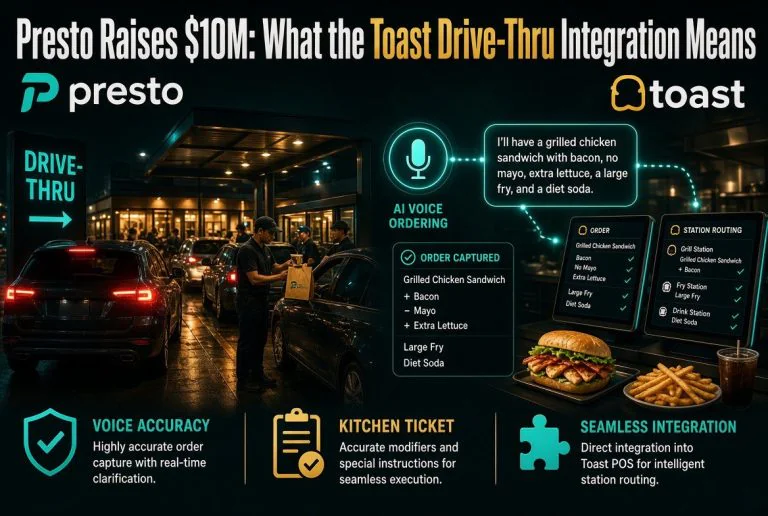
This is the same technology shift that is transforming customer engagement across the restaurant industry. Voice AI ordering systems from companies like Presto and SoundHound are handling drive-thru conversations. Toast’s AI-powered operational intelligence is surfacing margin improvement opportunities from POS data. SevenRooms Voice AI is auto-handling reservation calls.
The common thread is that generative AI has reached the reliability threshold where it can replace human effort for specific, well-defined operational tasks. Menu synchronization and listing management are textbook examples of such tasks: repetitive, rules-based, high-consequence if wrong, and low-creativity. These are precisely the tasks AI agents excel at.
What It Costs and How to Get Started
Chowly has not published exact pricing for the AI agent feature separately — it is bundled into their existing integration platform, which starts at roughly $99-199 per month depending on the feature set and number of locations. Marqii MCP pricing is structured similarly as an add-on to their existing reputation management platform.
For comparison, a basic marketing agency managing online listings for a single restaurant location costs $500-1,500 per month. An in-house staff member handling the same work costs $30,000-45,000 per year plus benefits. The AI agent approach is significantly cheaper — but it requires trust in the automation, which is understandably a hurdle for many owners.
Our recommendation: start with automated menu and hours synchronization only. Let the AI handle the repetitive, data-driven updates while you retain manual control over promotional content and strategic communications. Once you trust the system, expand to ad optimization and full-scope management.
This phased approach mirrors how leading restaurant operators have adopted AI broadly. According to recent industry data, 71% of restaurant operators now report using some form of AI in their operations, up from approximately 50% in early 2025. The adoption curve is steepening, and the tools are getting better — but the winning strategy remains starting small and proving value before scaling.
The Competitive Angle
This is not just about convenience. Restaurants with accurate, up-to-date digital presences rank higher in local search results, get more delivery orders, and receive fewer customer complaints about incorrect pricing or hours. Every inconsistency between what a customer sees online and what they encounter at your restaurant erodes trust and costs revenue.
There is also a competitive dimension that is easy to overlook. When one operator in a market adopts AI-driven digital presence management and another does not, the gap compounds over months. The AI-powered restaurant maintains fresher listings, runs more relevant ads based on real-time inventory data, and captures more off-peak traffic through automated promotional scheduling. The manual operator falls behind on all three fronts, not because their food is worse but because their digital infrastructure is worse.
For multi-location operators, the advantage multiplies. A regional group running five locations can manage all of them from a single dashboard with AI agents handling per-location updates based on each store’s POS data. What previously required a regional marketing coordinator now runs on automation with human oversight.
Drafting this post took 45 minutes. In that time, a restaurant using Chowly’s AI agents would have auto-synced its weekend brunch menu across six platforms. That is the gap the technology exists to close.
The question every independent operator should ask is not whether AI agents can handle menu updates. They can, and the technology will only get better. The real question is whether you can afford to spend another year manually updating six platforms every time you change a price, add a special, or adjust your hours. For most operators, the answer is now clear: you cannot. The margin in independent restaurants is too thin, the competition too intense, and the digital landscape too complex to leave to manual effort.
Frequently Asked Questions
Does Chowly’s AI agent work with any POS system?
Chowly integrates with most major restaurant POS systems including Toast, Square, Clover, and Micros. Check their current compatibility list for your specific setup.
Can I override what the AI agent posts?
Yes. Chowly’s system allows manual overrides for any update. The agent suggests changes based on POS data, but you approve or modify before publication. Marqii MCP requires explicit instruction for every change.
Is this better than hiring a marketing agency?
For routine updates like menu prices and hours, yes. For strategic content creation, photography, and brand voice, a human agency remains valuable. The best setup uses AI for maintenance and humans for strategy.
What platforms does Marqii MCP support?
Marqii MCP connects to Google Business Profile, Yelp, Facebook, Instagram, your website CMS, and major delivery platforms. The ChatGPT/Claude integration lets you update all of them from a single chat conversation.
Will this replace my restaurant website entirely?
No. AI agents manage content updates, not the underlying website infrastructure. You still need a website — but the content on it stays current without manual effort.

About Barak Schurr
Barak Schurr built and exited a major ticketing platform, ran global operations at Eventbrite, and now focuses on one question: which AI tools actually help independent restaurant owners run leaner and grow faster. He writes from the operator’s perspective — no vendor spin, no theory, just what’s real in 2026.
Email: [email protected]
More AI Resources