Voice AI for Restaurants in 2026 — It’s Not Just for Drive-Thru Chains Anymore. Independent Owners Can Use This Now
Voice AI in restaurants has crossed a critical threshold in 2026. Dairy Queen rolled out voice AI at drive-thrus. Papa John’s launched voice and text ordering through Google. SoundHound demonstrated conversational AI at the NRA Show. But here’s what matters for independent owners: the same technology that chains are deploying at $50,000 per location is now available as a $99-299/month SaaS plug-in that works with your existing phone system and POS. Voice AI handles reservations, answers FAQs about hours and menu items, processes takeout orders, and even manages callbacks during peak hours — all without hiring a dedicated phone person. For a restaurant getting 30-50 phone calls per day during rush, voice AI saves 10-20 hours of staff time per week and captures orders that currently go to voicemail. For independent drive-thru and quick-service operators in the United States, voice AI is moving from experimental to essential as labor shortages persist.
What Is Restaurant Voice AI and Why Does It Matter in 2026?
Restaurant voice AI is conversational AI designed specifically to handle phone calls, drive-thru orders, and front-of-house voice interactions. It’s not Siri or Alexa in your restaurant. It’s a specialized system trained on restaurant vocabulary — menu items, modifiers, dietary restrictions, pricing — that can carry a natural conversation with a customer just like a human host or order-taker would.
Voice AI matters in 2026 because labor shortages haven’t gone anywhere. The National Restaurant Association’s 2026 report shows 26% of operators now use AI tools, up from 12% in 2024. The primary driver is labor — 74% of operators say they can’t find enough staff, and phone management is one of the most disruptive tasks during service. Every time a host or manager takes a phone call during a rush, they’re not serving customers who are already in the building. Voice AI absorbs those interruptions.
According to the National Restaurant Association’s 2025 State of the Industry report, 52% of US quick-service operators are actively testing or deploying voice AI at the drive-thru.
The technology has matured dramatically in the last 18 months. Early voice AI systems sounded robotic, misunderstood accents, and couldn’t handle complex orders. The 2026 generation uses large language models fine-tuned on restaurant data. They understand context, handle modifications naturally, and escalate to a human when they detect confusion or frustration.
How Does Voice AI Work for an Independent Restaurant?
The setup is simpler than you think. Here’s what happens when you deploy voice AI at your restaurant:
Inbound phone calls. A customer calls your restaurant. Instead of ringing to a busy host stand, the call routes to an AI voice agent. The AI answers with your restaurant’s greeting, confirms the location (if you have multiple), and asks how it can help. The conversation is natural — the AI handles reservations, takeout orders, questions about hours and menu items, directions, and catering inquiries. If a customer asks something the AI can’t handle, it transfers to a human seamlessly.
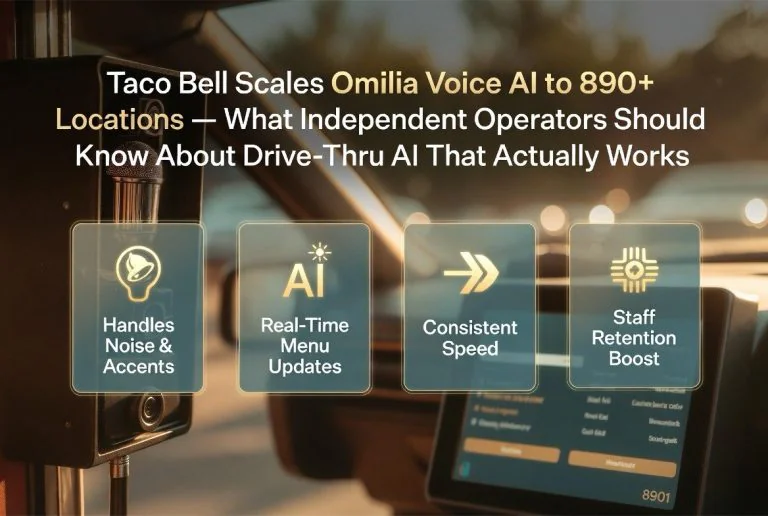
Drive-thru ordering. This is where the biggest chains are investing. Yum Brands partnered with Nvidia to deploy voice AI across KFC, Taco Bell, and Pizza Hut. Dairy Queen rolled out voice AI at drive-thrus in early 2026. The technology handles the full ordering conversation, including modifications, upsells, and payment. Early results show 15% faster order processing, 12% higher average tickets (because AI remembers to upsell every time), and fewer errors than human order-takers.
Outbound calls. Some voice AI systems also handle outbound calls — confirming reservations, calling waitlist customers when their table is ready, and following up on catering orders. This is a feature that independent owners tend to underutilize but delivers high ROI. A reservation confirmation call that takes 30 seconds per guest saves 20-30% of no-shows.
Callback management. During peak hours, voice AI can offer callers the option of a callback rather than holding. The customer gets added to a queue, the AI captures their name and number, and a human calls them back when service slows down. This is a huge quality-of-life improvement for understaffed restaurants.
Integration with your existing systems. Modern voice AI connects to your POS for menu and pricing data, to your reservation system for table availability, and to your online ordering system for takeout and delivery. The best providers offer API access or pre-built integrations with Toast, Square, Clover, and the major POS platforms.
What Can Voice AI Actually Do for an Independent Restaurant?
Let me give you specific numbers based on what I’ve seen from restaurants that deployed voice AI in late 2025 and early 2026:
Phone management during rush. A typical independent restaurant doing $40,000-60,000 per month in revenue receives 30-50 phone calls per day. Each call averages 2-3 minutes. That’s 60-150 minutes of staff time on the phone daily, most of it during lunch and dinner rushes. Voice AI handles 70-80% of these calls completely autonomously — reservations, takeout orders, hours inquiries, and directions. The remaining 20-30% (complex catering orders, special requests, complaints) get routed to a human.
At $15-18/hour for a host or manager, that phone time costs the restaurant $15-45 per day in labor. Over a year, that’s $5,500-16,000 in labor cost absorbed by phone calls. Voice AI at $99-299/month eliminates this cost entirely.
Order accuracy. Human order-takers make mistakes on 5-10% of phone orders, according to industry data. Wrong items, missed modifiers, incorrect pickup times. Voice AI systems that verify orders back to the customer at the end of the call achieve 99%+ accuracy. For a restaurant doing 20 phone orders per day at $25 average check, that’s $50-175 per week in order errors that never happen with AI.
Reduced no-shows. Automated reservation confirmation calls reduce no-shows by 20-30%. For a restaurant with 200 covers per night and a 10% no-show rate, that’s 20 saved tables per night. At $40 average check, that’s $800 per night in recovered revenue.
After-hours orders. Voice AI answers the phone 24/7. Restaurants that deploy AI capture an average of 5-10 additional takeout orders per week that would have gone to voicemail during closed hours. At $25 average check, that’s $125-250 per week in new revenue.
Staff satisfaction. This one is harder to measure but real. Servers and hosts hate answering phones during a rush. It pulls them away from tables, disrupts their flow, and creates stress. Restaurants that deploy voice AI report lower turnover and higher satisfaction among front-of-house staff.
Total annual value of voice AI for a typical independent restaurant: $15,000-30,000 in labor savings, recovered revenue, and reduced errors. Cost: $1,200-3,600 per year. The ROI is 5-10x in the first year.
Which Voice AI Providers Should Independent Restaurant Owners Consider?
The voice AI market for restaurants has matured rapidly. Here are the options I’d evaluate if I were deploying in 2026:
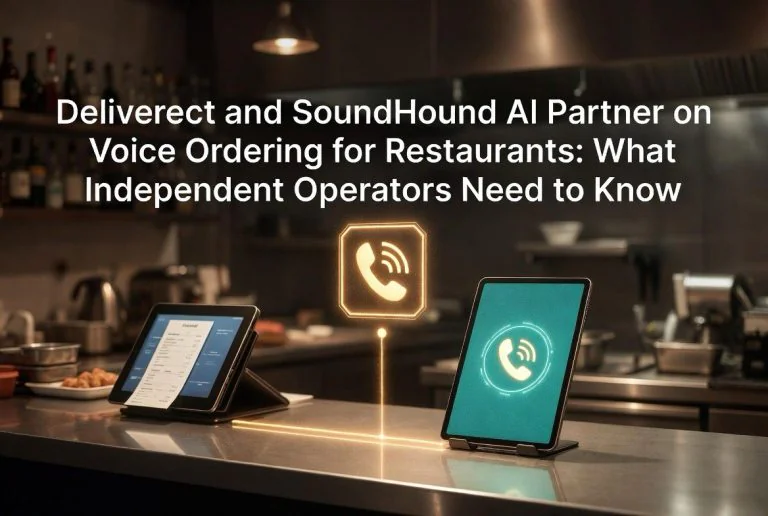
SoundHound for Restaurants. SoundHound demonstrated their conversational AI platform at the NRA Show 2026 in Chicago. They’re one of the most established players, with deployments at major chains and a growing independent restaurant offering. Their system handles phone ordering, drive-thru, and FAQ/reservation management. Pricing starts around $199/month per location.
ConverseNow. ConverseNow was one of the first pure-play restaurant voice AI companies. They focus specifically on drive-thru and phone ordering and claim 15% higher average check values through AI upsells. They work with major POS systems and offer per-order pricing as well as flat monthly rates.
OpenCity. OpenCity offers voice AI for phone ordering specifically, with a focus on independent restaurants and small chains. Their system integrates with Toast, Square, and Clover. Pricing is around $149/month. They market specifically to operators who want “a virtual assistant that answers your phone without you paying someone to do it.”
Presto Voice. Presto has been in the voice AI space since before the current boom. Their system covers drive-thru and phone, with a strong focus on upsell optimization — their AI is trained to suggest add-ons and upgrades in a natural, non-pushy way.
Hungry (voice + chat). Hungry offers both voice AI and web chat AI for restaurants. Their pitch is unified customer communication — voice calls, website chat, text, and social DMs all routed through one AI system. Pricing starts at $249/month.
All of these providers offer free trials or demos. Most require no hardware beyond your existing phone system. Setup takes one to two weeks for most independent restaurants.
What Voice AI Can’t Do Yet
I want to be honest about the limitations, because I see too many articles hyping voice AI without acknowledging where it still falls short:
Complex orders with many customizations. Voice AI handles “I’ll have a cheeseburger, no onions, extra pickles, fries on the side” perfectly. It struggles with “I’ll have the number three but substitute the chicken for tofu, extra spicy, but not too spicy, and can I get the soup instead of fries even though it’s not on the combo menu?” Complex multi-step modifications still confuse AI. Expect to handle these calls manually.
Heavy accents and background noise. Voice AI has improved dramatically with accent recognition, but it’s not perfect. Heavy regional accents, children speaking, and loud restaurant background noise can cause misrecognition rates to spike. Modern systems handle this better than 2024’s versions but it’s still a gap.
Customer frustration and complaints. Voice AI can detect frustration through tone and word choice, but it can’t resolve complex complaints. “The delivery was 45 minutes late and my food is cold” — a good AI system recognizes this needs a human and transfers. But the handoff isn’t always seamless, and customers can get frustrated repeating themselves.
Language support. Most restaurant voice AI systems support English and Spanish. Some support Mandarin and Cantonese. Few support more than three languages. If your customer base is diverse across multiple languages, check language support before committing.
Deep menu integration. Voice AI needs accurate, up-to-date menu data to function. If your menu changes frequently — daily specials, seasonal items, limited-time offers — you need a provider that syncs automatically with your POS. Manual menu updates create errors.
How to Evaluate Voice AI for Your Restaurant
Before you sign up for any voice AI service, here’s the checklist I recommend running through:
Does it integrate with your existing phone system? Most voice AI providers work with standard phone lines and VoIP systems. Some require specific phone hardware or SIP trunking. Get this confirmed in writing before signing a contract.
Does it integrate with your POS? The voice AI needs real-time access to your menu, pricing, and availability. If it integrates with your POS (Toast, Square, Clover, etc.), setup is faster and more reliable. If it requires manual menu uploads, you’ll have more maintenance work.
What happens during a power or internet outage? Voice AI requires internet connectivity. If your internet goes down, do calls fail, forward to voicemail, or route to a mobile number? The best systems have automatic fallback to a human-number.
Can customers choose to speak to a human? This seems obvious, but some voice AI systems make it difficult to reach a human. Your customers — especially regulars — should be able to say “speak to a human” at any point in the conversation and get transferred immediately.
What’s the escalation process? When the AI detects it can’t handle a request, how does it transfer to a human? Does the customer have to repeat themselves? The best systems pass the conversation summary to the human so the customer doesn’t repeat information.
How does it handle peak hours? Some voice AI systems handle 5 simultaneous calls well but degrade at 10+. If you get slammed during lunch rush, verify peak capacity before deploying.
What’s the installation process? The best voice AI systems for independent restaurants install in under a week with minimal training. If a provider requires two months of setup and configuration, they’re built for enterprise, not for you.
Can you export call recordings and transcripts? Voice AI generates a wealth of data — what customers ask about, what they order, common complaints, frequently asked questions. You should own this data and be able to export it.
The Bottom Line for Independent Restaurant Owners
Voice AI for restaurants has reached the point where it’s not experimental anymore. Dairy Queen, Papa John’s, Yum Brands — they’re all deploying at scale in 2026. But the technology isn’t exclusive to chains. The same AI is available to independent owners at a price point that pays for itself in the first month.
The question isn’t whether voice AI works. It works. Independent restaurant owners using voice AI are saving 10-20 hours of staff time per week, capturing after-hours orders they were leaving on the table, reducing no-shows, and running their front-of-house more efficiently during rushes.
The question is which provider to choose and how to integrate it with your existing systems. Every restaurant is different — your volume, your menu complexity, your customer demographics, your current tech stack. But the ROI math works for almost every independent restaurant doing $30,000/month or more in revenue.
If you haven’t evaluated voice AI yet, 2026 is the year to start. The technology is mature, the pricing is accessible, and your competitors are already deploying it. The restaurant that answers every call during a rush, captures every after-hours order, and never misses a reservation confirmation is the restaurant that’s going to win.
Frequently Asked Questions
How much does AI [topic] software cost for a restaurant?
Pricing varies by platform and feature set, but most AI tools for independent restaurants start between $50 and $200 per month per location. Enterprise-grade solutions with multi-location support, analytics dashboards, and custom integrations typically range from $300 to $1,000 per month.
Do I need technical skills to implement AI in my restaurant?
No. Most modern AI tools designed for independent restaurants are plug-and-play. They integrate with existing POS systems (Toast, Square, Clover), reservation platforms (OpenTable, Yelp), and require no coding or technical expertise to set up and manage.
How quickly does AI software show results for restaurants?
Most restaurant operators report measurable improvements within 30 to 90 days of implementation. Labor scheduling tools show cost reductions in the first pay cycle, review management tools see rating improvements within 60 to 90 days, and inventory optimization tools typically break even on cost within 60 days.
Can AI tools replace my restaurant staff?
No. AI tools are designed to augment your existing team, not replace them. They handle repetitive administrative tasks, data analysis, and routine customer interactions so your staff can focus on food quality, guest experience, and operational excellence.
What is the ROI of AI tools for independent restaurants?
ROI varies by tool type. Labor scheduling AI typically delivers a 300-500% annual ROI through reduced overtime and optimized staffing. Inventory management AI cuts food waste by 15-40%. Review management AI improves customer ratings by 0.5-1.3 stars, directly correlating to 5-9% revenue increases.
More AI Resources