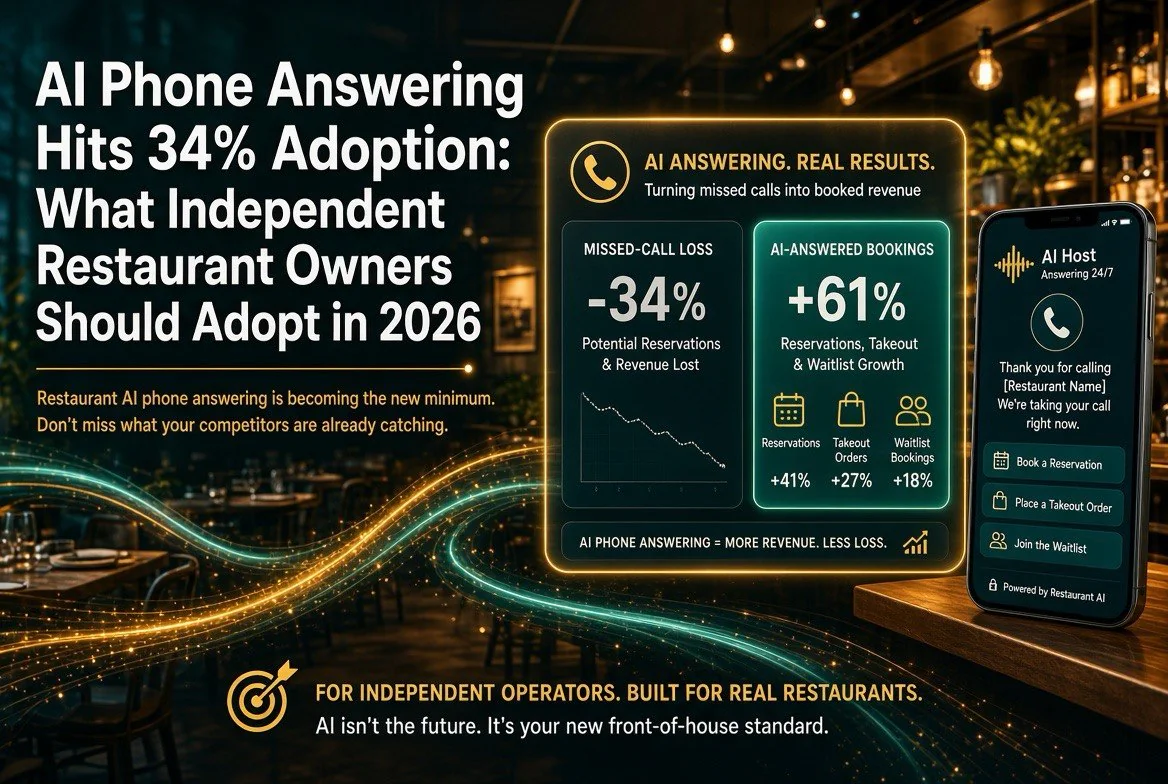
AI Phone Answering Hits 34% Adoption: What Independent Restaurant Owners Should Adopt in 2026
⚡ Expert Summary: Around one in three US restaurants now uses some form of AI to handle guest communications — the widely cited figure is roughly 34% for AI phone/voice answering, with independents and small chains adopting faster than big brands because the ROI is easier to isolate. For the independent American owner, this is the rare AI investment that pays for itself by recovering missed calls: industry estimates put the revenue leak of unanswered calls in the tens of thousands of dollars per location per year. The winning 2026 playbook isn’t full automation — it’s AI answering the volume and a trained human handling the exceptions.
Here’s a number every US restaurant owner should sit with for a second: about one in three restaurants is already using AI to handle phone calls, reservations, and guest communications. The exact figure that keeps showing up across 2025-2026 industry analysis is roughly 34% for voice-AI adoption in phone handling — and the more surprising part isn’t the number itself, it’s who’s driving it. It’s not the mega-chains. It’s independents and small chains, moving faster than the big brands because the payoff is easier to measure: every call the AI answers is a reservation, to-go order, or inquiry you weren’t losing.
If you’ve been treating AI phone answering as a gimmick or something “the big guys do,” the 2026 data argues otherwise. Let’s look at what the numbers actually say, where the real adoption is happening, and — most importantly — what a single-unit owner should actually deploy this year.
Where the 34% Figure Comes From
The 34% figure is cited across multiple vendor reports and industry analyses as the share of restaurants using AI voice tools for guest communications such as phone orders, reservations, and inquiries. It sits alongside more conservative official benchmarks — the National Restaurant Association’s State of the Restaurant Industry 2026 report (released February 2026) found 26% of operators using AI-related tools in some form, but only about 6% using AI specifically to take customer orders. The gap between those numbers tells the real story: AI has crossed into the back office — forecasting, scheduling, marketing, admin — far faster than it has reached the guest-facing phone line.
That gap is exactly why phone answering is still an early-mover advantage for independents rather than table stakes. The operators deploying a phone agent now are gathering data and refining the experience while most of the industry is still watching. By the time everyone does it, the differentiation is gone.
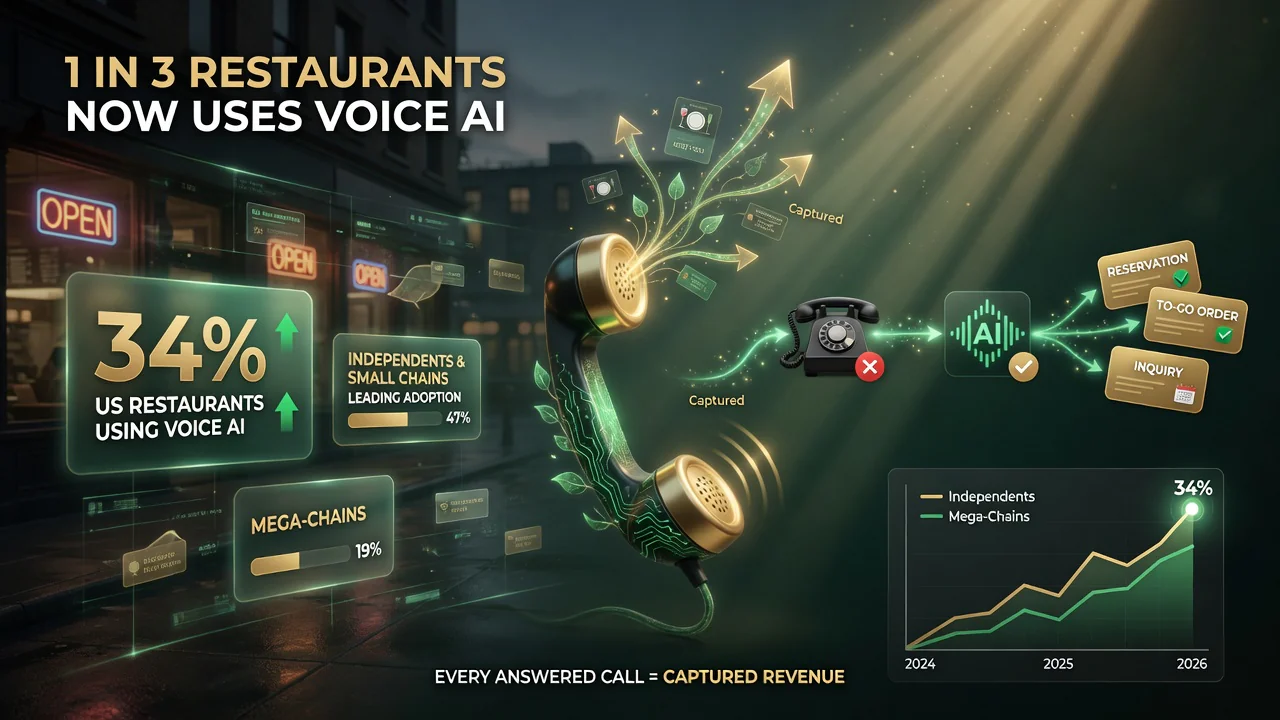
About one in three US restaurants now uses AI voice for phone calls, with independents and small chains adopting faster than mega-chains because every answered call is a captured reservation, to-go order or inquiry.
Why Phone Answering Is the Smartest First AI Investment
Across the US restaurant market, AI voice tools are showing up in three places: the drive-thru lane, inbound phone orders, and reservations. The most underrated — and the most relevant to an independent — is the phone. Here’s why the phone wins on ROI.
| Channel | Missed Call Cost | Deployment for Independents | First AI Pick? |
|---|---|---|---|
| Phone (orders + reservations) | Very high — every call can be a ticket | Fast — enable on a platform you use | ✔ Yes — easiest ROI to isolate |
| Drive-thru lane | High volume, but needs a lane | Slower — equipment + integration | Only if you have a drive-thru |
| Reservations only | Medium — depends on walk-in mix | Fast — booking platform add-on | Good if reservations drive traffic |
| Back office (scheduling, inventory) | Indirect — saves staff hours | Fast, but not guest-facing | Good second move, not first |
The reason independents are adopting phone agents faster than drive-thru AI is simple: deployment is quicker and the return on investment is easier to isolate. Every missed call is a lost ticket, and a voice agent that answers every time pays for itself in recovered orders. And the major POS vendors have noticed — both Toast and Square for Restaurants launched native AI phone-ordering features in 2025 and 2026, putting the capability within reach of a single-unit operator rather than just a national chain. Today, an independent can switch on phone answering without any drive-thru infrastructure.
The Revenue Leak You’re Ignoring Right Now
Let’s be concrete about what missed calls actually cost. Industry calculations around AI phone answering regularly point to the same problem: restaurants can miss anywhere from roughly 24% to over 40% of inbound calls during peak windows. When you’re in the weeds on a Saturday night and the phone rings off the hook, calls go to voicemail — and most diners don’t leave a message, they just call the next place on Google.
Vendor analyses have pushed this to a dollar figure that’s hard to ignore. One commonly cited estimate pegs the annual revenue leak from missed calls at $73,000+ per QSR (quick-service restaurant) location. Even if your numbers are half that, it’s a sum of money leaving through the phone line every year — and it’s recoverable with a tool that simply answers when you can’t.
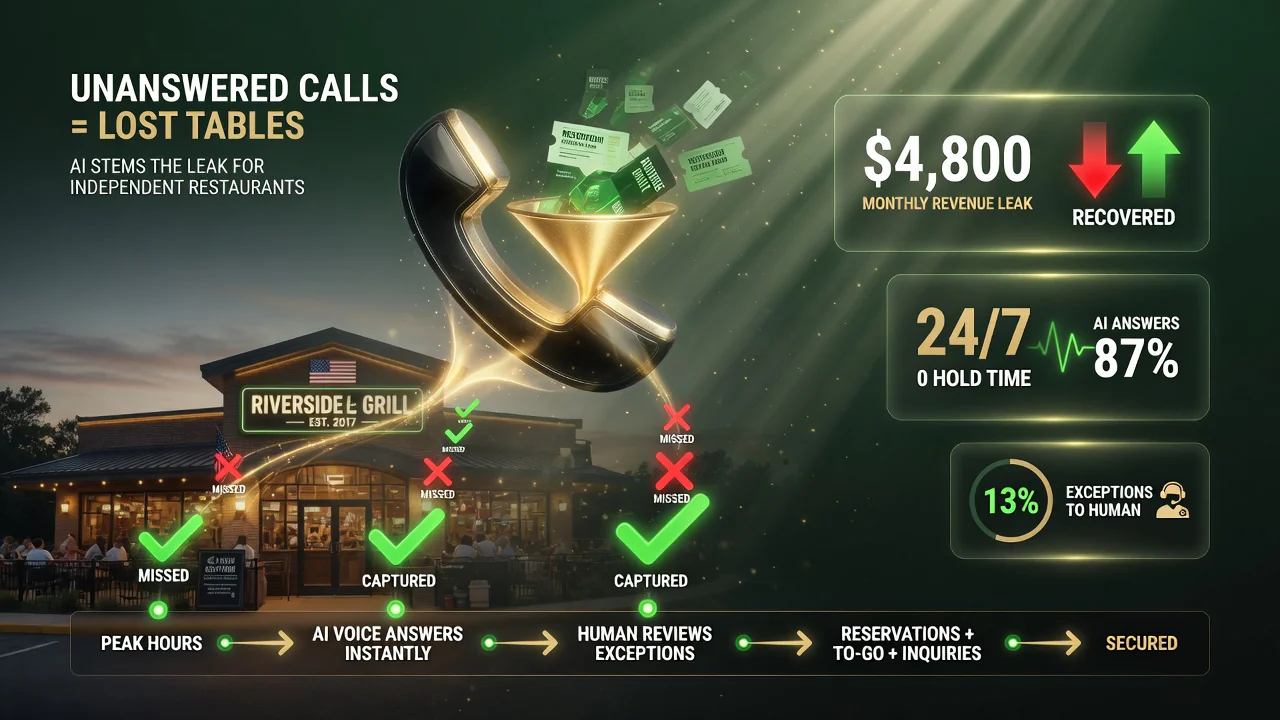
For an independent owner, phone answering pays for itself by recovering missed calls — AI answers the volume 24/7 with no hold time and a trained human handles the exceptions.
| Cost Factor | With Human + Voicemail (Status Quo) | With AI Phone Agent |
|---|---|---|
| Peak-hour missed calls | 24-40%+ go unanswered | Answered 24/7, near-zero missed |
| Revenue leaked per location/year | Tens of thousands (up to $73k+ by some estimates) | Recovered from the calls you save |
| Staff phone time at peak | Hosts pulled away from tables | Staff stay on the floor; AI handles calls |
| Accuracy | Human error under pressure | ~95% with a human in the loop |
The Accuracy Reality: Why AI + Human Beats Full Automation
Here’s where it pays to be skeptical of the hype — and where the 2026 data gets genuinely useful. Industry testing shows AI-powered drive-thru orders averaging around 83% accuracy, compared with about 87% for standard human-taken orders. That four-point gap matters: a wrong order means a remake, a refund, and a guest who doesn’t come back.
But the encouraging finding is what happens with a human in the loop. When staff step in to support the AI, accuracy climbs to roughly 95%. Today about 21% of AI-assisted drive-thru orders still require employee intervention, with menu customizations and noisy real-world lane conditions being the toughest cases. The takeaway for operators is that the winning model in 2026 is not full automation — it’s AI plus a trained team member, where the machine handles volume and the human handles the exceptions.
What Independents Should Actually Deploy in 2026
If you’re an independent US restaurant owner deciding where to spend this year, here’s a practical decision framework — not a vendor pitch.
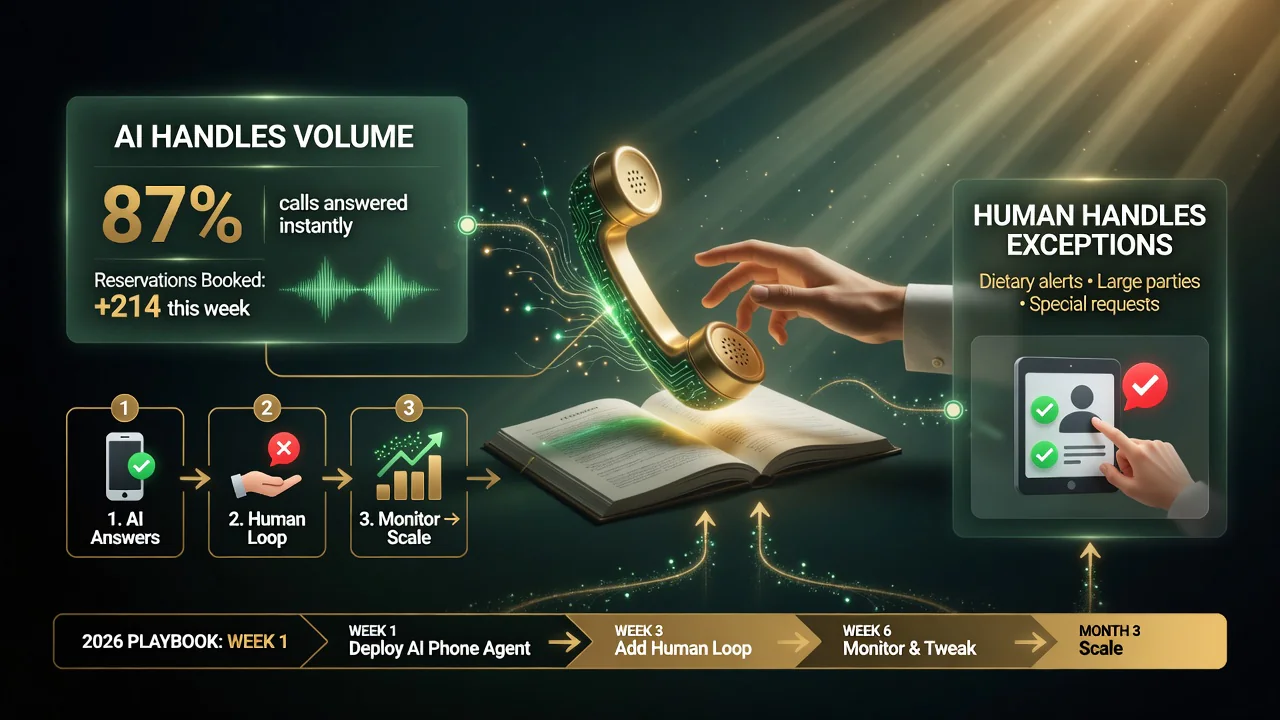
The winning 2026 playbook isn’t full automation — it’s AI answering the volume with a trained human handling the exceptions, deployed in a few monitored steps then scaled.
| Your Situation | Recommended First AI Tool | Why |
|---|---|---|
| Phone rings unanswered at peak | AI phone-answering agent | Fastest, lowest-risk win; recovers missed calls with zero new infrastructure. |
| High to-go / takeout volume | Phone agent that captures order details | Catches the takeout calls you lose during service and routes them correctly. |
| You have a drive-thru | Pilot AI ordering in 1-2 lanes | Measure accuracy and remake rates vs. your human baseline before scaling. |
| Mostly walk-in, thin margins | Start with booking + FAQ answering | Lowest commitment; protects the calls you do get without over-building. |
Start with the channel where you’re leaking revenue. If your phone goes unanswered during peak hours, a voice agent is a faster, lower-risk win than overhauling the drive-thru. If you run high-volume lanes, pilot in one or two locations, measure accuracy and remake rates against your human baseline, and design the workflow so a team member can step in instantly.
How to Roll It Out Without Making It a Headache
- Treat the first quarter as data collection, not a labor-replacement project. You’re not cutting staff — you’re recovering calls and freeing the host to host.
- Measure missed calls before and after. Count unanswered calls in your two peak hours per week. The tool’s whole job is to move that toward zero.
- Track booking and order completion. Of the calls the AI answers, how many become reservations or orders? That’s your recovered revenue.
- Keep a trained human for exceptions. Accuracy jumps to ~95% when staff can step in. Menu customizations and unusual requests are the edge cases to watch.
- Protect the guest experience. The operators winning in 2026 pair the tech with people, watch the numbers, and put the guest above the automation.
Diners are more ready than you might think. A June 2026 PAR survey found 62% of US diners say they’d order through an AI voice assistant or LLM under the right conditions. The willingness is already there — the gap is operators who haven’t switched on the phone line yet. For more on the specific tools, our restaurant AI coverage digs into the vendors behind this shift.
The Bottom Line for Independent Restaurant Owners
AI phone answering isn’t a futuristic story anymore — roughly one in three restaurants is already using it to handle guest calls, and independents are leading because the ROI is so easy to see in your own numbers. You don’t need a drive-thru, a big IT budget, or a technical team. You need a tool that answers the calls you’re losing at peak, books the seats, captures the to-go orders, and hands your staff back their time.
The 2026 playbook is clear: AI handles the volume, a trained human handles the exceptions, and you measure the missed-call number. Start with the phone — it’s the fastest place for an independent American restaurant to recover real money this year. If you want to see how Yelp is making this easy on a platform you already use, we just covered it here.
Frequently Asked Questions
What does “34% adoption” for AI phone answering actually mean?
It’s the share of restaurants — roughly one in three — using some form of AI to handle guest communications like phone orders, reservations, and inquiries. The figure is cited across multiple 2025-2026 vendor reports and industry analyses, and it’s higher than official benchmarks for order-taking AI (about 6% per the National Restaurant Association’s 2026 report), because phone handling has spread faster than fully automated order-taking.
Is AI phone answering worth it for a single restaurant?
For most independents, yes — it’s often the best first AI investment because the ROI is easy to isolate. Missed calls at peak are direct lost revenue, and a phone agent that answers every time recovers those calls. Vendors estimate the annual leak from unanswered calls can reach tens of thousands of dollars per location (some estimates say $73k+ per QSR).
Does AI phone answering replace my staff?
Not in the winning model. The 2026 data shows accuracy climbs to roughly 95% when a trained human steps in to support the AI, versus 83% for AI alone. The best setup is AI handling routine volume and calls while staff manage exceptions — it frees the host to host rather than cutting jobs.
Which tools should an independent restaurant use?
Start with a phone-answering agent you can enable on a platform you already use. Both Toast and Square for Restaurants launched native AI phone-ordering features (2025-2026), and Yelp added AI Host and Receptionist voice tools. Choose the one inside the POS or review platform you already run to minimize setup friction.
Are diners actually comfortable with AI answering?
Yes, increasingly. A June 2026 PAR survey found 62% of US diners say they’d order through an AI voice assistant or LLM under the right conditions. The demand is already there — the gap is mostly operators who haven’t switched it on.

About Barak Schurr
Barak Schurr built and exited a major ticketing platform, ran global operations at Eventbrite, and now focuses on one question: which AI tools actually help independent restaurant owners run leaner and grow faster. He writes from the operator’s perspective — no vendor spin, no theory, just what’s real in 2026.
Email: [email protected]
More Resources for Restaurant Operators