Get the AI Restaurant Quick-Start Guide — Free
The 5 AI tools independent US restaurant owners are using right now to cut labor costs and answer every call.
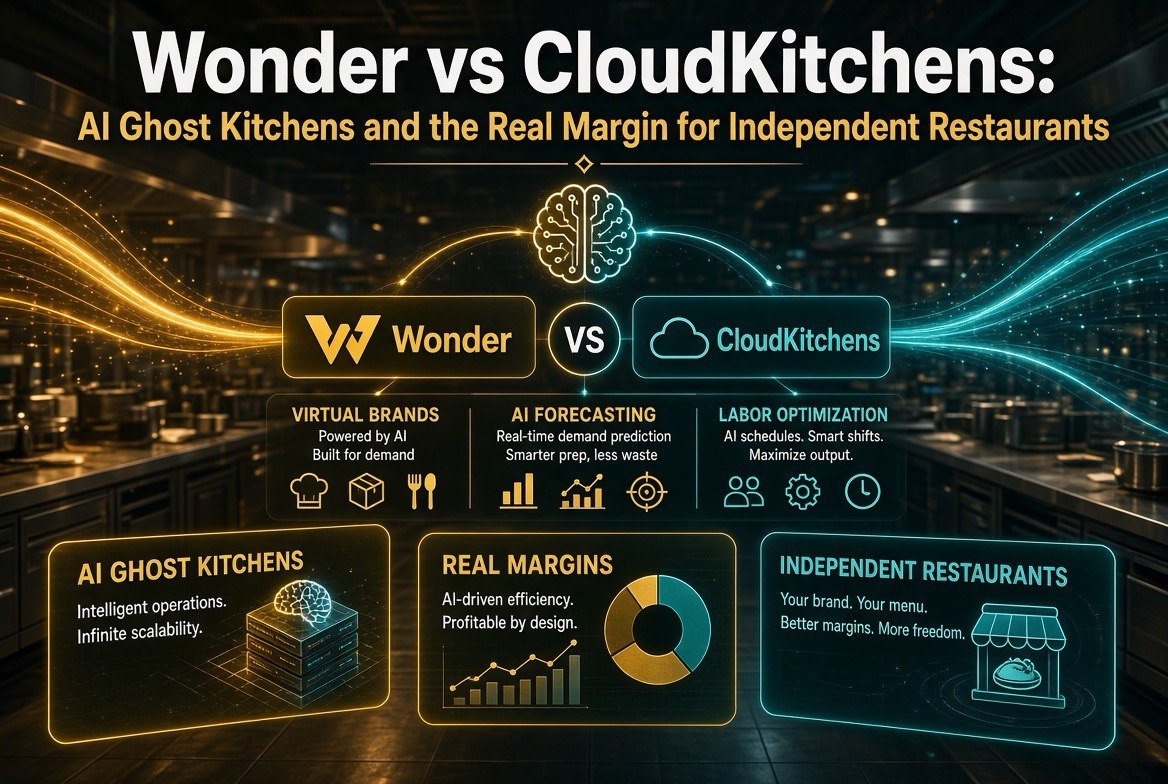
Wonder vs CloudKitchens: AI Ghost Kitchens and the Real Margin for Independent Restaurants
⚡ Expert Summary: Wonder and CloudKitchens are scaling AI-driven ghost kitchens, but the economics rarely favor a small independent operator. Wonder runs delivery-only virtual brands at scale; CloudKitchens licenses kitchen space plus software, including AI order and prep tools. Before committing rent, delivery fees, and AI software costs, an independent operator needs the real per-order math — which this guide breaks down with concrete numbers.
Wonder is one of the most recognizable names in the ghost kitchen space. Founded by Marc Lore (who built Jet.com and spent years inside Walmart’s e-commerce engine), Wonder raised hundreds of millions in 2025 and 2026 to build a delivery-native food business. CloudKitchens, backed by Travis Kalanick of Uber fame, took a different route: it rents optimized kitchen space to delivery brands and sells software that helps them run it.
Both lean hard on AI now. Wonder uses forecasting models to predict what it should prep and how many drivers it needs. CloudKitchens sells AI order-ahead, prep-scheduling, and kitchen-management tools to the operators who rent its space. If you run an independent restaurant in the United States and a sales rep from either platform knocks on your door, you need to know what you are actually signing up for.
This guide answers the question most owners actually ask: can an independent restaurant make money in an AI ghost kitchen? The honest answer is that it depends on your menu, your delivery mix, and your existing kitchen capacity — but the default assumptions most operators bring in are wrong.
What Wonder Actually Is in 2026
Wonder is not a single restaurant brand. It is a delivery-first food company running multiple virtual brands out of shared kitchens. You order from a phone first, and Wonder cooks when demand forecasts say to. Its AI stack predicts orders by neighborhood, time of day, weather, and local event calendars, then instructs each kitchen on prep volume and staffing.
For an independent operator, the relevant question is whether joining Wonder’s network — or copying its model — makes sense. Wonder’s model works at scale because it can pool demand across dozens of virtual brands under one roof. A single independent restaurant does not have that pool. If you launch one virtual brand with one kitchen, the forecasting engine has far less data to work with, so the margin math changes.
Wonder’s public metrics in 2025 and 2026 centered on order velocity and kitchen utilization rather than net profit per kitchen. That is a signal. Utilization is a volume metric; net margin is the one that pays your rent. When a platform celebrates utilization, it usually means the per-order margin is thin and the business relies on high throughput to stay in the black.
What CloudKitchens Actually Sells You
CloudKitchens is the landlord plus the software vendor. You rent a fitted kitchen, bring your menu, and use its platform to receive delivery orders from Uber Eats, DoorDash, and its own ordering funnel. On top of rent, you pay for its software, which now includes AI-assisted features like order-ahead prediction, prep scheduling, and labor forecasting.
The appeal is speed and leverage. You do not build a front-of-house, you do not handle dine-in, and the software is designed to route delivery orders efficiently so a small team can run multiple order streams. The catch is that you trade your front-of-house margin for delivery-platform fees and CloudKitchens’ own cut.
For a restaurant owner used to a 5-8% net margin on dine-in, an AI ghost kitchen changes the cost structure dramatically. You lose dine-in traffic and its margins, you pay higher per-order fees than one delivery app alone, and you now carry software subscription costs on top of rent. The AI software is additive, not transformative, unless you already have the volume to feed it.
The Per-Order Economics: Where the Margin Actually Goes
Let’s build the real math for an independent ghost-kitchen order. Use your own numbers, but here’s a realistic baseline for a US delivery order in 2026.
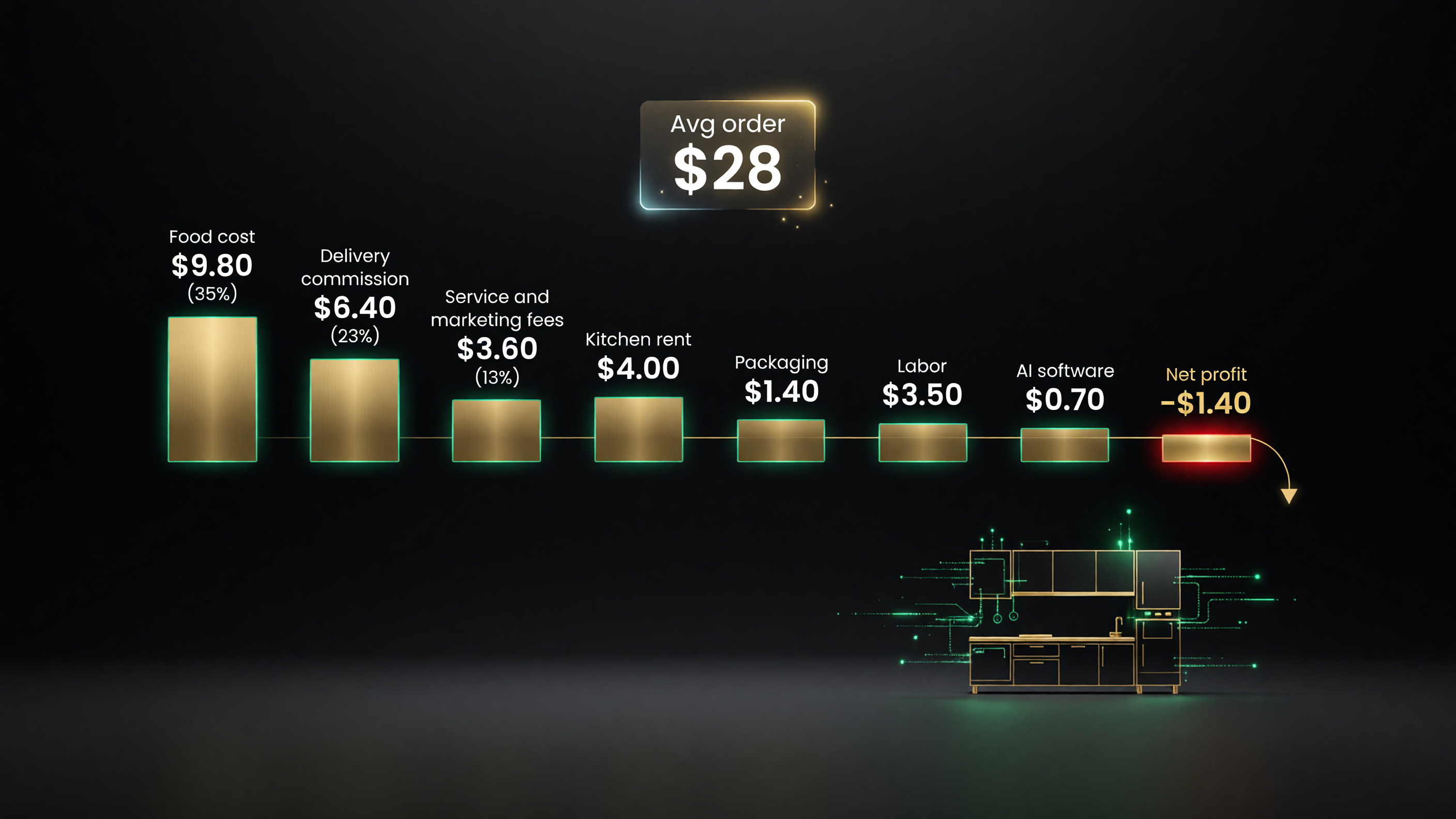
How a $28 delivery order becomes -$1.40: the seven cost lines that eat the margin before volume efficiencies kick in.
| Cost Line | Typical Value | Notes |
|---|---|---|
| Average order value | $28 | Delivery orders tend to run bigger than dine-in tickets |
| Food cost | $9.80 (35%) | Ghost kitchens still pay real ingredient costs |
| Delivery platform commission | $6.40 (23%) | Uber Eats/DoorDash bundle rates |
| Delivery platform service + marketing fees | $3.60 (13%) | Service and marketing add-ons stack |
| Kitchen rent (allocated) | $4.00 | Ghost kitchen rent or your own allocation |
| Packaging | $1.40 | Delivery-grade packaging costs more |
| Labor (allocated per order) | $3.50 | Prep and packing time |
| AI software subscription | $0.70 | Amortized monthly software fee |
| Estimated profit per order | -$1.40 | Negative until volume drives efficiency |
Run that on 50 orders a day and you lose about $70 a day before you even think about fixed overhead. The AI software does not fix this. What the AI can do is shrink the labor line by predicting prep volume more accurately, and shrink food cost by cutting waste — but those are single-digit percentage improvements on lines that are not the main cost driver. The main cost driver is the stack of delivery fees plus rent for a high-throughput preparation space.
How the AI Software Changes the Numbers
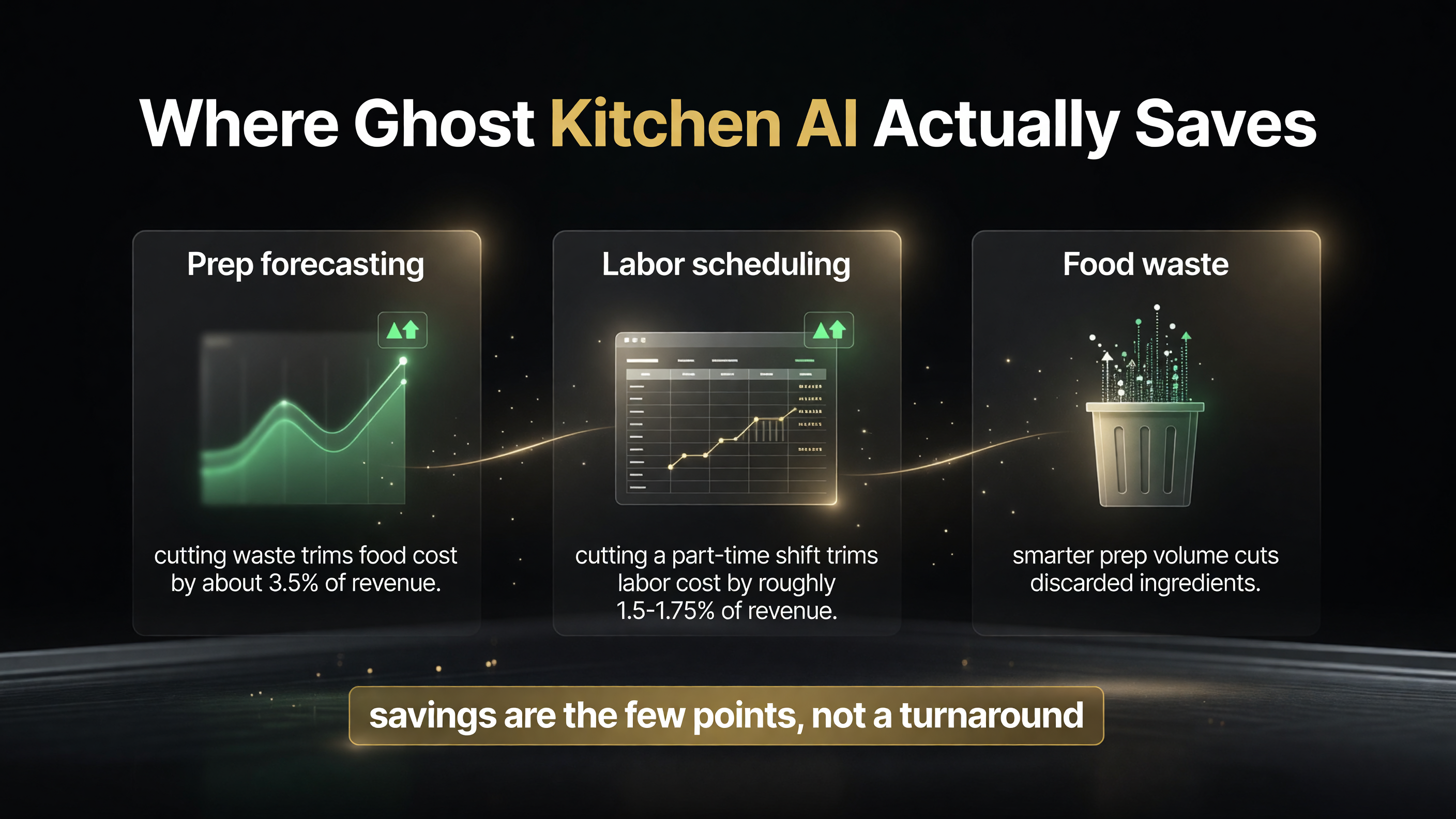
Caption: The three saving levers AI actually delivers: prep forecasting trims food cost ~3.5% of revenue, labor scheduling trims ~1.5-1.75%, and smarter prep cuts waste. Valuable but bounded — not a turnaround by themselves.
The AI sells on three promises: better prep forecasting, lower food waste, and tighter labor scheduling. Each is real, but each is bounded.
Prep forecasting. Wonder’s engine predicts order volume by neighborhood and time. For an independent operator, the same logic can tell you to prep 40 wings on a rainy Friday instead of 25. The savings come from less discarded food and fewer empty-cook times. On a 35% food cost, cutting waste by 10 points of that cost line saves you roughly 3.5% of revenue. That is meaningful but not a turnaround.
Labor scheduling. If the AI tells you staffing needs by shift based on predicted orders, you can trim a part-time shift on slow days. In a business where labor runs 28-35% of revenue in the United States, cutting even 5% of that line saves roughly 1.5% to 1.75% of revenue. Again, useful, but you have to weigh the software subscription against the saving.
The uncomfortable truth is that the AI’s biggest wins need volume. A forecasting model improves with data, and your kitchen starts cold. Expect the first 60-90 days to be a period of tuning, not instant optimization. Budget for it.
What an Independent Operator Should Actually Do
If you are not already at a delivery volume that justifies a dedicated ghost kitchen, do not sign a lease with a fixed monthly rent for one. The smarter path is to test demand first — for a deeper look at how AI is reshaping independent kitchen operations, browse the AI for Restaurants guide hub:
- Launch one virtual brand out of your existing kitchen during off-peak hours.
- Cap delivery platform spend by setting a marketing budget per order you can actually absorb.
- Track per-order profit by channel weekly — not monthly, not quarterly.
- Add AI forecasting only once you have 8-12 weeks of clean order data to feed it.
- Reconsider a dedicated ghost kitchen only if your virtual brand clears a true profit target for 4 consecutive weeks.
This sequence keeps your downside small. You have not locked into rent or a long software contract before proving the demand exists. This is the approach that protects an independent operator from the volume-based economics that favor the Wonder and CloudKitchens models, which are built for scale, not for a single location finding its footing.
Wonder vs CloudKitchens: Which Model Suits You?
The two companies are not interchangeable for an independent operator.
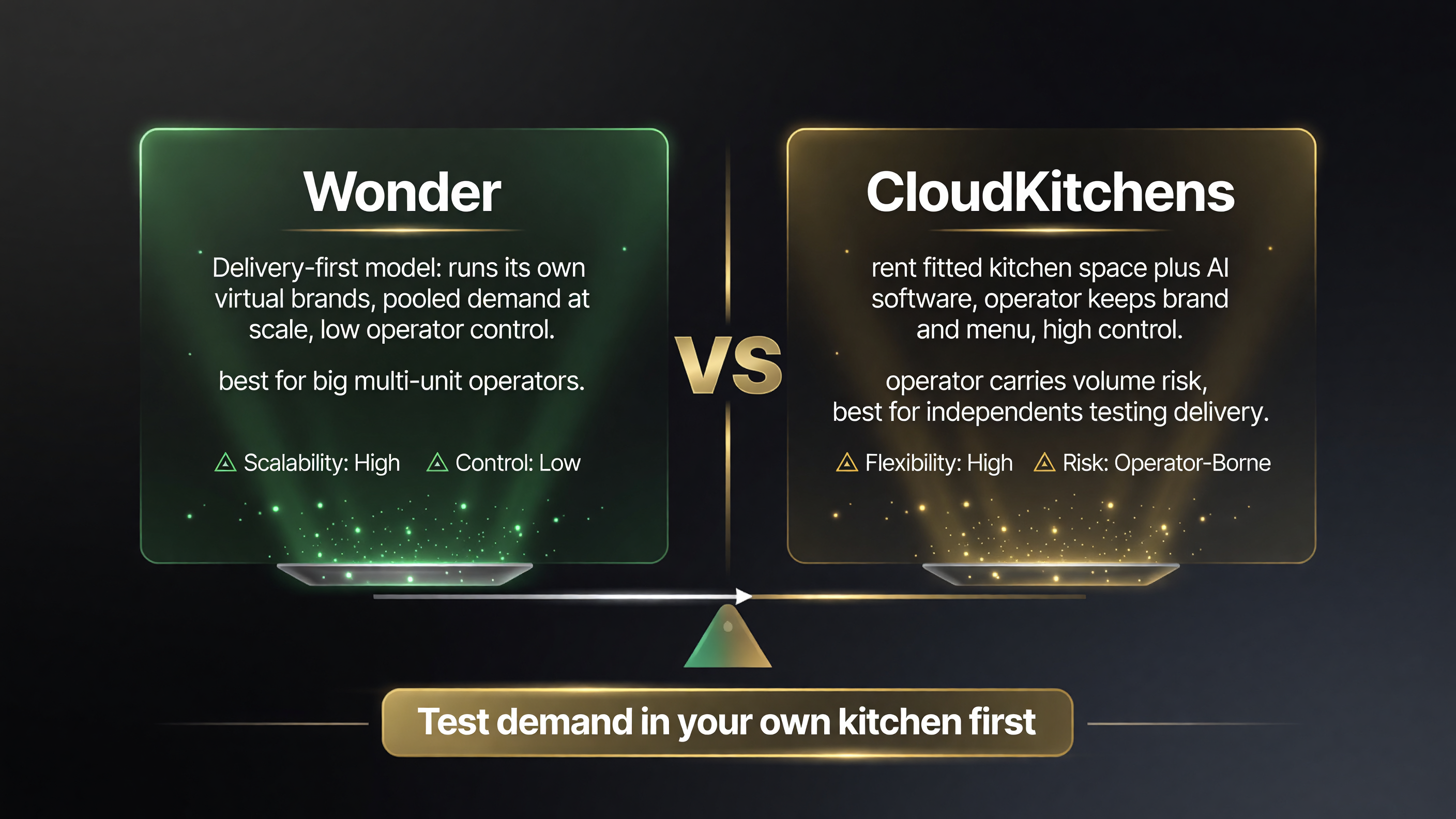
Wonder wins at pooled scale with low operator control; CloudKitchens gives you control but leaves the volume risk with you.
| Factor | Wonder | CloudKitchens |
|---|---|---|
| Model | Runs its own delivery brands | Rents space + sells software |
| Operator’s role | Join its network / supply chain | You keep your brand and menu |
| Control | Low | High |
| Margin leverage | Best at scale, pooled demand | You carry the volume risk |
| Best for | Big operators, multi-brand | Independent wanting a testbed |
If you want to keep your brand and your menu and test delivery with a fitted kitchen, CloudKitchens’ rent-and-software model is the more realistic entry point. If you are an established multi-unit operator with marketing reach, Wonder’s network can pool demand in ways a single brand cannot. For a true independent with one location, neither is a slam dunk — and the smart play is to validate demand in your own kitchen before either one.
The Bottom Line for Independent Restaurants
AI ghost kitchens are real, and the software genuinely does cut waste and labor waste — but only once you have the volume to feed the models. Wonder wins at scale; CloudKitchens gives you more control at the cost of carrying the risk yourself. For an independent restaurant in the US, the highest-ROI move is almost always testing a virtual brand in your existing kitchen first, tracking per-order profit by channel, and only committing to a dedicated ghost kitchen lease once the numbers prove out for a month straight.
FAQ
Is a ghost kitchen cheaper than running a restaurant?
Not automatically. You avoid front-of-house labor and dine-in space, but you add delivery platform fees and often a dedicated kitchen lease. For many independents the per-order cost is comparable or worse until volume is high.
Can an independent restaurant make money in an AI ghost kitchen?
Yes, if demand is proven first. The profitable path is testing a virtual brand in your existing kitchen, tracking per-order profit by channel, and only committing to a dedicated ghost kitchen lease after 4 consecutive profitable weeks.
Does Wonder work with independent restaurants?
Wonder primarily runs its own delivery brands and supply chain. It is built for scale and pooled demand across many virtual brands, which makes it a better fit for multi-unit operators than a single independent location.
What does CloudKitchens charge?
Costs vary by market and kitchen, but you typically pay monthly rent for the fitted kitchen space plus a software subscription. Delivery platform commissions from Uber Eats, DoorDash, and others stack on top of those fees.
What does the AI in a ghost kitchen actually do?
It forecasts order volume by neighborhood and time, schedules prep and labor around those predictions, and adjusts prep volume to cut food waste. The savings are real but bounded — typically a few points of revenue, not a turnaround by themselves.
Is a ghost kitchen cheaper than running a restaurant?
Not automatically. You avoid front-of-house labor and dine-in space, but you add delivery platform fees and often a dedicated kitchen lease. For many independents the per-order cost is comparable or worse until volume is high.
Can an independent restaurant make money in an AI ghost kitchen?
Yes, if demand is proven first. The profitable path is testing a virtual brand in your existing kitchen, tracking per-order profit by channel, and only committing to a dedicated ghost kitchen lease after 4 consecutive profitable weeks.
Does Wonder work with independent restaurants?
Wonder primarily runs its own delivery brands and supply chain. It is built for scale and pooled demand across many virtual brands, which makes it a better fit for multi-unit operators than a single independent location.
What does CloudKitchens charge?
Costs vary by market and kitchen, but you typically pay monthly rent for the fitted kitchen space plus a software subscription. Delivery platform commissions from Uber Eats, DoorDash, and others stack on top of those fees.
What does the AI in a ghost kitchen actually do?
It forecasts order volume by neighborhood and time, schedules prep and labor around those predictions, and adjusts prep volume to cut food waste. The savings are real but bounded — typically a few points of revenue, not a turnaround by themselves.

About Barak Schurr
Barak Schurr built and exited a major ticketing platform, ran global operations at Eventbrite, and now focuses on one question: which AI tools actually help independent restaurant owners run leaner and grow faster. He writes from the operator’s perspective — no vendor spin, no theory, just what’s real in 2026.
Email: [email protected]
More Resources for Restaurant Operators