Get the AI Restaurant Quick-Start Guide — Free
The 5 AI tools independent US restaurant owners are using right now to cut labor costs and answer every call.
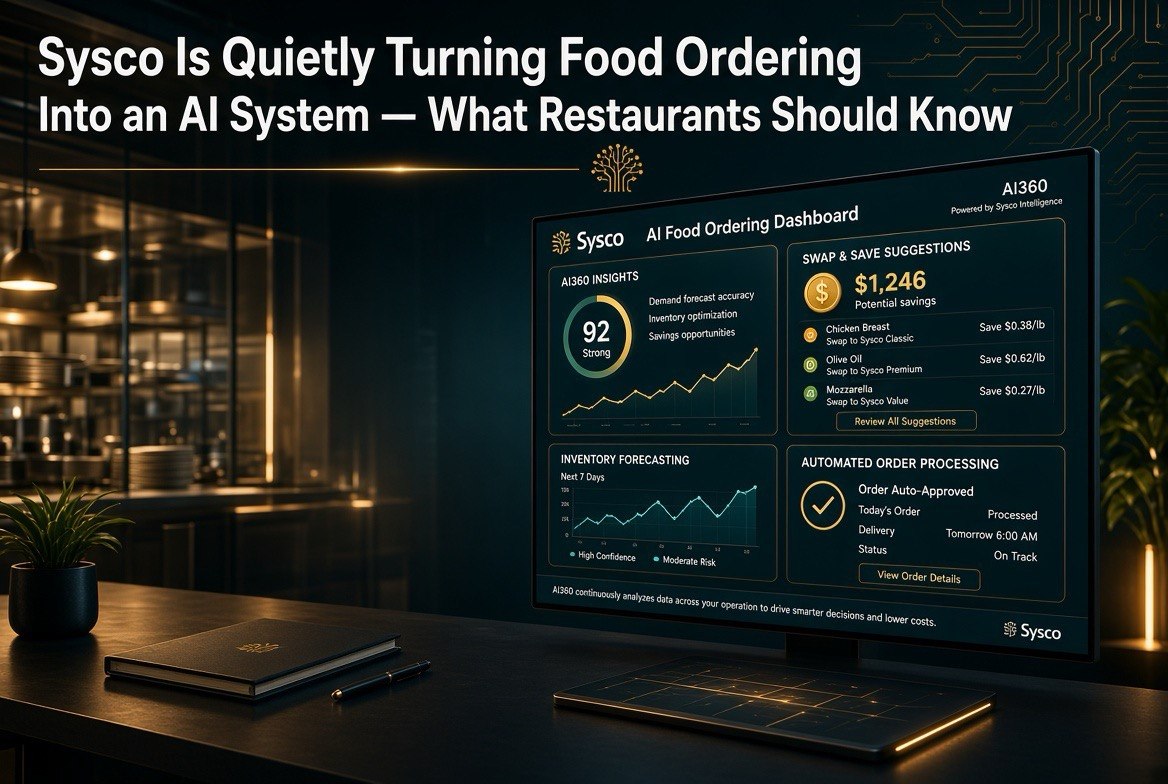
Sysco Is Quietly Turning Your Food Ordering Into an AI System — Here’s What It Means
⚡ Expert Summary: Sysco — the distributor behind a huge share of US restaurant kitchens — is embedding AI across its entire business, from the sales rep who calls on you to the ordering platform and warehouse behind it. Its AI360 sales tool now runs on 90-95% of Sysco reps, its SAGE agentic AI platform won a 2026 Newsweek award, and Sysco ties AI to roughly $100 million in fiscal 2027 productivity gains. For an independent operator, this changes how you buy food, catch price increases, and cut waste — whether you notice it or not.
You probably don’t think of Sysco as an AI company. You think of it as the delivery truck showing up at your back door at 6 a.m., the sales rep who knows your cooler, the company that supplies a staggering share of the food America’s restaurants cook. And that’s fair — that’s the Sysco you touch every week.
But underneath the trucks, Sysco has spent the past two years turning itself into something else: one of the biggest AI deployments in the foodservice industry. And because Sysco sits in the ordering pipeline of hundreds of thousands of independent restaurants, that shift reaches your kitchen whether you asked for it or not.
What Sysco Is Actually Doing With AI
Sysco’s AI push runs across four fronts, and it’s worth knowing each one because they affect you differently.
1. AI in the sales rep’s pocket
Sysco’s AI360 platform is the most visible piece. It’s used by an estimated 90-95% of Sysco’s sales consultants — the reps who call on restaurant operators every week. AI360 analyzes your order history, spots seasonality patterns, and gives the rep data-driven prompts: which products you’re likely to run low on soon, what cost-saving substitutions are available, and where your spend is creeping up.
One of the most useful features for independents is “Swap and Save.” The system flags products where a lower-cost equivalent can do the same job — a way to ease food-cost pressure without changing the plate. In a margin business, a tool that quietly finds substitution savings in your weekly order is real money.
2. Smarter, agentic AI behind the whole company
Beyond the sales reps, Sysco built an internal agentic AI platform it calls SAGE (Sysco Agentic Ecosystem). “Agentic” is the key word — that means AI that doesn’t just recommend but actually completes tasks across workflows. SAGE touches sales enablement, customer e-commerce, forecasting, inventory optimization, and back-office automation. In May 2026, Sysco won a Newsweek AI Impact Award (AI Brand & Retail, Best Outcomes) for SAGE.
What that means for you: your digital ordering experience gets smarter product discovery, and Sysco’s forecasting gets better at having the right product in the warehouse when you need it — which translates into fewer out-of-stocks on the items you actually cook with.
3. Automating the order itself
A lot of Sysco’s early AI work was unglamorous but measurable: automating inbound orders, including converting faxed and emailed orders to digital using document-reading AI. That removed manual data entry, cut errors, and reduced the overtime tied to re-keying orders. It’s the kind of efficiency that doesn’t make headlines but quietly keeps your order accuracy high and your delivery on time.
4. Food-cost and inventory intelligence
Sysco is also weaving AI into forecasting and inventory, and integrating with restaurant tech platforms for things like real-time inventory tracking. For an independent owner, the practical upside is better allocation: the system learns what a region’s restaurants actually order and keeps those products flowing, rather than guessing.
Why This Matters Even If You Don’t “Use” Sysco AI
Here’s the part owners miss. You might never log into an AI dashboard. But if you order from Sysco, you’re already inside the system. The AI affects which products get suggested to you, how your order history influences pricing and substitutions, and whether the items you need are on the truck Thursday morning.
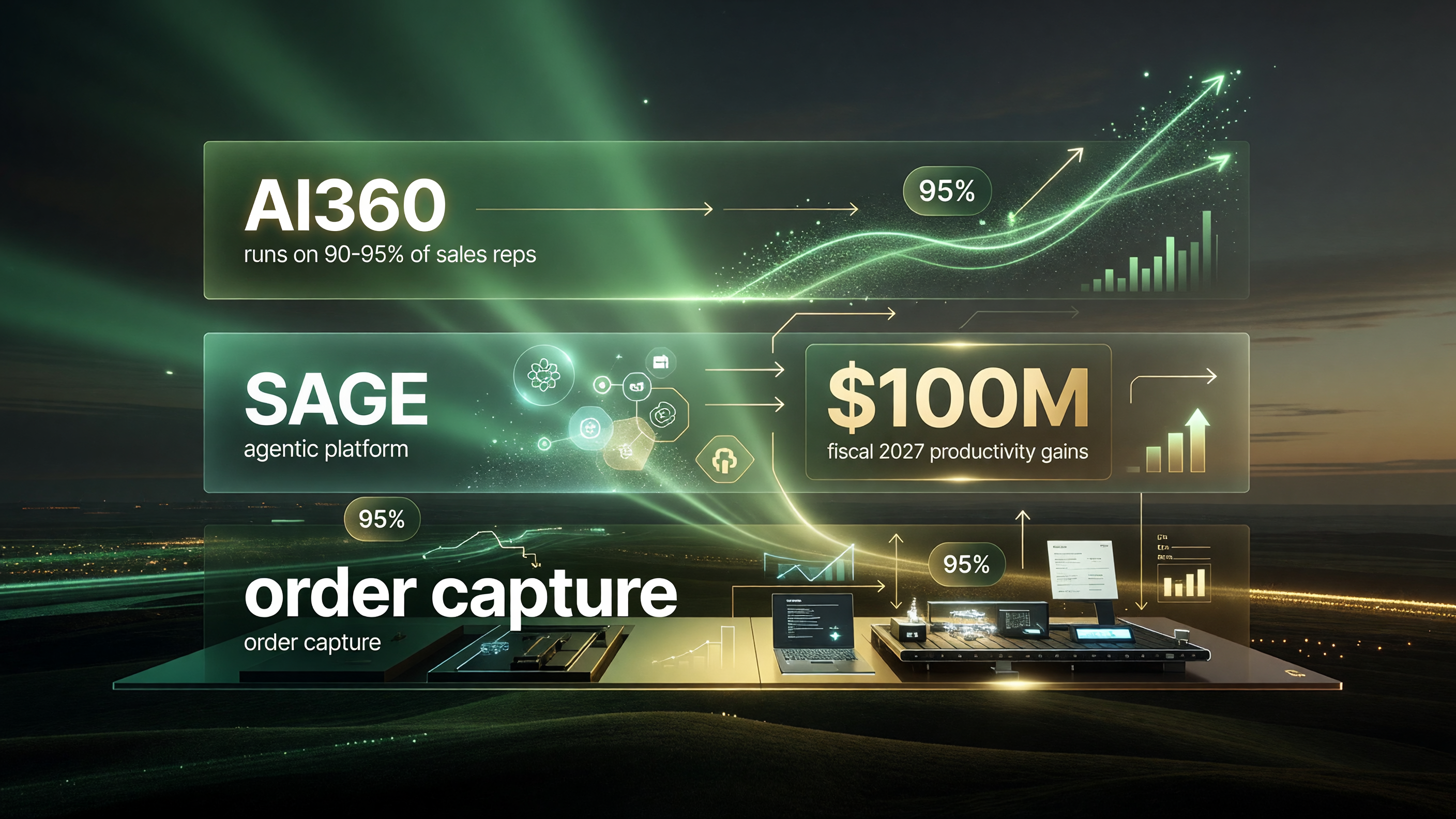
Sysco’s AI has three layers — AI360 for sales consultants, the agentic SAGE platform, and smarter ordering — and all of it touches how your food arrives.
That has three practical consequences for an independent operator:
- Your rep knows more than they used to. When your rep calls with a recommendation, it’s backed by data across your whole account — not a hunch. That’s either leverage for you (better questions to ask) or a reminder to review every suggestion rather than nodding along.
- Cost-saving substitutions are worth asking for. Features like Swap and Save mean savings are sitting in your order if you ask the right way. If you don’t review your order with an eye on substitutions, the opportunity is wasted.
- Your ordering footprint is being optimized with or without you. Sysco’s forecasting is getting better at predicting demand. The supplier that guesses your needs better is the supplier that’s less likely to short you on a busy holiday weekend.
What “Agentic” AI Actually Means for Your Order
Sysco’s SAGE platform is described as agentic, and that specific word is worth understanding because it signals a real shift from how AI worked before. Traditional AI tools suggest and inform: they analyze your data and hand a human a report. An agentic system goes further — it takes actions inside approved workflows, completing steps end-to-end rather than stopping at a recommendation.
In practical terms, that means SAGE doesn’t just tell a Sysco planner “this region stocks more salmon in summer.” It can drive the workflow that restocks the warehouse accordingly, update forecasts, and keep inventory optimized. When an AI itself runs steps of a process — instead of just suggesting them — the efficiency gains compound and the margin for human error drops.
For an independent restaurant, the honest takeaway is more modest but still useful: the people on the other side of your supply chain now work with AI that completes tasks, not just flags them. Your service levels, fill rates, and order accuracy are being managed by a smarter machine. That generally works in your favor — but it also means the distributor sees more of your patterns than ever, so staying engaged with your account relationship matters more.
The Ordering Journey, Before and After the AI
To see what Sysco’s AI has changed, walk through the old way to place an order versus the new one.
The old way: You or your manager call the rep or hand over a paper list. Someone re-keys the order into a system. Human error creeps in — a misread case size, a wrong quantity, a product typed under the wrong SKU. If the order was faxed, someone had to transcribe it by hand, and transcription errors and overtime were built into the process.
The new way: Inbound orders — including faxed and emailed ones — are captured and digitized automatically with document-reading AI. Order history and seasonality feed forecasting so the warehouse is stocked for what you’re actually likely to order. Your rep uses AI360 to see your patterns and proactively point out substitutions or flag that a core item is trending up in price. Your digital portal suggests products you genuinely need.
The difference is not flashy. It’s accuracy and efficiency at scale — fewer wrong orders, fewer stockouts, less manual work on both ends. And for a busy operator, an order that shows up right the first time is worth more than a slick interface ever could be.
A Real-World Example: Better Forecasting on a Busy Weekend
Consider what happens before a major US holiday weekend — Memorial Day, July 4th, Thanksgiving-adjacent catering rushes. Historically, distributors scramble to keep enough high-demand product on hand, and operators worry about whether their wings, ribs, or brisket will make it on the truck. Suppliers often over-order to be safe, which pushes costs around.
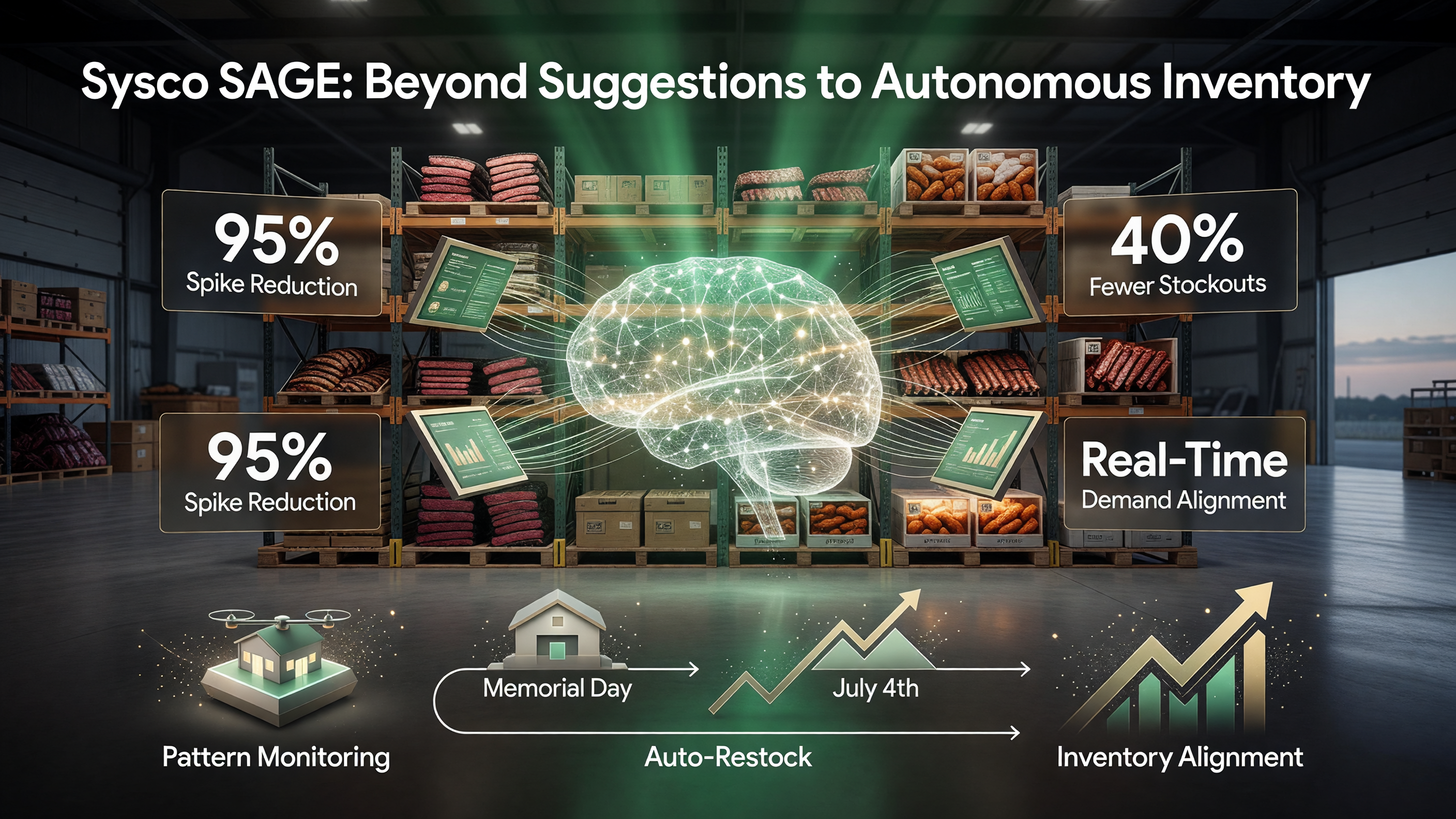
Agentic AI goes further than a suggestion tool — SAGE can watch your patterns, stock replenishment automatically, and flag you only when something needs a decision.
With forecasting AI, Sysco’s planners can see aggregated ordering patterns across a region and align inventory to real demand instead of guesswork. That means a better shot at keeping the items you cook with in stock when your dining room is fullest and your margin matters most. It doesn’t eliminate shortages in a supply crunch, but it smooths the ordinary weekly spikes that used to cause frustration.
The same logic applies to your own ordering discipline. Just as Sysco predicts demand, you can review your own order history to see what you consistently over-buy. That symmetry — using the data your distributor already holds — is a quiet way independents can cut waste without adding headcount or software costs.
The $100 Million Signal
Sysco has tied its AI initiatives to roughly $100 million in expected productivity gains for fiscal 2027. That headline number matters to independents for one reason: it means Sysco is betting its operations — and by extension its relationship with restaurant customers — on these systems working. That’s not a pilot program. That’s a directional bet that AI-driven procurement and sales is the future of foodservice distribution.
When a company of Sysco’s scale commits that much, the effects ripple down to every operator on its delivery routes. The AI isn’t a feature you opt into. It’s becoming the operating system of how food gets to your kitchen.
What This Means for Your Food Cost and Margin
Let’s get specific about the restaurant angle, because that’s what actually matters on a Friday service. Food cost for an independent sits roughly between 28% and 35% of revenue. In an environment where commodity prices swing and customer traffic softens, every point of food cost is a point of margin — and margin is survival.
AI-assisted procurement touches that number in three ways:
- Substitutions. Catching a like-for-like cheaper product on a high-volume item can shave fractions of a point off food cost with zero change to the guest experience.
- Waste reduction. Better forecasting and right-sized ordering mean buying closer to what you’ll actually sell, cutting spoilage and overstock.
- Price visibility. AI that flags spend creep gives you an early warning when a key item is trending up, so you can adjust menu pricing or swap suppliers before it hits your margin statement.
None of this requires you to be a tech adopter. It requires you to pay attention to your weekly order, ask your rep about substitutions, and actually use the data your distributor already has on your account.
How to Use This, Not Just Watch It
If you’re an independent operator who wants to capture some of that value today, a few concrete moves:
- Ask your Sysco rep to walk you through “Swap and Save” equivalents. Most independents don’t know this exists. The money is in the ask.
- Review your order history like your rep does. Look for products you’re buying on autopilot that may have cheaper equivalents or that you’re over-ordering.
- Use your digital ordering portal’s smarter search. Product discovery improvements in Sysco’s e-commerce mean you can find what you need faster and spot new options.
- Flag spend creep early. If a core ingredient keeps climbing, act — adjust the dish, reprice, or swap — before it’s baked into next month’s P&L.
The Bottom Line for Independent Restaurants
Sysco’s AI transformation is not a disruption you need to defend against. It’s an opportunity sitting in your ordering relationship — if you engage with it. The distributor that now knows your kitchen’s patterns better than ever can either work for you (finding savings, keeping you stocked) or upstream of you (optimizing its margins at the edge of yours). The difference is whether you show up to the conversation with the same data awareness your rep now has.
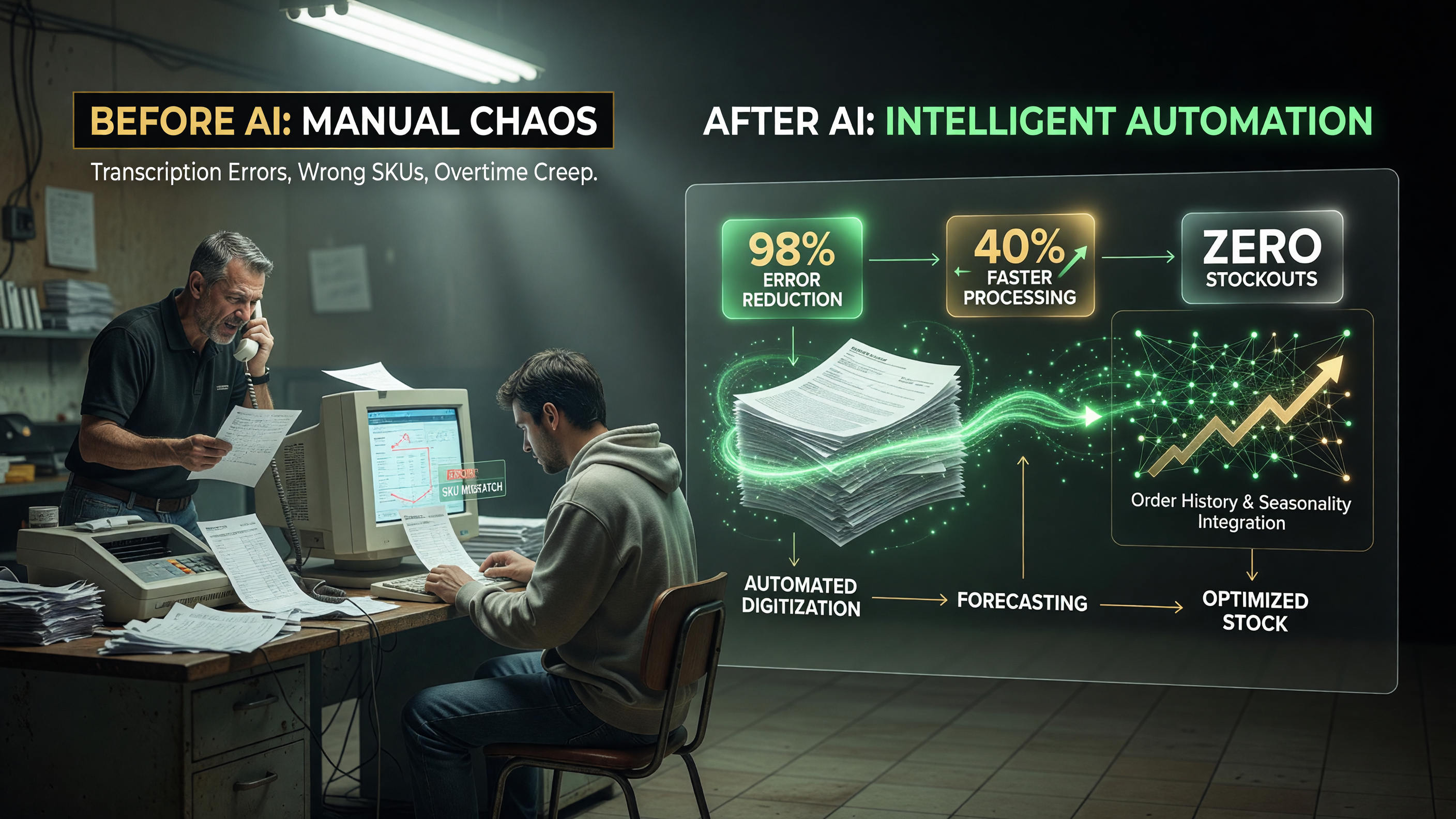
What actually changes on the order side — fewer mis-keyed orders and stockouts when AI captures and checks your ordering.
That asymmetry — a smarter AI on the other side of your weekly order — is the quiet story of 2026 foodservice. The winners will be the operators who treat their distributor relationship as an active, data-rich negotiation rather than an automatic reorder. The tools are on your side too; you just have to use them.
FAQ
Is Sysco using AI to improve restaurant food ordering?
Yes. Sysco has deployed AI across its sales, e-commerce, forecasting, inventory, and back-office operations, including its AI360 sales platform and its SAGE (Sysco Agentic Ecosystem) agentic AI platform, which won a Newsweek 2026 AI Impact Award.
What is Sysco AI360?
AI360 is Sysco’s AI-powered sales tool, used by an estimated 90-95% of Sysco sales consultants. It analyzes order history and seasonality to provide data-driven prompts, recommend cost-saving product substitutions (Swap and Save), and support menu planning.
How much is Sysco expecting to gain from AI?
Sysco has tied its AI initiatives to roughly $100 million in expected productivity gains for fiscal 2027, alongside measurable sales and supply-chain improvements.
How can AI food ordering help an independent restaurant control food costs?
AI-assisted procurement helps restaurants find lower-cost product substitutions, reduce waste through better forecasting and right-sized ordering, and flag spend creep on key ingredients early so operators can adjust pricing or suppliers before it hurts margins.
Does Sysco integrate with restaurant tech platforms?
Yes. Sysco partners and integrates with restaurant technology platforms for capabilities like real-time inventory tracking, and its digital ordering portal (Sysco Shop) offers smarter product discovery powered by AI.

About Barak Schurr
Barak Schurr built and exited a major ticketing platform, ran global operations at Eventbrite, and now focuses on one question: which AI tools actually help independent restaurant owners run leaner and grow faster. He writes from the operator’s perspective — no vendor spin, no theory, just what’s real in 2026.
Email: [email protected]
More Resources for Restaurant Operators