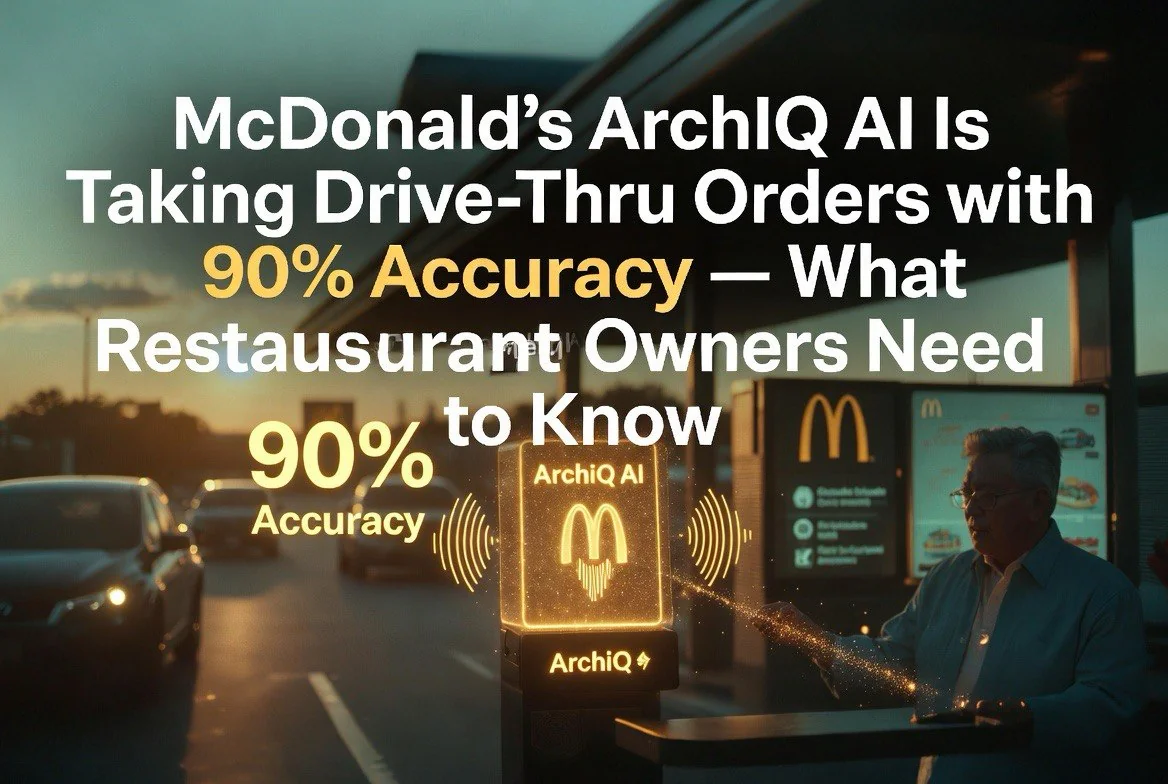
McDonald’s ArchIQ AI system, powered by Google Cloud’s Gemini, is processing drive-thru orders with 90% accuracy across 500+ locations. For independent restaurant owners in the United States watching from the outside, the immediate reaction is predictable: “That is a McDonald’s thing. I cannot afford that. I do not need that.” Two of those statements are wrong.
According to the National Restaurant Association’s 2026 Restaurant Technology Landscape report, the US restaurant industry is projected to reach over $1.2 trillion in revenue this year, with drive-thru accounting for approximately 60-70% of quick-service transactions and a significant share of fast-casual sales. Voice AI in the drive-thru is the fastest-growing AI category in the restaurant industry, with adoption expected to more than double among independent operators in the next 12 months. The tools are here. They work. And they are priced for independent margins.
The ArchIQ announcement is important not because your restaurant is like McDonald’s. It is important because McDonald’s is the largest test case for drive-thru voice AI in the world, and they are committing to it at scale. If the system did not work — if accuracy was too low, if customer satisfaction dropped, if the operational cost savings did not materialize — McDonald’s would not be expanding. They are expanding because the numbers work at 500 locations across diverse markets. Those same numbers apply to smaller operations.
What ArchIQ Actually Does
ArchIQ runs on Google Cloud’s Gemini AI model and handles the entire drive-thru ordering process: greeting customers, taking orders, handling modifications, recommending upsells, and passing the order to the kitchen display system. The system handles complex modifications — “quarter pounder with no cheese, add extra pickles, make it a large meal with a Coke Zero” — with the same 90% accuracy as standard orders. It also handles multiple languages and diverse accents, which has been a challenge for earlier voice AI systems.
The 18-second reduction in average order time is the headline metric, but it is not the most important one. The more significant metric is that ArchIQ handles the full order without human intervention in approximately 80% of cases. Staff involvement is required only when the system encounters an order it cannot parse with high confidence or when the customer requests a human. This means the drive-thru team can focus on food preparation and guest service instead of order-taking.
The upsell capability is also notable. The system recommends add-ons and upgrades based on the order, similar to how a trained human cashier would suggest apple pies or McFlurries. In McDonald’s testing, ArchIQ’s upsell success rate matched or exceeded human cashiers while never forgetting to ask. A cashier on hour six of a shift might skip the upsell. The AI asks every time.
What Independent Operators Need to Know
McDonald’s ArchIQ runs on Google Cloud infrastructure that costs more than most independent restaurants’ entire technology budget. The custom Gemini model integration, the 500-location deployment infrastructure, the dedicated IT support team — none of that is available to independents at any price that makes sense.
However, the voice AI category has matured to the point where third-party tools deliver comparable results at independent-appropriate prices. SoundHound’s restaurant voice AI product launched in 2025 and handles drive-thru ordering with 85-90% accuracy. SnapMenu’s voice ordering system integrates with existing phone systems and drive-thru audio equipment. Both tools cost $99-199 per month per location and work with any POS.
The difference between ArchIQ and independent voice AI is not accuracy or capability. It is integration depth and support infrastructure. ArchIQ runs on Google Cloud’s full ML pipeline with real-time model updates. Independent tools run on pre-trained models with periodic updates. For a single-location operator handling 200-400 drive-thru transactions per day, the independent tool does everything you need at a price that pays for itself in the first 30 days.
The Numbers That Matter
For a drive-thru restaurant doing 300 transactions per day with an average ticket of $12, the annual drive-thru revenue is approximately $1.3M. If ArchIQ’s 18-second reduction per order applies similarly to an independent voice AI system, that is 90 minutes of labor saved per day across the drive-thru — time that the team can redirect to food preparation, cleaning, or guest service. At $15/hour, that is $22.50 per day or $8,212 per year in recovered labor productivity.
The upsell impact is harder to quantify but potentially larger. If voice AI increases upsell conversion from 15% to 22% — a typical improvement reported by early adopters — that is an additional 7% of transactions generating an extra add-on sale. At $2 average add-on with 50% margin, that is approximately $7,665 per year in additional profit from a tool costing $1,800-2,400 per year.
The combined impact: $8,212 in labor productivity recovery plus $7,665 in additional upsell profit minus $2,400 tool cost equals $13,477 net annual benefit. For a restaurant operating on 4% net margins from $1.5M in revenue, that is a 22% increase in net profit from one operational change.
Why Accuracy Matters More Than You Think
The difference between 85% accuracy and 95% accuracy in voice AI is not a 10% difference in quality. It is the difference between a system that requires staff supervision and a system that operates independently. At 85% accuracy, a staff member needs to monitor the AI and intervene on approximately 15% of orders. That reduces the labor savings by roughly half because the staff member still needs to be present and engaged with the ordering process. At 90%+ accuracy, the staff member can step away from the ordering station and focus on food preparation or front-of-house management.
The ArchIQ system at 90% accuracy is approaching the threshold where independent operation becomes viable. The independent tools at 85-90% accuracy are in the same range. The industry trajectory suggests 95%+ accuracy within 18-24 months as models improve and training data from thousands of restaurants feeds into the systems. Every 5% improvement in accuracy compounds the labor savings because it reduces the need for human supervision exponentially, not linearly.
The accuracy numbers also depend heavily on the specific restaurant environment. Background noise, speaker quality, customer accent, and menu complexity all affect real-world accuracy. A well-implemented system in a quiet drive-thru with a simple menu will outperform a poorly implemented system in a noisy environment with a complex menu. The key implementation variable is audio quality — better headsets, directional microphones, and noise cancellation directly improve accuracy.
Implementation for Independent Operators
Deploying drive-thru voice AI in an independent restaurant requires three components: voice AI software, audio equipment, and POS integration. Software costs $99-199 per month. Audio equipment is typically a one-time investment of $500-1,500 for drive-thru-specific microphones and speakers. POS integration is handled by the voice AI provider and takes under a week to configure.
The setup process: the voice AI provider connects to your POS, uploads your menu and modifier list, configures the audio equipment, and runs test orders. Staff training takes approximately one hour — the system handles ordering while staff monitor and intervene only when needed. Full deployment typically takes 7-14 days from sign-up to live operation.
Most voice AI providers offer a 14-day free trial. The best approach is to run the system alongside your current ordering process during the trial period, tracking accuracy rates, customer response, and staff feedback. If the system meets or exceeds 85% accuracy in your specific environment, the ROI math works and you deploy permanently. If accuracy falls below 80%, either the audio equipment needs upgrading or the specific provider is not a good fit for your environment.
The Competitive Angle
The NRA report projects that voice AI in drive-thrus will reach 50% adoption among quick-service operators within two years. For independent operators with drive-thru windows, the competitive implication is clear: if half of the drive-thru restaurants in your market adopt voice AI and you do not, you are competing with a 90-minute-per-day labor advantage going to your competitors. That advantage compounds over time as the AI improves and the competitor’s team redirects labor from order-taking to guest experience.
The adoption curve for restaurant AI tools has followed a predictable pattern: early adopters gain a measurable operational advantage, mainstream operators adopt when the tools hit a price-performance threshold, and laggards adopt when not adopting becomes a competitive liability. Drive-thru voice AI in 2026 is at the transition point between early adopter and mainstream. The tools work. The ROI is proven. The price is right. The question is where you fall on the adoption curve.
McDonald’s ArchIQ is not your competitor’s tool. It is a proof point that voice AI in the drive-thru has reached production reliability at enterprise scale. The independent versions of that technology are available today at a price that makes sense for single-location operators. The 18-second reduction, the upsell improvement, the labor productivity recovery — all of it transfers to your operation with the right implementation.
The gap between McDonald’s ArchIQ and your drive-thru is not capability. It is integration and infrastructure. The capability is available. The question is whether you deploy now or wait until your competitors force the decision for you.
Common Implementation Mistakes
Operators who have deployed drive-thru voice AI report three common mistakes that reduce ROI. Knowing them in advance helps you avoid the same pitfalls.
Mistake one: treating voice AI as a replacement for staff rather than a productivity tool. The goal of voice AI is not to eliminate the drive-thru team. It is to free them from order-taking so they can focus on food quality, speed of service, and guest interaction. Operators who try to reduce headcount by one full-time equivalent per shift often find that the remaining staff cannot handle the peak volume when the AI hands off a complex order. The right approach is to maintain the same headcount and redirect the recovered labor to higher-value tasks.
Mistake two: poor audio equipment. Voice AI accuracy is heavily dependent on audio quality. Using existing drive-thru speakers that were designed for human-to-human communication rather than AI speech recognition introduces errors. A one-time investment of $800-1,200 in noise-cancelling microphones and speakers designed for voice AI systems increases accuracy by 5-10 percentage points. That investment pays for itself within the first 60 days through reduced error rates and fewer hand-offs to staff.
Mistake three: not training staff on when to intervene. Staff naturally want to take over when they hear a customer struggling, even if the AI would resolve the issue with another second or two of processing. Training staff to wait for the AI’s explicit hand-off request — rather than jumping in when they hear a hesitation — increases the autonomous completion rate by 10-15 percentage points. The system learns from every interaction. Every time a staff member intervenes unnecessarily, the system loses a training opportunity.
Menu Complexity and Voice AI Readiness
The complexity of your menu directly affects voice AI accuracy. A simple menu with 15-20 items and limited modifications achieves higher accuracy than a complex menu with 50+ items and extensive customization options. McDonald’s menu is relatively simple — a few core categories, standardized modifiers, and consistent naming conventions. If your menu is significantly more complex, accuracy may be 3-5 percentage points lower initially.
However, voice AI systems improve with exposure to your specific menu. The first week of deployment typically shows 80-85% accuracy. By week four, accuracy improves to 85-90% as the system learns your menu structure, common modifications, and customer ordering patterns. By week twelve, most operators report accuracy in the same range as ArchIQ’s reported 90% figure, because the system has been trained on thousands of orders specific to their menu and customer base.
The implication is clear: operators with complex menus should not wait for better accuracy. The system improves through use. Every order handled by the AI is a training data point that makes the system more accurate for the next order. The cost of waiting is not just the missed savings — it is the missed training data that would have improved the system over time.
The Bottom Line for Independent Operators
McDonald’s ArchIQ is not a glimpse of a distant future. It is a current proof point that drive-thru voice AI has reached enterprise-grade reliability. The independent equivalent is available now, at prices that work for single-location operators, with ROI that compounds over time as accuracy improves through use.
The competitive window is narrowing. The NRA projects 50% adoption within two years. Every operator who adopts now gains an operational advantage that grows as the system learns. Every operator who waits loses not just the months of savings but the months of training data that would have made their system more accurate when they eventually deploy.
Voice AI in the drive-thru is not complicated. Connect the software to your POS. Install good audio equipment. Let the system learn your menu. The result is 90 minutes of labor per day recovered, improved upsell conversion, and a competitive advantage that compounds every month the system operates.
The question is not whether drive-thru voice AI will become standard. It is whether your operation will lead, follow, or get left behind.
Frequently Asked Questions
What is McDonald’s ArchIQ AI?
ArchIQ is McDonald’s Google Cloud Gemini-powered AI system that handles drive-thru ordering, including order taking, modification handling, upsells, and kitchen routing. It operates across 500+ locations with 90% order accuracy and reduces average order time by 18 seconds.
How accurate is drive-thru voice AI for independent restaurants?
Independent voice AI tools like SoundHound and SnapMenu achieve 85-90% accuracy in drive-thru environments. Accuracy depends on audio equipment quality, background noise levels, and menu complexity. Most operators find 85%+ accuracy sufficient to generate positive ROI.
How much does drive-thru voice AI cost for an independent operator?
Voice AI software costs $99-199 per month per location. Audio equipment is a one-time cost of $500-1,500 for drive-thru-specific microphones and speakers. Setup takes 7-14 days. Most providers offer a 14-day free trial.
What ROI can I expect from drive-thru voice AI?
Operators typically see $10,000-15,000 net annual benefit from voice AI deployment. This comes from 90 minutes per day of labor productivity recovery ($8,000+ per year), improved upsell conversion ($7,000+ per year in additional profit), and reduced order time that increases throughput capacity.
Is drive-thru voice AI ready for a loud, busy restaurant environment?
Yes, but audio quality is the critical variable. Good directional microphones and noise cancellation hardware directly improve accuracy. Most reputable voice AI providers conduct an on-site audio assessment before deployment to ensure the equipment and environment support reliable performance.

About Barak Schurr
Barak Schurr built and exited a major ticketing platform, ran global operations at Eventbrite, and now focuses on one question: which AI tools actually help independent restaurant owners run leaner and grow faster. He writes from the operator’s perspective — no vendor spin, no theory, just what’s real in 2026.
Email: [email protected]
More AI Resources