Square Restaurants Can Now Accept Orders from ChatGPT and Claude
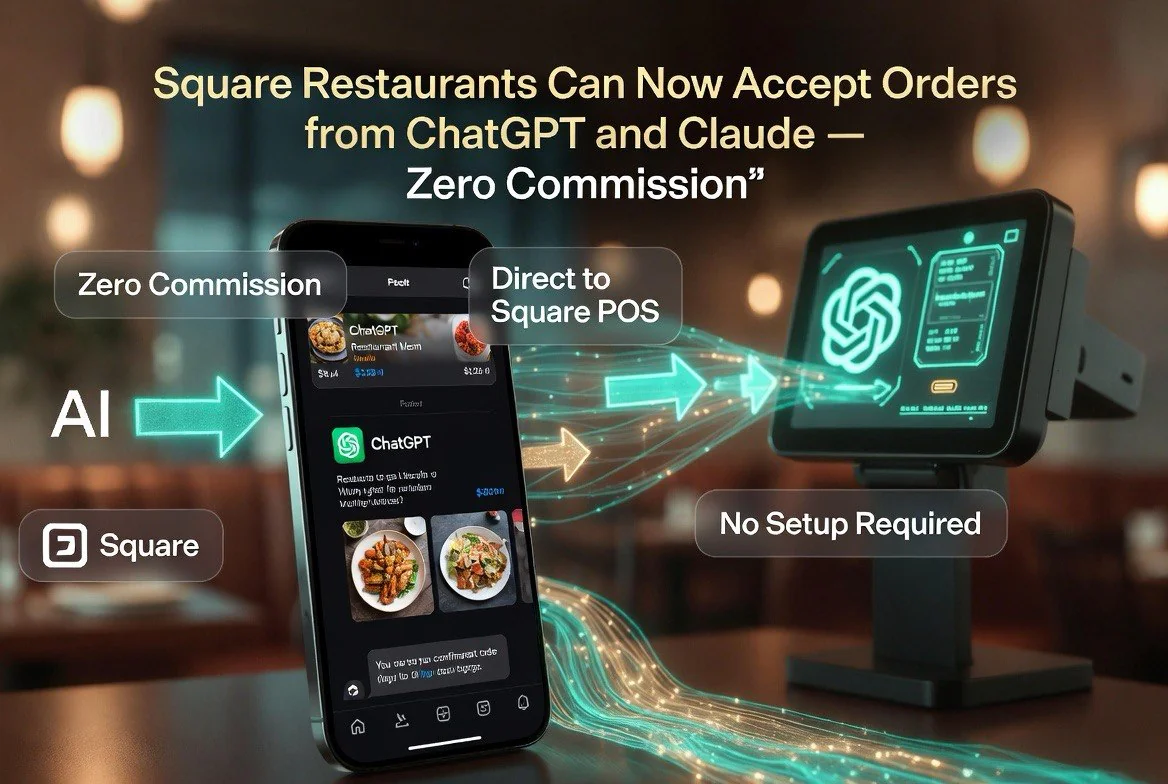
⚡ Expert Summary: On July 1, 2026, Square launched a game-changing integration for US restaurants: customers can now discover restaurants, browse live menus, and place orders directly inside ChatGPT and Claude conversations — with no extra marketplace commissions, no technical setup, and orders routing straight into the restaurant’s existing Square POS and kitchen display system. This is the first time AI chatbots have been connected directly to independent restaurant POS systems at scale.
How It Works
Square’s integration is remarkably simple from the restaurant’s perspective. If you already use Square for payment processing and have a Square Online ordering profile activated, you are automatically opted in. There is no additional hardware, no software installation, and no contract to sign.
Here is what happens when a customer places an order through an AI chatbot:
The customer opens ChatGPT or Claude and asks for restaurant recommendations or directly requests a specific restaurant’s menu. The AI assistant pulls live menu data from the restaurant’s Square profile, displays it to the customer, and processes the order selection. The order then routes directly into the restaurant’s Square POS system and kitchen display system, just like any other online order. The restaurant sees the source noted in their reporting, so they know which orders came through AI channels.
The critical detail for restaurant owners: Square charges only its standard payment processing fees on these orders. There are no additional marketplace commissions, no listing fees, and no per-order charges from Square for the AI channel. This is a radical departure from the third-party delivery model where platforms take 15% to 30% of every order.
Why This Is a Big Deal for Independent Restaurants
The US restaurant industry has been wrestling with the third-party delivery problem for years. Grubhub, Uber Eats, and DoorDash offer reach, but take enormous cuts that crush already thin restaurant margins. Independent operators have been caught in a bind: be on these platforms and lose money on every delivery order, or skip them and lose customer reach.
Square’s AI chatbot ordering changes this equation in several ways:
Direct orders at processing-cost margins. Standard payment processing fees typically run 2.6% to 3.5% plus a small per-transaction fee. Compare that to the 15% to 30% that third-party delivery platforms charge. For a restaurant doing $50,000 in monthly online orders, that difference could mean keeping an extra $6,000 to $13,000 per month instead of paying it to delivery platforms.
No setup cost or technical barrier. Square handles everything on the backend. The restaurant doesn’t need to build a custom ChatGPT plugin or hire developers. The integration is automatic for any Square seller with an online ordering profile. This matters enormously for independent operators who don’t have IT departments.
AI discovery replaces platform discovery. Instead of customers finding a restaurant through a delivery aggregator’s search (and the aggregator taking a cut), customers discover restaurants through AI conversations. ChatGPT and Claude become the discovery layer — and Square has ensured that discovery doesn’t come with a tax on the restaurant.
Orders integrate with existing workflows. Because the order goes directly into Square POS and KDS, there’s no tablet to juggle, no separate printer to manage, no manual entry. The AI-generated order looks the same in the system as an online order from the restaurant’s own website. Staff don’t need retraining.
The Economics: What a Restaurant Can Expect
| Factor | Third-Party Platform | Square + AI Chatbot |
|---|---|---|
| Commission on a $30 order | $4.50-9.00 (15-30%) | $0.90-1.05 (processing only) |
| Setup time | Days to weeks (onboarding, menu setup) | Zero (automatic for Square users) |
| Customer reach | Platform app users only | ChatGPT and Claude users |
| Kitchen integration | Tablet + separate printer | Direct to POS + KDS |
| Extra hardware needed | Yes (tablet, cellular backup) | None |
What This Means for the Restaurant Industry
Square processes payments for over 4.5 million sellers in the United States, with hundreds of thousands in the food and beverage category. That massive installed base means this integration is immediately meaningful — it’s not a pilot program or a limited rollout. Every eligible Square restaurant is already live on the AI channel.
The strategic implications are significant:
AI chatbots are becoming restaurant discovery engines. ChatGPT has hundreds of millions of active users. Claude is growing rapidly in professional contexts. When these platforms can surface restaurant menus and process orders, they become direct competitors to Yelp, Google Maps, and delivery aggregators for the “where should I eat” use case. Square has positioned its merchants to benefit from that shift from day one.
The 30% delivery commission model is under pressure. If AI chatbots can connect customers directly to restaurants at processing-cost margins, the economic argument for third-party delivery platforms weakens. Customers still need delivery fulfillment, but the order acquisition cost drops to near zero. Restaurants can partner with delivery services purely for logistics, not for customer acquisition.
AI-powered ordering reduces friction. Voice AI has been getting attention for drive-thrus and phone ordering. But text-based AI ordering through ChatGPT and Claude reaches a different customer — one who is already in the AI ecosystem and comfortable with conversational interfaces. For restaurants targeting younger demographics, this channel matters.
How to Make the Most of Square’s AI Ordering
For restaurant owners who already use Square and are automatically opted in, here are steps to maximize the opportunity:
Keep your Square profile updated. The AI pulls live menu data from your Square Online profile. If your menu items, prices, or availability are outdated in that system, that’s what ChatGPT and Claude will display. Make profile management a weekly habit.
Monitor AI-originated orders in your reporting. Square tags orders from AI channels separately. Watch for trends: which items are being ordered through AI vs. other channels, which times of day, and what the average order value looks like. This data tells you how AI customers behave differently from your other customers.
Optimize your menu for AI discovery. Since AI models prioritize clear, well-structured data, restaurants with complete and detailed Square profiles will surface more prominently in AI search results. Include thorough descriptions, accurate pricing, dietary tags, and high-quality images.
Consider AI-exclusive specials. Since the AI channel has no commission overhead, you can offer AI-exclusive deals or specials that would be unprofitable on third-party platforms. This creates a reason for customers to order through the AI channel specifically, building the habit.
Real Numbers: What This Means for Your Bottom Line
Let’s make this concrete with real restaurant numbers. Say you run a mid-volume independent restaurant in the United States doing 0,000 in monthly online orders. If those orders come through third-party delivery platforms, you are likely paying between ,500 and ,000 per month in commission fees. On a restaurant with typical 5-8% net margins, that commission can represent your entire profit — or more.
Now imagine that even 20% of those orders shift to the AI chatbot channel. That’s ,000 in monthly orders moving to processing-cost-only fees of roughly 80 instead of 00 to ,800 in platform commissions. The savings: 20 to ,620 per month. Over a year, that’s ,640 to 9,440 — real money for an independent operator.
And that’s conservative. As more customers adopt AI chatbot ordering, the percentage of orders coming through low-commission channels will grow. Restaurants that have built their online ordering infrastructure around their own POS system rather than third-party platforms will be best positioned to capture that shift.
The strategic play: Encourage customers to order through the AI channel directly. Promote it on your in-store signage, social media, and email lists. Every order that moves from a 30% commission platform to a 3% processing-fee channel goes straight to your bottom line. Over time, that margin difference compounds into meaningful business advantage.
For multi-location operators, the math is even more compelling. Ten locations each shifting ,000 in monthly orders to the AI channel saves ,500 to ,000 per month across the group. That’s the equivalent of adding a full shift of profitable revenue without a single extra customer walking through the door.
FAQ
Do I need to sign up or set anything up for Square’s AI ordering?
What fees does Square charge for AI chatbot orders?
Which AI chatbots can customers use to order?
How do orders from ChatGPT and Claude reach my kitchen?
Is this available for all Square restaurants in the US?
Can I opt out if I don’t want AI orders?

About Barak Schurr
Barak Schurr built and exited a major ticketing platform, ran global operations at Eventbrite, and now focuses on one question: which AI tools actually help independent restaurant owners run leaner and grow faster. He writes from the operator’s perspective — no vendor spin, no theory, just what’s real in 2026.
Email: [email protected]
More AI Resources