AI Demand Forecasting for Restaurants Is Finally Practical — Weather, Events, and What It Means for Your Inventory
⚡ Expert Summary: AI demand forecasting for restaurants has moved from experimental to practical in 2026. Platforms like Restroworks now integrate weather patterns, local events, and historical sales data to predict daily traffic and menu item demand with increasing accuracy. For independent operators, this means ordering the right amount of inventory, reducing food waste by 15-30%, and avoiding the double cost of overstocking or running out of ingredients during a surprise rush. The systems cost a fraction of what a dedicated operations manager would and integrate directly with existing POS and inventory systems.
Your walk-in cooler is packed with 50 pounds of salmon because you expected a busy Friday. It is raining. Your patio is empty. You are looking at $800 of fish you will have to discount or toss.
Every restaurant operator has lived this. The alternative — running out of an ingredient mid-service — is worse. You either waste money on inventory you do not use or turn customers away because you do not have what they want.
AI demand forecasting claims to solve this exact tradeoff. And in 2026, it is finally becoming practical for independent restaurants, not just chains with data science teams.
How the AI Actually Works Under the Hood
The machine learning models behind restaurant demand forecasting are not exotic. Most use ensemble methods — combining multiple algorithms to produce a weighted prediction. The inputs fall into three categories:
Internal data. Your POS sales history, split by day of week, hour of day, and menu item. The model identifies patterns: Tuesday lunch always sells 40% more of the grilled chicken wrap, Saturday brunch sells three times as many mimosas as the rest of the week combined. The more historical data the model has — ideally 12+ months — the more granular these patterns become.
External signals. Weather API data pulls temperature, precipitation probability, and humidity forecasts for your specific location. Event calendars flag local sports games, concerts, festivals, and school holidays. Some systems also pull Google Trends data for relevant search terms in your area.
Real-time adjustments. As the forecast date approaches, the model updates its prediction based on changing weather forecasts, newly announced events, and current sales velocity. A sunny forecast that shifts to 80% rain by Thursday changes Friday’s predicted patio covers, and the model adjusts the recommended prep quantities automatically.
The output is a probabilistic forecast, not a single number: “85% confidence that Friday dinner will do between 180 and 220 covers, with a peak probability at 202 covers.” This probability range is more useful for ordering than a single number, because it tells you the risk level.
What Happens When a Weather Forecast Changes
The real test of a demand forecasting system is not baseline accuracy — it is how the model handles forecast changes. A typical scenario: on Monday, the system predicts 200 covers for Saturday. On Wednesday, the weather forecast shifts from sunny with a high of 78 to 90% chance of thunderstorms. The system recalculates: Saturday patio covers drop by 60%, delivery orders increase by 35%, and recommended prep quantities shift accordingly.
This recalculation happens automatically. The prep list that prints on Friday night already reflects the updated prediction. The manager does not need to check the weather app, decide whether the forecast will hold, and manually adjust orders. The system handles the probability weighting — a 90% rain forecast gets more weight than a 40% one, and the prediction smooths across the range of possible outcomes.
The same logic applies to local events. A concert at the nearby amphitheater adds 500 potential customers to your neighborhood. But if the concert is a country music act and your restaurant is a vegan bistro, the actual impact may be negligible. Good forecasting systems learn these cross-correlations over time — they do not just add 50 covers because there is an event; they add covers specifically on the menu categories that sold during similar events in the past.
Seasonal Adjustments: Where the Model Really Earns Its Keep
Seasonal forecasting is where AI pulls away from manual methods. A human operator knows summer is busier than winter and adjusts orders accordingly. But humans struggle with transitional seasons — is late March still winter patterns, or is it spring? The answer depends on whether spring break has started, how the weather is trending, and whether Easter falls early or late this year.
AI handles transition periods cleanly. It identifies the inflection points in your sales data — the week when patio season actually starts in your specific location, not when the calendar says spring begins. A restaurant in Miami has a different seasonal profile than one in Portland, and the model adjusts to the local climate rather than applying generic seasonal multipliers.
The operational benefit is inventory carryover. Restaurants that overshoot seasonal transitions end up with three cases of watermelon in October or four bags of winter squash in May. AI forecasting reduces these transition errors by identifying the shift points earlier and more precisely than calendar-based planning.
How Accurate Does It Get?
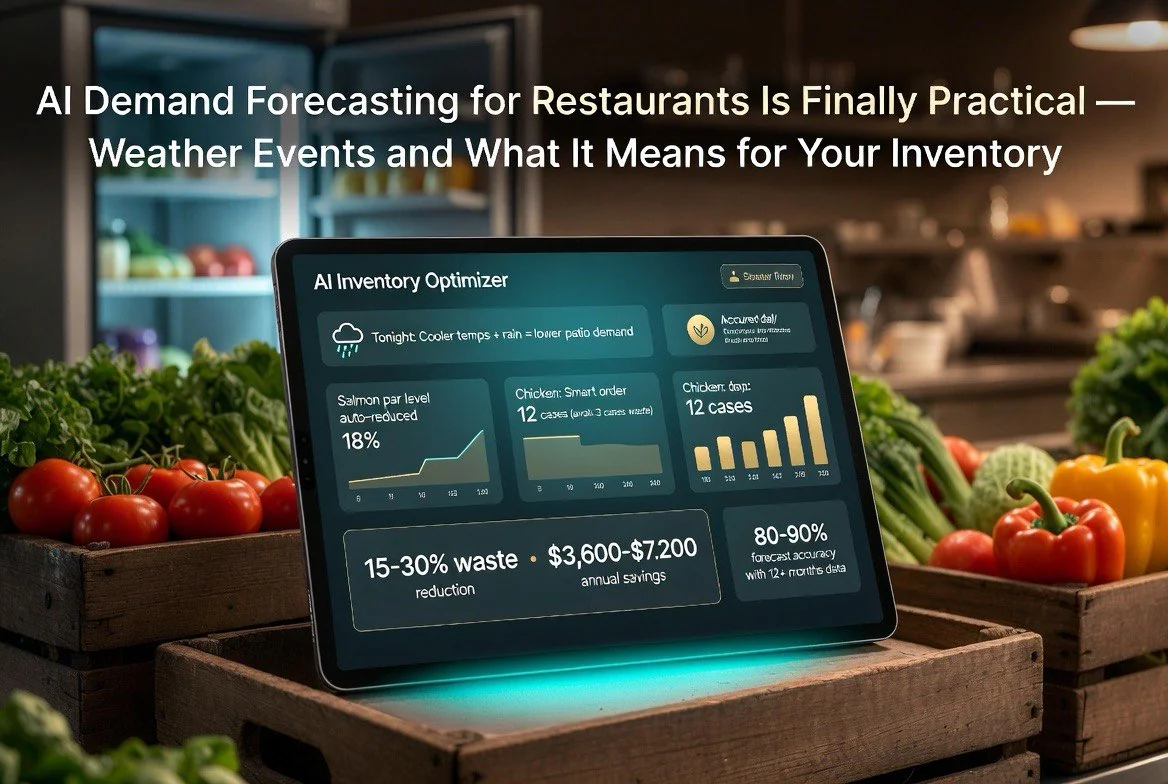
Restroworks reports accuracy rates of 80-90% for total cover forecasting after the model has trained on 12 months of data. Individual menu item forecasting is less accurate — typically 65-80% — because single-item demand is affected by daily specials, supplier changes, and customer mood in ways that total traffic is not.
Weather-based adjustments add roughly 5-10 percentage points of accuracy compared to models using sales data alone. A study published in the International Journal of Hospitality Management in 2025 found that restaurants using weather-integrated demand forecasting reduced waste by an average of 22% compared to those using historical sales data alone.
The key insight: accuracy matters less than consistency. A model that is consistently wrong by 10% is still operationally useful because you learn the bias and adjust. A model that alternates between spot-on and wildly wrong is useless regardless of average accuracy.
Real Economics for a Real Restaurant
Let’s run the numbers for an actual independent restaurant. Joe’s Bistro does $850,000 in annual revenue with a food cost of 32% — $272,000 in food purchases per year. The industry benchmark for food waste is 4-10% of purchases. Joe’s runs at the high end — about 8% waste — losing roughly $21,760 annually to spoiled ingredients, over-prepped items, and expo waste.
An AI forecasting platform like Restroworks costs $79/month for the insights module ($948/year) or $199/month for full integration with inventory and purchasing ($2,388/year). At the $2,388 tier with a 22% waste reduction (conservative based on the 2025 study), Joe saves $4,787 on waste in year one. That is a 2:1 ROI in year one, and the cost drops to zero net after the waste savings accumulate.
Add in the labor savings. Joe spends roughly 4 hours per week on manual inventory ordering — checking levels, counting stock, writing order sheets. At $22/hour for the assistant manager’s time, that is $4,576 in annual labor. The forecasting system reduces that by at least half, saving another $2,288.
Total year-one benefit: roughly $7,075 against a $2,388 cost. Three-to-one ROI in the first year, and the waste savings compound as the model improves with more data.
Platform Comparison
Restroworks is closest to an all-in-one solution. Their demand forecasting module integrates directly with their inventory management and purchasing system, so predicted demand automatically adjusts par levels and generates purchase order suggestions. They support over 25,000 restaurant locations globally. Best for restaurants that want forecasting connected to procurement, not just a dashboard. Pricing: $79-$199/month depending on module.
MarketMan focuses on inventory management with forecasting as an add-on feature. Their strength is multi-location support — if you run 2-5 locations, MarketMan’s comparative analytics show which location is forecasting most accurately. Weaker on weather integration compared to Restroworks. Pricing: $79-$159/month.
xtraCHEF (acquired by SpotOn in 2024) approaches forecasting from the procurement angle. Their system analyzes invoice data to identify price trends from your suppliers and flags when you should lock in pricing. Forecasting is secondary — they assume you bring your own demand prediction and they optimize the purchasing side. Best for cost-focused operators who already have a forecasting method. Pricing: custom quoted.
Setting Up Forecasting: The Real Timeline
Setting up forecasting is not a weekend project. Here is the realistic timeline:
Data preparation (2-4 weeks). Your POS data needs to be clean, consistent, and mapped to menu items. If you renamed menu items mid-year, changed pricing, or switched POS systems, that data needs reconciliation. Restroworks and MarketMan both offer data migration support, but the quality of your output depends on the quality of your input.
Model training (1-2 weeks). Once data is connected, the model needs time to establish baselines. Some platforms start producing useful forecasts immediately; others need a minimum of 3 months of data before predictions reach operational accuracy.
Staff training (1 week). The hardest part is not the technology — it is getting your manager to trust a computer’s ordering recommendation over their gut. Most platforms recommend running the AI’s recommendations in parallel with manual ordering for two weeks to build confidence.
Full switchover (day 15-21). Once the team sees that the AI’s predictions were at least as accurate as their manual process, they will adopt it. The waste reduction starts immediately from that point.
Where Forecasting Falls Short
AI forecasting will not help if your data is bad. A restaurant that punches orders into the POS inconsistently, has menu items mapped to the wrong categories, or changes suppliers weekly will get noisy predictions regardless of the algorithm.
The models also struggle with black swan events. A sudden health department shutdown of a competitor, a celebrity visiting town, or a freak snowstorm in May are not in the training data. The model will miss these completely, and manual override is still required.
Pricing matters. The $79/month entry point is achievable for most restaurants, but the full integration tier at $199/month plus any add-on costs can feel expensive for a $400,000/year restaurant. The ROI math works, but the monthly bill is visible in a way that the waste savings are not.
Frequently Asked Questions
How much does AI demand forecasting cost for restaurants?
Platforms like Restroworks offer forecasting modules starting around $79/month. Full-featured platforms with inventory integration typically range from $79 to $200/month depending on location count and modules selected.
Does AI forecasting work for small independent restaurants?
Yes. The algorithms work with 12+ months of consistent historical data. Many independent operators find the strongest ROI because they lack the data analysis resources that chains have.
What data does AI forecasting need?
Historical sales data, menu item popularity, day-of-week patterns, and POS data. Weather and event data are pulled automatically from public APIs by the platform.
How accurate is AI restaurant demand forecasting?
Total cover forecasting reaches 80-90% accuracy with 12 months of training data. Individual menu item forecasting is 65-80%. Weather integration adds 5-10 percentage points of accuracy.
Is AI forecasting difficult to set up?
The full setup timeline from data preparation to staff adoption is roughly 4-6 weeks. The technology setup is fast; the staff buy-in and data cleanup are the real bottlenecks.

About Barak Schurr
Barak Schurr built and exited a major ticketing platform, ran global operations at Eventbrite, and now focuses on one question: which AI tools actually help independent restaurant owners run leaner and grow faster. He writes from the operator’s perspective — no vendor spin, no theory, just what’s real in 2026.
Email: [email protected]
More AI Resources