Maple AI Review 2026: The Phone Agent That Answers Calls AND Takes Full Orders
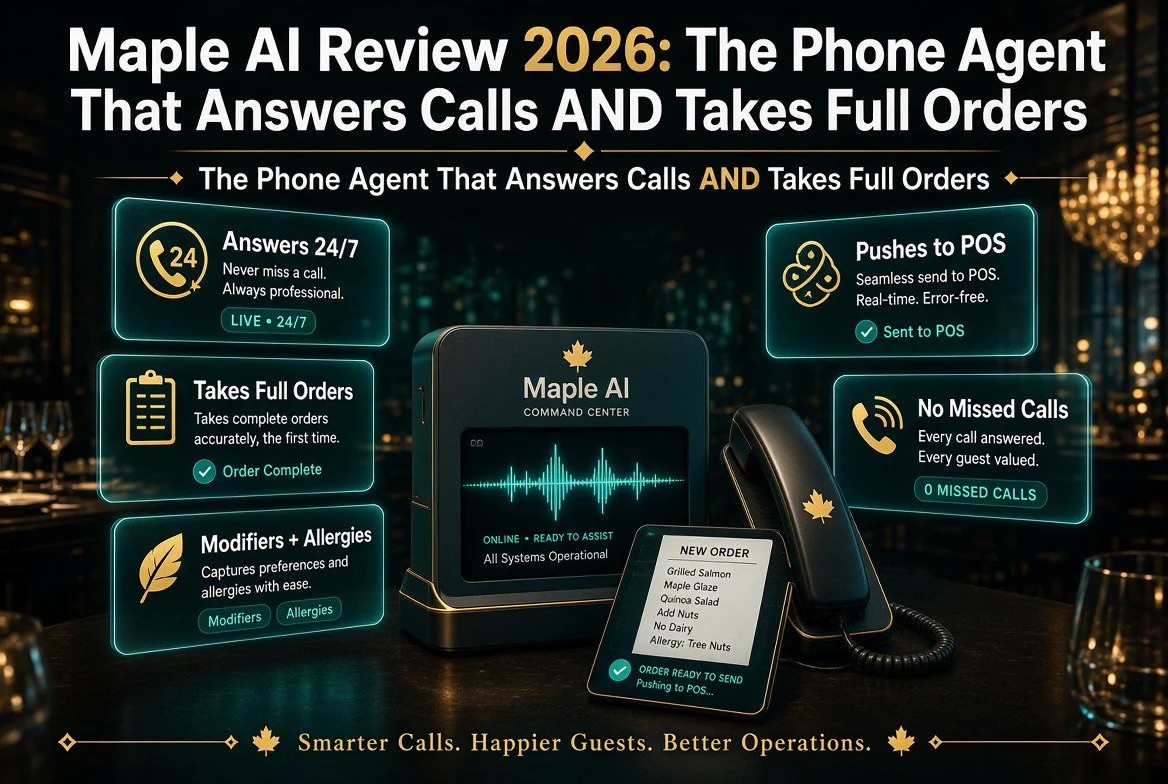
⚡ Expert Summary: Maple is a voice AI phone agent built specifically for restaurants that does what most answering tools are too timid to do: it takes the full order — including modifiers, allergies, and special requests — and pushes it straight into your POS so it lands on the kitchen display. Flat pricing from $85/month for call answering up to roughly $350/month for full order-taking with Toast, Square, and Clover integration. For independent operators missing calls at the bar, on the line, or during a rush, that is captured revenue your human staff physically cannot reach.
Why a phone agent that just answers is not enough anymore
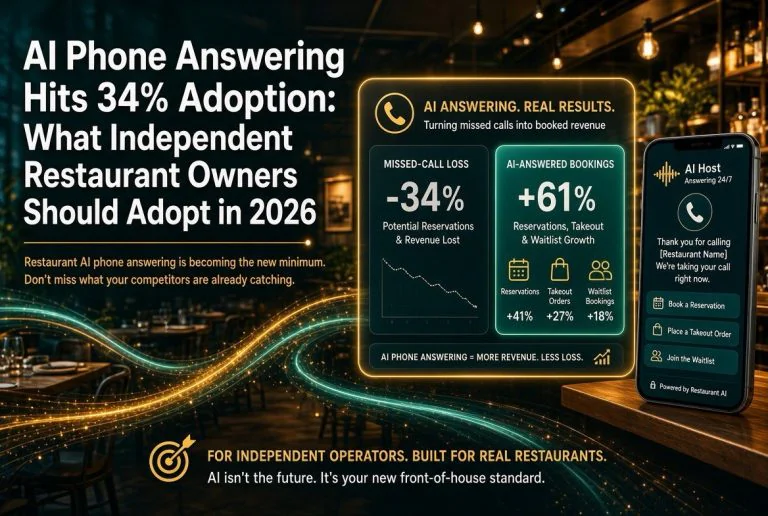
Walk through a real Friday night service and you will see the problem. The phone rings while you are three tickets deep on the line, the expo is calling tickets, and a server is juggling a twelve-top. When you finally get to the phone, it went to voicemail — and that caller already moved on to the place down the street that picked up. That scenario repeats at every independent restaurant in the United States, and each one of those missed calls is a table that never walked in or an order that never happened.
The first wave of AI phone tools solved half of this. They answered, took a message, and told the caller your hours. Useful, but a missed order is still a missed order — the caller came to spend money and left with nothing but a promise of a callback they will not wait for. That is the gap Maple is built for. It does not just answer the phone. It completes the transaction.
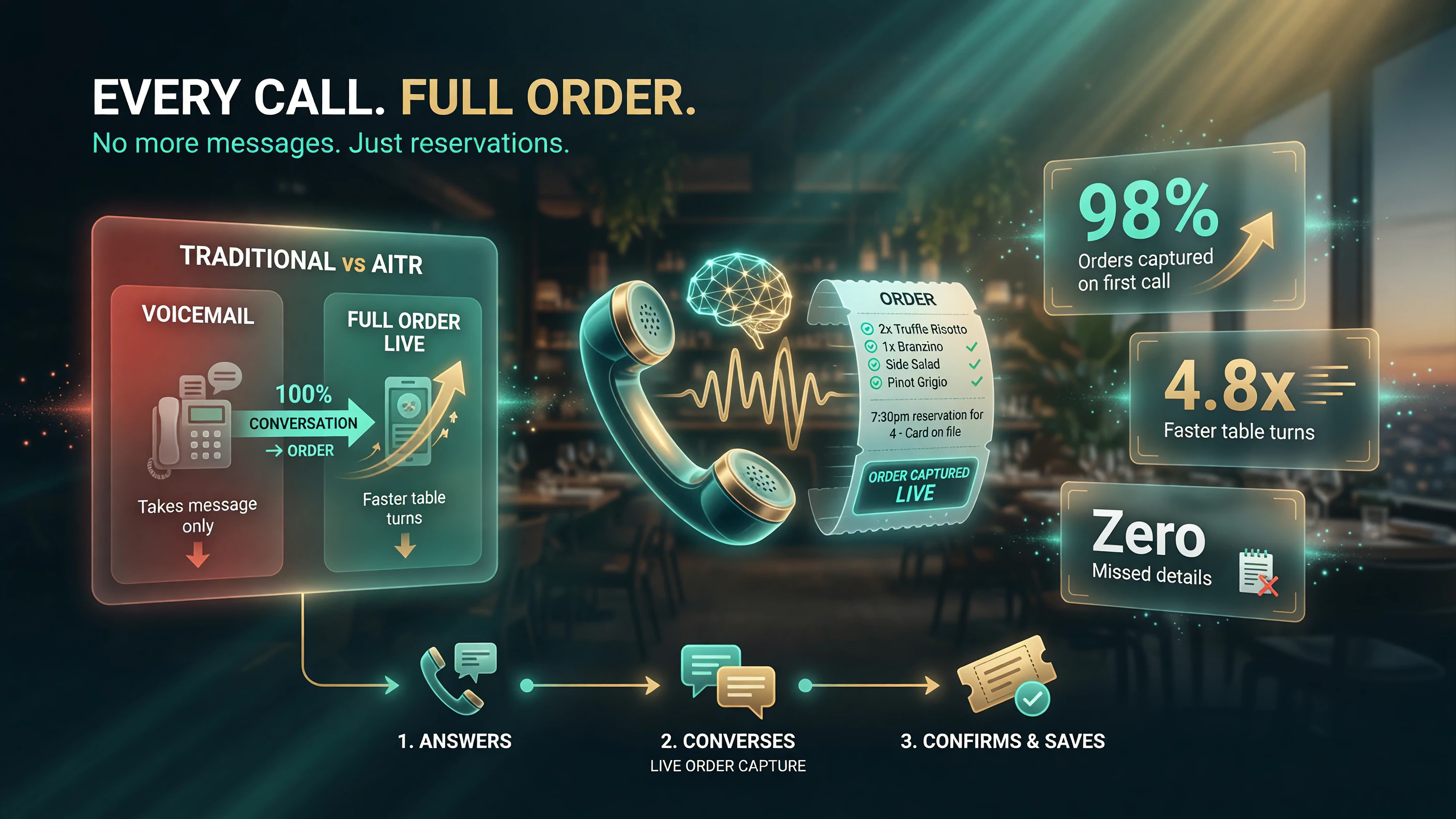
The difference that matters: a message-only line answers a call, while the MAPLE-style AI phone agent converts it into a live order and reservation in real time — no missed details, no callbacks.
What Maple actually is
Maple is a voice AI platform made specifically for restaurants, built around one job: handling the phone like your best-trained host and order-taker combined, 24 hours a day. It is not a general ChatGPT wrapper you bolt onto your website. It is trained on restaurant conversation — the way a real order sounds when someone calls in a rush.
The headline capability is full phone order taking. Maple listens to the caller, works through modifiers, combos, and custom requests, confirms the order back, and pushes it directly into your POS so it appears on the kitchen display without a human re-keying a single item. That matters enormously during a rush, when your front-of-house team is stretched and the phone is the easiest thing to let ring.
| Capability | How It Works for an Independent Restaurant |
|---|---|
| Full phone order taking | Listen, work modifiers and specials, confirm back, write to POS in real time |
| 24/7 call answering | Hours, directions, daily specials, FAQs — even when you are slammed or closed |
| Reservations | Book, modify, cancel — including through OpenTable where you use it |
| Human handoff | Transfers catering, complaints, and odd requests to a real staff member |
| Multilingual support | Handles guests and staff who speak languages other than English |
Order taking that lands in your actual POS
Here is where Maple separates itself from most competitors. A lot of voice AI tools will happily chat with a caller and then text them a link to order online — sending the guest right back into the digital funnel and off your phone line. Maple instead completes the order over the phone and syncs it in real time into the POS you already run.
Supported systems include Toast, Square, Clover, SkyTab, and SpotOn, with two-way native integration where available. That means the menu — items, prices, modifiers, and availability including 86’d items — syncs from your POS into Maple automatically, so the AI is not guessing what you actually have in stock on a given night. It also supports phone payments and can send an order confirmation text to the guest.
For an independent operator, this is the difference between software that books a reminder and software that books revenue. The order appears in your system the same as one taken by a human at the counter, flows to the line, and the caller is handled start to finish without eating a single minute of staff time.
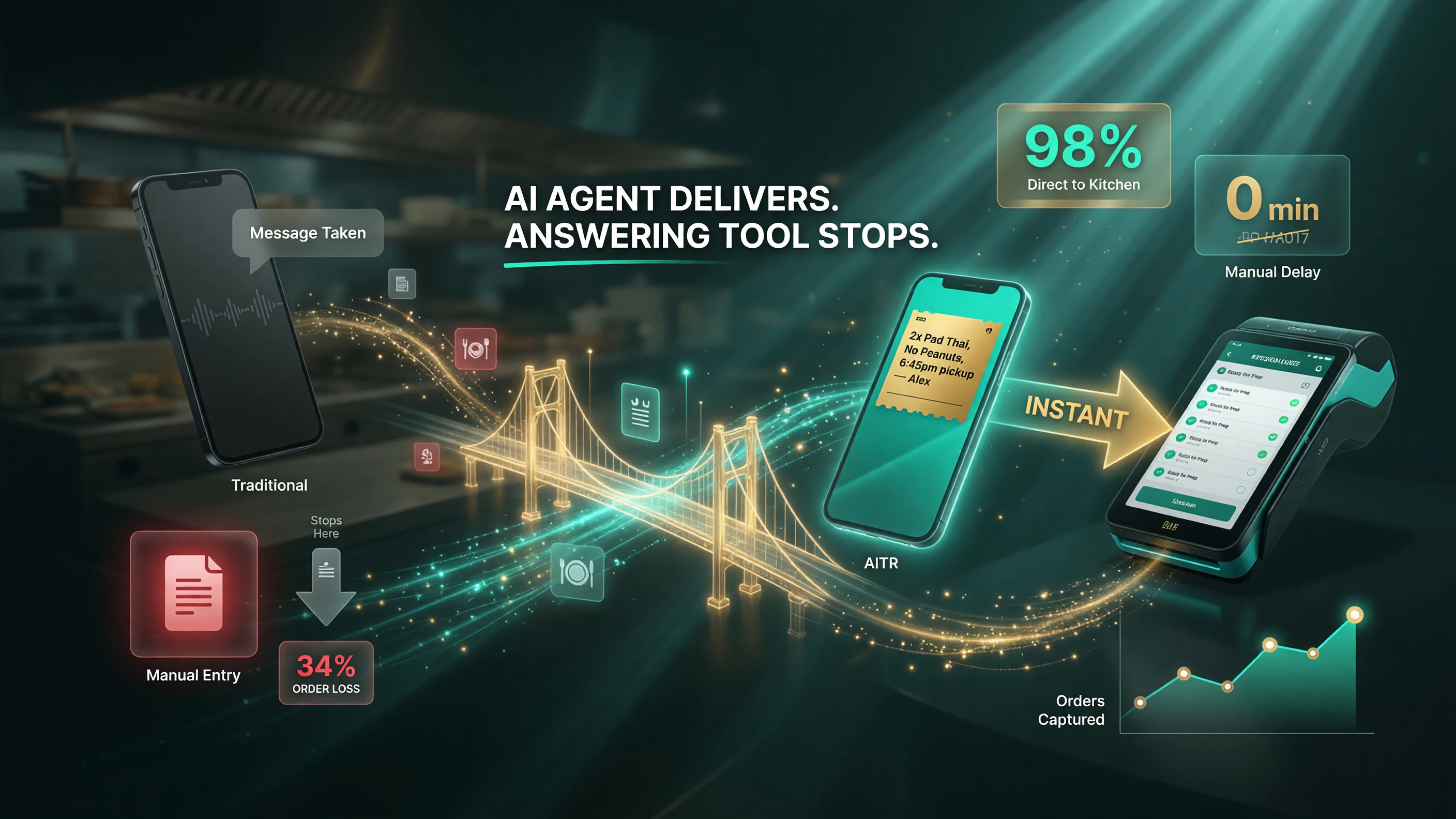
Where the value shows up: an answering tool ends at “message taken,” while a Maple-style agent pushes the captured order straight into the point-of-sale with zero manual re-entry — no lost orders, no limp callback.
Call answering, reservations, and the everyday stuff
Order taking is the headline, but Maple handles the full range of phone traffic that buries a small team. It answers routine questions about hours, directions, parking, and daily specials in a natural voice. It books, modifies, and cancels reservations, including through OpenTable for locations that run reservations there. It handles FAQ volume so your human staff are not repeating the same answers twenty times a night.
When a call genuinely needs a human — a catering inquiry, an escalated complaint, an unusual request — Maple transfers to a staff member rather than trying to bluff its way through. It is also multilingual, which matters for kitchens and neighborhoods across the United States where guests and staff speak multiple languages.
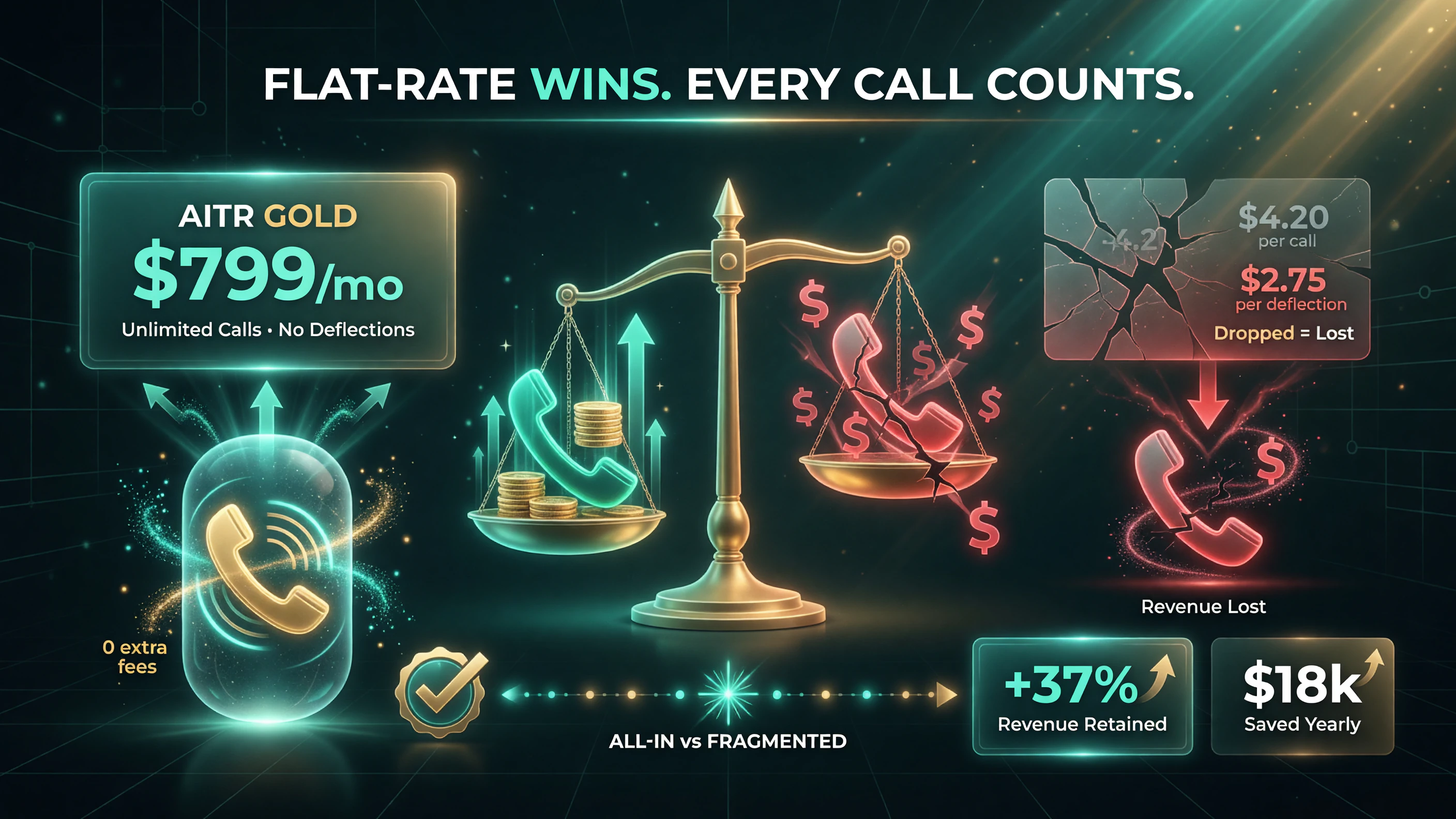
Why flat-rate wins for a phone-ahead restaurant: per-call and per-deflection pricing quietly builds up, and every call that ends in a message is revenue you had to call back to chase.
Maple vs the deflection-style AI answering tools
To understand where Maple sits in the market, it helps to separate phone AI tools into two camps. The first camp deflects: it answers, fields FAQs, and pushes callers toward an SMS link or an online ordering page. It protects your line but does not complete a sale on the phone. The second camp — where Maple lives — transacts: it takes the full order over the call and writes it into your POS.
For a pizzeria, an Italian spot, a diner, or a Thai takeout window, that transaction-completing difference is the entire point. Callers who want food want to order food, not click a link. When the AI finishes the job on the phone and the order is already in your system, you capture the same revenue you would have from a counter sale — minus the staff time.
The flat-rate pricing structure
Maple’s pricing is refreshingly simple for a category that loves to hide per-minute surprises. It runs flat monthly, with no per-call or per-minute fees — so a 200-call night costs the same as a slow Tuesday. Annual billing pulls the monthly rate down by roughly 37 to 43 percent.
The entry tier, Maple Voice, runs about $85 a month on annual billing or roughly $150 month-to-month. It covers call answering, FAQ handling, hours and directions, call transfer, analytics, and multilingual support — a solid option if you do not need order-taking or reservations but want to stop missing calls.
The most popular plan, Maple Pro, runs about $220 a month on annual billing or roughly $350 month-to-month. It adds full phone order taking into your POS, reservations including OpenTable, all supported POS integrations, intelligent upselling, secure phone payments, and order confirmation texts. For a busy independent that takes a meaningful share of its business over the phone, Pro is the tier that actually moves revenue.
An Enterprise tier handles multi-location groups with custom pricing, volume discounts, a dedicated success manager, and custom integrations.
| Feature | Maple | Typical AI Answering Tool |
|---|---|---|
| Phone order taking | Full order over the call with modifiers and special requests | Deflects to SMS link or online ordering page |
| POS integration | Toast, Square, Clover, SkyTab, SpotOn — writes order to KDS | Often limited or requires re-keying |
| Menu sync | Items, prices, modifiers, 86’d availability auto-sync from POS | Often manual or static FAQ only |
| Pricing model | Flat monthly, no per-call or per-minute fees | Varies; some charge per minute or call |
| Revenue capture | Completes the sale on the phone | Does not complete a sale over the call |
| Reservations | Books, modifies via OpenTable integration | Answers questions only |
Where Maple earns its keep
The clearest ROI case is any restaurant that takes a meaningful share of its business by phone. Think pizzerias and Italian spots during dinner rush, diners and breakfast places when the morning line is long, Thai and Chinese takeout windows, or any counter-service operation where call-in orders were once a staple and quietly faded because nobody could pick up.
Maple also shines as a pure labor play even before you count captured orders. Every call it handles is minutes of a human’s time returned to the floor. If your host or manager currently breaks away from tables to answer the phone, Maple absorbs that interruption entirely — the call is handled, the order is in the POS, and your staff stayed focused on the guests in front of them.
The honest caveats
Maple is not magic, and a fair review flags the limits. Voice AI order-taking still stumbles on heavily accented or noisy calls, heavy background din, or very unconventional orders — which is exactly the kind of traffic a busy independent kitchen generates. You should expect occasional errors that a human would not make, especially at the margins of a chaotic Friday service.
The second caveat is that Pro pricing is real money for a small operator. At roughly $220 to $350 a month, Maple only pays for itself if it actually captures orders you were otherwise missing. A slow counter-service spot that takes a handful of calls a week will struggle to justify the top tier; a high-volume phone operation will recover it quickly.
Finally, test setup depth before you commit. Flat “live within minutes to 24 hours” claims sound great, but white-glove onboarding is reserved for Pro, and the quality of your menu sync and 86’d discipline determines how well the AI handles real service.
Maple vs doing it yourself with a human or a generalist AI
It is worth asking why your staff simply cannot answer more calls. The honest answer: in a rushed service, the phone is the lowest-priority task, and no amount of training fixes that. A human host answering the phone is a human who is not seating, not running food, not resolving a complaint. Maple removes that trade-off.
Against a general-purpose AI assistant you prompt yourself, Maple wins on integration depth. A generic model does not know your Toast menu, cannot write an order to your kitchen display, and will happily invent an answer when it does not know one. Maple is purpose-built for the restaurant call, trained on the real structure of an order, and wired to your actual systems.
What to test in your trial
If you bring Maple in for a trial, run it against the three scenarios that actually break phone agents. First, call during your busiest window and place a genuinely complex order — multiple items, modifiers, a special request, and a change of mind mid-call. See whether it holds the thread and lands the order correctly in your POS. Second, test an 86’d item and confirm it does not try to sell something you are out of. Third, test a human handoff — raise an unusual request and check that the transfer is smooth rather than awkward.
Pay attention to the confirmation loop too. A good phone agent reads the full order back and confirms before it hits the kitchen. If Maple does not nail that, you will eat the cost of wrong tickets on a busy night.
The bottom line
Maple is one of the more serious phone AI tools for independent restaurants because it is built to complete sales rather than deflect them. Full order-taking that writes straight into your POS, flat transparent pricing, and real integration with the systems operators already run make it a credible pick for any food business that still relies on the phone.
The decision comes down to your call volume. If you are missing meaningful orders because you cannot pick up during a rush, Pro pays for itself quickly by capturing revenue your staff physically cannot reach. If your phone is quiet and most business flows online or in person, the cheaper answering tier keeps your line covered without the order-taking overhead. Either way, Maple deserves a real trial before you dismiss phone AI as a gimmick — this is the rare version that ends with money in the till, not just a polite chatbot.
Frequently Asked Questions
What is Maple AI for restaurants?
Maple is a voice AI phone agent built for restaurants. It answers calls, handles FAQs, books reservations, and most importantly takes full phone orders — including modifiers and special requests — and pushes them directly into your POS so they appear on the kitchen display. Pricing is flat monthly with no per-call fees.
Does Maple integrate with Toast and Square?
Yes. Maple supports native two-way integration with Toast, Square, Clover, SkyTab, and SpotOn. The menu, including items, prices, modifiers, and availability, syncs automatically from your POS, and orders taken over the phone appear directly in your system without re-keying.
How much does Maple cost?
Maple Voice starts around $85 a month on annual billing or roughly $150 month-to-month, covering call answering and FAQs. Maple Pro, around $220 a month annual or roughly $350 monthly, adds full phone order taking, reservations, and all POS integrations. There are no per-call or per-minute fees.
Can Maple take a full restaurant order over the phone?
Yes — that is its core capability. Maple works through modifiers, combos, and custom requests, confirms the order back to the guest, and writes it directly into your POS to flow to the kitchen. It also supports secure phone payments and order confirmation texts.
Is Maple better than a general AI chatbot for my restaurant?
For phone traffic, yes. A general chatbot cannot take a real order or write to your Toast or Square system. Maple is purpose-built for restaurant calls — it knows your menu, handles the structure of an order, and completes the sale on the phone rather than deflecting to an online link.
Is Maple worth the cost for a small restaurant?
It depends on your call volume. If you miss meaningful orders because staff cannot pick up during a rush, Maple Pro captures revenue your team physically cannot reach and pays for itself quickly. If your phone is quiet, the lower-cost answering tier keeps your line covered without the order-taking overhead.

About Barak Schurr
Barak Schurr built and exited a major ticketing platform, ran global operations at Eventbrite, and now focuses on one question: which AI tools actually help independent restaurant owners run leaner and grow faster. He writes from the operator’s perspective — no vendor spin, no theory, just what’s real in 2026.
Email: [email protected]
More Resources for Restaurant Operators