The 5 Most Popular AI Tools Independent Restaurants Use in 2026 (Ranked by Real Adoption Data)
\n\n
⚡ Expert Summary: Toast IQ is the single most widely used AI system in U.S. restaurants in 2026 — 125,000+ locations engaged with it in Q1 2026 out of a roughly 171,000-location installed base. Square AI follows as the pick for smaller independent operators, with voice AI (Presto at chains, Slang.ai at independents) the fastest-growing category, and one general-purpose tool earns its spot because almost every owner already has it open. This ranking is built on real adoption numbers and what independent owners actually run — not vendor hype.
\n\n
Search “which AI do independent restaurants actually use” and you get a wall of listicles recycling the same names. What you rarely get is a straight answer backed by real numbers: which systems have actual locations running them, and which are just loud marketing.
\n\n
By 2026 adoption data, the picture is clearer than the hype suggests. A National Restaurant Association survey found 26% of U.S. operators now use AI-related tools, and a TouchBistro study of 600 independents reported 95% using some form of AI. The real question owners ask is narrower and more useful: which specific systems should I bet on?
\n\n
This ranking answers that with named-systems usage data — the platforms with real location counts, real engagement numbers, and real traction among independent operators in 2026. If you run one restaurant or a small local group, these five are the tools your peers are actually paying for.
\n\n
How We Ranked These Five
\n\n
We ranked by genuine U.S. adoption signals rather than feature checklists: total restaurant locations a platform serves, how many of those locations actively engage with the AI feature, and where the tool appears across tracked restaurant sites. Vendor self-reported numbers were cross-checked against industry surveys (National Restaurant Association, TouchBistro, PAR Technology) and third-party tracking. The list is scoped to what independent owners run day to day, not enterprise-only pilots.
\n
 \n\n
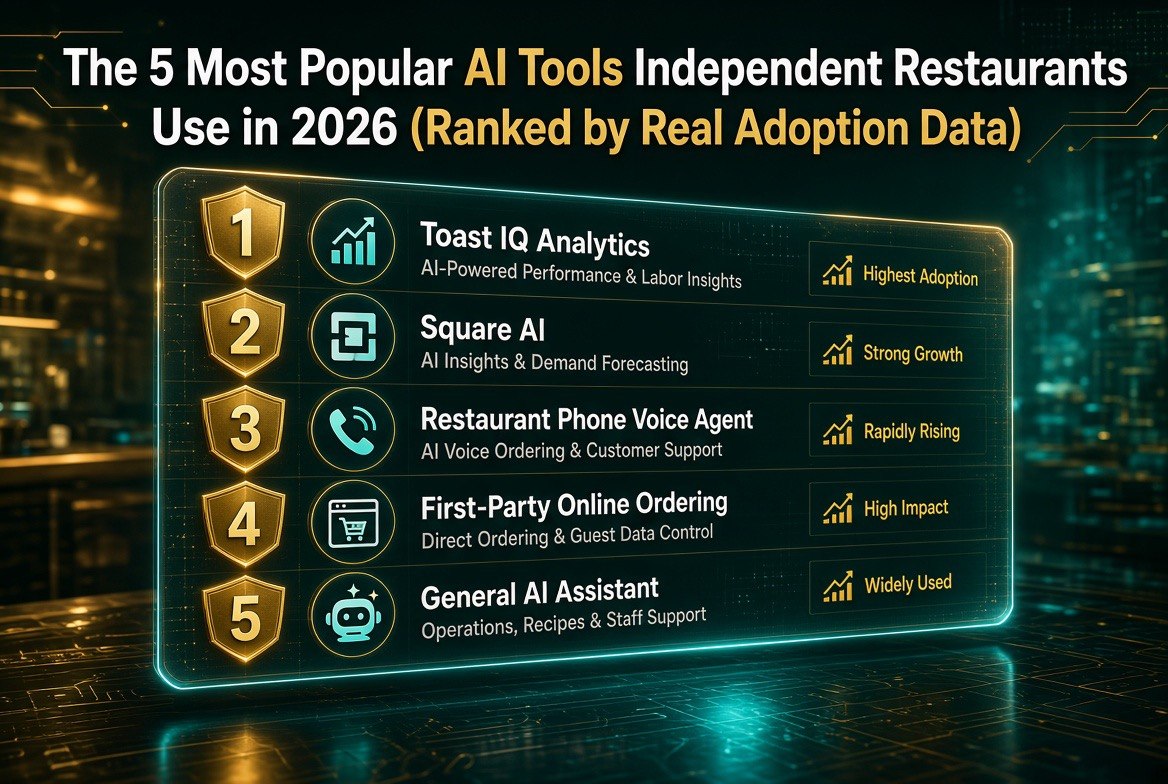
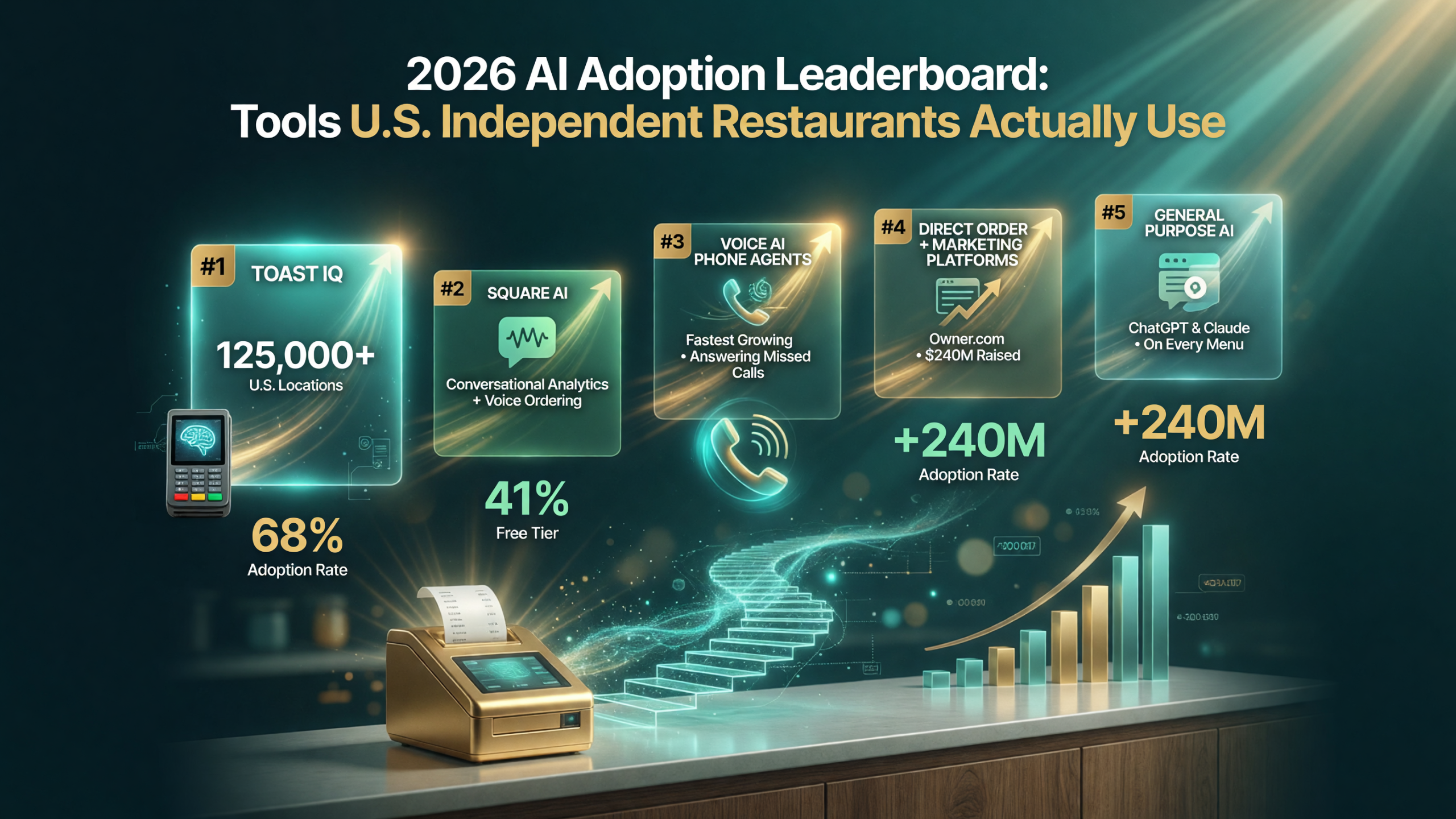
How the 2026 adoption data shakes out: a ranked leaderboard of the five AI tools independent restaurants actually run, led by Toast IQ at 125,000+ locations in Q1 2026.
\n\n\n
| Rank | AI Tool | What It Is | Real 2026 Adoption Signal |
|---|---|---|---|
| 1 | Toast IQ | AI analytics assistant inside the Toast POS | 125,000+ U.S. locations engaging in Q1 2026 |
| 2 | Square AI | Conversational analytics + voice ordering for smaller ops | On ~18% of tracked U.S. restaurant sites; free-tier AI |
| 3 | Voice AI phone agents (Slang.ai / Loman / similar) | Answer missed calls, reservations, and phone orders | Fastest-growing category for independents in 2026 |
| 4 | Marketing + direct-order platforms (Owner.com / Popmenu) | AI-driven web, marketing, and no-commission ordering | Owner.com just raised $240M; powers more locations than many chains |
| 5 | General-purpose AI (ChatGPT / Claude) | Menus, social posts, review replies, email drafts | The default first AI most independents already pay for |
\n\n
That is the 2026 adoption leaderboard in one glance. Below, each tool gets the detail an owner actually needs: what it costs, what real operators use it for, and where it fits.
\n\n
1. Toast IQ — The Default Answer for Scale
\n\n
If you want the single most-installed answer to “which AI do restaurants use,” it is Toast IQ. Toast’s POS sits on roughly 171,000 restaurant locations, and the company reported 125,000+ U.S. locations actively using Toast IQ‘s conversational assistant in Q1 2026 — with 40,000+ weekly active users and 21 million-plus conversation threads. No other restaurant AI comes close to that engagement base.
\n\n
What independent owners actually ask Toast IQ: sales and revenue questions lead (47% of restaurants), followed by menu and inventory (34%) and guests and marketing (32%). The most common specific uses are menu optimization (26%) and labor cost and efficiency checks (13%). Notably, fine-dining locations use it 29% more than fast-casual spots — the owners with complex menus get the most value from asking their POS plain questions.
\n\n
The catch for a true independent: Toast IQ rides on the Toast POS, so it is only relevant if you already run Toast or are willing to move your whole point-of-sale to get the AI. For owners already in the Toast ecosystem, it is the easiest AI win on this list because there is nothing extra to install — it is baked into the terminal you already use.
\n\n
2. Square AI — The Free-Tier Option for Smaller Independent Operations
\n\n
Square is the natural alternative when you are a smaller independent or a single-location operator who does not want a big POS commitment. Square AI brings conversational analytics to the Square platform — you query sales, labor, inventory, and even external factors like weather and local events in plain language. It also adds AI voice ordering to answer phone calls and an integration that lets customers order directly through ChatGPT or Claude at low fees with no separate marketplace commission.
\n\n
Square appears on the websites of roughly 18% of tracked U.S. restaurants — smaller than Toast’s one-third-plus share but built around the exact independent owner this vertical serves: no long-term contract, a genuinely free tier to start, and AI that does not require you to rip out your existing setup or sign a multi-year deal.
\n\n
Square earns its rank not on raw locations but on accessibility. For a solo owner who wants to test restaurant AI before committing real money, Square AI is the lowest-friction on-ramp here — which is exactly why independents adopt it.
\n\n
3. Phone Voice AI — The Fastest-Growing Category for Independents
\n\n
Voice AI is where growth is happening fastest in 2026, and for independents the phones are the battleground — not the drive-thru. When you miss a call because you are cooking, that is a lost reservation or a lost order. Phone voice agents answer those calls, take reservations, field FAQs, and capture orders without a human picking up.
\n\n
The biggest names in drive-thru voice AI are chain-focused: Presto runs enterprise QSR drive-thrus for brands like Dairy Queen, Del Taco, and Carl’s Jr., and raised $10 million in January 2026 to scale; SoundHound powers White Castle’s “Julia” and phone ordering at hundreds of Red Lobster locations. But the tools an independent owner actually adopts are the phone-first agents aimed at small operations — Slang.ai (reservations and FAQs from around $199 a month per location) and Loman AI being the two most frequently cited.
\n\n
For a single independent restaurant, a phone agent delivers the fastest, most measurable AI ROI on this entire list: it catches the calls you are already missing. If you lose even two or three reservation calls a day to voicemail, a ~$200-a-month agent pays for itself quickly.
\n\n
4. Marketing + Direct-Order Platforms — Cut the Commission, Keep the Customers
\n\n
The platforms that combine AI marketing with commission-free direct ordering have quietly become some of the most-adopted tools in independent restaurants — largely because they attack the thing owners hate most: paying 30% to delivery apps.
\n\n
Owner.com is the standout on pure scale. It raised $240 million in 2026 and now powers more U.S. restaurant locations than Domino’s or Taco Bell, built on giving independents an AI-driven website, marketing engine, and direct-ordering system where they keep the customer data and skip third-party delivery commissions. Popmenu plays a similar role with menus, marketing, and online ordering. The appeal is unified: one platform that runs your web presence, sends the marketing, and routes orders straight to your staff instead of through a delivery marketplace.
\n\n
This category ranks fourth on raw installs but is arguably second on sheer daily usefulness for an independent owner, because it replaces a patchwork of expensive subscriptions and directly increases the profit on every order.
\n\n
5. General-Purpose AI — The Tool Independents Already Have Open
\n\n
Rounding out the five is the one most owners never think of as “restaurant AI”: a general assistant like ChatGPT or Claude. Independent owners lean on it constantly for the unglamorous work — drafts of social posts, menu descriptions, replies to reviews, email responses to suppliers and staff. In the TouchBistro survey, marketing content (30%) and menu creation (31%) were among the top uses of AI across 600 independents, and much of that work happens in a general-purpose chatbot.
\n\n
It ranks fifth not because it is weak but because it is general — it is not purpose-built for a restaurant’s specific data the way a POS-integrated or phone agent is. But it is the lowest-cost (often free or a few dollars a month) and the easiest to start with today. If you have not used any restaurant AI yet, this is the tool you already have open on your phone that proves the concept before you subscribe to anything specialized.
\n\n
The Side-by-Side Comparison
\n\n
Here is how the five stack up on the factors an independent owner actually balances — cost to start, effort to set up, and the specific job each handles best.
\n\n
| Factor | Toast IQ | Square AI | Voice Agents (indie) | Marketing + Direct Order | General AI |
|---|---|---|---|---|---|
| Best single use | Ask-your-data analytics | Low-cost all-rounder + voice | Catch missed calls / orders | Own-brand ordering + marketing | Content, menus, review replies |
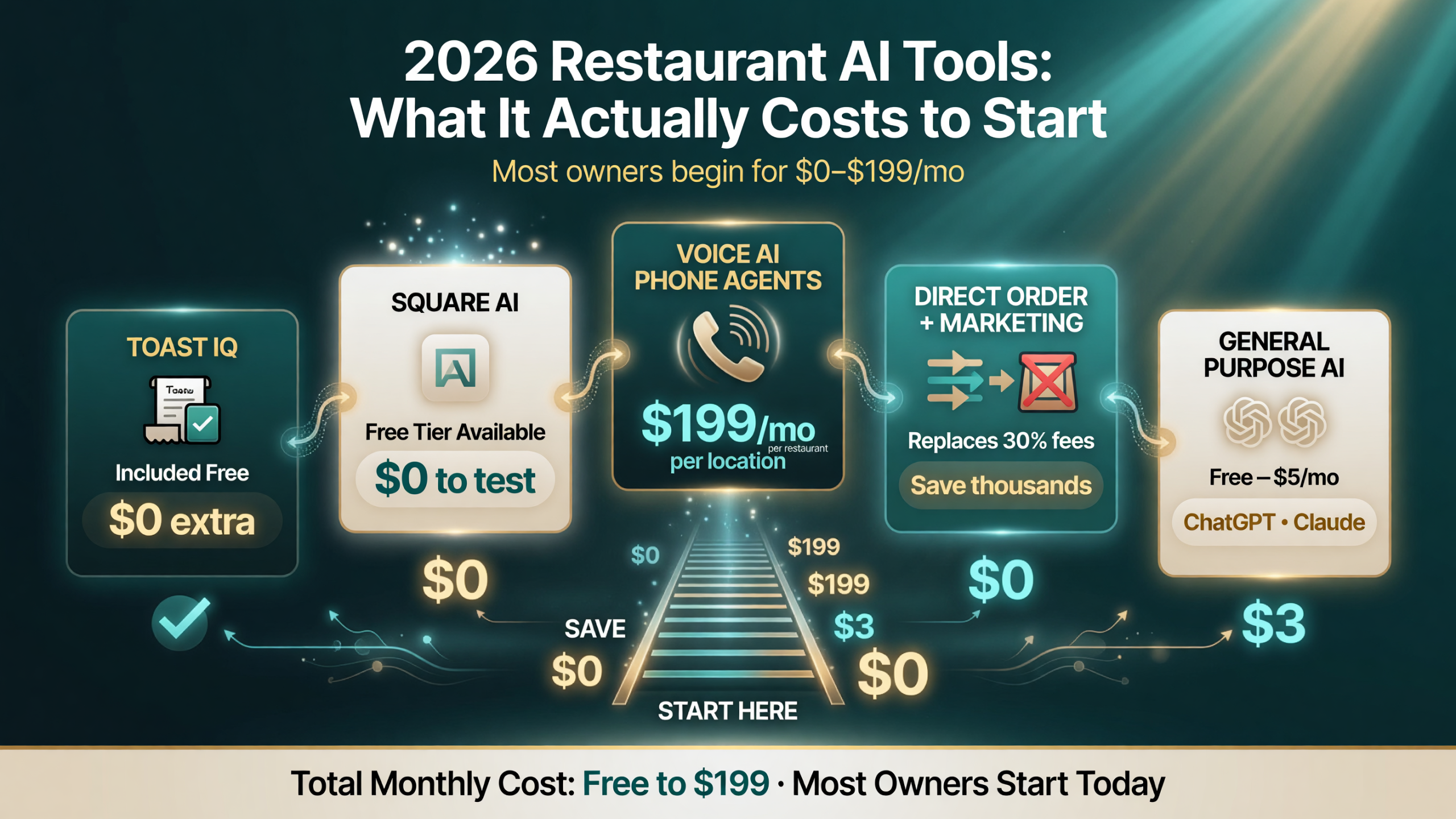
| Cost to start | Included with Toast POS | Free tier available | ~$199+/mo per location | Subscription; replaces 3PD fees | Free to a few $/mo |
| Setup effort | None if on Toast POS | Low — free tier to test | Moderate — connect phone line | Moderate — build ordering site | Zero — already installed |
| Best for | Owners already on Toast | Small single-location ops | Anyone missing phone calls | Owners tired of 30% delivery fees | Absolute beginners |
\n\n
 \n\n
What it really costs to start with the top restaurant AI tools — from $0 extra with Toast IQ or Square’s free tier, up to roughly $199 a month per location for phone voice agents that replace delivery-app commissions.
\n\n
Which One Should You Start With?
\n\n
Do not sign up for all five. Start where your biggest leak is.
\n\n
 \n\n
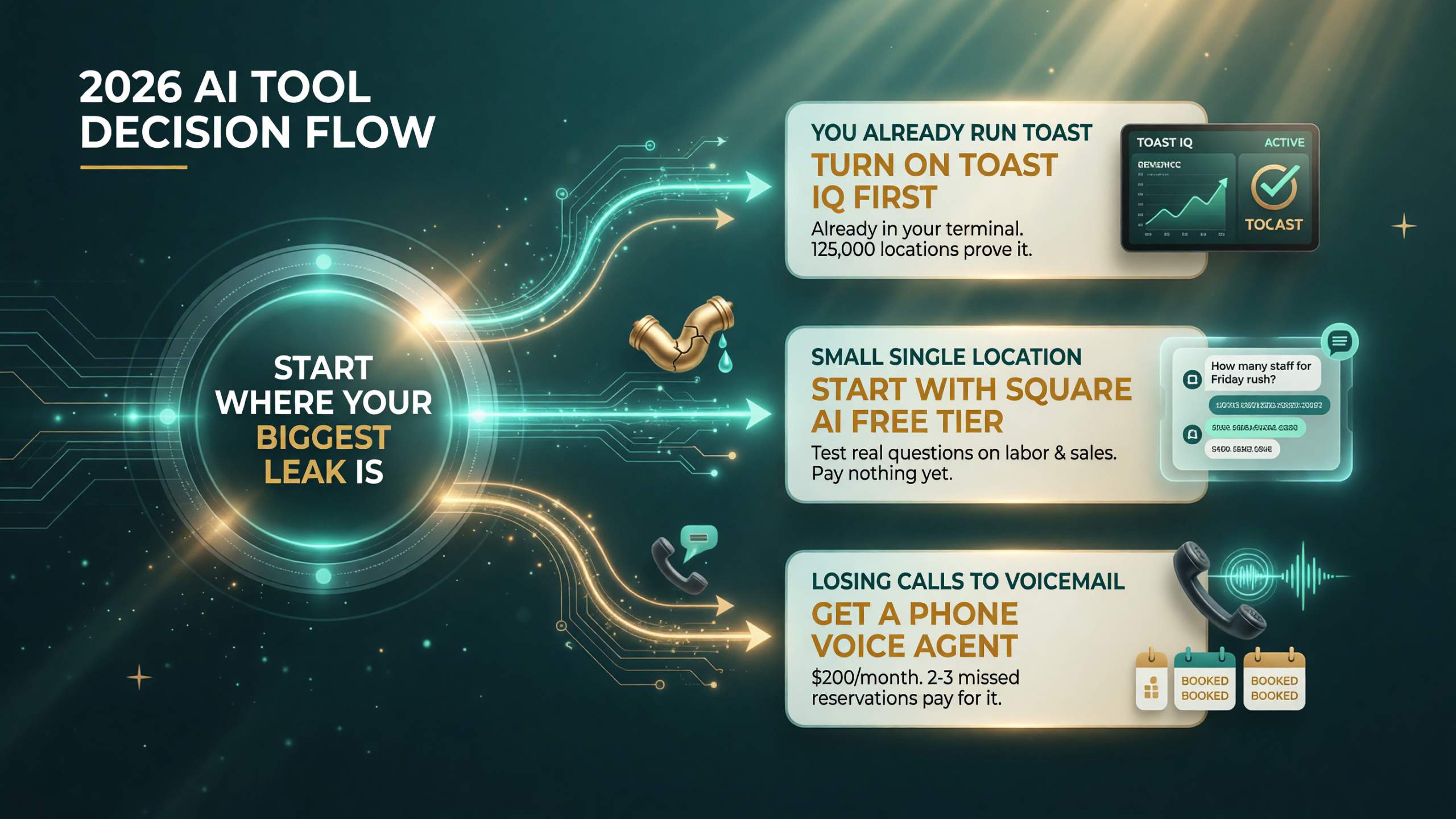
Start where your biggest leak is: on Toast, flip on Toast IQ first; small single location, open Square’s free tier; losing calls to voicemail, put a voice agent on the line for around $200 a month.
\n\n\n
If you already run Toast: turn on Toast IQ first — it is already in the terminal you use, and 125,000 other locations prove it works. Ask it your sales and menu questions this week.
\n\n
If you are a small single location not on Toast: open Square AI‘s free tier and test it on real questions about your labor and sales before you pay for anything.
\n\n
If you are losing calls to voicemail: skip the analytics tools and get a phone voice agent on your line — that is the fastest paying-for-itself decision on the list.
\n\n
If you are watching a third of every delivery order go to fees: look at a direct-order platform like Owner.com or Popmenu, which pays for itself the moment it replaces your delivery-app dependence.
\n\n
If you have not used any AI yet at all: use the general assistant already on your phone to write your next menu description or review reply, and see how much time it saves before you commit a subscription anywhere.
\n\n
The through-line from the 2026 data is simple: the most popular restaurant AI tools are not the flashiest — they are the ones that solve a specific, expensive problem an owner already has, whether that is unanswered calls, buried sales data, or delivery commissions eating margin. Match the tool to the leak, and adoption pays for itself.
\n\n
Frequently Asked Questions
\n
What is the most widely used AI system in U.S. restaurants in 2026?
\n
Toast IQ is the most widely used integrated restaurant AI, with 125,000+ U.S. locations engaging with its conversational assistant in Q1 2026 out of a roughly 171,000-location Toast base. No other single restaurant AI approaches that level of active engagement.
\n
Is the most popular AI tool always the best one for an independent restaurant?
\n
No. Toast IQ has the largest adoption base but only helps owners already on the Toast POS. Square AI is better for small single-location operations, phone voice agents win for restaurants missing calls, and direct-order platforms win for owners hit hard by delivery-app fees. Match the tool to your specific problem.
\n
How much does restaurant AI cost for an independent owner in 2026?
\n
Costs range from free (Square AI’s tier, general-purpose assistants) to included with your POS (Toast IQ) to roughly $199 or more per month per location for phone voice agents. Direct-order platforms are subscriptions that usually replace what you were paying in delivery-app commissions.
\n
Do independent restaurants really use AI, or is it mostly chains?
\n
Both, but differently. Chains dominate high-profile drive-thru voice AI, while independents adopt lower-friction tools: POS-integrated analytics, phone agents, and direct-order marketing platforms. A TouchBistro survey of 600 independents reported 95% using some form of AI, led by inventory, menu, and marketing tasks.
\n
Will general-purpose AI like ChatGPT replace restaurant-specific tools?
\n
No — they do different jobs. A general assistant is great for content, menus, and replies, but it lacks access to your live sales, inventory, and phone line. Purpose-built tools (Toast IQ, phone agents, direct-order platforms) act on your real restaurant data, which a general chatbot cannot do on its own.
\n\n\n\n\n
\n\n

About Barak Schurr
Barak Schurr built and exited a major ticketing platform, ran global operations at Eventbrite, and now focuses on one question: which AI tools actually help independent restaurant owners run leaner and grow faster. He writes from the operator’s perspective — no vendor spin, no theory, just what’s real in 2026.
Email: [email protected]
\n\n
More Restaurant AI Resources
\n
 \n
\n
 \n
\n
\n
\n\n\n\n\n\n