Get the AI Restaurant Quick-Start Guide — Free
The 5 AI tools independent US restaurant owners are using right now to cut labor costs and answer every call.
Best AI Catering & Private Event Tools for Independent Restaurants in 2026
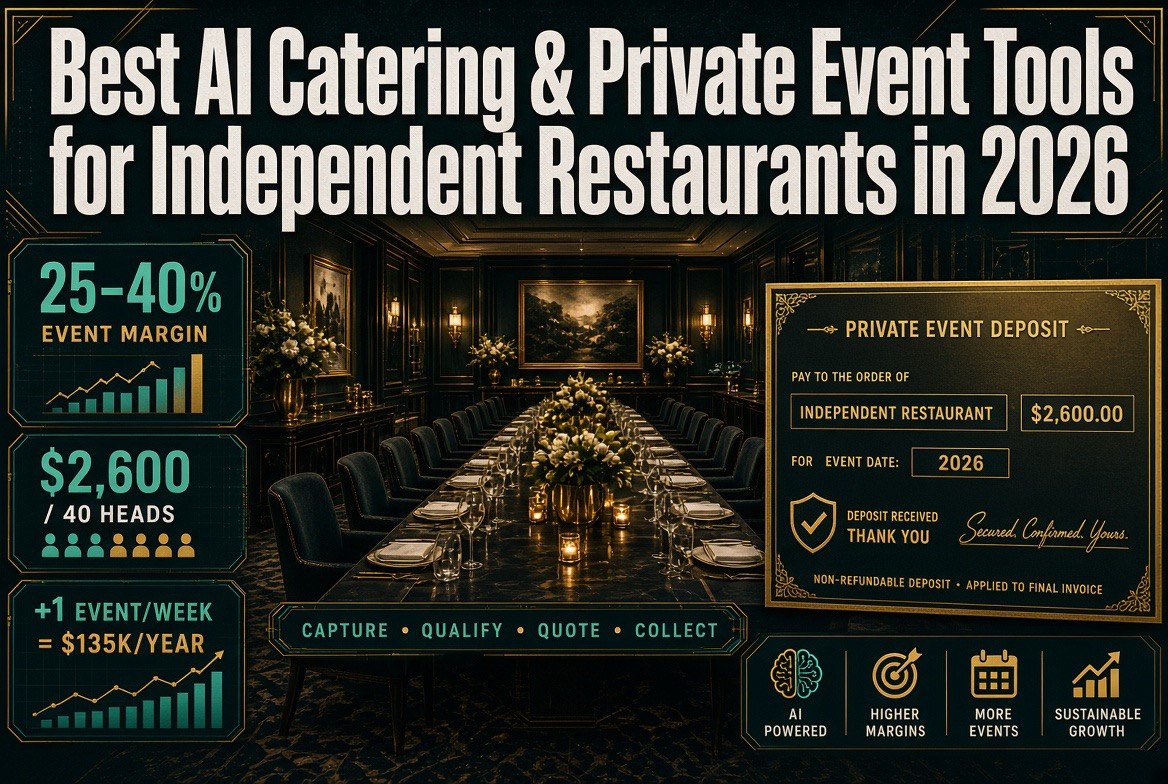
⚡ Expert Summary: Catering and private events are the highest-margin revenue most independent restaurants already have access to and consistently under-sell. One booked private event can equal a full week of dinner service in profit, with no third-party commission taken off the top. This guide compares the AI tools that handle event inquiries, quotes, deposits, and follow-up, and shows you which stack fits a single-location operator.
Your dining room sells covers at a margin of 10 to 15 percent. A private event sells the same kitchen’s output at a margin of 25 to 40 percent, often with a deposit collected thirty days before the food is ever cooked. The labor is scheduled in advance. The menu is fixed. The spend per head is set before anyone walks in. For independent US restaurants, that gap is the difference between surviving a soft quarter and growing through it.
So why do independent restaurants let event inquiries die in an unread inbox?
Because catering does not behave like service. A reservation is a transaction. A catering inquiry is a sales process — it needs a reply inside an hour, a quote built from variable headcount and menu choices, a deposit link, a contract, and a follow-up sequence over weeks. That is a B2B sales workflow sitting inside a restaurant that has no sales team.
That gap is exactly what AI event tools close. Here is what actually works for a single-location independent operator in 2026.
Quick Verdict
Tripleseat wins for restaurants that book several private events a month — it is the most complete AI-assisted event sales platform, handling capture, quoting, contracts, and deposits in one pipeline. Perfect Venue wins for smaller independents that want a clean booking calendar and deposit collection without the setup burden. Neither fixes the real bottleneck: unanswered inquiries. Add AI call answering first, then pick your platform.
If you run one location and want the fastest path to capturing event revenue you are currently losing, start with the platform layer you already pay for. Add a general-purpose AI layer (Claude or ChatGPT) for writing proposals and follow-ups, and add an AI answering layer if your phone is not being picked up during service.
Do not buy an event platform before you fix response time. A perfect booking system does nothing if the inquiry sits unanswered for six hours while your team runs Friday dinner.
Why Catering Is the Highest-Leverage AI Project for US Independent Restaurants
Most restaurant AI spending goes into labor scheduling, inventory, and phone answering. Those are cost-control projects. They protect margin. Catering is a revenue project, and the ceiling is far higher.
Consider the arithmetic on a single booking. A 40-person private dinner at $65 per head is $2,600 of revenue, plus beverage, plus a service fee, plus gratuity. Your food cost on a fixed menu is controllable and lower than à la carte because you are buying and prepping against known counts. There is no third-party delivery commission taking 25 to 30 percent. There is no no-show risk because the deposit was collected up front.
Now consider volume. If your restaurant books even one additional private event per week at that size, you have added roughly $135,000 of annual revenue from a channel that costs nothing to market to — the inquiries are already arriving. They are just not converting.
That conversion problem is where AI has a genuine, measurable edge, because the bottleneck is not culinary. It is administrative throughput.
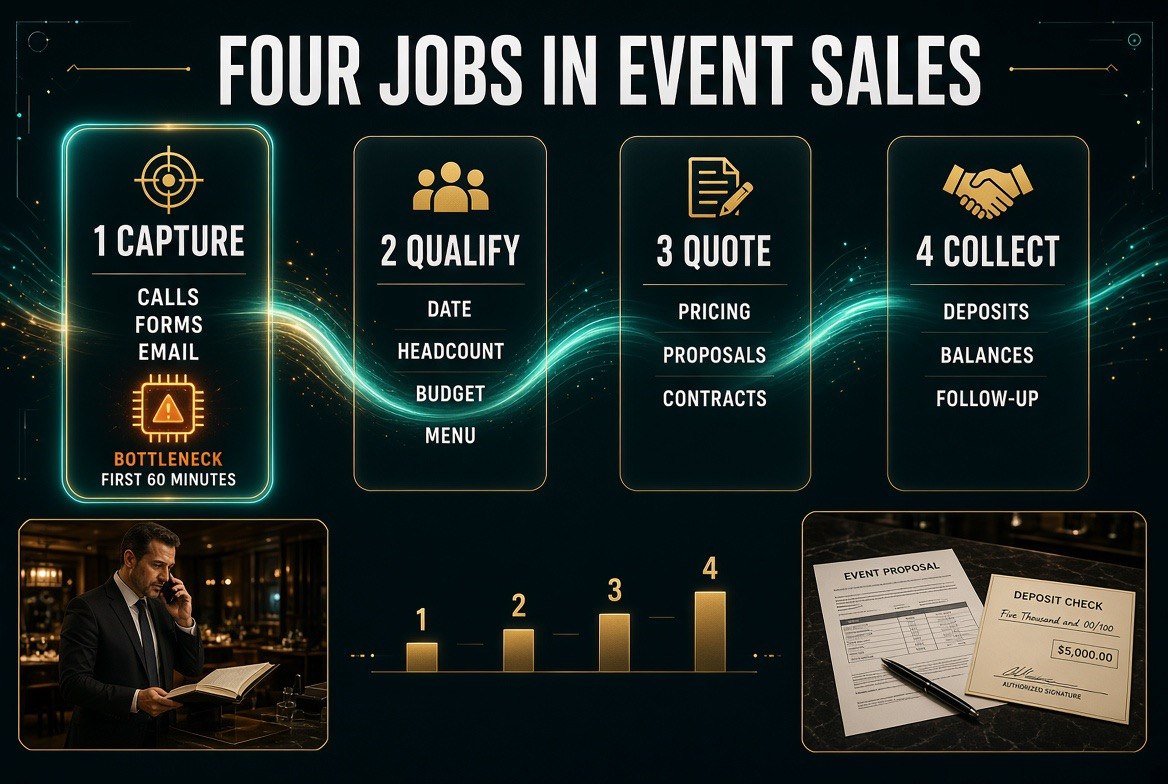
Every catering tool you buy does some combination of these four jobs. Capture is the one that decides whether the rest of the stack ever gets used — the first sixty minutes after an inquiry arrives are where most independent restaurants lose the booking.
The Four Jobs AI Event Tools Actually Do
Every tool in this roundup does some combination of four jobs. Understanding which job you are buying for keeps you from over-paying.
| Job | What It Covers | Why It Matters to Margin | Where AI Adds Value |
|---|---|---|---|
| Capture | Calls, web forms, email inquiries | Every unanswered inquiry is lost revenue | AI answering + intent routing |
| Qualify | Date, headcount, budget, menu fit | Stops your team quoting dead leads | Automated intake questionnaires |
| Quote | Pricing, proposals, contracts | Faster quotes win more bookings | Template generation, auto-pricing rules |
| Collect | Deposits, balances, follow-up | Deposits eliminate no-show loss entirely | Automated payment + reminder sequences |
Most operators buy for the quote job and neglect capture. That is backwards. The bottleneck is almost always the first sixty minutes after an inquiry arrives.
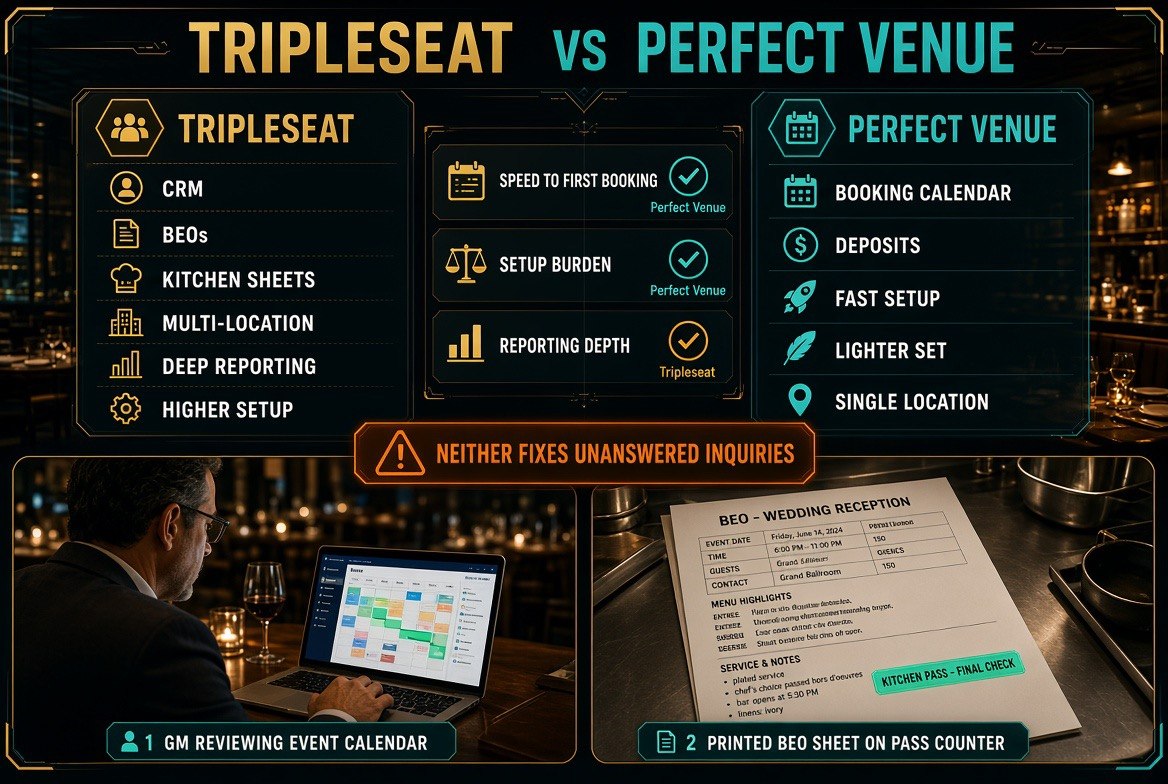
The trade-off in one view: Perfect Venue wins on speed to first booking and setup burden, Tripleseat wins on reporting depth and multi-location control. Neither one answers the phone — fix response time before you buy either.
The Top AI Catering & Private Event Tools Compared
Here is how the leading platforms stack up for an independent, single-location restaurant.
| Factor | Tripleseat | Perfect Venue |
|---|---|---|
| Best for | Operators who want a complete event sales platform | Small operators who want simple booking without bloat |
| Lead capture | Web forms, email parsing, phone logs, inquiry routing | Web booking widget with availability calendar |
| Quoting | Templated menus, auto-pricing, proposals, contracts | Package-based pricing with optional add-ons |
| Payment handling | Deposits, installments, balance collection, BEO generation | Deposit collection at booking, card on file |
| Calendar & space | Multi-space management, shared calendars, staff tasks | Single-space or simple multi-space, clean calendar |
| AI features | Smart lead scoring, automated follow-up, document drafting | Automated guest messaging, booking reminders |
| Setup burden | Higher — menus, packages, and rules must be configured | Lower — usable in an afternoon |
| Ongoing cost | Monthly per-location subscription, priced above the entry tier | Monthly subscription at a friendlier entry point |
The honest read: Tripleseat is a sales system and Perfect Venue is a booking system. Both solve the same core problem, but they assume different amounts of administrative attention from you. Pick based on how much time you will really put into it, not on the feature list.
Tripleseat: The Full Event Sales Platform
Tripleseat is built for the restaurant that wants to treat private events as a real business line. It pulls inquiries in from web forms, email, and phone logs into one pipeline, then walks a booking from initial inquiry through proposal, contract, deposit, and a kitchen-ready event order.
What makes it worth the money for a restaurant that actually books events is the document layer. You build menus and packages once, and the system generates proposals and contracts from them. Pricing rules handle headcount tiers, add-ons, and service fees without anyone rebuilding a spreadsheet. Deposits and balances collect automatically. The kitchen gets a structured event order instead of a text message.
Where it asks something of you: setup is real work. You have to define your menus, packages, minimums, and pricing rules before it starts saving you time. Operators who skip that step end up with a system that is slower than their inbox.
Who it is for: Restaurants booking at least several private events a month across one or more spaces, where the labor cost of manually quoting has become the actual constraint.
Perfect Venue: The Simpler Booking System
Perfect Venue takes the opposite approach. Instead of a full sales CRM, it gives you a clean booking system: an availability calendar, packages with pricing, a deposit collected at booking, and automated guest messaging.
For a small independent restaurant booking private events occasionally, this is often the right call. It removes the back-and-forth email chain, it stops double-booking a private room, and it takes the deposit before you commit the date. The AI layer is modest — automated messaging and reminders rather than lead scoring — but the reduced administrative surface is the point.
Where it asks something of you: it is a booking system, not a pipeline. If your problem is generating and chasing leads rather than closing them, you will want the capture layer on top.
Who it is for: Single-location independents who book private events regularly but not at a volume that justifies a full event sales platform.
Where General AI Beats Specialty Tools in Event Sales
Not every job needs a vertical SaaS subscription. Two jobs in the catering workflow are handled better and cheaper by a general AI model than by a dedicated platform.
The first is proposal writing. Event proposals are formulaic but not identical — headcount, menu tier, season, and occasion all shift the language. A general model with your menu and pricing as context drafts a proposal in seconds that a booking platform’s rigid template cannot match. You keep the pricing authority and let AI handle the prose.
The second is follow-up sequencing. Catering sales cycles run weeks, and most lost bookings are simply forgotten bookings. A general AI layer can draft the four-touch follow-up sequence — day one, day three, day seven, day fourteen — in your voice, ready to paste into whatever system you already run.
Use specialty platforms for the parts that must be structurally correct: pricing math, contracts, deposits, and calendar integrity. Use general AI for the parts that are text. That split gets you a complete workflow without paying vertical SaaS prices for copywriting.
Building the Stack: A Decision Framework
Here is how I would choose, based on where your specific bottleneck sits.
| Your Situation | Start With | Add Next |
|---|---|---|
| Inquiries arriving but never answered fast | AI phone answering for event calls | Booking system with deposit collection |
| Quoting eats hours every week | Tripleseat with templated menus | General AI for proposal prose |
| Occasional events, no system at all | Perfect Venue | Follow-up sequence drafted with AI |
| Deposits collected inconsistently | Auto-deposit at booking | Automated balance reminders |
| Running multiple private spaces | Tripleseat multi-space calendar | Staff task automation per event |
Notice the pattern. Every path starts by fixing capture and ends by fixing conversion. The platform decision comes in the middle, and it matters less than people assume.
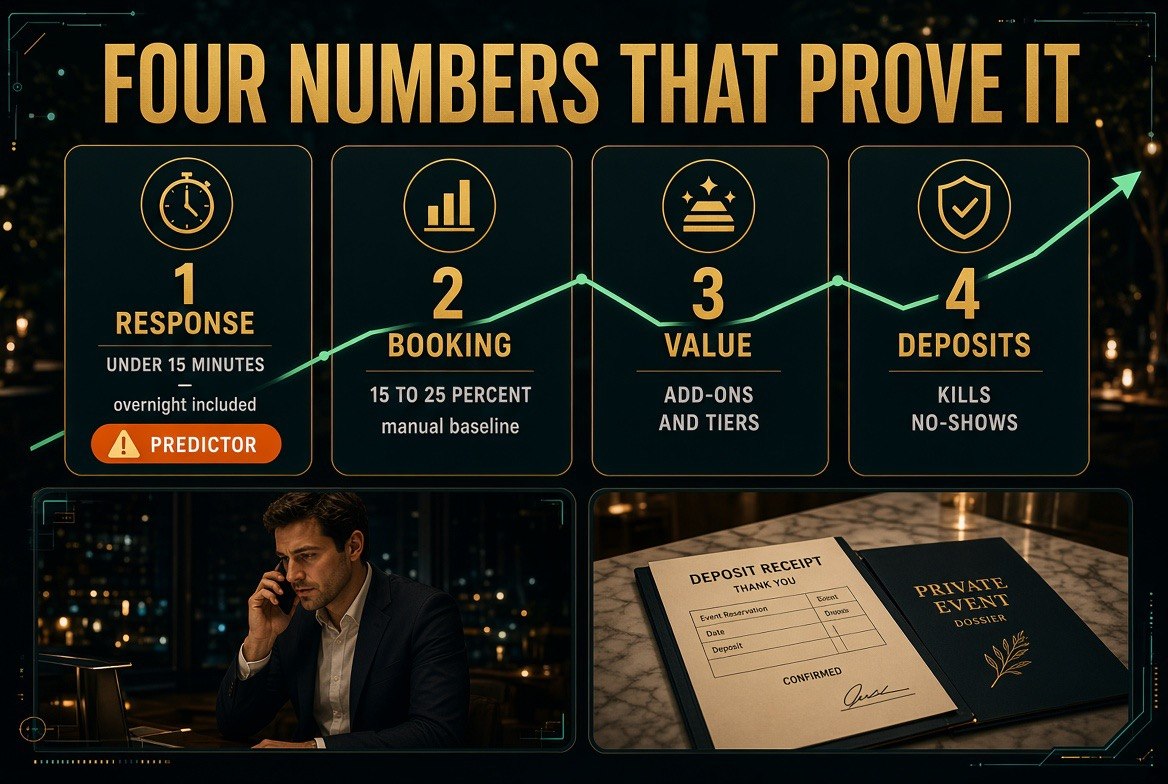
Track these four and you can defend the subscription. Response time is the strongest single predictor of conversion, and deposit collection rate is the number that removes no-show loss from your P&L.
The Metrics That Tell You It Is Working
If you deploy any of this and cannot measure it, you cannot defend the subscription. Track four numbers. If you are still building out your stack, our restaurant AI tools hub covers the rest of the operation — voice, inventory, scheduling, and reviews.
Inquiry response time. The single strongest predictor of whether a catering inquiry converts. Automated capture should push this under fifteen minutes, including overnight.
Booking rate per inquiry. Before automation, most independents sit somewhere between 15 and 25 percent. A working capture-plus-follow-up stack should move this meaningfully, because you are no longer losing bookings to silence.
Average event value. AI quoting with well-built packages tends to raise this, because proposals surface add-ons and beverage tiers that a rushed manual quote forgets.
Deposit collection rate. If this is not near 100 percent, your booking process is leaking. Every uncollected deposit is a no-show risk you are carrying for free.
Track these monthly against your pre-tool baseline. If response time improves and booking rate does not, the problem is your pricing or your offering — not your software.
What AI Cannot Fix in Catering Sales
Worth being blunt about this, because vendor marketing is not.
AI cannot fix a menu that does not work for groups. If your private event menu is your regular menu scaled up, you will lose bookings to the restaurant down the street that built a package priced for a fixed headcount. AI automates the sales process; it does not create a product worth buying.
AI cannot fix capacity you do not have. If your kitchen cannot execute a 60-person plated dinner without breaking Friday service, more bookings will damage your reputation faster than they add revenue.
AI cannot fix pricing that is already too low. If your event pricing was set by gut feel years ago and never revised against current food costs, automation will just help you book more unprofitable work. Raise the prices first, then automate the quoting.
The tooling layer is the last step, not the first. Get the offer, the capacity, and the pricing right, and then deploy software to stop losing inquiries you should already be converting.
Frequently Asked Questions
Do independent restaurants really need dedicated catering software?
Not always. If you book private events occasionally, a simple booking system with deposit collection covers most of it. Dedicated catering platforms earn their cost once you are booking multiple events a month and manually quoting has become the bottleneck.
What is the fastest AI win for a restaurant with no event system?
Response time. Add an AI answering layer so event inquiries get an immediate reply, even during service and overnight, then collect the details through a structured intake form. Capture first, software later.
Can AI write catering proposals and contracts?
AI drafts proposals well when you give it your menus, packages, and pricing rules as context. Contracts and pricing math should come from a system that enforces the numbers, not from a generative model, because a drafting error in a contract is a real liability.
How much should a restaurant pay for event software?
Treat it as a percentage of the revenue it protects. If the tool helps you book one additional $2,500 event a month, almost any entry-tier subscription is justified. If your event volume is too low for that math to work, stay on a booking system until volume justifies more.
Does collecting deposits upfront hurt booking rates?
In practice, deposits raise them by filtering out non-serious inquiries. The exception is a market where competitors book private events with no deposit at all — in that case, use partial deposits rather than full prepayment.
Should I use AI to handle event inquiries by phone?
Yes, if your phone is not consistently answered during service and after hours. AI voice agents can capture date, headcount, and contact details and route the inquiry into your pipeline. What they should not do is negotiate pricing or commit to availability without a human confirming capacity.
What is the biggest mistake restaurants make with private events?
Treating them as a side project with no owner. Private events need a named person responsible for the pipeline, a defined response-time standard, and a system that enforces both. AI makes that person far more effective, but it does not replace having one.

About Barak Schurr
Barak Schurr built and exited a major ticketing platform, ran global operations at Eventbrite, and now focuses on one question: which AI tools actually help independent restaurant owners run leaner and grow faster. He writes from the operator’s perspective — no vendor spin, no theory, just what’s real in 2026.
Email: [email protected]
More Resources for Restaurant Operators