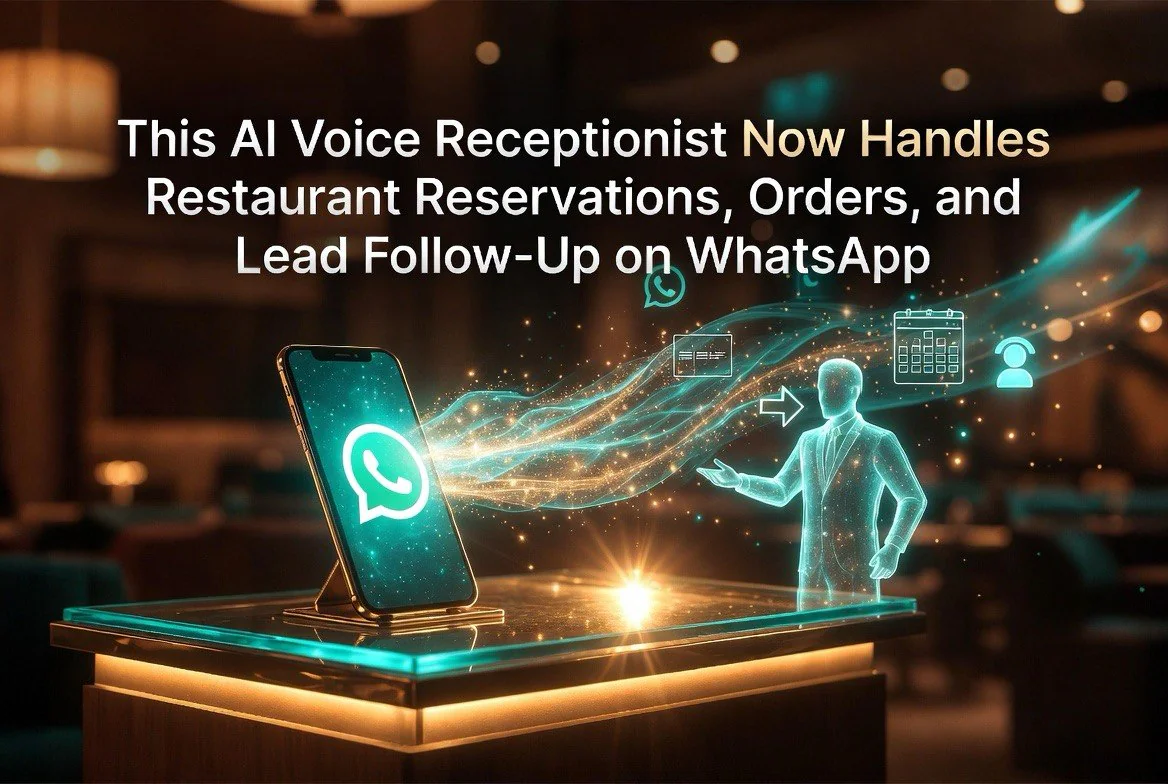
This AI Voice Receptionist Now Handles Restaurant Reservations, Orders, and Lead Follow-Up on WhatsApp
⚡ Expert Summary: A new generation of AI voice receptionist tools is expanding beyond traditional phone calls to handle restaurant communication across multiple channels, including WhatsApp, SMS, and web chat. These AI receptionists can book reservations, process takeout orders, answer menu questions, and follow up with leads — all without human involvement. For independent US restaurant operators, WhatsApp-based AI receptionists are particularly valuable for reaching the growing number of customers who prefer messaging over phone calls for restaurant interactions. The technology has matured to the point where setup takes hours, not weeks, with measurable ROI appearing within the first 90 days through higher booking conversions, reduced phone interruptions, and eliminated third-party reservation platform fees.
The Multi-Channel Shift in Restaurant Communication
Restaurant customers are increasingly choosing text-based communication over phone calls. The National Restaurant Association’s 2026 consumer survey found that 47% of US consumers prefer to use text messaging or WhatsApp for restaurant communication — reservations, order inquiries, menu questions — compared to 38% who still prefer phone calls and 15% who prefer email. Among consumers aged 18-34, the preference for text-based communication rises to 63%.
This shift creates a challenge for independent restaurants that have invested in AI phone agents but have no equivalent for text-based channels. A restaurant that can answer phone calls with AI but cannot handle WhatsApp messages or SMS inquiries is missing a growing share of customer interactions. The AI voice receptionist category is responding by adding multi-channel capabilities that let the same AI handle conversations across phone, WhatsApp, SMS, and web chat from a single platform.
The Deloitte 2026 Restaurant Technology Outlook identified multi-channel AI communication as one of the fastest-growing categories in restaurant technology, with adoption among US independent operators projected to reach 25% by the end of 2027. WhatsApp-based AI receptionists are the leading segment of this growth, driven by WhatsApp’s 2.5 billion global user base and the platform’s dominance in international customer communication.
How WhatsApp AI Receptionists Work
WhatsApp AI receptionist tools integrate with a restaurant’s existing WhatsApp Business account and deploy an AI agent that handles all incoming messages. The AI uses natural language processing to understand customer requests and can respond with reservation availability, menu information, pricing, hours of operation, and more.
For reservations, the AI checks availability in the restaurant’s reservation system, presents available time slots to the customer, confirms the booking, and sends a calendar invite. If the customer needs to cancel or modify the reservation, the AI handles that too. The entire interaction happens within WhatsApp without the customer ever speaking to a human.
For takeout orders, the AI presents the menu, captures the customer’s selections, processes payment if configured, and sends the order to the restaurant’s POS or kitchen display system. The AI handles modifications, special requests, and dietary restrictions by cross-referencing the menu data and asking clarifying questions when needed.
Tools Available for Independent US Restaurants
Several platforms now offer WhatsApp-based AI receptionist capabilities for independent US restaurants. Each platform takes a different approach to the multi-channel AI receptionist category.
Botsify launched its restaurant-specific AI receptionist in April 2026. The platform handles phone calls, WhatsApp, SMS, and web chat from a single AI engine. The system integrates with Toast, Clover, and Square POS systems for reservations and orders. Botsify’s key feature is its multilingual capability — the AI handles conversations in English, Spanish, and Mandarin without additional configuration. Monthly cost: $179 per location.
ChatFood focuses specifically on WhatsApp communication for restaurants. The platform was originally developed for Southeast Asian markets where WhatsApp is the dominant restaurant communication channel and has expanded to US markets. ChatFood’s AI handles reservations, order inquiries, and marketing follow-ups through WhatsApp. Monthly cost: $99 per location.
Restroworks offers an AI receptionist that covers phone, WhatsApp, and SMS within its broader restaurant management platform. The system is particularly strong at handling complex modifications and special requests because it connects directly to the restaurant’s menu database and kitchen systems. Monthly cost: $149 per location as an add-on to Restroworks ($79/month base).
Lead Follow-Up and Marketing Automation
Beyond reservations and orders, WhatsApp AI receptionists handle lead follow-up and marketing automation that most independent restaurants currently lack the time and staff to manage. When a customer reaches out through WhatsApp inquiring about catering, private events, or group dining, the AI captures the lead, asks qualifying questions, and schedules a follow-up call with the appropriate staff member.
The AI also executes automated marketing campaigns through WhatsApp. It can send birthday offers, loyalty program updates, and re-engagement messages to customers who have not visited in 60 days. The Intouch Insight 2026 study found that restaurants using WhatsApp marketing automation saw a 28% increase in repeat visit frequency among customers who opted into WhatsApp communication.
The key advantage of WhatsApp marketing over email is the open rate. WhatsApp message open rates average 98% within three minutes of delivery, compared to 20-25% for email. For time-sensitive offers like last-minute dinner specials or weather-related closures, WhatsApp is significantly more effective at reaching customers quickly.
Restaurant operators should also consider the compounding effect of WhatsApp lead follow-up over time. Each lead captured and converted through WhatsApp creates a data point that improves the AI’s understanding of the restaurant’s customer base. After six months of operation, the AI can predict which customers are most likely to respond to specific offers, which customer segments prefer WhatsApp over phone, and what time of day generates the highest conversion rates for different message types. This predictive capability grows more valuable with each customer interaction and represents a significant competitive advantage for early adopters.
Implementation Considerations
Deploying a WhatsApp AI receptionist requires several steps that operators should plan for. First, the restaurant needs a WhatsApp Business account, which is free and takes one business day to set up. Second, the AI platform needs to be configured with the restaurant’s menu, pricing, hours, and reservation policies. Third, the integration with the POS and reservation system needs to be tested.
The National Restaurant Association recommends a 14-day soft launch period where the AI handles only a portion of incoming messages while staff monitor and correct any errors. After the calibration period, the AI can be set to handle all messages with human oversight of complex requests. Most operators find that the AI handles 80-85% of WhatsApp conversations without any human involvement after the initial calibration period.
Real Results: What Operators Report After 90 Days
Independent restaurants that have deployed WhatsApp AI receptionists for at least 90 days report measurable improvements across several operational metrics. Data collected from US restaurant operators on Botsify’s platform shows that the average AI receptionist handles 2,400 WhatsApp messages per month per location, with peak volume occurring between 5 PM and 8 PM when dining room staff are busiest with in-person guests.
Restaurant operators report three consistent outcomes after 90 days. First, phone call volume decreases by an average of 34% as customers shift to WhatsApp for routine inquiries. Second, reservation-related WhatsApp conversations convert to confirmed bookings at a rate of 72%, compared to a 58% conversion rate for phone call inquiries. Third, the AI captures and responds to inquiries outside of operating hours that would otherwise go unanswered. The Restaurant Business Association’s 2026 operations report found that independent restaurants miss an average of 4.2 customer inquiries per day during closed hours. WhatsApp AI receptionists capture these leads and convert them into confirmed bookings by the time the restaurant opens the next morning.
The cost savings are also significant. Third-party reservation platforms typically charge 20-30% per cover. WhatsApp AI receptionists that handle reservations directly through the restaurant’s own system eliminate these fees entirely. For a restaurant processing 150 WhatsApp reservations per month at an average check of $45, eliminating third-party fees saves $1,350 to $2,025 per month. These savings alone cover the cost of the WhatsApp AI tool several times over.
Customer satisfaction data from Restroworks shows that WhatsApp AI interactions receive an average satisfaction score of 4.3 out of 5, compared to 3.8 out of 5 for phone-based AI interactions. Customers report that they prefer WhatsApp because they can send a message and continue with their day rather than waiting on hold. For restaurants, this shift means fewer phone line interruptions during peak service hours, which directly translates to better in-person guest experience and reduced stress on front-of-house staff who no longer juggle phone calls while serving seated guests.
Security and Privacy Considerations
WhatsApp AI receptionists process sensitive customer data including names, phone numbers, order histories, and payment information. Independent restaurant operators need to understand how their AI platform handles this data before deployment. All three platforms mentioned in this guide use end-to-end encryption for WhatsApp communications, which means message content between the customer and the AI is encrypted by default through WhatsApp’s infrastructure. However, the AI platform provider may log conversation data for training and quality improvement purposes within their own systems.
Botsify and Restroworks both offer data retention policies that let restaurant operators set automatic deletion periods for conversation logs. ChatFood stores conversation data for 90 days by default with an option to extend or reduce the retention window. For operators concerned about data privacy, the recommendation is to set a 30-day retention policy, which provides enough data for quality monitoring and AI improvement while minimizing stored customer information. Restaurant Technology News reports that data privacy is the number one concern for independent operators evaluating WhatsApp AI tools, with 62% of operators citing it as a primary decision factor in their 2026 equipment and technology buying survey.
Restaurant operators should also verify that their AI provider is SOC 2 compliant or equivalent before signing a contract. Botsify maintains SOC 2 Type II certification. Restroworks is SOC 2 compliant through its parent platform. ChatFood uses AWS infrastructure with SOC 2 compliance but has not obtained independent certification as of June 2026. For most independent restaurants, these security standards exceed what the restaurant itself can maintain for customer data, making AI platforms a net improvement in data security compared to manual phone log management.
Frequently Asked Questions
How much does a WhatsApp AI receptionist cost?
WhatsApp AI receptionist tools for restaurants range from $99 to $179 per month. ChatFood is most affordable at $99. Botsify costs $179 for multi-channel AI receptionist including WhatsApp. Restroworks is $149 as an add-on to its base platform. All offer free trials of 7-14 days.
Do I need a WhatsApp Business account?
Yes. A WhatsApp Business account is required and is free to set up. The setup process takes approximately one business day for verification. Your existing phone number can be used for the WhatsApp Business account, or you can get a new number dedicated to business communications.
Can WhatsApp AI handle complex order modifications?
Yes, modern WhatsApp AI receptionists handle most modifications by cross-referencing the restaurant’s menu database. The AI knows which ingredients can be substituted, which modifications are available, and which special requests require kitchen approval. Complex requests that the AI cannot handle are escalated to human staff with full context.
Is WhatsApp popular enough in the US for restaurant use?
Yes, WhatsApp usage in the US has grown significantly. The National Restaurant Association reports that 47% of US consumers now prefer text-based communication for restaurant interactions, and WhatsApp is the leading platform for this preference. International visitors to US restaurants also strongly prefer WhatsApp, making it essential for restaurants in tourist destinations.
How long does it take to set up a WhatsApp AI receptionist?
Setup takes 2-4 hours for configuration of menu data, hours, policies, and integration with POS and reservation systems. Most platforms offer live onboarding support. A 14-day soft launch period is recommended for calibration before switching to full AI operation.
What happens if the WhatsApp AI cannot handle a customer’s request?
The AI is programmed to recognize requests it cannot handle and transfers them to a human team member. The transfer includes the full conversation history so the human does not need to repeat questions. Most operators find that 80-85% of WhatsApp conversations are handled entirely by the AI.

About Barak Schurr
Barak Schurr built and exited a major ticketing platform, ran global operations at Eventbrite, and now focuses on one question: which AI tools actually help independent restaurant owners run leaner and grow faster. He writes from the operator’s perspective — no vendor spin, no theory, just what’s real in 2026.
Email: [email protected]
More AI Resources