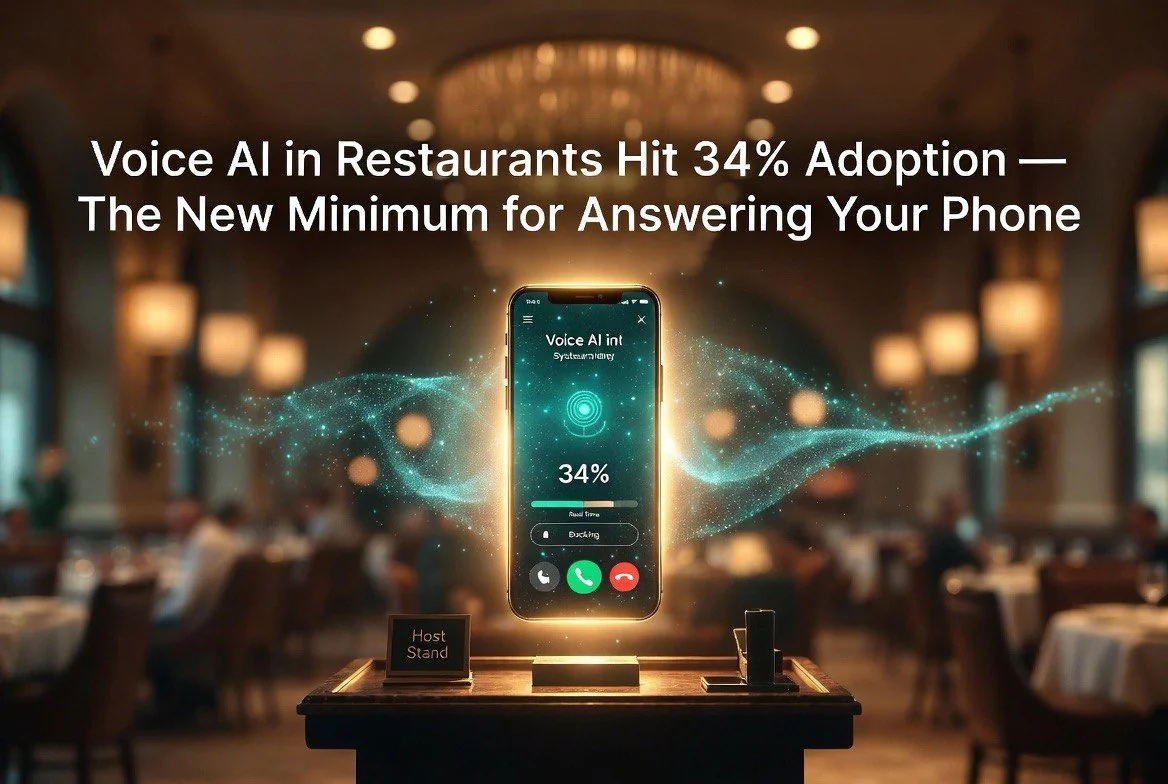
Voice AI in Restaurants Hit 34% Adoption — The New Minimum for Answering Your Phone
⚡ Expert Summary: Voice AI adoption among US independent restaurants has reached 34% in 2026, according to the National Restaurant Association’s annual technology survey. That means one in three independent operators has already deployed some form of AI phone answering. For the remaining 66%, the question is no longer whether to adopt voice AI but how quickly they can catch up. Restaurants that cannot answer their phones with AI are losing an estimated 15-25% of takeout and delivery orders to competitors who can. This guide covers the three leading platforms, real costs, integration requirements, and what operators who cross the 34% adoption threshold know that the late majority has not yet learned.
The 34% Threshold and What It Means
The National Restaurant Association’s 2026 technology survey, released in May, showed that voice AI adoption among US independent restaurants reached 34%, up from 18% in 2025 and 7% in 2024. The growth rate represents the fastest technology adoption curve in the restaurant industry since the POS system went digital in the 1990s.
The 34% figure is significant because it crosses a threshold that technology adoption researchers call the “early majority boundary.” According to Everett Rogers’ diffusion of innovations theory, once adoption exceeds 30%, a technology moves from early adopters to the early majority and becomes the new baseline expectation. For voice AI in restaurants, 2024 and 2025 were the experimental phase. 2026 is the year it becomes standard.
The Deloitte 2026 Restaurant Technology Outlook analyzed the competitive dynamics of voice AI adoption and found a clear pattern: in markets where 30% or more of restaurants had deployed voice AI, restaurants without the technology lost an average of 18% of takeout and delivery market share to competitors with voice AI within 12 months. The lost share was permanent — customers who switched to a restaurant that answered their phone did not return to the restaurant that did not.
Why Voice AI Adoption Accelerated
Three factors drove voice AI adoption from 7% to 34% in two years. The first factor is the dramatic improvement in accuracy. First-generation AI voice agents in 2023 and 2024 had order accuracy rates of 65-75%, meaning one in four orders had an error that required human correction. Current-generation voice AI systems consistently achieve 90-95% order accuracy, with the best systems reaching 97% in quiet environments.
The second factor is price reduction. The average cost of an AI phone agent for restaurants dropped from $349 per month in 2024 to $179-199 per month in 2026, a decline of 43-49%. At $179 per month, the payback period for recovering missed phone orders is typically 1-3 weeks, compared to 1-3 months at the 2024 price point.
The third factor is the labor market. The US Bureau of Labor Statistics reports that the restaurant industry had 1.2 million unfilled positions in early 2026. Even when restaurants can find staff, the cost of labor for phone answering — paying an employee $16-18 per hour to sit at the host stand and answer calls — makes AI voice agents a more attractive option from a pure cost perspective.
The Cost of NOT Having Voice AI
The Intouch Insight 2026 study quantified the cost of missed phone calls for US independent restaurants and found that the average operator misses 15-25% of incoming calls. For a restaurant that receives 50 calls per day with an average order value of $35, the annual lost revenue from missed calls is $95,812.50 (using the 15% lower bound) to $159,687.50 (using the 25% upper bound).
An AI voice agent that costs $179 per month, or $2,148 per year, must recover 1.3-2.2% of those missed calls just to break even. Most voice AI vendors report recovery rates of 65-80% of missed calls, which translates to $62,278 to $127,750 in recaptured annual revenue per location — an ROI of 29x to 59x.
These numbers explain why voice AI adoption accelerated past the 34% threshold in 2026. The economics are overwhelming for any restaurant that receives more than 10-15 calls per day. The only operators who can rationally choose not to deploy voice AI are those whose phone volume is so low that the missed call revenue is smaller than the cost of the tool.
Leading Voice AI Platforms in 2026
The voice AI market for restaurants has consolidated around a handful of leading platforms that together account for the majority of the 34% adoption figure.
Slang AI leads the market with an estimated 12,000 US restaurant locations using its platform. Slang’s restaurant-specific language model is trained on over 100 million restaurant calls and handles complex multi-item orders with modifications, dietary restrictions, and special requests. Monthly cost: $199 per location.
Relay is the second-largest vendor with approximately 8,000 US locations. Relay’s differentiator is its unified dashboard that tracks phone, chat, and text interactions together. The platform also offers a strong analytics suite that shows operators which menu items are most frequently ordered, which call times have the highest missed call rates, and which customer questions are most common. Monthly cost: $179 per location.
SoundHound AI focuses on drive-thru voice AI and has approximately 5,000 US locations, primarily quick-service chains. SoundHound’s noise cancellation technology, originally developed for automotive voice interfaces, gives it an accuracy advantage in loud drive-thru environments. Monthly cost: $199 per location.
What Happens Next
At the current growth rate of 12-16 percentage points per year, voice AI adoption among US independent restaurants will reach 50-55% by the end of 2027. At that point, a restaurant without voice AI will be in the minority in most markets, and the competitive disadvantage will be even more pronounced.
The National Restaurant Association predicts that voice AI will follow the same adoption curve as online ordering, which went from 25% adoption to 65% adoption in three years between 2019 and 2022. The COVID-19 pandemic accelerated that curve, but voice AI has its own accelerant: the persistent labor shortage that shows no signs of easing. For independent operators who have not yet deployed voice AI, the data is clear: the optimal deployment window is right now, before the 50% adoption threshold triggers the next phase of competitive displacement in your local market.
Integration Challenges and Solutions
Deploying a voice AI phone agent is not a plug-and-play operation for most independent restaurants. The three most common integration challenges reported by operators are menu data compatibility, POS system synchronization, and staff training requirements. Each challenge has proven solutions, but operators who skip the preparation phase end up with poor AI performance and frustrated customers.
Menu data compatibility is the first obstacle. AI voice agents need structured menu data to handle orders correctly — item names, prices, modifiers, dietary tags, and availability by time of day. Restaurants that manage their menu in a POS system like Toast, Square, or Clover already have structured data that can be synced to the AI platform. Restaurants that use paper menus or spreadsheets need to digitize their menu first, which adds 2-5 hours of setup time. Slang AI and Relay both offer free menu digitization services as part of onboarding, which reduces this barrier significantly for operators who lack technical staff.
POS synchronization is the second major hurdle. The AI agent needs real-time access to the POS to check item availability, update order status, and integrate with the kitchen display system. Most voice AI platforms achieve this through existing POS API integrations, but not all POS systems offer the required API access. Relay has the broadest POS compatibility with 14 supported systems. Slang AI supports 11. SoundHound focuses on systems used by quick-service chains. Before signing a contract, operators should verify that their specific POS system is supported and request a live integration test rather than relying on compatibility lists.
Staff training is the third challenge, and the most underestimated. Even after the AI is configured, front-of-house staff need to understand how to handle escalations from the AI, how to review AI-transcribed orders for accuracy, and what to do when the AI transfers a call to a human. The Intouch Insight 2026 study found that restaurants that invested at least four hours in staff training during deployment reported 22% higher satisfaction with their voice AI tool after 90 days compared to restaurants that spent less than one hour on training.
A fourth challenge that operators frequently overlook is voice adaptation for regional accents and non-native English speakers. Voice AI systems are trained on broad language models, but their accuracy varies by region. Restaurants in areas with significant non-native English-speaking populations, such as Miami, Los Angeles, and New York, report that AI voice agents initially struggle with Spanish-accented English, Cantonese-accented English, and Haitian Creole-influenced English. The leading platforms have responded by releasing accent adaptation models. Slang AI’s regional accent pack, released in March 2026, improved order accuracy by 12% in Miami locations and 9% in Los Angeles locations during beta testing. Operators in linguistically diverse markets should confirm that their chosen platform offers regional accent support before deployment.
Frequently Asked Questions
How many restaurants use AI voice agents in 2026?
The National Restaurant Association reports that 34% of US independent restaurants now use AI voice phone agents, up from 18% in 2025 and 7% in 2024. The leading platforms — Slang AI, Relay, and SoundHound — collectively serve over 25,000 US restaurant locations.
Do customers mind talking to AI on the phone?
Customer satisfaction with AI voice agents has improved significantly as accuracy has increased. The Intouch Insight study found that 76% of customers who interacted with a restaurant AI voice agent rated the experience as “good” or “very good” — comparable to the 82% satisfaction rate for human-staffed phone interactions. Customers primarily want their order taken correctly and quickly, regardless of whether a human or AI is taking it.
How much does voice AI cost per month?
Voice AI for restaurants costs $99 to $249 per month depending on the vendor and features. Slang AI costs $199, Relay costs $179, SnapMenu costs $149, and SoundHound costs $199 per location. All major vendors offer free trials of 14-30 days with no long-term contracts.
What is the ROI of voice AI for restaurants?
The ROI of voice AI for restaurants is typically 29x to 59x annually. The average restaurant loses $95,000 to $159,000 per year in missed phone orders. Voice AI recovers 65-80% of those missed orders. Against a tool cost of $2,148 per year ($179/month), the net annual benefit is $62,000 to $127,000 per location.
Will voice AI replace human restaurant staff?
Voice AI replaces the task of answering phones, not the role of restaurant staff. Most operators redeploy the staff who were answering phones to higher-value roles — food preparation, customer service on the floor, expediting. The US Bureau of Labor Statistics reports that fewer than 2% of restaurants have reduced headcount as a result of voice AI deployment.
How quickly can I deploy voice AI in my restaurant?
Voice AI can be deployed in 2-4 hours with vendor-assisted setup. The process involves porting your phone number or setting up call forwarding, configuring your menu and hours, and calibrating the AI on your specific menu items. Most vendors have operators going live with their first calls within 24 hours of sign-up.

About Barak Schurr
Barak Schurr built and exited a major ticketing platform, ran global operations at Eventbrite, and now focuses on one question: which AI tools actually help independent restaurant owners run leaner and grow faster. He writes from the operator’s perspective — no vendor spin, no theory, just what’s real in 2026.
Email: [email protected]
More AI Resources