Get the AI Restaurant Quick-Start Guide — Free
The 5 AI tools independent US restaurant owners are using right now to cut labor costs and answer every call.
McDonald’s ArchIQ: Google AI Drive-Thru Ordering, Explained
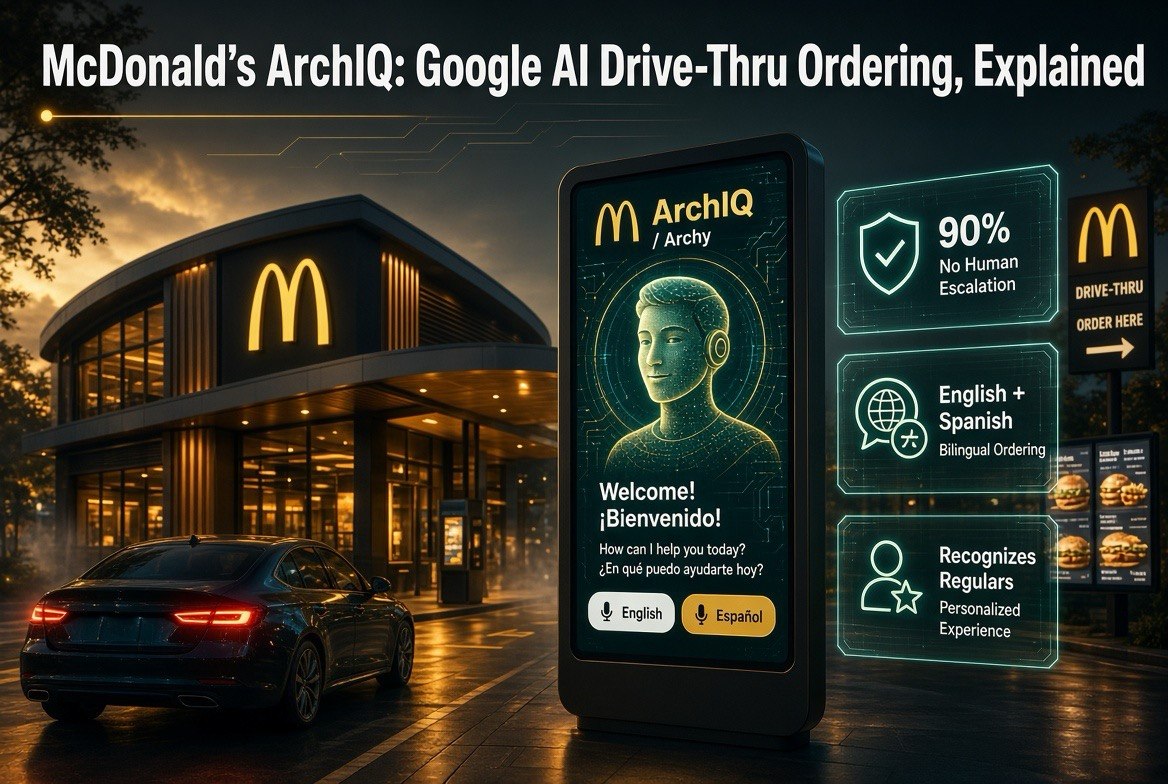
⚡ Expert Summary: McDonald’s revealed ArchIQ, a Google-powered AI ordering platform, at its 2026 worldwide convention and is now testing it at five US locations. A franchise owner’s video shows the system greeting customers, taking orders in English and Spanish, handling “Can I get my usual?” requests, and reportedly completing 90% of orders without human escalation. For independent restaurant owners, this is not another vendor rollout to ignore — it is Google stepping directly into drive-thru ordering, which signals where voice AI is heading and raises the bar on what your own ordering tech should do.
What Is McDonald’s ArchIQ?
McDonald’s is testing a new AI-powered drive-thru system called ArchIQ, built on Google’s AI platform, at five locations in the United States. Revealed at the company’s 2026 worldwide convention, the system is designed to handle the entire ordering exchange that has traditionally required a human crew member. According to a McDonald’s franchise owner who shared a video on X, the tech is nicknamed “Archy.”
The video shows how the flow works: the AI system greets the customer, takes their order, pauses to process any changes or requests, then displays the finalized order and total on a screen before prompting the customer to pull ahead for pickup. It also responds to repeat customers who ask, “Can I get my usual?” — a feature that only works if the system can recognize the customer and recall their preferences.
Here is why this is different from every other drive-thru AI rollout you have read about. Most of those systems come from specialized vendors like Presto, Omilia, or SoundHound. ArchIQ is built on Google’s platform directly. That means one of the largest technology companies in the world is now applying its AI stack to quick-service ordering — a material step up in the resources and integration power behind drive-thru automation. For straight talk on the AI tools that actually move the needle for independent restaurants, our restaurant AI hub collects the practical guides that matter.
What the “90% Without Escalation” Stat Actually Means
The most striking claim from the franchise owner’s post is that 90% of orders so far had been completed without human escalations. If that holds at scale, it changes the labor math for drive-thru operations in a way prior voice-AI tests did not.
To understand why, consider what drive-thru actually costs a restaurant. The drive-thru is typically the highest-volume channel for quick-service restaurants, but it runs on a separate crew lane that competitors cannot easily automate away. Historically, the drive-thru headset is the seat that gets hardest to staff in a tight labor market. A system that takes 9 out of 10 orders without a human in the loop directly targets that pinch point.
The honest caveat: “without human escalations” describes the system’s own run. The real test is whether those orders are accurate and whether customers accept them. McDonald’s has been here before — it shelved a 2024 IBM-powered automated ordering test after videos of incorrect orders went viral on social media. The lesson from that episode is that accuracy and customer trust, not raw automation rates, decide whether drive-thru AI survives contact with a real Friday-night rush.
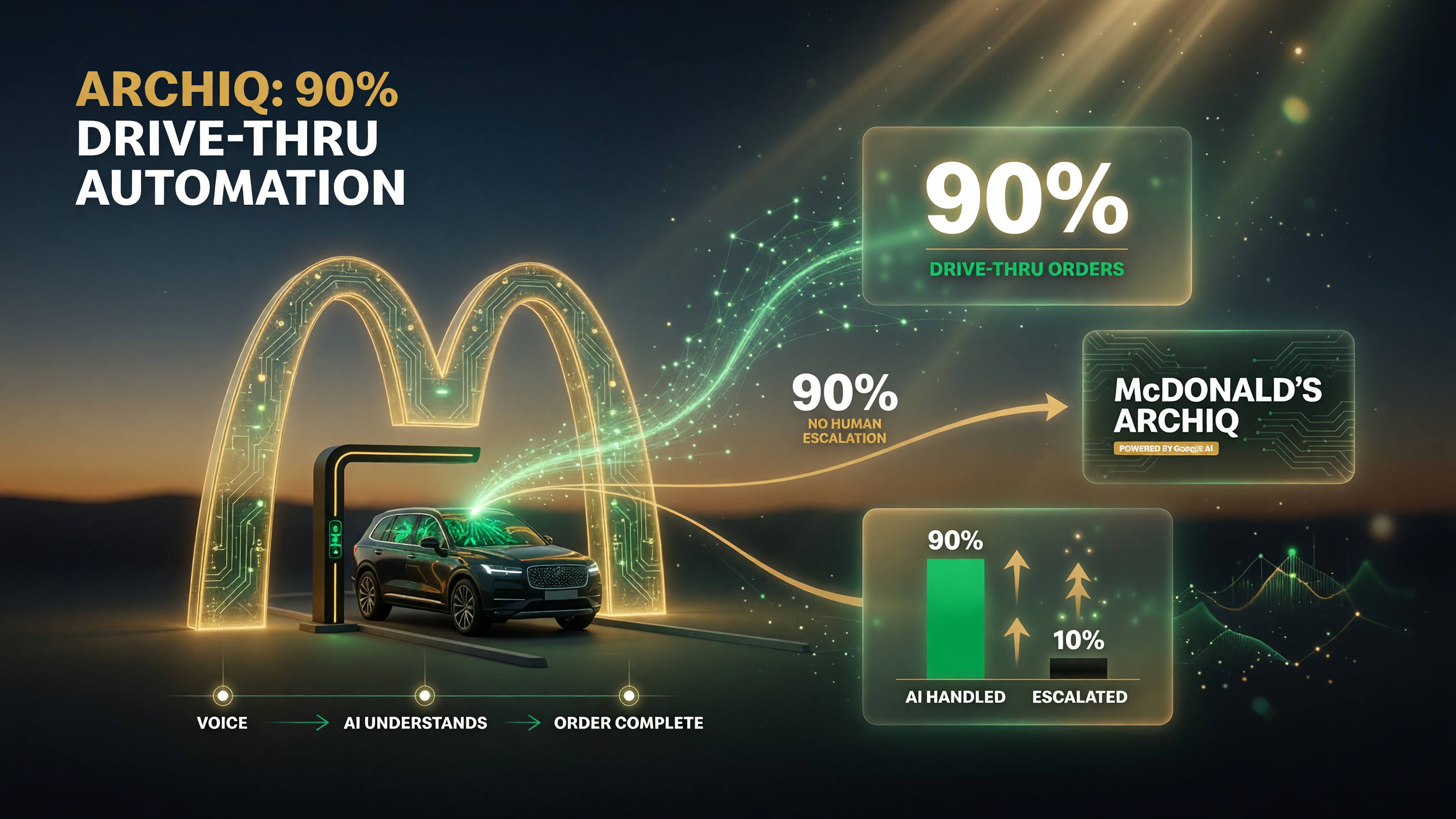
90% of orders completed without human escalation — the new baseline for drive-thru AI at McDonald’s.
Why This One Matters More Than the Last Drive-Thru AI Story
Independent operators have watched a steady stream of drive-thru AI announcements — Taco Bell scaling its system to hundreds of locations, Wendy’s, Dairy Queen, and others all rolling out voice ordering. It is fair to feel some fatigue. But ArchIQ carries a strategic signal the vendor rollouts did not: Google is now a direct player in restaurant ordering.
The significance is twofold for independents. First, when a platform owner like Google backs drive-thru ordering, the integration surface grows — Google Maps, Google Assistant, Google’s loyalty and payments infrastructure can all plug into the same ordering stack. Second, it raises the competitive floor. If the biggest tech platform drives down the cost and raises the quality of AI ordering, the expectation gap between what a chain’s drive-thru does and what your operation does gets wider.
| Feature | What It Does | Why It Matters for You |
|---|---|---|
| Google-powered AI platform | Built directly on Google’s AI stack, not a third-party voice vendor | Signals platform-level investment that will keep improving |
| English and Spanish ordering | Takes orders in either language | Bilingual capability is becoming table stakes for voice ordering |
| “Can I get my usual?” | Recognizes repeat customers and recalls preferences | Personalization is the next frontier beyond just taking orders |
| 90% orders without human escalation | Per franchise owner, 9 in 10 orders need no human handoff | Direct hit on the hardest-to-staff drive-thru labor seat |
| Order confirmation screen | Shows finalized order and total before pickup | Builds in a verification step that reduces error-driven complaints |
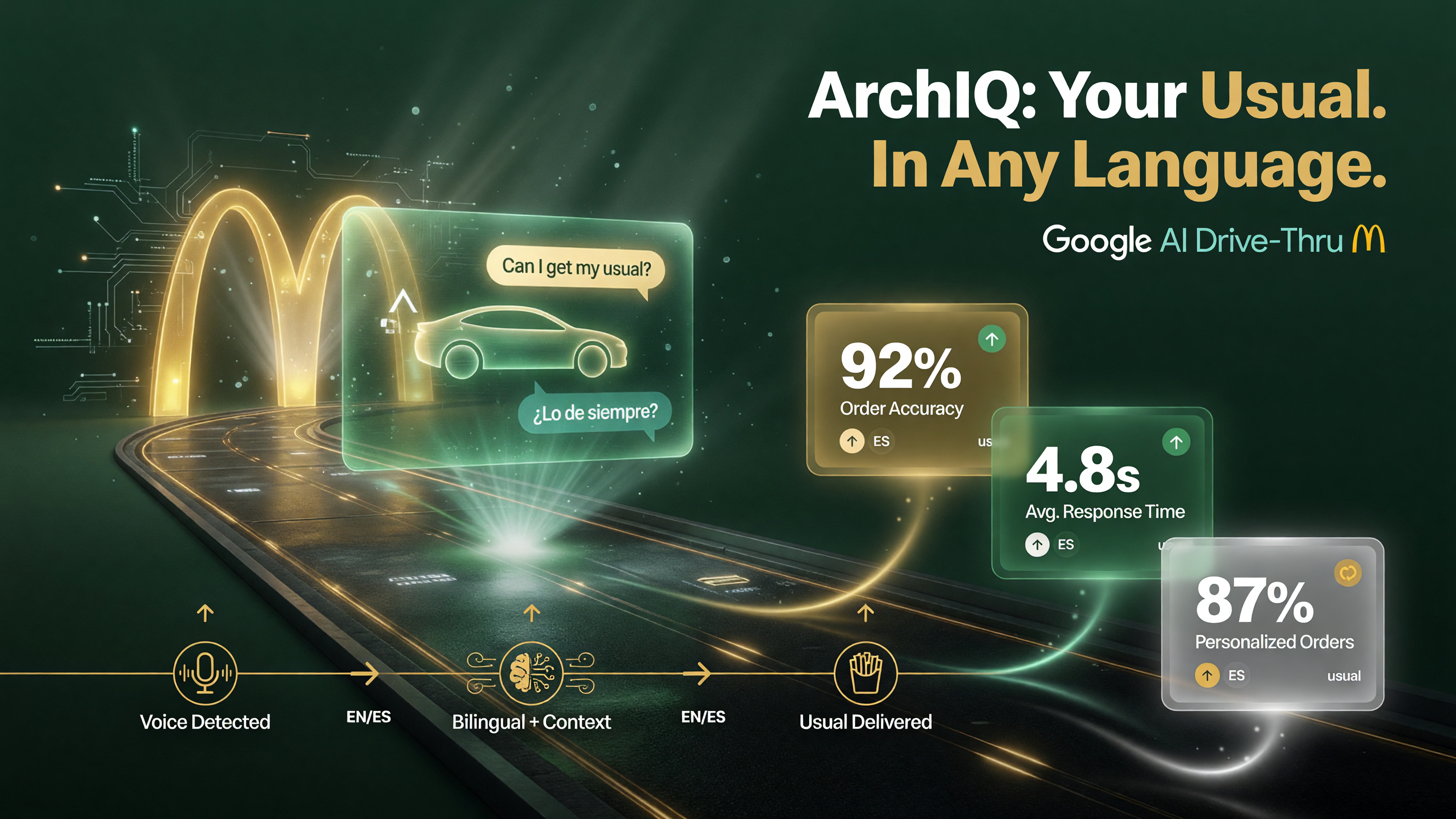
The table above strips out the hype and shows the concrete capabilities. Two of them — bilingual ordering and “get my usual” personalization — point to where the whole drive-thru AI category is headed, not just McDonald’s.
What the CEO’s Memo Tells Us About the Direction
McDonald’s CEO Chris Kempczinski framed the shift in a recent company memo. He said the company is launching a new strategy as “more of the customer journey becomes automated,” which means “there are fewer opportunities for guests to connect with crew.” His follow-on point is the one independent operators should internalize: with fewer human interactions, “the bar for hospitality that makes people feel seen, welcomed, and valued only goes up.”
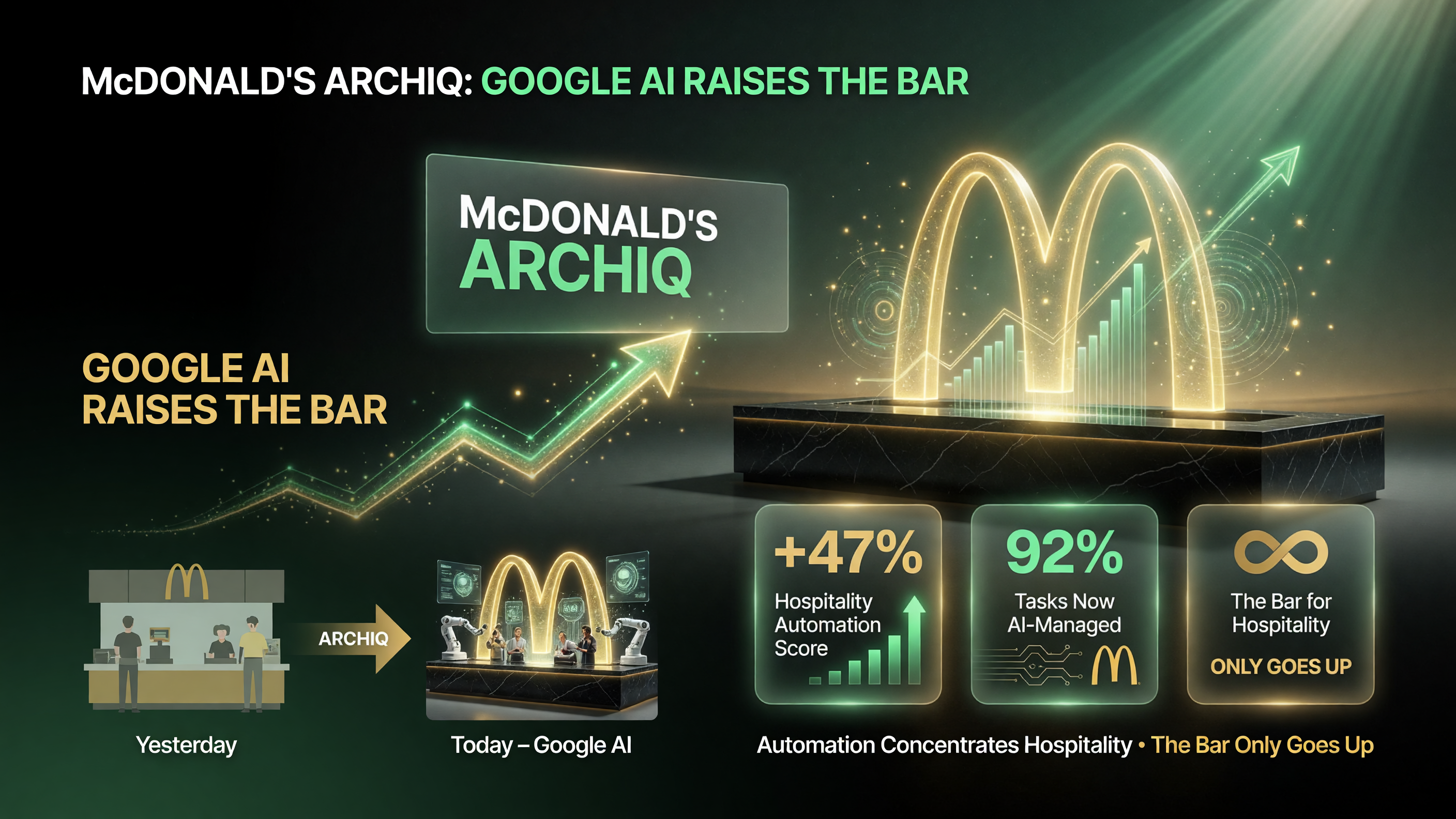
The hospitality bar goes up — Google AI raises the floor for every operator.
That is a critical reframe. The fear with AI ordering is that automation makes the experience colder and more transactional. McDonald’s is explicitly arguing the opposite — that as human touchpoints shrink, the human moments that remain become more important, not less. For independents, this is the single most useful lesson in the announcement: automation does not replace hospitality; it concentrates it. The operators who win will be the ones who treat every remaining face-to-face moment as higher-stakes, not lower.
Kempczinski also tied the strategy to value. “Customers also depend on us for compelling, predictable value, and even more so with unprecedented inflation,” he wrote, noting the company must “earn, and re-earn, each and every visit.” The pairing of automation with a sharper focus on value and hospitality is the strategic through-line worth watching.
What History Says About Drive-Thru AI
It is worth being clear-eyed about the track record. McDonald’s already shelved a 2024 IBM-driven automated ordering test after incorrect orders went viral. That history matters for two reasons: it shows the technology is still maturing, and it explains why the company is being measured about the current pilot — it has not confirmed any broader rollout, and it is emphasizing that ArchIQ is meant to improve speed, accuracy, and experience, not replace jobs.
The pattern is the same across the industry. Taco Bell and Wendy’s have both launched their own AI-powered drive-thru systems. Restaurant Business editor-in-chief Jonathan Maze, quoted by ABC News, framed it plainly: “You are literally automating a task that was taken by a person. The stated goal that companies use when they use this is to free up an employee’s time to do something else.” Maze also sketched the longer horizon — imagining a future five to ten years out where no orders at McDonald’s are taken by a human at all.
For independents, the practical reading is not doom. The realistic near-term outcome is that AI ordering becomes an addition to the crew, handling routine orders and freeing staff for hospitality and problem-solving — precisely the roles Kempczinski says become more important. The operators to watch are the ones who treat automation as a tool to reallocate labor toward service, not simply to cut headcount.
What Independent Operators Should Actually Do
You do not run McDonald’s. So what does this announcement mean for your restaurant? Here is a practical framework.
- Watch bilingual capability: If voice AI is on your roadmap, language support should be a screening criterion. The standard is moving toward English-plus-Spanish out of the box.
- Test the personalization angle: “Can I get my usual?” is where ordering AI becomes profitable — faster ordering for repeat customers. Ask any vendor whether their system can recognize a returning guest, not just take a first-time order.
- Reconsider the drive-thru seat: If drive-thru staffing is your hardest problem, this is the channel where automation pays off first. Model the math on your own peak-hour labor, not on McDonald’s volume.
- Keep hospitality human: The most durable takeaway from the CEO memo is that fewer touchpoints raise, not lower, the value of the human ones. Invest in the moments AI cannot replicate.
- Hold off on panic adoption: McDonald’s own history shows AI ordering has failed at scale in the recent past. Wait for accuracy and customer-acceptance evidence from pilots before committing your capital.
If you are evaluating voice-ordering vendors, a good comparison table against your actual needs will beat chasing headlines. The tools that win for independents will be the ones that solve your specific labor and accuracy problems — not the ones that make the loudest announcement.
What This Signals for the Next Few Years
Three trends are converging in this announcement:
- Platform owners entering the stack: Google powering ArchIQ means the ordering conversation is no longer just specialty vendors; the big AI platforms are now directly involved. That will accelerate capability and lower cost.
- Personalization as the differentiator: Recognizing a repeat customer and their “usual” is where ordering AI moves from cost-saving to revenue-building.
- Hospitality redefined: As automation shrinks human touchpoints, the few that remain become the brand. That is a strategic shift every operator should plan around.
The bottom line for an independent restaurant owner: McDonald’s ArchIQ is worth watching because it is the first direct signal that Google is entering drive-thru ordering — not because you should copy McDonald’s. Your move is to use the capabilities it highlights (bilingual, personalized, accurate) as the benchmark for your own voice-AI evaluation, and to defend the hospitality that automation cannot replace.
FAQ
What is McDonald’s ArchIQ?
ArchIQ is McDonald’s Google-powered AI drive-thru ordering platform, revealed at its 2026 worldwide convention and currently being tested at five US locations. It greets customers, takes orders in English and Spanish, and can handle repeat-customer requests like “Can I get my usual?”
How many McDonald’s locations are testing ArchIQ?
McDonald’s is testing ArchIQ at five of its US locations. The company has not confirmed any plans for a broader rollout.
Is McDonald’s AI ordering replacing jobs?
McDonald’s says ArchIQ is intended to improve speed, accuracy, and experience for customers and crew, not replace jobs. The stated industry goal of drive-thru AI is typically to free up employee time for other tasks.
Did McDonald’s try AI ordering before?
Yes. McDonald’s tested an IBM-powered automated ordering system in 2024 but shelved it after videos of incorrect orders went viral on social media.
What should independent restaurants learn from McDonald’s ArchIQ?
Independents should watch the capabilities heading to the market — bilingual ordering, repeat-customer personalization, and the strategic shift where fewer human touchpoints raise the value of the remaining human moments of hospitality.

About Barak Schurr
Barak Schurr built and exited a major ticketing platform, ran global operations at Eventbrite, and now focuses on one question: which AI tools actually help independent restaurant owners run leaner and grow faster. He writes from the operator’s perspective — no vendor spin, no theory, just what’s real in 2026.
Email: [email protected]
More Resources for Restaurant Operators