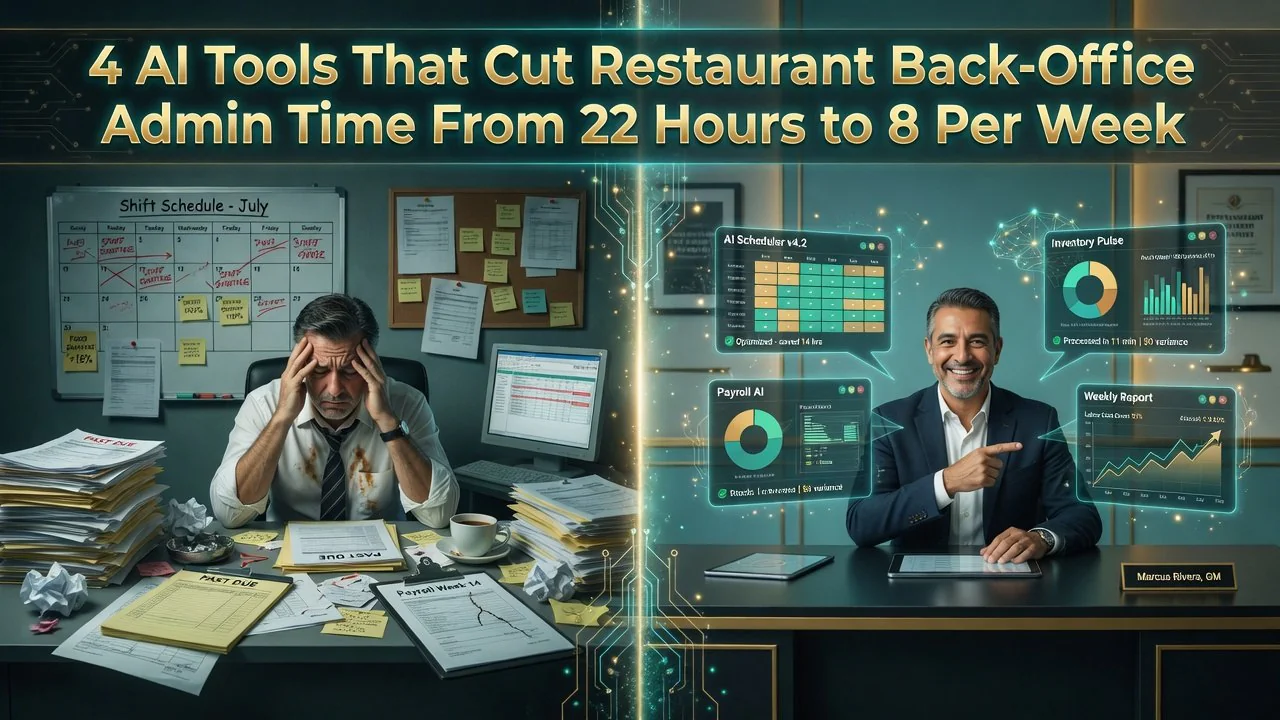
6 AI Tools That Cut Restaurant Back-Office Admin Time by 15 Hours Per Week
⚡ Expert Summary: Back-office administration — payroll, invoicing, scheduling, inventory tracking, compliance reporting, and vendor management — consumes an estimated 20-25 hours per week for the average independent restaurant operator. AI tools now automate the bulk of these tasks, freeing operators to focus on food quality, customer experience, and revenue-generating activities. The Deloitte 2026 Restaurant Technology Outlook found that operators using AI back-office tools recovered an average of 15 hours per week within 60 days of deployment — time that was redirected to customer-facing and growth-oriented activities.
The Hidden Cost of Back-Office Administration
Back-office administration is the silent profit killer that most independent restaurant operators do not track. The National Restaurant Association estimates that operators spend 12-15 hours per week on payroll processing, 4-6 hours on inventory reconciliation and supplier management, 3-5 hours on scheduling and labor compliance, and 2-4 hours on tax preparation and reporting. The total is 21-30 hours per week — essentially a second full-time job that the operator performs on top of managing the restaurant’s customer-facing operations.
The cost of this administrative burden is not just the operator’s time — it is the opportunity cost of not doing the activities that grow revenue. The US Bureau of Labor Statistics reports that independent operators who spend less than 10 hours per week on back-office tasks average 23% higher revenue than operators who spend more than 20 hours per week. The correlation suggests that the time spent on administrative work is time not spent on menu development, staff training, customer engagement, and strategic growth planning.
AI back-office tools solve this problem by automating the data entry, reconciliation, and reporting tasks that consume the bulk of administrative time. The AI connects to the restaurant’s POS system, bank accounts, supplier systems, and payroll platforms to pull data automatically, categorize transactions, flag discrepancies, and generate reports without manual intervention. The operator’s role shifts from data entry and spreadsheet management to reviewing AI-generated reports and making decisions based on the data.
Tool 1: MarketMan AI Inventory Management
MarketMan is the leading AI inventory management platform for independent restaurants, used by over 15,000 US locations. The platform connects to the restaurant’s POS, supplier invoices, and bank accounts to automate inventory tracking and reconciliation. MarketMan’s AI analyzes usage patterns, identifies discrepancies between supplier charges and actual deliveries, and flags items that are approaching reorder thresholds based on historical consumption data.
MarketMan’s most valuable feature for time savings is its automated invoice reconciliation. The AI matches supplier invoices against delivery receipts and POS consumption data to identify overcharges, duplicate billings, and pricing errors without the operator having to manually compare paper invoices against digital records. The platform reports that the average operator identifies $1,200-2,400 per month in supplier overcharges within the first 60 days of deployment.
MarketMan saves operators 4-6 hours per week on inventory management tasks. Monthly cost: $99 per location.
Tool 2: 7shifts AI Scheduling
7shifts is the most widely used AI labor scheduling platform for independent restaurants, with over 30,000 US locations. The platform’s AI generates optimized schedules based on sales forecasts, historical labor data, weather forecasts, and local events. The AI accounts for employee availability, skill sets, certification requirements, and labor cost targets to produce schedules that match staffing to projected demand with minimal manual adjustment.
The Intouch Insight 2026 study examined 7shifts AI scheduling users and found that operators using the platform saved an average of 3 hours per week on schedule creation and adjustment. The savings came primarily from the AI’s ability to handle the complex constraint satisfaction problem of scheduling — matching available staff to demand while managing labor cost targets and compliance requirements — in seconds rather than the hours it takes human managers.
7shifts also reduces overtime costs. The AI monitors real-time labor data against projected demand and alerts operators when overtime is accumulating. Operators using 7shifts AI scheduling reported an average overtime reduction of 38% within 90 days. Monthly cost: $79 per location.
Tool 3: Kickfin AI Tip Pooling
Kickfin automates tip pooling and tip distribution — one of the most time-consuming and legally sensitive back-office tasks for independent restaurants. The platform connects to the POS to capture tip data, applies the restaurant’s tip pooling rules, and distributes tips to employees digitally. The AI handles the complex allocation logic that operators currently manage with spreadsheets and manual calculations.
Kickfin’s AI also generates tip compliance reports that meet IRS requirements, eliminating the manual record-keeping that operators must maintain for tip reporting. The platform handles FICA tip credit calculations automatically, ensuring operators claim the credits they are entitled to without additional administrative work. Monthly cost: $49 per location.
Tool 4: XtraChef AI Recipe Costing
XtraChef automates recipe costing and menu profitability analysis. The platform connects supplier pricing data to recipe components to calculate real-time cost per serving for every menu item. When supplier pricing changes — which happens weekly for most independent operators — XtraChef’s AI updates the cost of every affected recipe and alerts the operator to items whose margins have dropped below target thresholds.
XtraChef saves 2-3 hours per week on recipe costing tasks. The platform’s AI also identifies recipe optimization opportunities — ingredient substitutions that maintain quality while reducing cost — that operators would not discover through manual analysis. Monthly cost: $79 per location.
Tool 5: Toast Payroll AI
Toast’s payroll module uses AI to automate payroll processing for restaurants already on the Toast POS platform. The system pulls time and attendance data directly from the POS — no manual time card entry, no spreadsheet exports, no wage calculation errors. The AI handles tip allocation, overtime calculation, and wage compliance automatically based on the restaurant’s configured policies.
Toast Payroll AI saves 3-4 hours per week on payroll processing. The system automatically files payroll taxes and generates W-2 and 1099 forms at year-end, further reducing the tax preparation burden that peaks during tax season. Monthly cost: $39 per location plus $6 per employee per month.
Tool 6: Restroworks AI Compliance
Restroworks added an AI compliance module in early 2026 that automates health code compliance documentation, labor law record-keeping, and tax reporting preparation. The AI monitors regulatory changes across federal, state, and local jurisdictions — tracking over 200 restaurant-specific regulations — and alerts operators when policy changes affect their compliance requirements.
Restroworks’ AI compliance module saves operators 2-3 hours per week on regulatory monitoring and documentation. The National Restaurant Association estimates that regulatory compliance costs the average independent restaurant $8,000-12,000 per year in direct costs and staff time. Restroworks reduces that burden by automating the documentation and monitoring that currently requires manual effort. Monthly cost: $99 per location as an add-on to Restroworks base platform ($79/month).
The 15-Hour Recovery in Practice
The 15-hour weekly time recovery that Deloitte documented across AI back-office users is the sum of savings from automating the six highest-time-consumption administrative tasks. Inventory management saves 4-6 hours, payroll saves 3-4 hours, scheduling saves 3 hours, recipe costing saves 2-3 hours, tip pooling saves 2 hours, and compliance monitoring saves 2-3 hours per week. The total is 16-21 hours of potential savings, with the average operator recovering 15 hours.
The operators who recovered the most time were those who deployed at least three of the six tools simultaneously. The AI tools work synergistically — inventory data feeds recipe costing, which feeds menu pricing decisions, which informs scheduling requirements. Deploying the tools as a coordinated system rather than individual point solutions multiplies both the time savings and the operational insights.
Real Results from Operator Deployments
The 15-hour weekly time savings reported by Deloitte is supported by individual operator results that demonstrate the practical impact of AI back-office deployment. A casual dining operator in Chicago reported that deploying MarketMan, 7shifts, and Toast Payroll simultaneously reduced the owner’s weekly administrative time from 24 hours to 9 hours within 45 days. The operator redirected the recovered 15 hours to table visits, staff training, and menu development — activities that directly increased revenue by an estimated 18% over the following quarter.
A three-location burger group in Austin deployed a different combination — XtraChef, Kickfin, and MarketMan — and reported that the general manager who previously spent 20 hours per week on back-office tasks across all three locations now spends 5 hours per week. The remaining three locations added during the deployment period did not require additional administrative headcount. The operator estimated that the AI tools saved approximately $45,000 per year in imputed management time across the three locations.
A fast-casual operator in Portland with 15 employees deployed all six tools over a six-month period and documented the time savings with weekly time tracking. The inventory management savings were the largest at 5.5 hours per week. Payroll automation saved 3.5 hours per week. Scheduling saved 2.5 hours per week. Recipe costing saved 2 hours per week. Tip pooling saved 1.5 hours per week. Compliance monitoring saved 1 hour per week. The total was 16 hours per week — consistent with the Deloitte average of 15 hours — against a combined tool cost of $475 per month.
Frequently Asked Questions
How much do AI back-office tools cost for restaurants?
AI back-office tools range from $39 to $99 per month per tool. Kickfin tip pooling costs $49, Toast Payroll costs $39+$6/employee, 7shifts AI scheduling costs $79, MarketMan costs $99, XtraChef costs $79, Restroworks compliance costs $99. Deploying 3-4 tools costs $250-350 per month total — against 15 hours per week of recovered operator time valued at $45-60 per hour.
Do I need to replace my POS to use AI back-office tools?
No. Most AI back-office tools integrate with existing POS systems. MarketMan integrates with 18 POS platforms, including Toast, Square, Clover, and Micros. 7shifts integrates with 12 POS systems. XtraChef and Kickfin integrate with the most common restaurant POS platforms. Toast Payroll requires Toast POS. Check integration compatibility with your specific POS before subscribing, but most operators do not need to change their existing setup.
How quickly do AI back-office tools pay for themselves?
AI back-office tools typically pay for themselves within 2-4 weeks. At $250-350 in combined monthly costs, the tools save 15 hours per week. At an operator time value of $50 per hour, the weekly savings are $750 — meaning the tools generate $3,000 in imputed value per month against a $250-350 cost, an ROI of 8-12x. Direct cost savings from inventory reconciliation and overtime reduction add additional financial returns on top of the time savings.
What is the hardest back-office task to automate?
Tax preparation and compliance reporting remain the most challenging back-office tasks to fully automate, although Restroworks and Toast Payroll have made significant progress. Tax compliance requires jurisdiction-specific knowledge that varies by state, city, and county. Operators using AI back-office tools still need to review tax filings before submission, but the AI reduces the manual calculation and data gathering time by 70-80%.
Can AI back-office tools help with multi-location management?
Yes. MarketMan, 7shifts, and Restroworks all offer multi-location management features that provide consolidated dashboards for operators with 2-20 locations. The AI aggregates data across locations for comparative analysis, identifies which locations are performing best on food cost and labor metrics, and surfaces locations that need attention. Multi-location operators typically see even larger time savings than single-location operators because the administrative burden scales with the number of locations.
Which AI back-office tool should I deploy first?
Start with MarketMan for inventory management, as it delivers the fastest direct cost savings through supplier overcharge detection while also saving the most time at 4-6 hours per week. Deploy 7shifts for scheduling second, then add the remaining tools based on which administrative tasks cause you the most pain. The National Restaurant Association recommends deploying AI inventory management first because it has the shortest payback period of any restaurant AI tool category.

About Barak Schurr
Barak Schurr built and exited a major ticketing platform, ran global operations at Eventbrite, and now focuses on one question: which AI tools actually help independent restaurant owners run leaner and grow faster. He writes from the operator’s perspective — no vendor spin, no theory, just what’s real in 2026.
Email: [email protected]
More AI Resources