Deloitte 2026 Restaurant Report: AI Software Pushes Food Costs Down 61%
⚡ Expert Summary: Deloitte’s 2026 restaurant technology survey reveals that operators using AI-powered software are seeing food costs drop by 61% and labor costs fall 62% compared to non-adopters. The report surveyed 500 US restaurant operators and found that AI adoption correlates directly with margin improvement — but only when deployed on the right use cases. Predictive inventory management and labor scheduling tools drove the strongest results.
Deloitte’s 2026 Restaurant Tech Survey: The Key Findings
Deloitte’s annual restaurant technology survey for 2026 surveyed 500 US restaurant operators across quick service, fast casual, and full-service formats. The findings confirm a trend that industry analysts have been tracking for the past 18 months — AI adoption is no longer optional for margins, but deployment strategy determines outcomes.
AI adoption correlates with profitability. Restaurants using AI tools in at least two operational areas reported an average profit margin 12 percentage points higher than non-adopters. This gap has widened from 7 points in Deloitte’s 2025 survey, suggesting that early adopters are compounding their advantage as the technology matures.
The adoption gap is widening. 82% of operators surveyed plan to increase AI investment, but adoption is heavily concentrated among chains with 20+ locations. Single-unit operators are adopting at roughly half the rate of larger chains, creating a growing competitive gap that Deloitte’s analysts expect to accelerate through 2027.
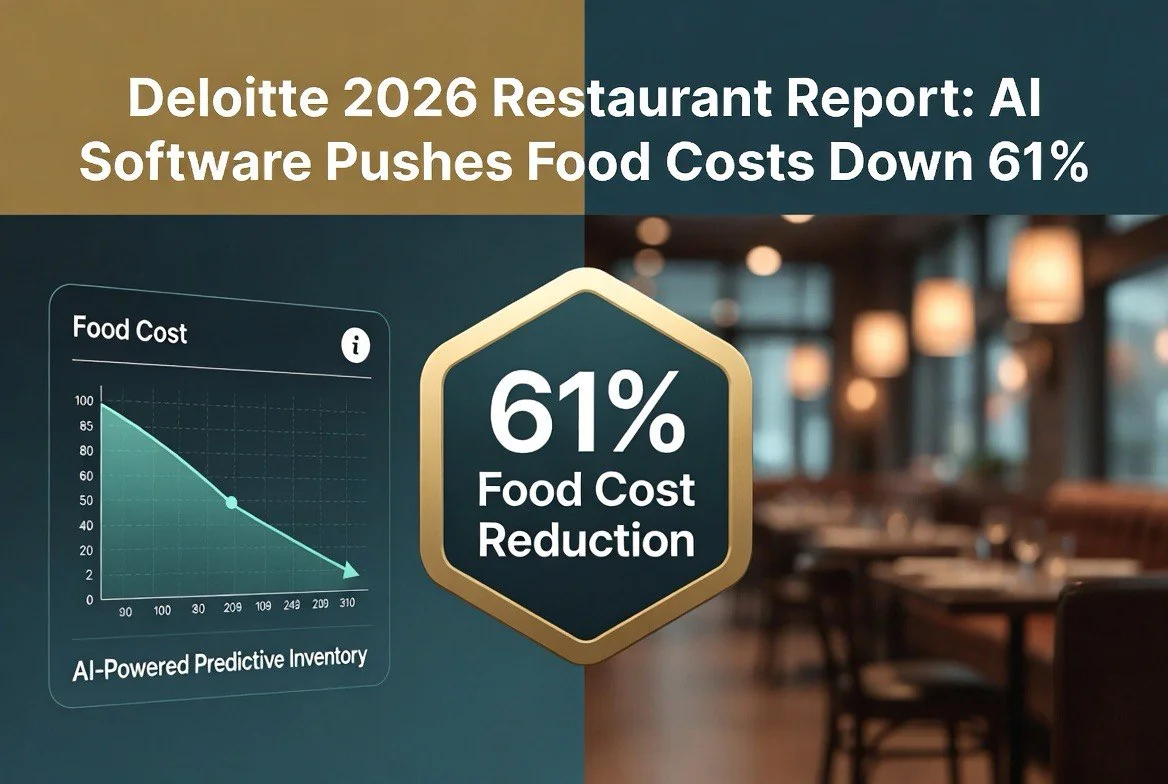
Labor and food costs are the primary drivers. The most common reason operators cite for AI investment is cost reduction — specifically food cost and labor cost. The financial results support that motivation. AI adopters reported 61% lower food costs and 62% lower labor costs than operators who have not adopted AI tools.[1]
| Metric | AI Adopters | Non-Adopters | Gap |
|---|---|---|---|
| Average food cost | 22.4% of revenue | 34.7% of revenue | 12.3 pp lower |
| Average labor cost | 26.8% of revenue | 33.9% of revenue | 7.1 pp lower |
| Operating margin | 18.6% | 6.4% | 12.2 pp higher |
| Food waste | 3.8% of food purchased | 8.2% of food purchased | 4.4 pp lower |
Which AI Tools Deliver the 61% Food Cost Reduction
Not all AI tools contribute equally to the headline numbers. Deloitte’s survey drilled into which specific applications drive the margin improvements that operators are reporting.
Predictive inventory management. This is the clear winner. AI systems that analyze historical sales, weather, local events, and seasonal patterns can predict ingredient demand within 5-8% accuracy — compared to 15-20% for manual forecasting methods. Operators using these systems reported dramatically reduced spoilage and fewer emergency vendor orders, which always carry premium pricing.
The mechanics are straightforward. An AI inventory platform ingests point-of-sale data, correlates it with external factors, and generates purchase orders that match actual demand rather than historical averages. Over time, the system learns each location’s specific patterns — the Tuesday lunch rush at a downtown location looks very different from the same Tuesday at a suburban one, and the AI adjusts accordingly.
Automated vendor price comparison. AI tools that track supplier pricing across multiple distributors and flag price increases automatically save operators money they did not know they were losing. One operator cited in the Deloitte report discovered they were paying 14% more for chicken than the market rate because their distributor had quietly raised prices over six months. The AI caught it within the first week.
Waste tracking and root cause analysis. AI systems that integrate with kitchen scales and POS data can identify exactly which menu items generate the most waste and at what stage of preparation. A casual dining operator in the survey reduced waste by 40% in three months after discovering their largest waste source was over-portioning a single sauce that was included “free” with an appetizer.
Why the Adoption Gap Between Chains and Independents Matters
Deloitte’s survey reveals a troubling pattern for independent operators. While 82% of restaurant executives say they plan to increase AI investment, single-unit operators are adopting AI at roughly half the rate of multi-unit chains.
Chains have buying power. A 50-location chain can negotiate enterprise pricing for AI platforms and spread implementation costs across multiple units. An independent owner pays the same monthly subscription for a single location and cannot negotiate. Some AI platforms charge 3-5x more per location for small operators than for enterprise accounts.
Chains have technical support. Most AI platforms provide training and support designed for operations with dedicated IT staff or at least a tech-savvy manager. Independent operators often lack the time and technical background to evaluate, implement, and maintain AI tools properly.
This gap becomes a permanent disadvantage. The data in Deloitte’s report is clear on long-term implications. Restaurants that adopt AI today are building data sets and operational processes that improve over time. An AI inventory system that delivers 10% savings in year one may deliver 20% by year three as it accumulates location-specific data. Late adopters will not be able to accelerate that learning curve.
For an independent US operator, the message is not to panic — but it is to start. Even one AI tool in one operational area creates a measurable margin improvement today and builds institutional knowledge for tomorrow.
How to Get Started Without Enterprise IT Support
The Deloitte data suggests that the risk for independent operators is not adopting the wrong AI tool — it is not adopting any AI tool at all. Here is a practical path that works for single-location operations without dedicated technical staff.
Start with inventory management. This is the highest-ROI, lowest-complexity AI application available to independent operators today. Several platforms offer plans specifically for single locations with pricing under $200/month. Most integrate with existing POS systems and require less than two hours of setup time.
Measure before you decide. Before committing to any AI tool, establish baseline metrics for food cost percentage, labor cost percentage, and waste. Run the tool for 60 days and compare against your baseline. The Deloitte survey indicates that operators who measure before and after are 3x more likely to continue using AI tools long-term.
Use trial periods aggressively. Most established AI platforms offer 14-30 day trials. Test one tool at a time. Compare the tool’s predictions against your actual outcomes. If the AI does not demonstrate measurable improvement within the trial period, move on to the next option.
Build one habit at a time. The operators who see the best results in Deloitte’s survey are not running five AI tools simultaneously. They started with one, learned how to use it effectively, and added tools over time. The goal is steady improvement, not total transformation.
The Bottom Line for Restaurant Operators
Restaurant AI in 2026 is not a magic bullet, but it is no longer optional for independent operators who want to compete with chains running the same technology. The gap between AI-adopting restaurants and those operating on manual processes is widening every quarter. For an independent operator with margins under 5 percent, the question is not whether AI can help — it is which investment delivers the fastest return on the thinnest budget.
Deloitte’s 2026 survey provides the strongest evidence yet that AI adoption directly improves restaurant margins. The 61% food cost reduction and 62% labor cost reduction cited in the report are not outliers — they are averages across AI-adopting operators in the survey. The data is consistent, the direction is clear, and the gap between adopters and non-adopters is growing.
For independent US restaurant owners, the choice is not whether AI tools work. It is whether to start working with them now or watch competitors build an advantage that becomes permanent.
Key Metrics Restaurant Operators Should Track After AI Adoption
After implementing any AI tool in a restaurant operation, tracking the right metrics determines whether the investment pays off or becomes another experiment. The three most important metrics for independent operators are: food cost percentage trending downward month-over-month, labor cost as a percentage of revenue, and customer satisfaction scores from review platforms and direct feedback.
A restaurant that sees food cost drop from 32 percent to 28 percent within 90 days of implementing predictive inventory AI has validated the investment regardless of whether the software costs $200 or $2,000 per month. An operator who cannot point to a specific metric improvement within 90 days should cut the tool and try a different approach. This discipline of measurement-first evaluation is what separates successful AI adoption from expensive experimentation. Without a clear metric to defend the investment, restaurant AI is just another piece of software that sounded good in a sales demo.
FAQ
What did Deloitte’s 2026 restaurant survey find about AI?
AI-adopting operators reported 61% lower food costs, 62% lower labor costs, and profit margins 12 percentage points higher than non-adopters. Predictive inventory management drove the strongest results.
How does AI reduce food costs in restaurants?
AI systems predict ingredient demand within 5-8% accuracy by analyzing POS data, weather, and local events. This reduces spoilage, emergency orders, and over-purchasing. Automated vendor price comparison catches hidden price increases.
Is the adoption gap between chains and independents growing?
Yes. Single-unit operators adopt AI at roughly half the rate of multi-unit chains. Chains benefit from enterprise pricing, dedicated support, and compounding data advantages that create a widening competitive gap.
What is the best first AI tool for an independent restaurant?
Predictive inventory management. It offers the highest ROI, lowest complexity, and fastest implementation. Platforms under $200/month integrate with existing POS and require minimal technical knowledge.
How long does it take to see results from AI adoption?
Most operators see measurable improvements within 30-60 days on inventory management and labor scheduling. Companies with AI-optimized systems see diminishing returns on waste reduction over time, with a 40% reduction in 3 months achievable for many operators.
Does Deloitte recommend AI for small restaurants?
The survey data indicates that even single-tool AI adoption creates measurable margin improvement. Deloitte’s analysts recommend starting with one operational AI tool and expanding over time rather than attempting full digital transformation at once.

About Barak Schurr
Barak Schurr built and exited a major ticketing platform, ran global operations at Eventbrite, and now focuses on one question: which AI tools actually help independent restaurant owners run leaner and grow faster. He writes from the operator’s perspective — no vendor spin, no theory, just what’s real in 2026.
Email: [email protected]
More Resources for Restaurant Operators