Get the AI Restaurant Quick-Start Guide — Free
The 5 AI tools independent US restaurant owners are using right now to cut labor costs and answer every call.
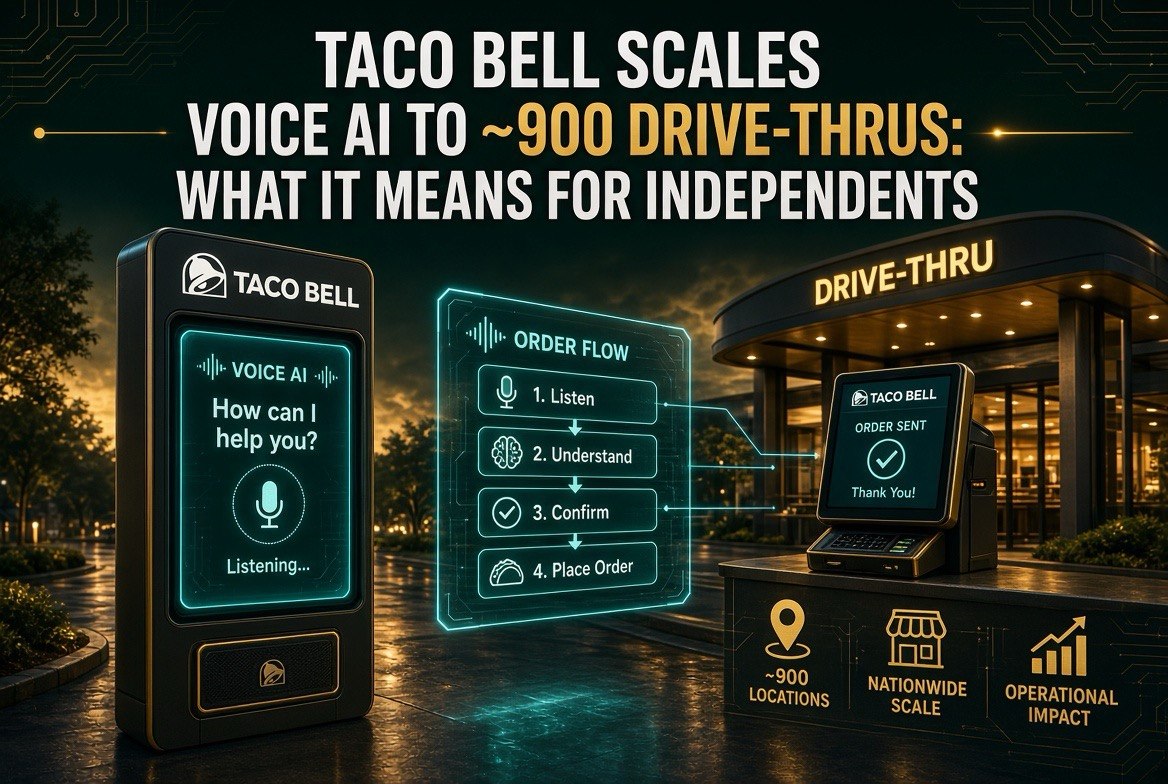
Taco Bell Scales Voice AI to ~900 Drive-Thrus: What It Means for Independents
⚡ Expert Summary: Taco Bell has pushed its Omilia voice AI drive-thru ordering to roughly 900 US locations across 38 states as of August 2026. The system takes orders at the speaker, handles custom modifications and accents, filters road noise, and adapts to each location’s real-time menu and stock levels. What this scale-up signals for independent US operators is not “buy the same robot Taco Bell bought” — it is that drive-thru voice AI has crossed from pilot to default infrastructure, the cost to access it is dropping, and independents who understand what the technology actually automates are better positioned than those who assume it only works for chains with Yum!’s budget.
You do not have Taco Bell’s marketing budget, its national footprint, or its vendor contracts. But when the largest QSR in the quick-service space moves almost a thousand of its drive-thrus to AI order-taking in under a year, that is not a Taco Bell story — it is a market signal. The technology that took voice AI from a test lane to a default part of the drive-thru is the same technology being sold to independents, and the price keeps falling. This article breaks down what the ~900-location milestone actually proves, what parts of it are relevant to an independent US restaurant, and what parts you should ignore.
What the ~900 Location Milestone Actually Proves
Taco Bell’s voice AI deployment, powered by the conversational AI platform Omilia, now spans roughly 890 to 900 of its US locations across 38 states. The system does the order-taking at the drive-thru speaker in real time: it handles complex and custom orders, recognizes different accents, filters out road and engine noise, and adapts to each location’s live menu — including limited-time offers and current stock levels. That is not a scripted phone tree. It is a production system reading live POS data and completing a transaction conversationally.
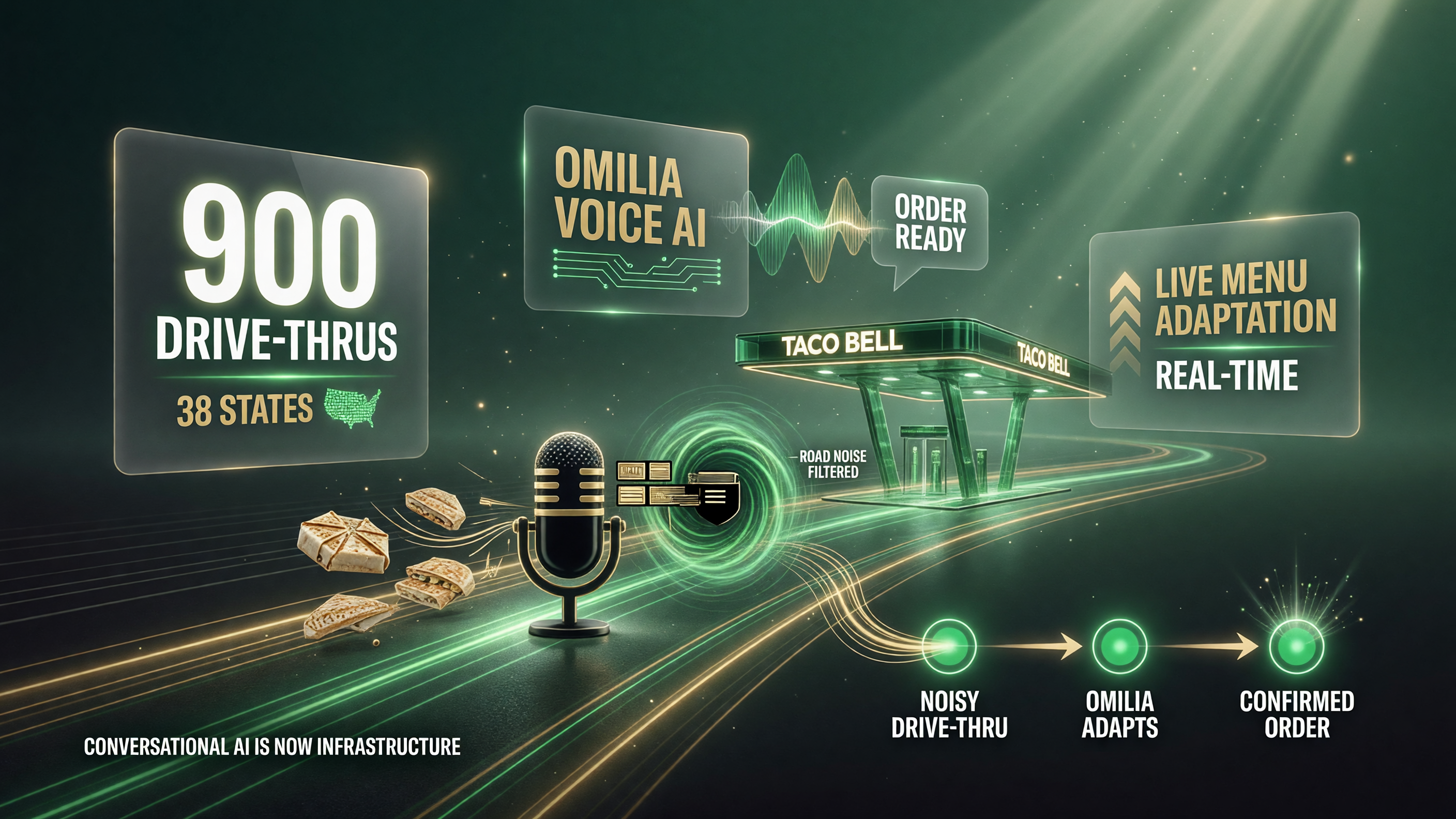
Omilia voice AI now takes drive-thru orders at roughly 900 Taco Bell US locations across 38 states, handling custom orders and live menus in real time.
For an independent operator, the first lesson is about scale validation. When a technology is deployed across hundreds of high-volume drive-thrus and the parent company keeps expanding it rather than retiring it, that tells you the failure rate is acceptable at chain scale. Voice AI in the drive-thru is no longer something a startup is betting on; it is something a company that runs thousands of restaurants is betting its service standard on. Independent operators who have been watching this space since 2023 have seen it move from pilot to rollout to default — and that progression is what matters, not the exact count.
The reported benefits align with what restaurant operators actually care about. According to the rollout reporting, Taco Bell and Omilia cite faster or equivalent transaction times versus human-only ordering, higher team retention because staff are freed from taking repetitive speaker orders, and on-par or better guest satisfaction. In plain terms: the system removes a tedious, high-turnover task from the crew, keeps the line moving, and does not make guests angrier. That is the bar a small restaurant should hold the same technology to.
Why This Is Not Just a “Chain Budget” Story
The most common reaction from independent operators is “that’s great for Taco Bell, but I can’t afford Omilia’s enterprise contract.” That instinct is half right. The marketing version of this technology is expensive. The functional version — a voice agent that takes drive-thru or phone orders and connects to your POS — has been available to independents for a fraction of the enterprise cost through vendors like Presto, SoundHound, Audivi, ChampOS, and Omilia’s smaller tiers. The point of the Taco Bell scale-up is not that Taco Bell is paying Taco Bell prices; it is that the underlying technology matured enough for a chain to bet hundreds of locations on it, which drops the risk profile for every smaller vendor using the same approach.
Here is the operational reality for an independent US restaurant: the same class of voice AI that handles Taco Bell’s drive-thru can handle your phone, your call-ahead orders, or a drive-thru lane if you have one. The capabilities Taco Bell’s system demonstrates — conversational ordering, modification handling, noise filtering, live menu adaptation — are the capabilities these vendors ship, not custom Taco Bell inventions. The scale-up is proof of concept for the whole category, and the category’s price curves down as the install base grows.
The Cost Reality for Independent Operators
The economics of voice AI for independents have changed noticeably over the past year. What was once a six-figure custom deployment is now sold as a monthly subscription that competes with the cost of a part-time call handler. The table below is not a price sheet — pricing shifts constantly — but it shows the shape of the decision: the cheaper tier automates the repetitive capture work, and the higher tiers add deeper POS integration and analytics.
| Approach | Typical Monthly Cost | What It Automates | Best Fit |
|---|---|---|---|
| Basic voice answering | ~$200-$475/mo | Answers calls, takes call-ahead orders, no missed calls | Independents with high call volume and limited staff |
| POS-integrated voice ordering | ~$475-$1,200/mo | Full order capture into the POS, menu + stock adaptation | Drive-thru lanes or high-volume carryout independents |
| Enterprise chain deployment | Custom (annual contract) | Hundreds of locations, full analytics, custom integrations | Multi-unit operators with vendor negotiation power |
Representative cost tiers for restaurant voice AI as of mid-2026. Actual pricing varies by vendor, location count, and integration depth.
A useful way to think about it: if a ~$300-a-month voice agent reliably replaces a $15-an-hour employee for the hours that matter, the break-even math works out in months, not years. But that is only true if the system actually converts orders and does not create guest frustration. That is why measurement matters more than the sticker price.
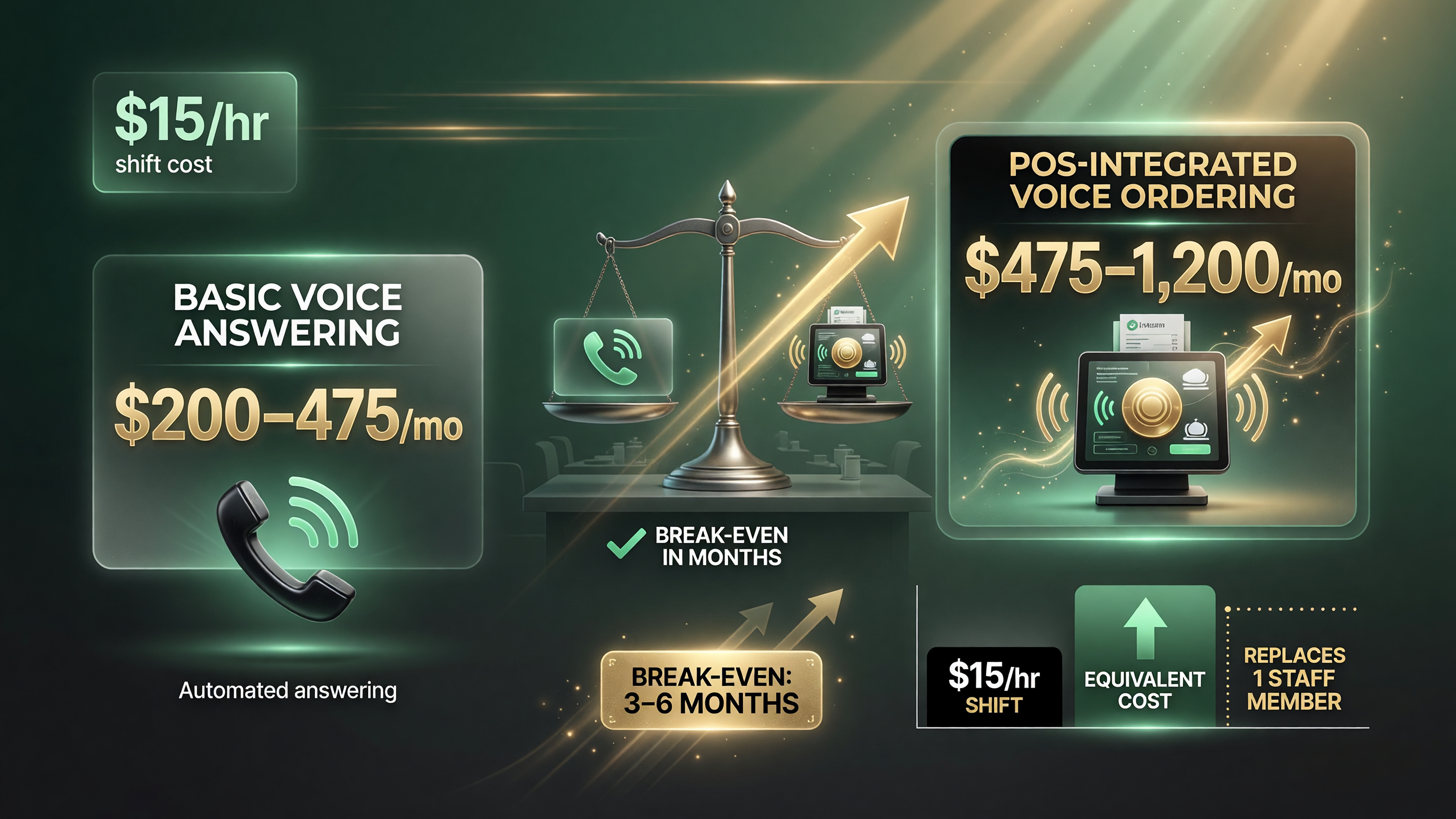
Independent voice AI tiers compete directly with labor: basic answering runs $200-475/mo and POS-integrated ordering $475-1,200/mo, with break-even in 3-6 months against a $15/hr shift.
What Is Actually Different Now Versus Six Months Ago
The Taco Bell milestone lands after a year of rapid consolidation in restaurant voice AI. The vendors that survived this round are the ones that moved from “we recognize speech” to “we complete the transaction and write to the POS.” That shift is the single most important change for independents: early voice AI just transcribed an order for a human to punch in; working voice AI takes the order, sends it to the kitchen line, and updates inventory. The Taco Bell system represents the latter, and the category has largely followed.
Two practical consequences follow. First, the quality bar has risen: an independent operator should now expect a voice AI vendor to demonstrate real POS integration and live menu handling, not just speech recognition. Second, the risk of adopting early is lower than it was in 2024, because the integration patterns are proven. You are no longer buying a science experiment; you are buying a mature tool category that a national chain just validated at scale.
What Taco Bell’s Scale-Up Does NOT Tell You
It is worth being precise about what this news does not mean for independents. Taco Bell’s deployment is heavily standardized — a consistent menu, consistent kitchen setup, corporate-backed vendor support. An independent with one or two locations, a rotating menu, and modest technical staff has none of those advantages. That does not mean voice AI will not work for you; it means you cannot copy Taco Bell’s setup and expect the same result. You have to tune the system to your menu, your staff, and your guests, and you have to budget time for that tuning.
There is also the human factor. The benefit Taco Bell reports — higher team retention because staff are freed from speaker duty — assumes you have the staffing model to redeploy that saved labor. A small restaurant’s crew is already doing a dozen jobs. If voice AI just removes one repetitive task and you do not have a plan for what the freed time should be spent on, you will not see the same retention benefit. The technology removes work; it does not decide how to reinvest the hours it saves.
How to Evaluate Voice AI for Your Independent Restaurant
If the Taco Bell scale-up has you reconsidering voice AI, evaluate vendors against the same bar the chain implicitly set. Work through these questions before you sign anything:
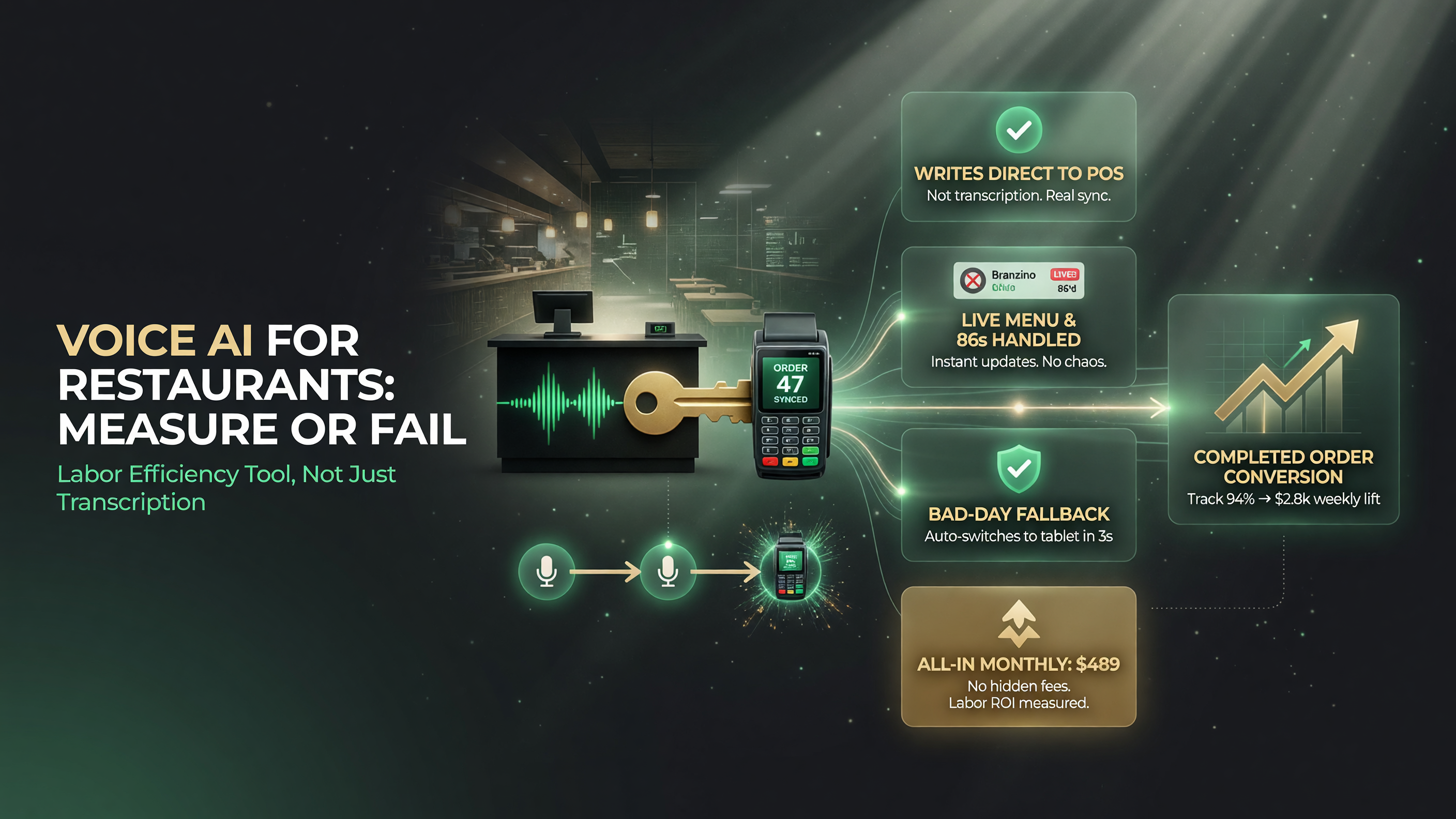
Evaluate vendors on whether they write to the POS, handle live menu and 86s, fall back gracefully, and let you measure completed-order conversion — not just transcription.
- Does it write to your POS, or just transcribe? Transcription alone still costs you labor. Full POS integration is the difference between useful and decorative.
- How does it handle your real menu? Modifications, limited-time items, and out-of-stock items must be handled live, not from a static script.
- What happens on a bad day? When the system fails, is the fallback a human, or does the guest wait silently? The recovery path matters as much as the happy path.
- Can you measure order conversion? The vendor should be able to show you completed-order rates, not just “calls answered.”
- What is the real price per month, all-in? Ask for the total with integrations, not the headline teaser price.
The right vendor for a single independent location will not look like the enterprise vendor serving Taco Bell. It will be a system sized to your call volume and your menu, with a pricing model that competes with labor, and a fallback your staff can execute without training.
The Bottom Line for Your Restaurant
Taco Bell pushing voice AI to roughly 900 drive-thrus is the clearest signal yet that conversational order-taking is standard restaurant infrastructure, not a pilot program. For an independent US operator, the practical takeaway is not to rush out and buy whatever Taco Bell bought. It is to recognize that the category has matured, the cost has come down, and the capability — real POS integration, live menu handling, transaction completion — is now available to independents at prices that compete with a shift of paid labor.
The smart move is measured: evaluate voice AI against your actual bottleneck (missed calls, slow drive-thru, repetitive speaker duty), demand proof of POS integration rather than speech recognition, and budget for tuning time. The restaurant that treats voice AI as a labor-efficiency tool it measures — rather than a marquee technology it wants to show off — is the one that comes out ahead as the category becomes default.
Sources: Restaurant Dive, “Taco Bell aims to drive AI into dining” (August 10, 2026); Business Wire, Omilia Powers Taco Bell’s Expansion of Voice AI Across 890 U.S. Drive-Thrus (July 7, 2026); Fox Business, Taco Bell ramps up voice AI use across drive-thrus (2026). Figures on location count, states, and reported benefits as cited by those sources.
Frequently Asked Questions
Is Taco Bell’s voice AI available to independent restaurants? Not Taco Bell’s exact enterprise deployment, but the same category of technology — conversational drive-thru and phone ordering connected to the POS — is sold to independents by vendors like Presto, SoundHound, Audivi, and ChampOS at monthly prices that compete with labor. The Taco Bell scale-up validates the technology category, not a product independents can buy directly.
How much does drive-thru voice AI cost for a small restaurant? Meaningful quotes for independents tend to range from roughly $200 to $1,200 per month depending on whether you need basic phone answering or full POS-integrated drive-thru ordering. Enterprise chain deployments run under custom annual contracts far above that range. Always ask for the all-in price including integrations.
Will voice AI replace my drive-thru staff? It replaces the repetitive task of taking repetitive speaker orders, not your crew. Taco Bell’s reported benefit is higher retention because staff are redeployed from speaker duty to other work. If you do not have a plan for the freed hours, you will not capture the full benefit.
Is voice AI reliable enough for a single-location restaurant? The category has matured to the point that a national chain trusts it across hundreds of locations. For a single location, reliability depends on the vendor’s POS integration quality and your willingness to tune the menu handling. Demand a real POS integration and a clear fallback path before committing.
Should I adopt voice AI now or wait? There is no penalty for measured adoption. If missed calls or a slow drive-thru are costing you real business, a well-integrated voice agent is worth testing. If you have no clear bottleneck, waiting is fine — but understand that the technology is becoming default, and competitors who deploy it may be capturing the same call volume you are missing.

About Barak Schurr
Barak Schurr built and exited a major ticketing platform, ran global operations at Eventbrite, and now focuses on one question: which AI tools actually help independent restaurant owners run leaner and grow faster. He writes from the operator’s perspective — no vendor spin, no theory, just what’s real in 2026.
Email: [email protected]
More Resources for Restaurant Operators