Get the AI Restaurant Quick-Start Guide — Free
The 5 AI tools independent US restaurant owners are using right now to cut labor costs and answer every call.
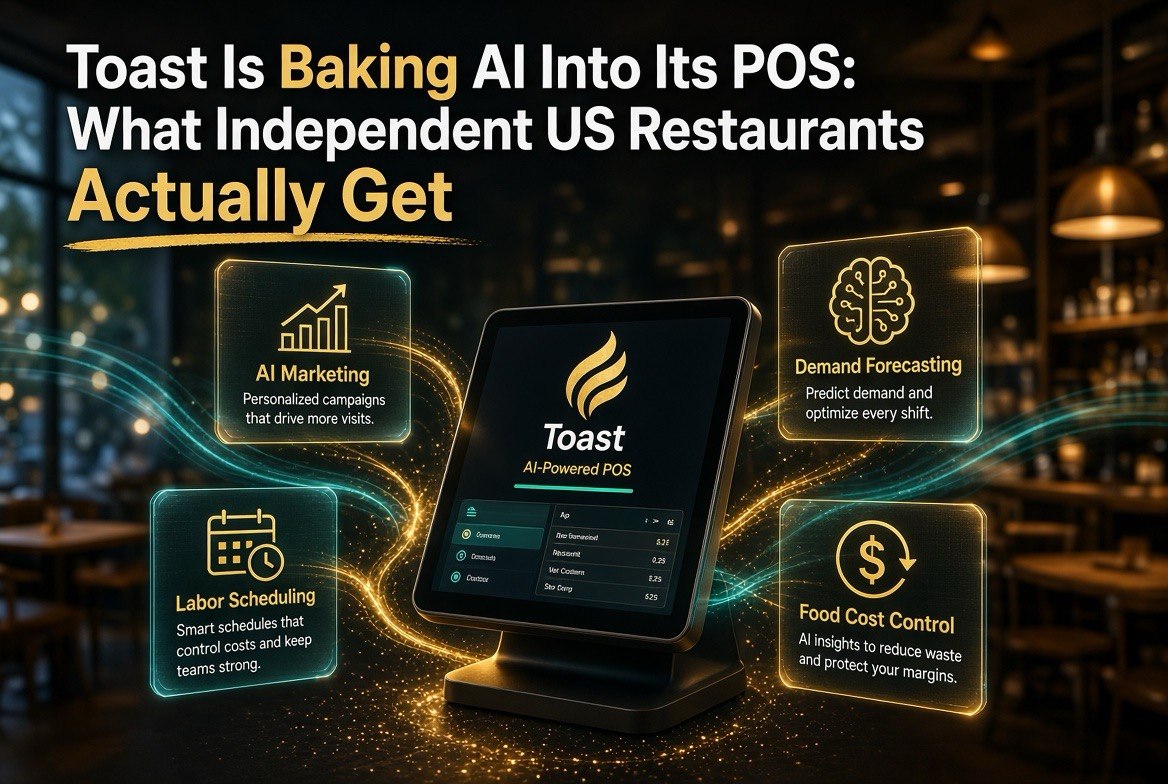
Toast Is Baking AI Straight Into Its POS: What Independent US Restaurants Actually Get
⚡ Expert Summary: Toast is turning its POS from a transaction recorder into an AI operations layer. The headline product, Toast IQ Grow, is an AI marketing engine that builds and runs campaigns straight from your sales data, and Toast says it could become its fastest-growing product with roughly $10 million in annual revenue. The broader roadmap adds agentic AI for labor scheduling, demand forecasting, food cost control, and tax help. For an independent US restaurant, the immediate value is less “buy the AI” and more “your POS data just became the fuel for decisions you used to make on gut feel.” Expect the useful, money-saving capabilities to roll out gradually across 2026, not all at once.
You did not buy your point-of-sale system to do marketing. You bought it to ring tickets, track sales, and split checks. But Toast — the cloud POS now running in roughly 180,000 restaurant locations in the United States — has a different plan for the terminal sitting by your bar. The company spent early August 2026 laying out an AI roadmap that treats your POS not as a cash register but as the data brain that runs your whole business. This is not another “add an AI widget” press release. It is a shift in what the box on your counter is actually for, and independent US operators who understand it early have a margin advantage the chains are already banking on.
What “Baking AI Into the POS” Actually Means
When Toast executives say they want to “drive AI into dining,” they mean embedding AI into the workflows you already touch daily — not bolting on a separate chatbot you have to remember to open. The concept is straightforward: your POS already knows what you sell, when you sell it, who your regulars are, and exactly what each item costs. Historically that data sat in reports you had to pull and read. The AI layer’s job is to act on it without you becoming a data analyst.
According to Restaurant Dive’s August 10, 2026 report, Toast is positioning this as a move into “agentic products” — AI agents that handle restaurant operations more autonomously. The areas named were demand forecasting, labor scheduling, income tax assistance, food cost management, and availability tracking. For a small operator who currently outsources marketing, payroll, and bookkeeping because there are not enough hours in the day, that list reads like the exact administrative load that never gets done properly.
The reason this matters for independent restaurants specifically is margin. Full-service and quick-service independents run on thin, volatile margins where a single bad labor week or an unmanaged food cost spike can erase a month of profit. The chains have entire analytics teams. You do not. AI baked into the tool you already pay for is the closest thing to closing that gap without hiring a corporate staff.
Toast IQ Grow: The Product That Puts Your POS to Work on Marketing
The flagship piece of the announced roadmap is Toast IQ Grow, which Toast describes as its first AI-enabled workflow product. Launched in May 2026 and highlighted again in the August earnings cycle, it is a digital marketing engine that pulls directly from your POS data. It optimizes your website, your search rankings, your digital orders, and your social presence, then runs campaigns and ties the results back to actual orders your system records.
Here is the part independent operators should pay attention to: because the system lives inside your POS, it does not need you to export customer lists or reconcile sales manually. It already knows which menu items drive your best margins and which guests order most often. Toast executives told Restaurant Dive they expect IQ Grow to become the company’s fastest-growing product and to generate around $10 million in annual revenue — a signal that Toast sees real willingness to pay for AI that shortens the gap between marketing spend and measurable restaurant sales.
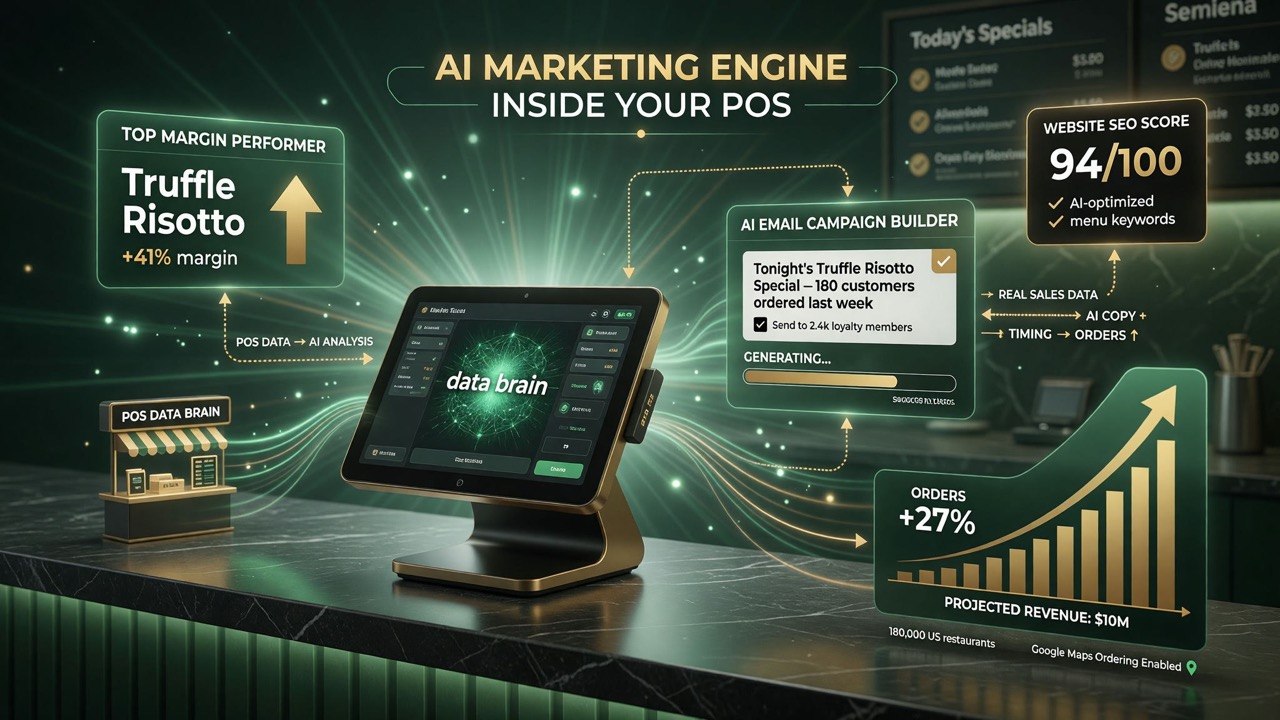
Toast IQ Grow turns POS sales data into a marketing engine — it flags top-margin items, drafts campaigns, and ties results back to real orders instead of guesswork.
| What It Automates | What You Used to Do Manually | Why It Matters for an Independent |
|---|---|---|
| Website + SEO optimization | Hire an agency or ignore it entirely | Local search is how new guests find you |
| Campaign creation from POS sales data | Guess who to target, generic blasts | Campaigns follow real guest and item data |
| Results tied to actual orders | Marketing ROI was a guessing game | You see what campaign actually drove ticket sales |
The smart way to read IQ Grow is not “Toast is now my marketing agency.” It is “the POS data I already collect finally gets used for something besides a nightly sales report.” The product is most valuable to operators who have been underusing their guest data — which covers most independent restaurants in the US.
The Agentic Roadmap: What Comes Next
Marketing is the beachhead, but the fuller vision is agentic AI across the back office. Toast’s stated direction is AI agents that take over recurring operational tasks. The four most relevant to a small US restaurant owner:
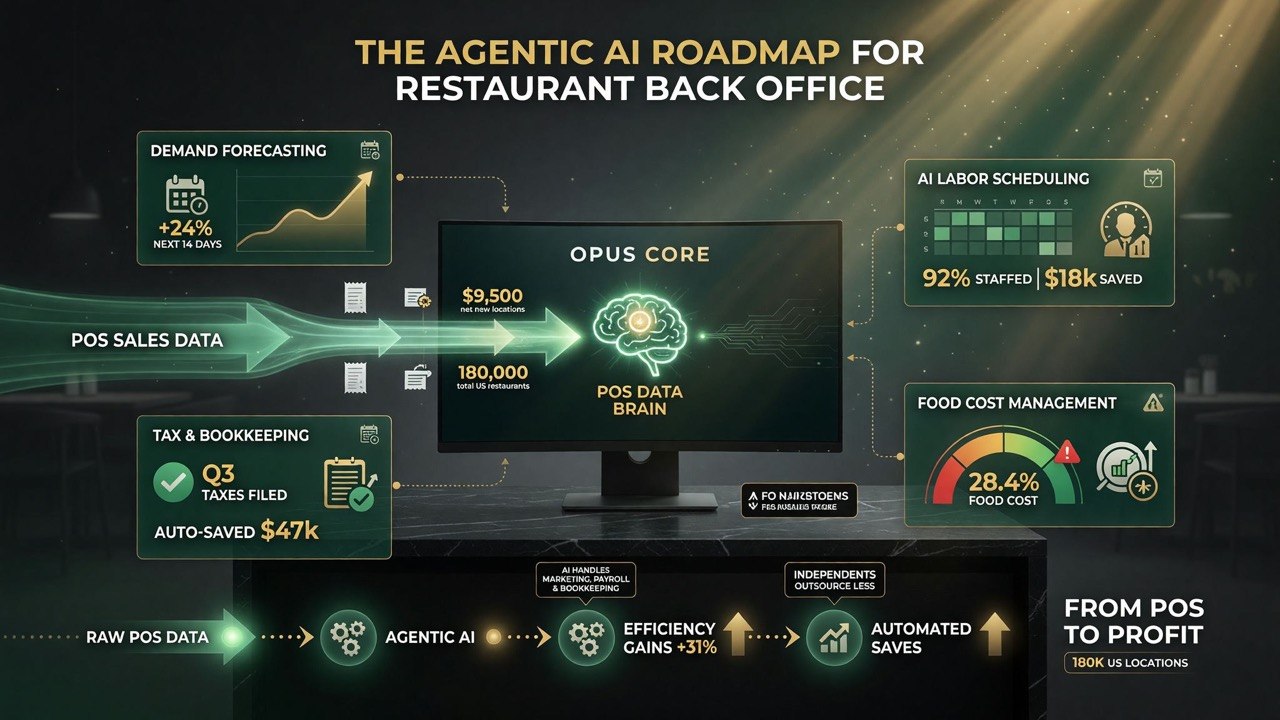
Toast’s agentic roadmap moves beyond marketing: demand forecasting, labor scheduling, food cost control, and bookkeeping all feed off the same POS data brain.
- Demand forecasting — predicting sales by daypart so you stop overstaffing slow Tuesdays and understaffing busy Fridays.
- Labor scheduling — building schedules from sales forecasts and your staff’s availability instead of a spreadsheet and a hunch.
- Food cost management — flagging when ingredient costs or portions are eating your margin on specific menu items.
- Income tax assistance — an unexpected one, but it targets the bookkeeping and tax burden that independent operators routinely outsource.
The through-line is that all of these sit on top of POS data the restaurant already generates. You are not feeding a new system from scratch; you are letting the system you already pay for read its own output. That is why the “baking in” framing matters — it is a different cost and effort profile than adding yet another standalone subscription.
Why the Timing Matters for US Independents
The August timing is not accidental. Toast reported its Q2 2026 earnings around early August with a record pace of location growth — roughly 9,500 net new locations, bringing the total to about 180,000. When a POS company is adding locations that fast and simultaneously pushing AI, it is signaling that AI is a growth lever, not a side experiment. For an independent operator, that means two things: your competitors on Toast are going to be offered these tools, and the tools will get cheaper and more capable as the install base grows.
There is also a practical race element. According to Restaurant Dive, Toast frames its AI push around helping time-strapped operators who currently outsource marketing, payroll, and bookkeeping. If your restaurant is still doing those things the old way — or paying a person to do what AI from your POS can now assist with — the gap between you and a nearby operator who adopts these tools will widen over the next 12 to 18 months, not shrink.
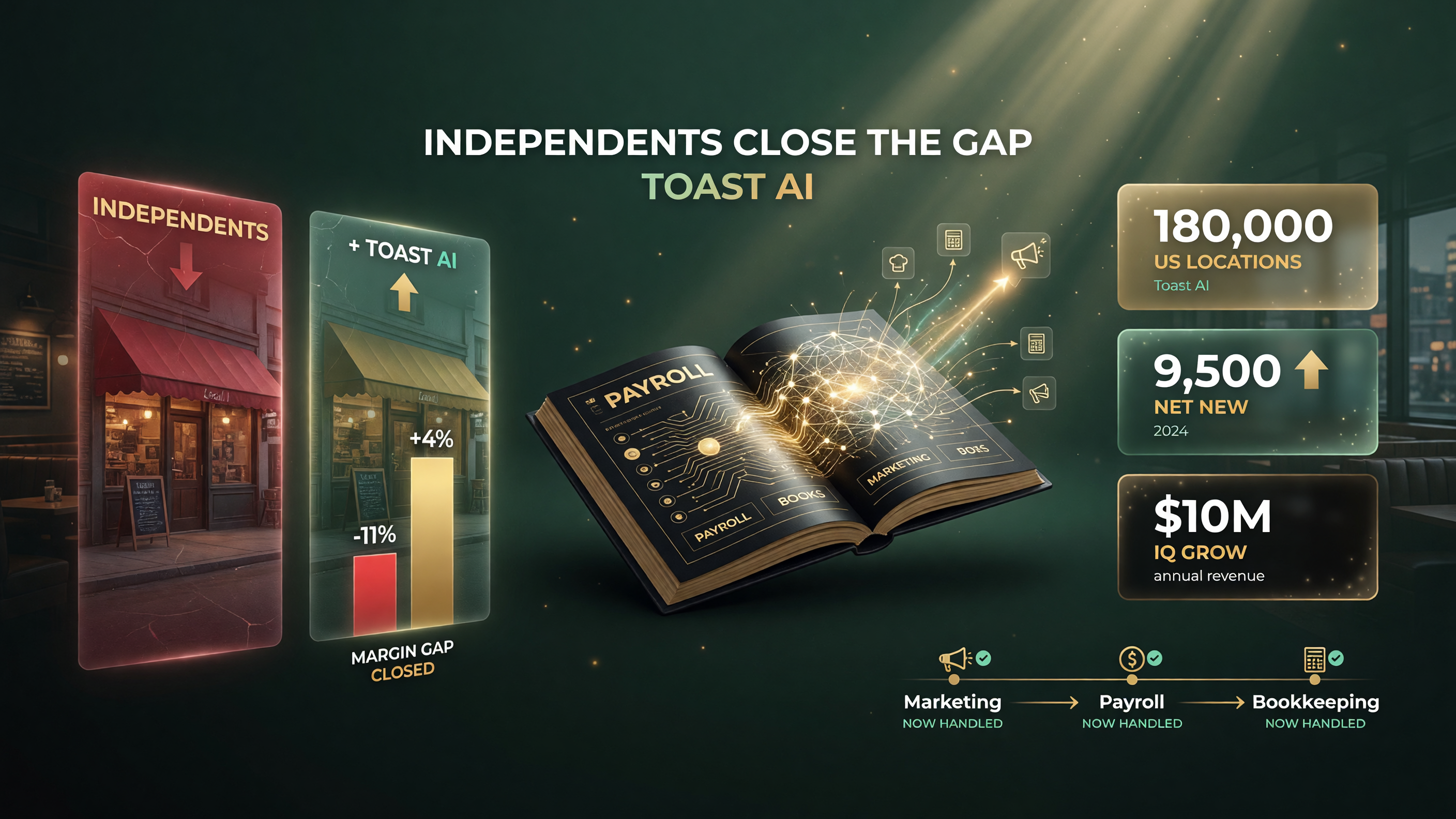
Independents close the gap: Toast AI handles the marketing, payroll, and bookkeeping that independents currently outsource — AI in roughly 180,000 US locations.
What This Means for Your Restaurant Right Now
Before you upgrade your plan or sign up for anything, separate the signal from the marketing. Here is the practical checklist for a US independent operator evaluating Toast’s AI push:
- Check what your current Toast plan already includes. Many AI features roll out to the base platform, not just premium tiers. Do not pay for what is already bundled.
- Look for the IQ features in your existing dashboard. Toast IQ has been shipping in waves since 2025 — the question is which capabilities your location has access to today.
- Treat AI marketing as an experiment with a budget, not an all-in move. Run one campaign on your best-margin item and measure real orders before expanding.
- Do not rip out existing tools yet. If your labor or food cost process works, keep it. Adopt AI where it clearly removes manual work, not where it is just a new tab in your software.
| AI Capability | What It Replaces | Adopt When |
|---|---|---|
| IQ Grow (AI marketing) | Agency or DIY generic campaigns | You want orders tied to marketing spend |
| Demand forecasting | Gut-feel staffing and ordering | Labor or inventory waste is hurting margin |
| Food cost management | Manual spreadsheet tracking | You chase food cost spikes after the fact |
| Labor scheduling | Paper or manual scheduling | Schedules are eating hours your week |
The Bottom Line for Your Restaurant
Toast baking AI into its POS is not a reason to panic-upgrade, and it is not vaporware you can ignore. It is a genuine reframing of what your most-used operational tool can do. The data your POS already records — sales, items, guests, costs — becomes the input for marketing, scheduling, forecasting, and cost control that previously required dedicated staff or outsourced help.
For an independent US restaurant, the smart move is measured: understand what your current plan already gives you, test one AI capability where it removes a real manual burden, and tie every adoption decision to a measurable result in orders or margin. The restaurant that treats its POS data as an asset — and lets the AI already inside it work — starts steadily ahead of the one treating the terminal as just a cash register.
Sources: Restaurant Dive, “Toast aims to drive AI into dining” (August 10, 2026); Toast Q2 2026 earnings and investor materials. Figures on location count and IQ Grow revenue projections as reported by those sources.
Frequently Asked Questions
Is Toast actually building AI into my POS, or is this just marketing?
It is real, productized work, not a vision deck. Toast IQ has been shipping in waves since 2025, and the August 2026 focus is on operative AI products like Toast IQ Grow (AI marketing tied to real orders) plus a roadmap for agentic labor scheduling, demand forecasting, and food cost management. Restaurant Dive reported the strategy in depth on August 10, 2026.
How much does Toast IQ Grow cost?
Toast has not published a universal public price; IQ features have rolled out across plan tiers and waves. The practical advice is to check what your current plan already includes before paying anything extra, since many AI capabilities ship bundled into the base platform.
Will this replace the marketing agency or bookkeeper I already use?
Not automatically, and you should not rip out working systems on day one. The tools target the recurring manual work that independent operators often outsource — marketing, scheduling, food costs, tax help. Adopt them where they clearly remove manual effort, and measure the result before committing.
Does my restaurant need to be on the newest Toast hardware to get the AI?
Not necessarily. Because the AI layer runs in the cloud on POS data, most capabilities depend on your plan and account, not a hardware replacement. Confirm which features your specific location has access to rather than assuming an upgrade is required.
How fast should I adopt this versus waiting?
There is no penalty for measured adoption. Test one capability — most naturally, AI marketing on a single high-margin item — and tie it to real orders. Waiting is fine as long as you understand that competitors on the platform will be offered the same tools and adoption will widen the gap over the next 12 to 18 months.

About Barak Schurr
Barak Schurr built and exited a major ticketing platform, ran global operations at Eventbrite, and now focuses on one question: which AI tools actually help independent restaurant owners run leaner and grow faster. He writes from the operator’s perspective — no vendor spin, no theory, just what’s real in 2026.
Email: [email protected]
More Resources for Restaurant Operators