Get the AI Restaurant Quick-Start Guide — Free
The 5 AI tools independent US restaurant owners are using right now to cut labor costs and answer every call.
Kutlerri.ai Raises $4 Million to Sell Restaurant AI on Outcomes, Not Seats
⚡ Expert Summary: Kutlerri.ai raised $4 million to build AI agents for independent restaurants, and the funding is not the interesting part. The pricing model is. Kutlerri charges for outcomes rather than software seats, telling customers they pay only when the work produces revenue. One named customer, RASA, reports closing $450,000 in new catering revenue in ten months without hiring, more than ten times what they paid Kutlerri. If that model holds up, it changes how every restaurant technology vendor has to sell. If it does not, it is a very good marketing line attached to a familiar product.
Restaurant software has been sold the same way for twenty years. You pay a monthly fee per location, or per user, or per covered integration. Whether the software produces anything is your problem, not the vendor’s. When it does not work, you cancel and you have lost the fee either way.
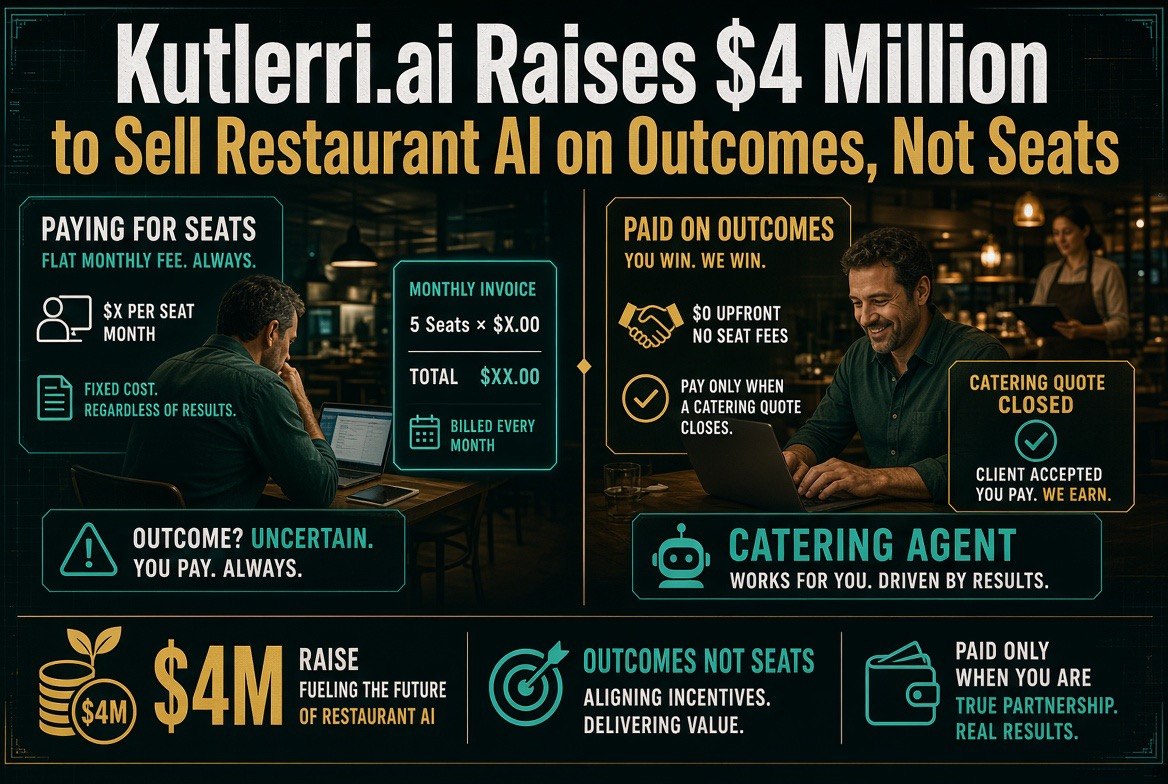
Kutlerri.ai, which just raised $4 million, is selling against that model directly. Their pitch is that you pay for the outcomes, not for the software. For their catering agent, the company states plainly that they get paid only when you do.
That is either the most interesting commercial change in restaurant technology this year, or a clever sentence wrapped around an ordinary product. The difference matters to every independent operator deciding what to buy next.
What Kutlerri Actually Sells
Kutlerri describes itself as restaurant growth backed by data, and it sells AI agents rather than a platform with modules. The agents split into two buckets: three focused on revenue expansion and three on cost control.
The revenue side covers customer acquisition, marketing, and catering. The cost side covers the operational leaks that quietly eat margin: labor scheduling, supply and inventory, and the waste that shows up on a P&L as unexplained variance.
The framing the company uses is that restaurants do not have a data problem, they have an action problem. Most operators already know their food cost is high or their catering is underused. What they lack is the staff time to act on it every single day.
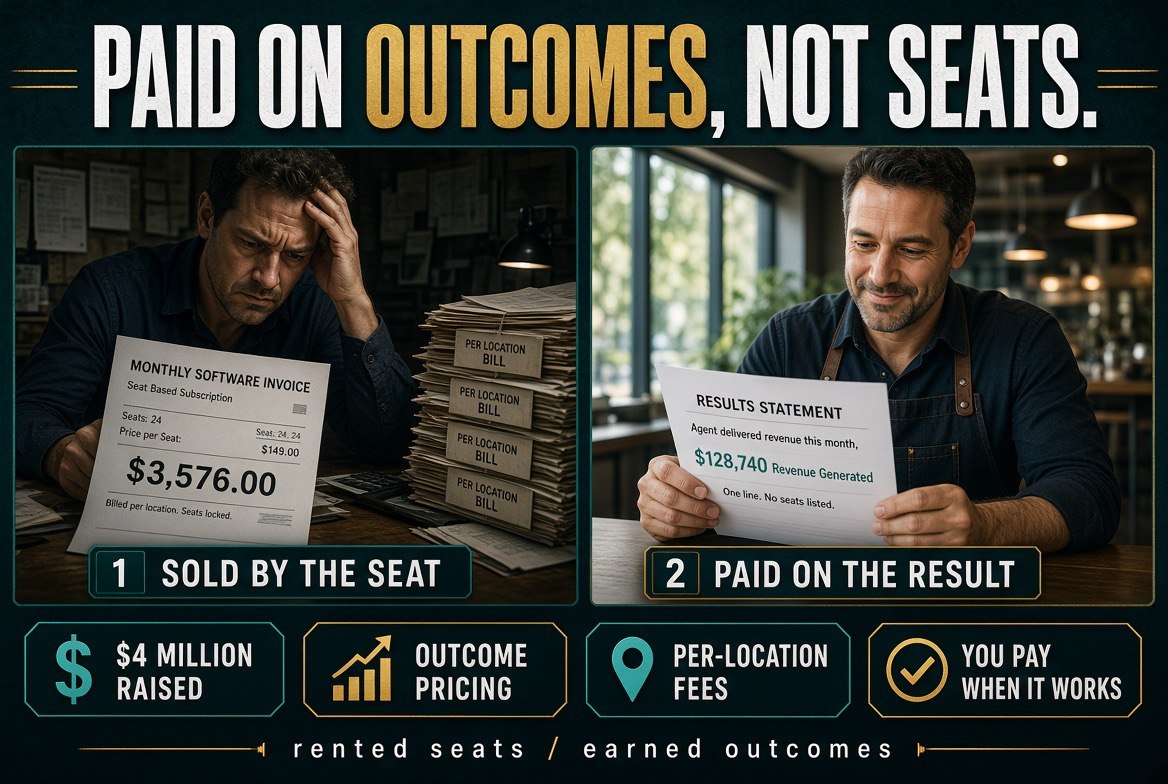
The whole pitch in one contrast: software billed by the seat whether it works or not, against an agent billed only when the work produces revenue.
The Result That Sells the Model: RASA and $450,000
The outcome-based pitch only matters if the outcomes are real and verifiable. Kutlerri names one customer outright.
RASA, a restaurant operator, is reported on Kutlerri’s site as having closed $450,000 in new catering revenue in ten months without hiring anyone, and Kutlerri states that figure is more than ten times what RASA paid them.
Read that carefully, because the multiple is the claim and the absolute number is the proof. A $450,000 catering increase without adding headcount is a meaningful business result for an independent operator. A 10x return on what the vendor costs is what makes the pricing model work.
It is also a single named customer. One data point on a vendor’s own website is marketing until it is corroborated by operators willing to say the same thing independently.
Why That Multiple Is Even Possible
Kutlerri’s own framing explains why the numbers can get large. Their playbook states that most restaurants capture only four to eight percent of their catering potential.
If that range is accurate across the industry, the upside is not a marginal improvement. It is an entire revenue line that most operators have never turned on because nobody has the staff hours to chase it consistently. Catering is high-ticket, it is often prepaid, and it does not consume table turns during peak service. It is the rare revenue stream that does not cannibalize the dining room.
The agent does not need to be brilliant. It needs to be persistent, which is exactly the thing humans are worst at when they are also running a Friday night.
What the Catering Agent Actually Does All Day
The workflow detail is where this stops being a pitch and starts being a product.
| Metric | Reported Figure |
|---|---|
| Daily actions taken | Roughly 37 |
| Items flagged for owner approval | About 2 |
| Typical quote turnaround | Around one minute |
| What the owner does | Approves or rejects the flagged items |
| What the owner does not do | Prospecting, follow-up, and quote drafting |
The ratio is the design. Thirty-seven actions a day collapsed into two decisions for a human is the difference between an agent that replaces your workload and one that adds to it. A system that flags thirty-seven items for approval is not an agent, it is a to-do list with a subscription.
The one-minute quote turnaround matters for a different reason. Catering inquiries are extremely time-sensitive. A prospective customer asking about food for eighty people is usually asking three vendors at once, and the one who responds with a real number first is usually the one who wins. Speed here is not efficiency. It is the whole sale.
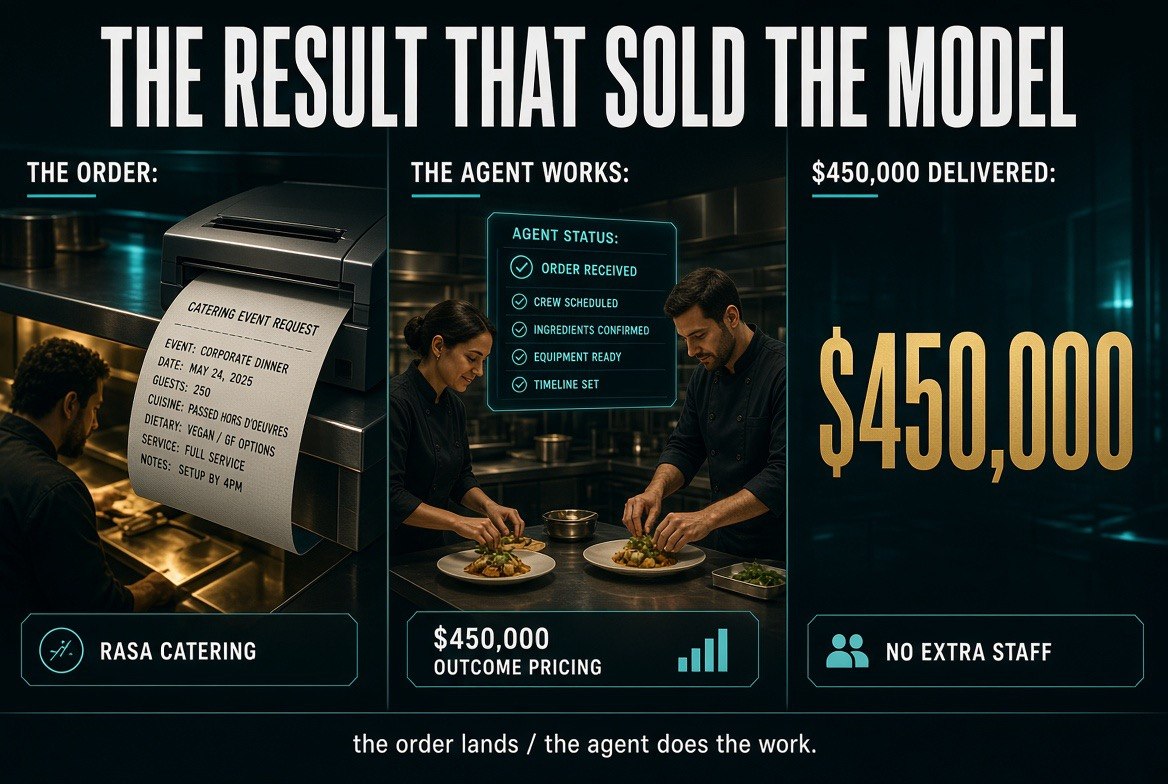
The result that sells the model: an order lands, the agent works it end to end, and the numbers come out the other side without extra staff on the floor.
The Cost-Side Agents: Where the Quiet Money Goes
Most of the attention in restaurant AI goes to the revenue side, because generating sales is more exciting than preventing loss. The cost agents are where the unglamorous margin recovery happens, and for a lot of operators they matter more.
Labor scheduling. Labor is the largest controllable cost in a restaurant and the one most often scheduled by habit rather than by forecast. Managers build next week’s schedule from last week’s, adjust for a couple of known events, and absorb the overage. An agent forecasting demand by daypart can schedule to the curve instead of to the memory of the busiest Friday last month. On a thin-margin operation, a few points of labor efficiency is the difference between a good quarter and a flat one.
Supply and inventory. Ordering is usually a manager standing in a walk-in at 11pm with a clipboard, guessing. Over-order and you write off spoilage. Under-order and you 86 a dish during service, which costs you both the sale and the trust of the table that wanted it. Neither error shows up as a line item. Both show up in your food cost percentage at the end of the month, unexplained.
Waste reduction. This is the agent that attacks variance directly. Where is product disappearing? Which prep is over-producing? What is being thrown out and when? Most operators can tell you their food cost to within a point. Almost none can tell you which three items are responsible for the gap, because nobody has the hours to track it.
The common thread is that none of these are intelligence problems. A competent manager already knows what to do. They are attention problems, and attention is the one resource a restaurant never has enough of during service.
Why This Category Exists At All
Restaurant labor has been getting more expensive and harder to staff for several years running. Industry research from UKG has documented the scale of the problem: high turnover, persistent hiring difficulty, and a cost structure where labor keeps rising while pricing power stays constrained by what the local market will bear.
That combination is what created the opening. When labor costs rise and hiring stays hard, the value of a system that absorbs routine work goes up even if the system is imperfect. An agent that handles prospecting, follow-up, and quote drafting for catering is not competing with a great salesperson. It is competing with the reality that you never hired one.
This is also why outcome pricing is a smart commercial choice for the vendor specifically. When your buyer is a restaurant owner who has been burned by software before and does not trust that a new tool will produce anything, removing the upfront risk is the fastest way to get a trial started. Whether that generosity survives contact with a scaled customer base is the open question.
Outcome Pricing vs. Seat Pricing: The Real Question
This is where the offer either fits your restaurant or does not, and the honest answer is that it depends on arithmetic you have to run yourself.
| Factor | Traditional Seat Pricing | Outcome Pricing |
|---|---|---|
| How you pay | Flat monthly fee per location or user | Fee tied to revenue the agent produces |
| What happens if it fails | You keep paying until you cancel | Vendor earns little or nothing |
| Vendor incentive | Retain the account | Produce measurable revenue |
| Your cash risk | Predictable, sunk regardless of result | Lower upfront, higher if it works |
| Margin risk | Low | Fee can scale with your success |
| Best fit | Tools with steady, predictable utility | Revenue lines you have not fully exploited |
| Worst fit | Anything you use every day regardless | Businesses with thin margin and no catering base |
The row that deserves real thought is margin risk. Outcome pricing is not free money. If the fee scales with the revenue the agent produces, the vendor is participating in your upside, and the better the agent performs the more you owe. That is a fair trade only if the multiple stays comfortably above one. Kutlerri’s own RASA figure puts it at more than ten times what the operator paid, which leaves enormous room. If that multiple compresses toward two or three as a customer scales, the math gets much tighter and the model becomes less obviously generous.
The other question worth asking is what counts as an outcome. Revenue the agent sourced directly is easy to attribute. Revenue that would have come in anyway, from a customer who was always going to call, is not. Any outcome-based contract needs that definition in writing before you sign.
Where This Fits for an Independent Operator
If you have a catering business that underperforms. This is the strongest case. Catering is the revenue line most independents leave partially dormant, the inquiries are time-sensitive, and the work is exactly the kind of persistent follow-up that falls apart during service. If you are capturing anywhere near the four-to-eight percent range Kutlerri cites, the upside is large enough to justify running a test.
If you do not offer catering at all. Start there before buying an agent for it. The software is not the missing piece; the offer is.
If your margins are already thin. Outcome pricing reduces your upfront risk, but it does not eliminate cost if the agent works. Run the arithmetic on the multiple before you sign, not after.
Whatever you do, get the attribution definition in writing. This applies to every outcome-priced vendor you will ever talk to, not just this one.
Ask for references you can call. The RASA result is a strong number published by the vendor. Two or three independent operators who will speak to their own results is worth more than any case study on a homepage.
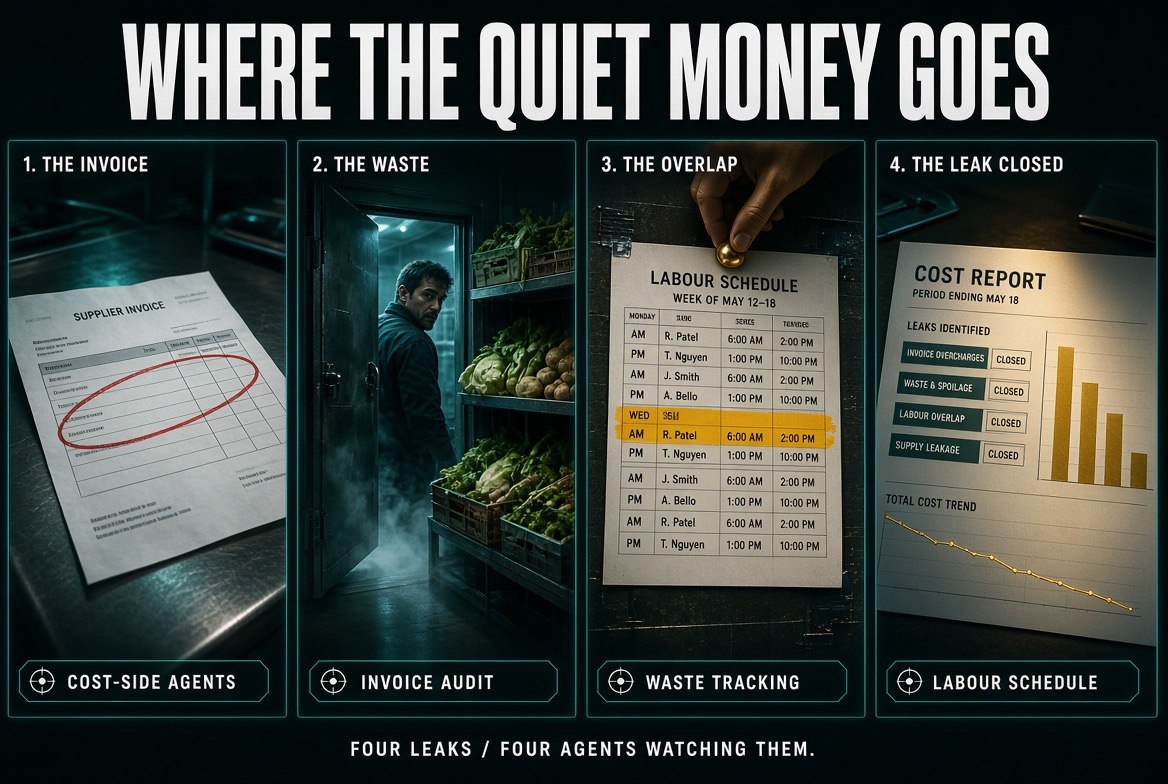
Where the quiet money goes: the invoice, the waste, the schedule overlap, and the report that shows each leak closed. This is the side of the business nobody puts on a poster.
Who This Is Not For
A useful test for any new tool is whether it can tell you when not to buy it. This one can.
If you run a single location with no catering operation and a stable team, there is very little here for you. The revenue agents need an underused revenue line to work against. The cost agents need enough transaction volume for pattern detection to beat a manager who has been running the same kitchen for a decade. A well-run single shop with an experienced owner already does most of this by instinct.
If you are the operator who will not act on what the agent surfaces, skip it. This is the most common way restaurant software fails. The agent flags the item, the owner is too busy during service to look at it, and a month later the subscription is quietly cancelled. The two-approvals-a-day design only works if you actually approve them.
If you are looking for something to fix your food cost overnight, no agent will do that. Consistent margin recovery comes from acting on the same small corrections week after week, and that requires you to show up for the decisions.
If you are not prepared to define “outcome” in writing, do not sign an outcome-priced contract. This is the single most important clause and the one most owners skim.
Frequently Asked Questions
What is Kutlerri.ai?
Kutlerri.ai is a restaurant technology company that sells AI agents rather than a traditional software platform. It offers six agents split across revenue expansion and cost control, covering customer acquisition, marketing, catering, labor scheduling, supply and inventory, and waste reduction.
How does Kutlerri’s pricing work?
Kutlerri charges for outcomes rather than software seats, telling customers they pay only when the work produces revenue. For its catering agent, the company states that it gets paid only when the restaurant does. That inverts the standard restaurant software model of a flat monthly fee per location or user.
What results has Kutlerri customers reported?
Kutlerri reports that RASA, a restaurant operator, closed $450,000 in new catering revenue in ten months without hiring anyone, and states that figure is more than ten times what RASA paid them. That is a single named customer on the vendor’s own site, so independent references are worth requesting.
How much of their catering potential do most restaurants capture?
Kutlerri’s playbook states that most restaurants capture only four to eight percent of their catering potential, which is why the company argues catering is the strongest revenue opportunity for agents to pursue.
What does the catering agent do each day?
Kutlerri reports the catering agent takes roughly 37 actions per day, flags about two items for owner approval, and produces quotes in around one minute. The design goal is to collapse a large volume of routine prospecting and follow-up into a small number of human decisions.
Is outcome-based pricing better than a flat subscription?
It depends on the multiple. Outcome pricing lowers your upfront risk because you pay when the agent produces revenue, but the fee can scale with your success and the vendor participates in your upside. It works best on revenue lines you have not fully exploited, such as catering, and it needs a written definition of what counts as an outcome before you sign.

About Barak Schurr
Barak Schurr built and exited a major ticketing platform, ran global operations at Eventbrite, and now focuses on one question: which AI tools actually help independent restaurant owners run leaner and grow faster. He writes from the operator’s perspective — no vendor spin, no theory, just what’s real in 2026.
Email: [email protected]
More Resources for Restaurant Operators