Get the AI Restaurant Quick-Start Guide — Free
The 5 AI tools independent US restaurant owners are using right now to cut labor costs and answer every call.
How AI Agents Could Change Restaurant Ordering: What Operators Need to Decide Now
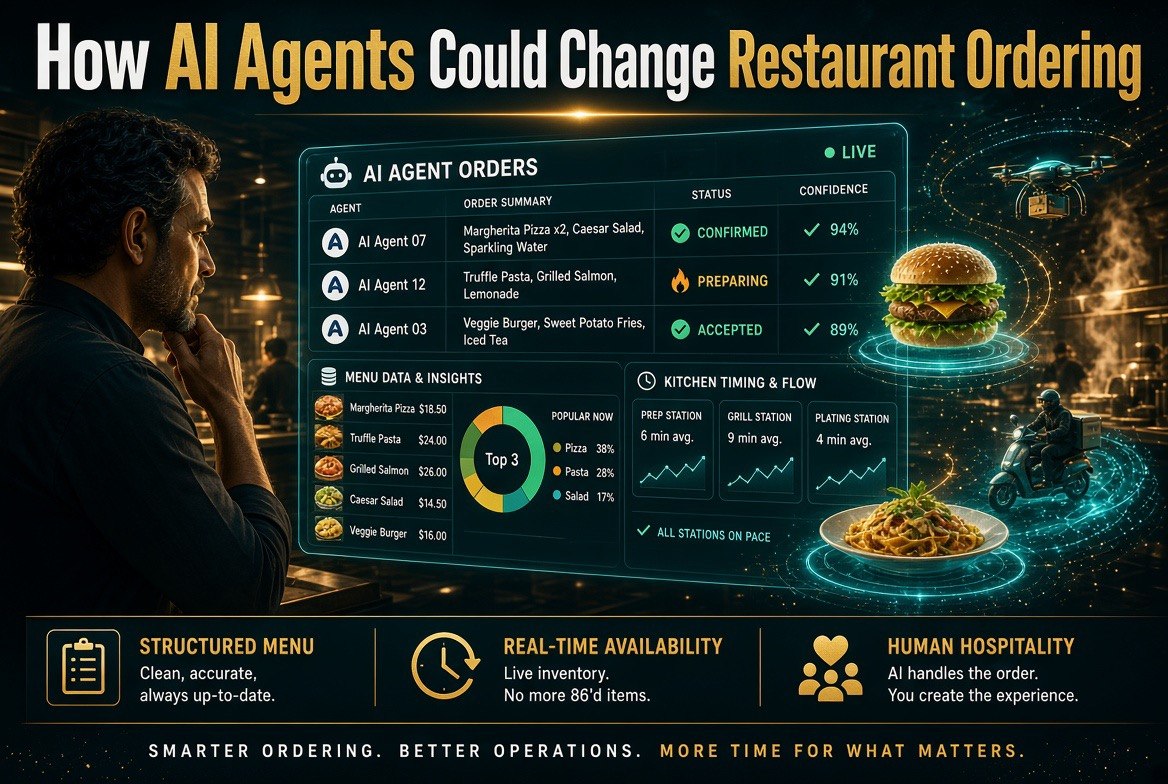
⚡ Expert Summary: AI agents that order food on a customer””s behalf are moving from demo to deployment, and they break the assumptions your POS, your menu, and your third-party delivery contracts were built on. An agent does not browse your menu for the photos. It reads structured item data, checks availability and modifiers, compares total delivered price, and orders — or skips you entirely. This guide covers what the shift actually looks like at the counter, the three channels agents enter through, and the four operational decisions that determine whether agent orders are margin or mayhem.
Your next regular might not be a regular at all. It might be a piece of software that learned what they like, holds a budget, and places the order without a human thumb ever touching a screen. That is not a hypothetical for 2030 — the infrastructure to do it is already in production across the ordering stack you use today.
For independent operators, the uncomfortable part is not the technology. It is that almost every number in your restaurant was built assuming a person was looking at a menu when they decided what to buy.
[PENDING INLINE IMAGE 1]
What Actually Changed in Restaurant Ordering
Ordering has moved through three distinct eras, and each one changed what a restaurant had to be good at. The agent era is the third, and it is the first one where the customer is not the person deciding.
| Ordering Era | Who Decides | What You Had to Win On |
|---|---|---|
| Counter and phone | The guest, standing in front of you or on the line. | Food quality, speed, and whether they remembered you existed. |
| Delivery apps | The guest, scrolling a ranked list inside someone else””s app. | Photo quality, ratings, ranking position, and promo spend. |
| AI agents | Software acting on the guest””s stated preferences and budget. | Structured item data, availability accuracy, landed price, and integration. |
Notice what disappears in the third row: the photo, the vibe, the name recognition. An agent does not scroll past your tacos and feel something. It evaluates whether your item matches the constraint it was given at a total price it can justify, and then it either can place the order or it cannot.
The Three Channels Agents Are Entering Through
Agentic ordering is not arriving as one product. It is arriving through three separate doors, and each one lands differently on your operation.
1. Inside the delivery marketplaces you already pay
The third-party platforms that already take a commission on your orders are the most natural home for agent ordering, because they already hold the menu data, the pricing, and the payment relationship. When a consumer””s assistant places a delivery order, it is most likely doing it inside an ecosystem you are already listed in — which means the agent””s decision is shaped by the same ranking and data-quality factors that already determine whether you show up.
The operational consequence is blunt: if your menu data on those platforms is thin or stale, you were already losing rank. With an agent, you may not even be a candidate.
2. Through your own ordering stack
Your POS, your online ordering provider, and your reservation system are all shipping AI features into the same pipes you use daily. Voice ordering on the phone line, agents that handle a reorder for a known guest, and assistant-driven checkout are being layered onto existing infrastructure. That is good news — it means you are not adopting a new system so much as discovering what your current vendor already turned on.
3. Through direct consumer assistants
The slowest but most interesting door is a general-purpose assistant that a guest has authorized to order food. This is where agents stop being a feature of someone else””s app and become a genuine channel of their own. It is also the door where you have the least control and the most to gain, because there is no ranking screen at all — only whether an agent can read your items, confirm availability, and complete a transaction.
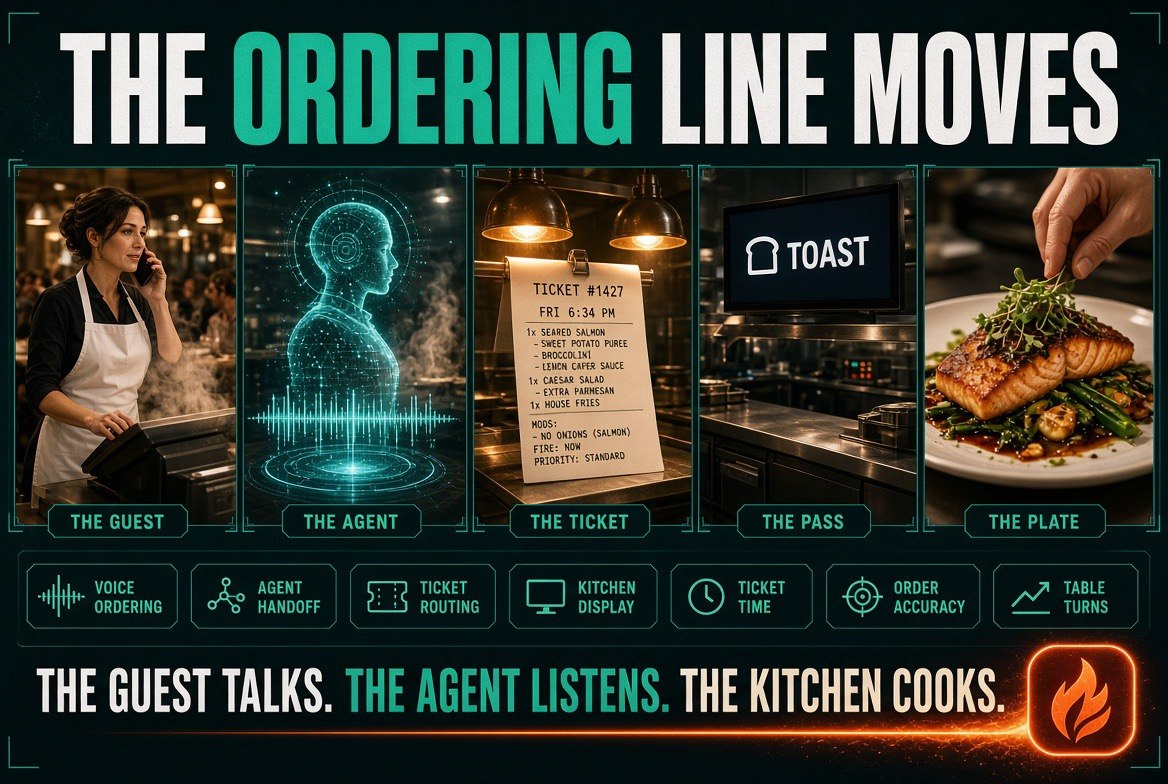
The ordering line end to end: the guest talks, the agent turns speech into a structured ticket, the pass receives it, and the plate comes out the other side.
What Agent Ordering Does to Your Margins
Here is where the conversation stops being theoretical. An agent optimizes for the constraint it was given by its user. That constraint is usually cost, speed, or a specific craving — and only one of those three is on your side.
| Pressure Point | How It Shows Up | Operator Response |
|---|---|---|
| Price comparison | The agent compares total delivered cost, not menu price. | Control packaging and fee structure so your landed price stays competitive. |
| Modifier ambiguity | An unclear option set makes an agent skip the item. | Clean, explicit modifier groups with clear defaults and upcharge values. |
| Availability drift | Selling out an item the agent still sees as available triggers failures. | Real-time 86ing reflected to every channel, not just your own. |
| Ticket size erosion | Agents order exactly what was asked, no impulse add-ons. | Build value into bundles, not into suggestive upsell moments. |
| Dispute exposure | An agent orders wrong, and the guest blames the restaurant. | Confirm clearly, keep order records, and define your refund posture upfront. |
The ticket-size row is the one people miss. Human ordering has a built-in upsell surface — the counter person who asks if you want fries, the app that shows a dessert carousel. An agent ordered to “get one burrito under fifteen dollars delivered in thirty minutes” will get exactly that. Your average ticket design has to assume the upsell moment may not exist.
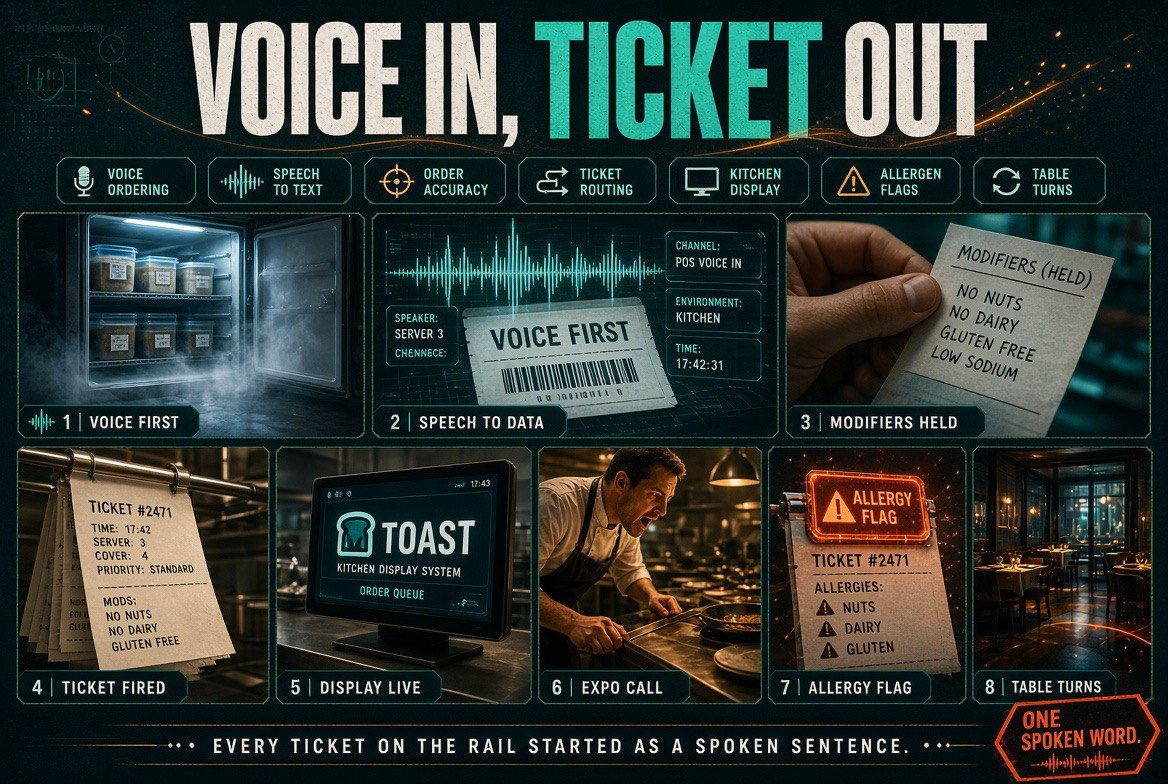
Eight moments in one shift where an agent either helps the kitchen or gets in its way — from the first spoken sentence to the last table turn.
The Four Decisions That Determine Whether This Helps or Hurts You
None of these require new software. All four require someone to actually make a call.
1. Own your structured menu data
Item names, descriptions, allergens, modifier groups, portion sizes, availability. If you cannot read your own menu as a machine would — clean fields, unambiguous options, accurate prices — an agent cannot confidently place the order either. This is the highest-leverage work in the entire shift and it costs nothing but attention.
2. Know what your current stack already does
Call your POS and online ordering provider and ask directly: what agent or AI ordering features are already enabled on our account, and what is in the roadmap? Most operators are paying for capabilities they have never switched on, and a handful are already training agents on their menu without realizing it.
3. Decide your channel posture before someone decides it for you
Do you want agent orders coming through the marketplaces that take a commission, through your own direct ordering, or both? That is a margin decision, not a technology decision, and it gets much harder to make once the volume starts arriving through whichever door you happened to leave open.
4. Protect the human experience for the orders that stay human
Even in an agent-heavy future, most covers still walk through the door and eat in. Your dine-in service is not competing with an algorithm. Do not gut the hospitality side of your operation to chase a channel that is still early — the guests in your dining room are paying full margin.
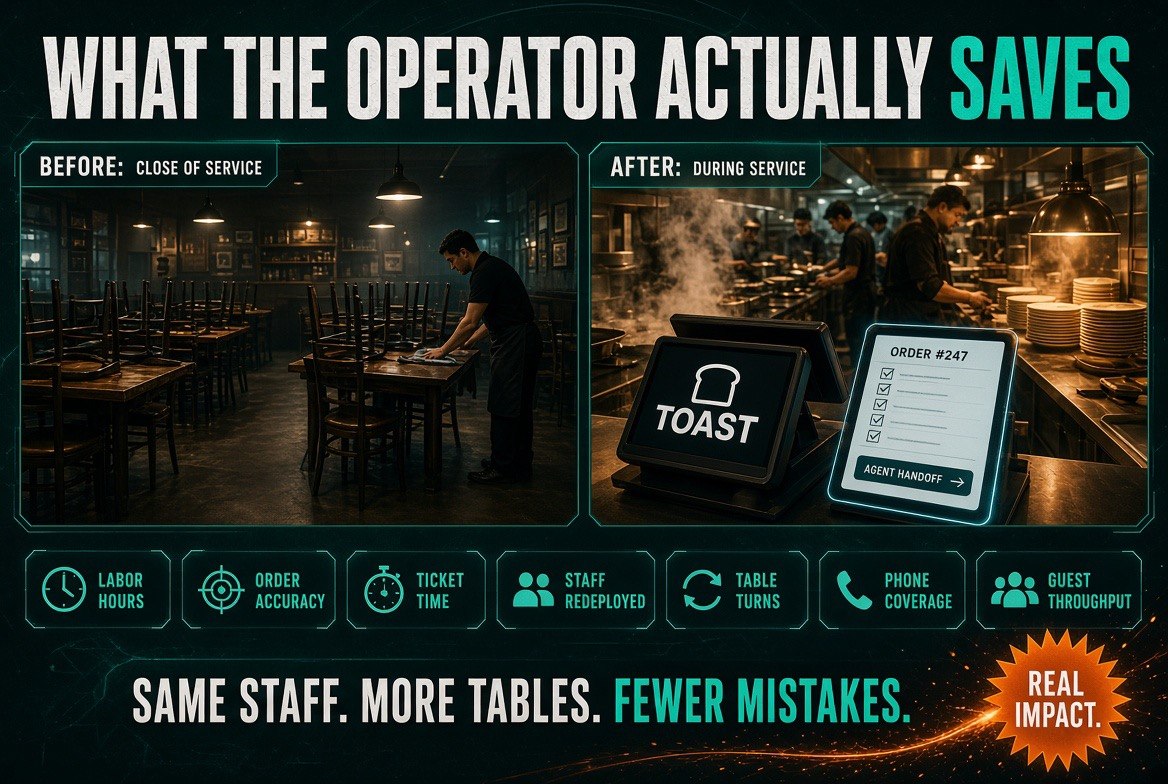
What the operator actually saves: the same close-of-service labour, or the same crew mid-rush with fewer mistakes and more covers turned.
What Happens to Your Kitchen When Agents Start Ordering
Most of the agent discussion stays in the front of the house, but the operational shock lands in the back. An agent does not order at a human pace, and it does not order at human hours.
Two patterns show up quickly. The first is demand compression — agent orders arrive in bursts, because the guest””s assistant fires the order the moment a condition is met, not when a person finally gets around to deciding they are hungry. Ten orders in two minutes is a wave the kitchen was never staffed for if those orders used to dribble in across forty minutes.
The second is off-hours ordering. An agent working on a schedule can place a lunch order for a guest at 6am, or a dinner order at 11am, because it is executing a plan rather than reacting to a craving. Your prep schedule, your staffing model, and even your open hours suddenly matter to a channel that does not experience hunger on a normal clock.
Neither pattern is a disaster. Both are planning problems, and both are solvable with information you already have. The operators who handle this well do one thing early: they watch the timestamps on incoming agent orders for a few weeks before they change anything about staffing, so they are reacting to a real pattern instead of a guess.
The phone-line problem nobody talks about
Voice ordering is the oldest agent channel in restaurants, and it has quietly become the most consequential. A voice agent answering a busy phone line is an improvement over a guest who hangs up after six rings — but it is also a machine placing orders into a kitchen that may already be at capacity.
The failure mode is not the voice system. It is the handoff. If a voice agent books an order that the kitchen cannot actually produce in the promised window, you have automated the creation of a bad guest experience. Before you turn voice ordering on, know how it interacts with your current order throttling, your promised times, and your 86 list.
What This Means for the Independent Operator
The honest read: agentic ordering is real, it is early, and the early phase favors operators who keep clean data and clear thinking. You do not need to buy anything. You need to know what your systems already say about your menu, and you need to decide what you want agent orders to do to your margins before they start arriving.
The operators who get hurt here are not the ones who refuse the technology. They are the ones who never looked — who discover a year from now that a meaningful share of their delivery volume was being chosen by software, and that their own menu data was the reason the software kept choosing someone else.
Start with the menu data. It is boring, it is free, and it is the entire ballgame.
One more thing worth internalizing: this shift does not require you to beat a competitor on technology. It requires you to be legible. A restaurant with a beautifully photographed menu and no structured item data is invisible to an agent. A restaurant with an unglamorous menu but perfect data can be the obvious answer to “find me a burrito under fifteen dollars.” The competitive ground moved, and it moved somewhere a small operator can genuinely win, because the work is attention rather than budget.
The two-week menu data checklist
If you want something concrete to do this month, do this. It takes two weeks, an hour a day, and no money.
- Week one, day one and two: export your full menu as a spreadsheet. Every item, every modifier, every price. Look at whether the data is actually structured or just a wall of text descriptions.
- Week one, day three and four: standardize your modifier groups. Sizes, temperatures, preparation options, add-ons. Each group needs a clear name and clear defaults.
- Week one, day five: check allergen and dietary information on every item. This is the field agents are most likely to filter on, and the one most restaurants leave vague.
- Week two: log into every channel where your menu appears — delivery marketplaces, your online ordering portal, your POS — and compare them side by side. Fix the discrepancies. Stale prices across channels are how you lose an agent””s trust quietly.
Nobody will thank you for doing this. Nothing about it looks like growth. It is exactly the kind of unglamorous operational work that decides which restaurants end up inside the shortlist when a machine does the choosing.
Frequently Asked Questions
What is agentic ordering in a restaurant context?
Agentic ordering means software acting on a guest””s behalf to place a food order — comparing items, checking availability, and completing checkout based on stated preferences and a budget, without a person manually browsing the menu.
Do I need new hardware or a new POS to accept AI agent orders?
Usually not. Most agent ordering arrives through systems you already run — your delivery marketplace listings, your online ordering provider, or your POS vendor. The work is in clean data and clear configuration, not new equipment.
How do AI agents decide which restaurant to order from?
Agents typically optimize for the constraint the guest gave them: total delivered price, delivery time, or a specific item. They select on structured data such as item accuracy, modifier clarity, availability, and price rather than on photos or brand recognition.
What breaks most often with agent-placed restaurant orders?
Modifier ambiguity and stale availability. If an option set is unclear or an item that is sold out still appears available in a channel, the agent either skips the item or places an order the kitchen cannot fulfill.
Will AI agents reduce my average ticket size?
They can. Agents order what was asked and generally do not respond to impulse upsells the way a human guest or a counter employee does. Building value into bundles and item structure matters more than relying on suggestive selling moments.
What should I do first?
Audit your menu data as a machine would read it. Then call your POS and online ordering providers and ask what agent or AI ordering features are already enabled on your account. Those two steps cost nothing and cover most of your exposure.

About Barak Schurr
Barak Schurr built and sold a major ticketing platform, ran global nightlife operations at Eventbrite, and now spends his time figuring out which AI tools actually move the needle for independent restaurant owners — and which ones are just noise. No hype. No fluff. Just what works.
Email: [email protected]
More AI Resources for Your Business