Get the AI Restaurant Quick-Start Guide — Free
The 5 AI tools independent US restaurant owners are using right now to cut labor costs and answer every call.
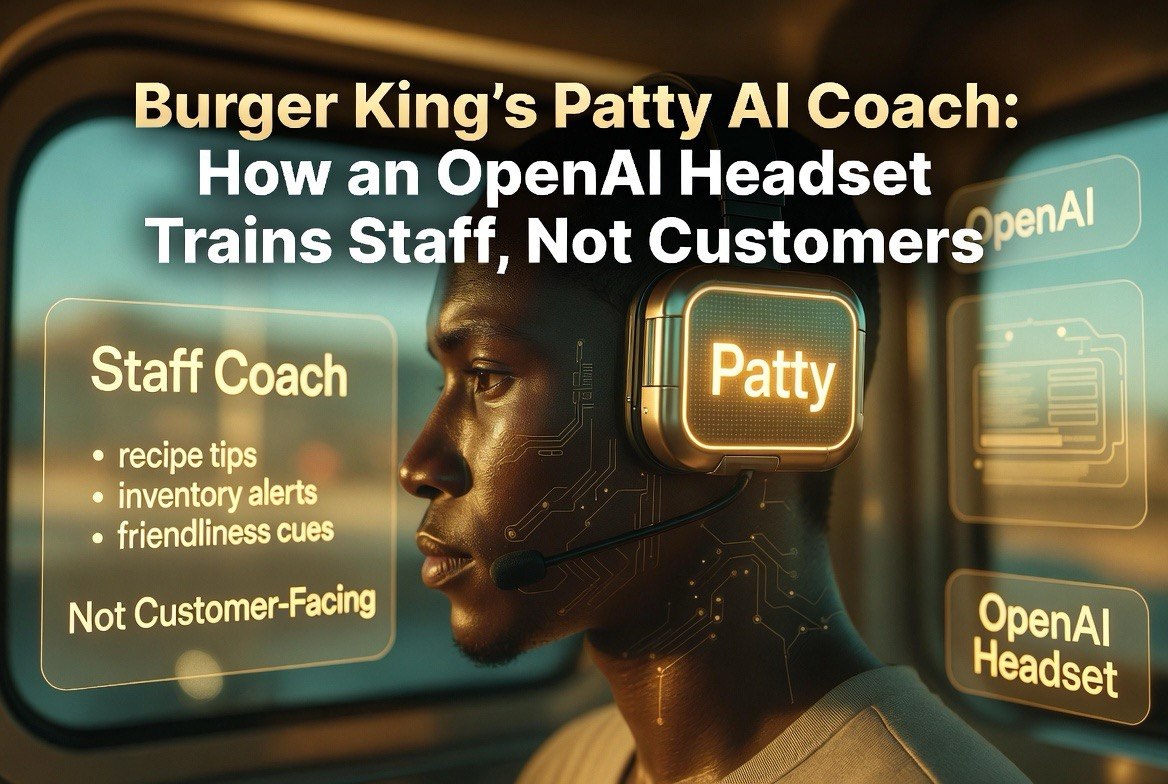
Burger King’s Patty AI Coach: How an OpenAI Headset Trains Staff, Not Customers
⚡ Expert Summary: Burger King is piloting “Patty,” an OpenAI-powered voice assistant built into its BK Assistant platform that coaches employees through drive-thru headsets — not customers. Patty answers staff questions on recipes and inventory, flags low stock and equipment issues, and tracks “please,” “thank you,” and “welcome” cues into a location-level friendliness score. Roughly 500 U.S. restaurants joined the pilot around February 2026, with nationwide U.S. rollout targeted by end of 2026. The lesson for independent operators: you do not need a customer-facing bot — you need an on-the-line coach that catches the soft-skills and accuracy misses driving your reviews.
Every restaurant AI headline lately is the same: a robot taking the drive-thru order. Burger King flipped it. “Patty” never talks to a single guest. It rides in the employee’s headset and coaches the team while the window stays open.
That is a bigger deal for independent owners than another order-taking bot — because it points at the real cost center in your restaurant: the soft-skill and consistency misses that show up in your reviews, your repeat rate, and your labor waste.
Think about what actually drags a 4.2-star independent spot down to a 3.8. It is rarely the food. It is the drive-thru or takeout window where a customer hears a snapped “what do you want” or an item rings in wrong and nobody catches it until the bag hits the car. Patty is Burger King’s bet that AI can close those gaps on the employee side of the counter — and the model is small enough and cheap enough that you should pay attention.
Why This Story Is Different From Every Other Voice AI
Most of what you have read about restaurant voice AI is customer-facing: the bot that takes the order through a speaker, a phone line, or an app. Patty is the opposite. According to The Verge, Patty is part of BK Assistant and works as an employee-facing assistant that coaches staff through headsets on operations, recipes, inventory, and drive-thru service.
No customer ever talks to Patty. The AI listens to drive-thru audio on the operations side and speaks only to the employee wearing the headset. That small design decision sidesteps the accuracy and refund problems that have dogged customer-facing ordering bots — the human stays in the loop, and the AI sharpens the human.
For an independent operator, that reframe matters. You have been told for two years that the answer to your labor problem is a bot that replaces the order-taker. That pitch keeps failing on accuracy, on upset guests, and on the sheer cost of getting it to understand every dialect and mumble. Burger King is betting the opposite: keep the human on the window, give that human an invisible coach, and let the AI handle the consistency layer. It is a cheaper, lower-risk way to get most of the same margin back.
What Patty Actually Does on the Line
Break Patty down into four real jobs, all aimed at the front-line worker:
- Recipe and prep coaching: an employee asks how to build a specific sandwich or how long a patty stays in the warmer, and Patty answers instantly through the headset.
- Inventory and stock alerts: when a core item runs low, Patty flags it before the next car pulls up — not after a customer is told “we’re out.”
- Equipment issue detection: it pulls signals from kitchen equipment and surfaces problems (a holding unit drifting out of range, a fryer sensor) so the shift lead can act.
- Friendliness coaching: it tracks courtesy cues — “please,” “thank you,” “welcome” — across the location and feeds a friendliness score used for coaching, not for singling out one employee.
NBC News and The Guardian both covered the friendliness-monitoring angle, which is the part that gets the most attention — and the part you should think hardest about before copying it. Every one of those four jobs maps to a place where a small independent restaurant loses money every single week: a mistimed prep step, an avoidable stock-out, equipment that runs wrong for an hour, and the courtesy slip that lands in a review.
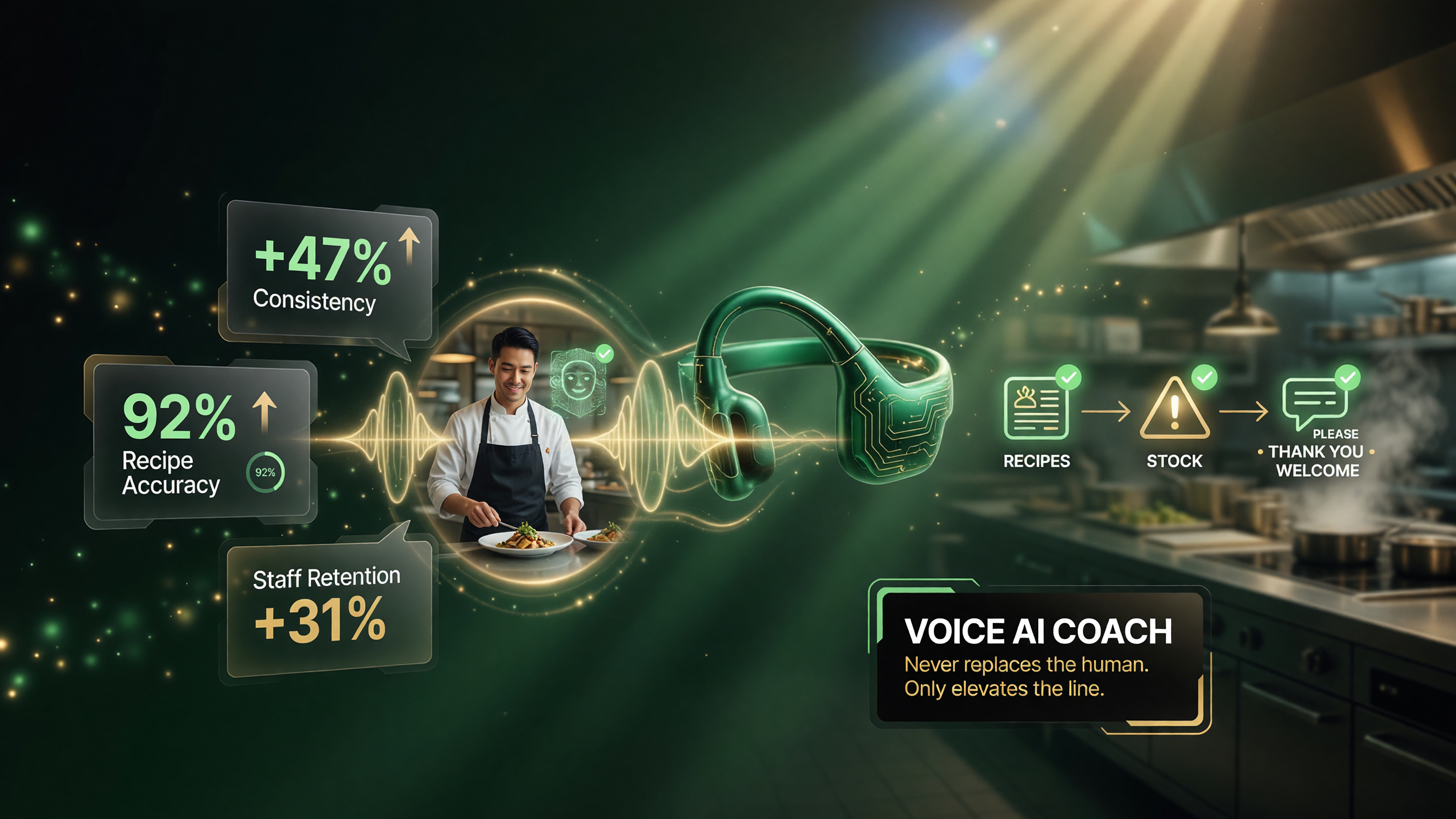
Patty-style headset coaching surfaces what a shift manager cannot watch alone: recipe accuracy, stock alerts, and the courtesy cues that land in your reviews.
How Patty Gets Its Signals
Patty is not a single trick. It ties together the data streams that already exist in a modern restaurant and turns them into something an employee can act on. Drive-thru conversations give it the courtesy and accuracy cues. Point-of-sale data shows it what actually sold. Kitchen equipment feeds it temperature and sensor signals. Inventory tells it what is running thin. Digital orders add the third-party and app-order picture on top.
When those streams line up, the assistant does something a shift manager physically cannot do across a busy lunch rush: watch every window at once. It catches the moment a holding unit dips below spec, flags the item about to sell out, and reminds the crew to hold the greeting line — all in the moment, not in a post-shift meeting nobody reads.
The honest limitation: none of that works if your store doesn’t have the digital plumbing. If you are still on a paper chit system and a terminal that doesn’t export data, you cannot run a Patty-style coach yet. That is itself a signal of where your tech stack needs to go before you can layer AI on top.
The U.S. Pilot and What the Timeline Tells You
Burger King started the pilot in roughly 500 U.S. restaurants around February 2026. The full BK Assistant platform — Patty included — is slated for nationwide U.S. availability by the end of 2026, with Canada expansion later in the year. These are U.S.-market numbers, and they matter for one reason: a national rollout by year-end means the tool is already proven on real drive-thrus, not a lab experiment.
It also tells you the economics work. Burger King is a franchise system — franchisees pay for their own tech and push back hard on anything that does not help the P&L. A nationwide rollout across hundreds of franchise-run drive-thrus is a signal that the headset coach delivers measurable service and labor value, or the operators would have killed it. That is the strongest endorsement an AI tool can get in this industry.
If you operate one store or five, you are not deploying Patty tomorrow. But the fact that a giant is betting its national service standard on headset coaching tells you where the next competitive edge sits.
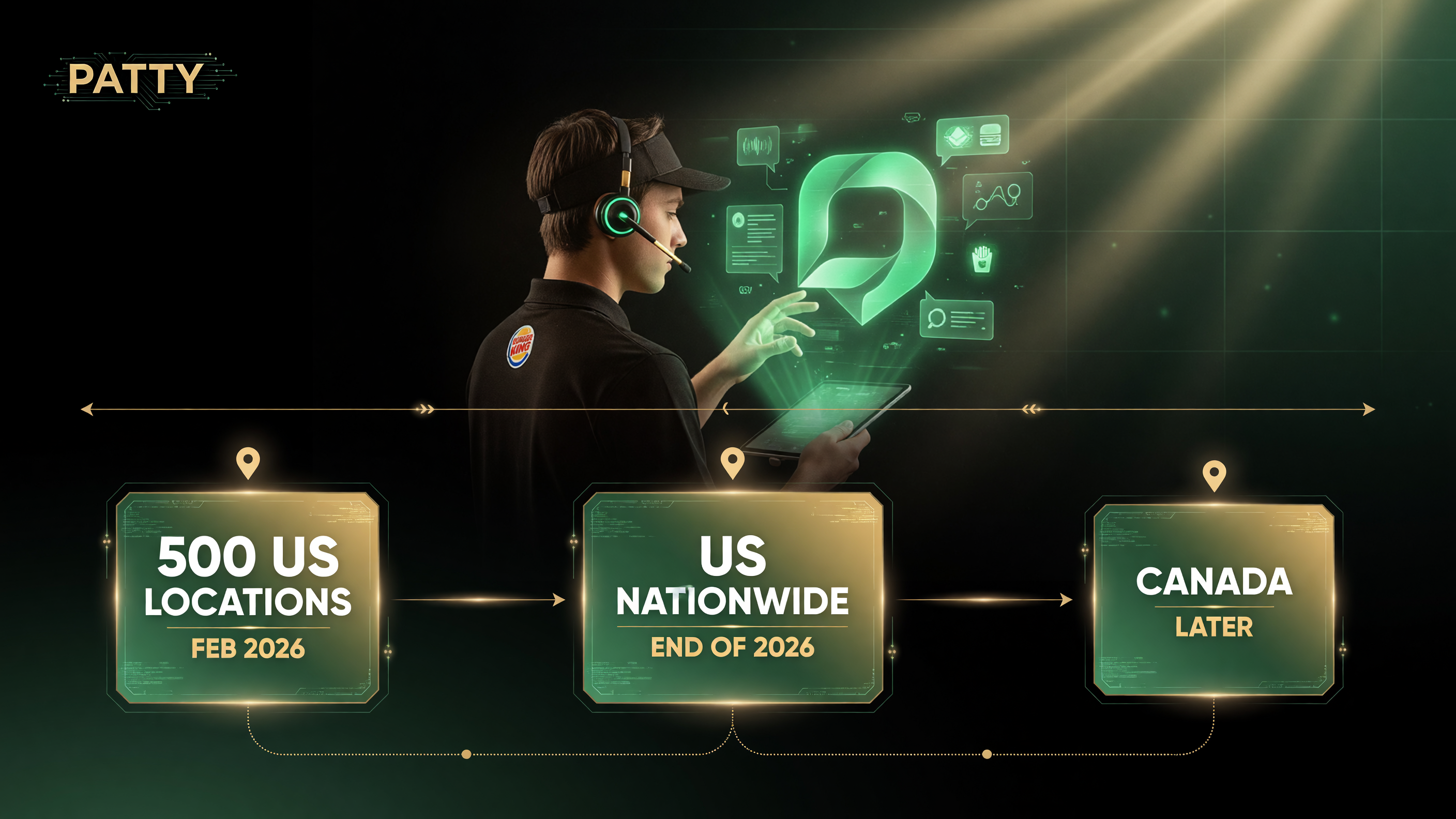
Burger King’s Patty pilot began at ~500 U.S. drive-thrus in February 2026, with nationwide U.S. rollout targeted by end of 2026 — proof the headset-coach model works on real lines before scaling.
| Feature | Customer-Facing Order AI | Patty Staff Coach (BK Assistant) |
|---|---|---|
| Primary user | Guest | Employee via headset |
| Accuracy risk | High — wrong order = refund | Low — coaches the human |
| Soft-skill tracking | None | Friendliness cues logged |
| Data surfaced | Guest conversation | Location-level scores + alerts |
| Employee cost | Still needs full staff | Same staff, higher consistency |
| U.S. rollout | Limited experiments | 500-store pilot, full U.S. by Dec 2026 |
The Friendliness Score: Coaching Tool or Surveillance?
Here is the honest part. Patty counts courtesy phrases and builds a friendliness score per location. Burger King has said the score is for coaching, and it does not score individual employees — but any system that listens to every drive-thru exchange raises real questions about data use and how staff feel about being monitored.
The Guardian framed the rollout partly through the lens of workplace monitoring, and that is the right question to ask. The difference between a coaching tool and a surveillance tool is not the technology — it is how you use it and what you tell people. A location-level score used to train a team is one thing. A per-employee score used to discipline or terminate is another entirely.
If you copy this model, decide in advance how you will tell your team what is recorded, why, and what safeguards exist. Transparency builds trust faster than any AI feature builds efficiency. The moment staff feel spied on, the tool stops coaching and starts hurting retention — and your labor shortage gets worse, not better.
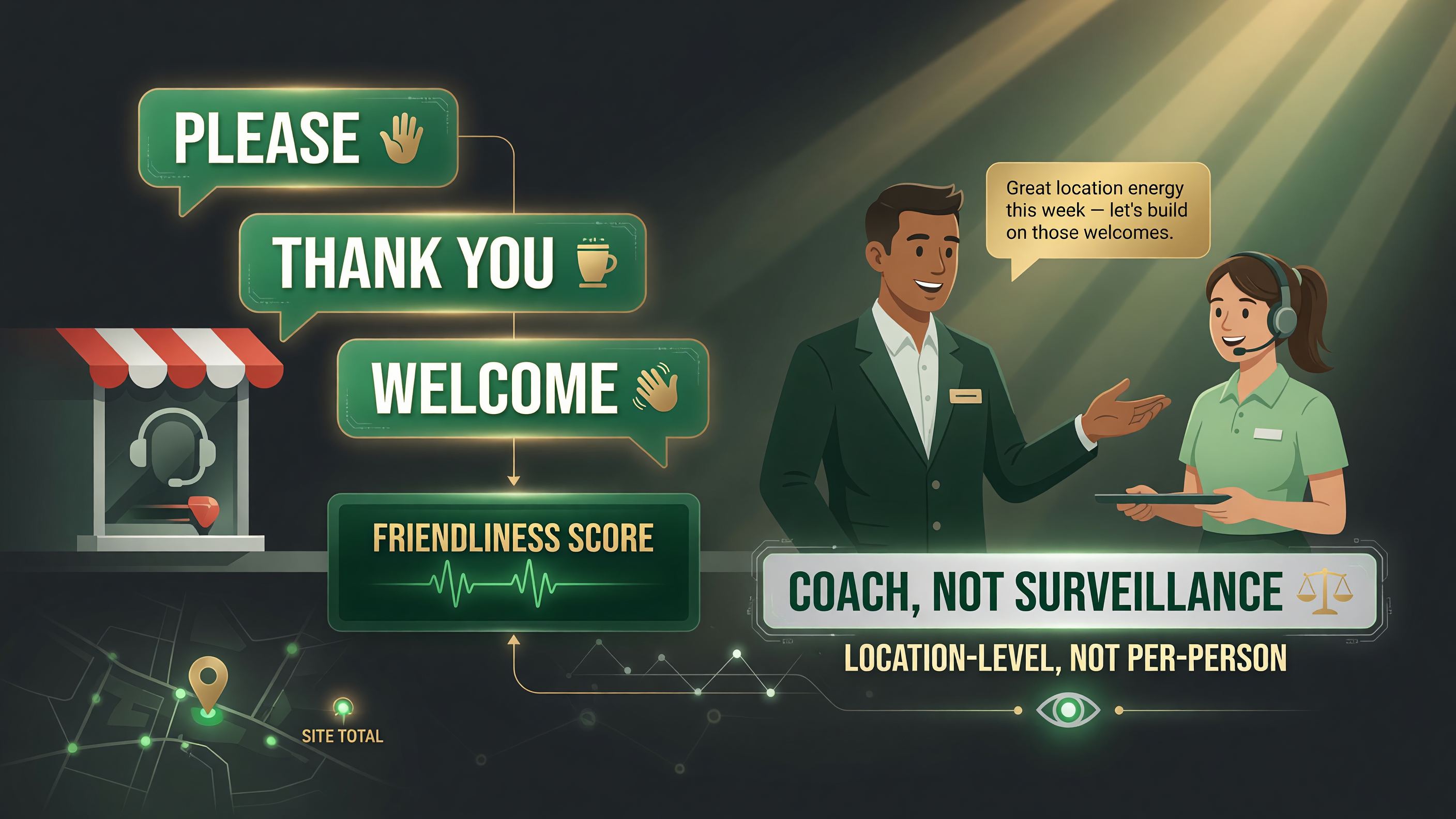
The difference between a coaching tool and a surveillance tool is not the technology — it is whether the score is location-level, transparent, and used to train rather than punish.
There is also a customer-facing angle you should get out ahead of. If your guests ever learn that conversations at the window are being analyzed, some will not like it. Whatever Burger King does publicly, you can go further: post a short, plain-language notice that the drive-thru audio is used to improve service quality, and let it speak for itself.
What an Independent Operator Can Copy This Week
You do not need Burger King’s scale to steal the idea. Start small and focused:
- Pick one line: a drive-thru, a takeout counter, or a phone line where order accuracy hurts most.
- Define the cues you care about: courtesy phrases, order-confirmation language, cross-sell prompts — not a vague “be friendlier.”
- Score at the location level, not the person level: this protects morale and keeps the tool a coach.
- Measure what the tool moves: order accuracy, refunds, review mentions of service, repeat-customer rate — not just the friendliness number.
- Start with the free ingredients before you buy anything: a printed greeting script, a checklist at the line, and one metric you track weekly. Ask whether the miss is a training gap or an information gap before you add software.
Most operators will find that half the service problems are information problems — nobody knew the stock was low, nobody knew the unit was drifting, nobody reminded the window to hold the greeting. An AI coach closes those gaps. But a manager who actually walks the line can close a surprising share of them for free.
The Bottom Line for Your Restaurant
Patty is worth your attention for one reason that has nothing to do with Burger King’s size: it confirms that the highest-ROI place to put AI in a restaurant is not in front of the customer — it is behind the counter, making the people you already employ more consistent. That is a model any independent operator can evaluate with a fraction of the budget and almost none of the risk.
The payoff is concrete. One missed “thank you” or one silent “we’re out of that” can cost you a customer forever. Patty’s real lesson is that the cheapest way to more covers is catching the small misses on the line — before they become a bad review. Whether you buy a tool or build a checklist, start closing those gaps this week.
The Real Cost of Consistency in an Independent Restaurant
Put a number on why this matters. Labor in a typical U.S. independent restaurant runs 28-35% of revenue. On a $100,000 month, that is $28,000 to $35,000 going out the door to your team. The difference between a great shift and a mediocre one is rarely the number of bodies — it is how consistently those bodies hit the standard. One under-timed fryer basket, one stock-out that should have been caught, one snappy greeting: each is a small leak. Over a month, those leaks add up to real margin.
The genius of the Patty model is that it attacks consistency directly instead of hoping a good hire fixes it. A coach in the headset does not replace your people. It raises the floor of what every shift produces, so your best practices do not evaporate the night your strongest shift lead is off. For an owner running two or three units who cannot be on every line at once, that is exactly the leverage you are missing.
You do not need OpenAI to get started. The insight transfers to a printed line-speed checklist, a shared prep log, and one weekly number you actually watch. Tools like Patty just make the discipline cheaper to enforce at scale.
Frequently Asked Questions
Is Patty a customer-facing AI that takes drive-thru orders?
No. Patty operates inside employee headsets and coaches staff. Customers never speak directly to the AI.
How many U.S. Burger King locations are using Patty?
The pilot covers roughly 500 U.S. restaurants, starting around February 2026.
Does Patty score individual employees?
No. Burger King feeds only location-level friendliness scores used for coaching, not to single out individuals.
When will Patty be available nationwide?
The full BK Assistant platform, including Patty, is scheduled for nationwide U.S. coverage by the end of 2026, with Canada later.
What can an independent restaurant owner learn from Patty?
You can copy the coach model: use voice AI or simple prompts to coach courtesy, order accuracy, and stock alerts at the location level, without building a customer-facing bot.

About Barak Schurr
Barak Schurr built and exited a major ticketing platform, ran global operations at Eventbrite, and now focuses on one question: which AI tools actually help independent restaurant owners run leaner and grow faster. He writes from the operator’s perspective — no vendor spin, no theory, just what’s real in 2026.
Email: [email protected]
More Resources for Restaurant Operators