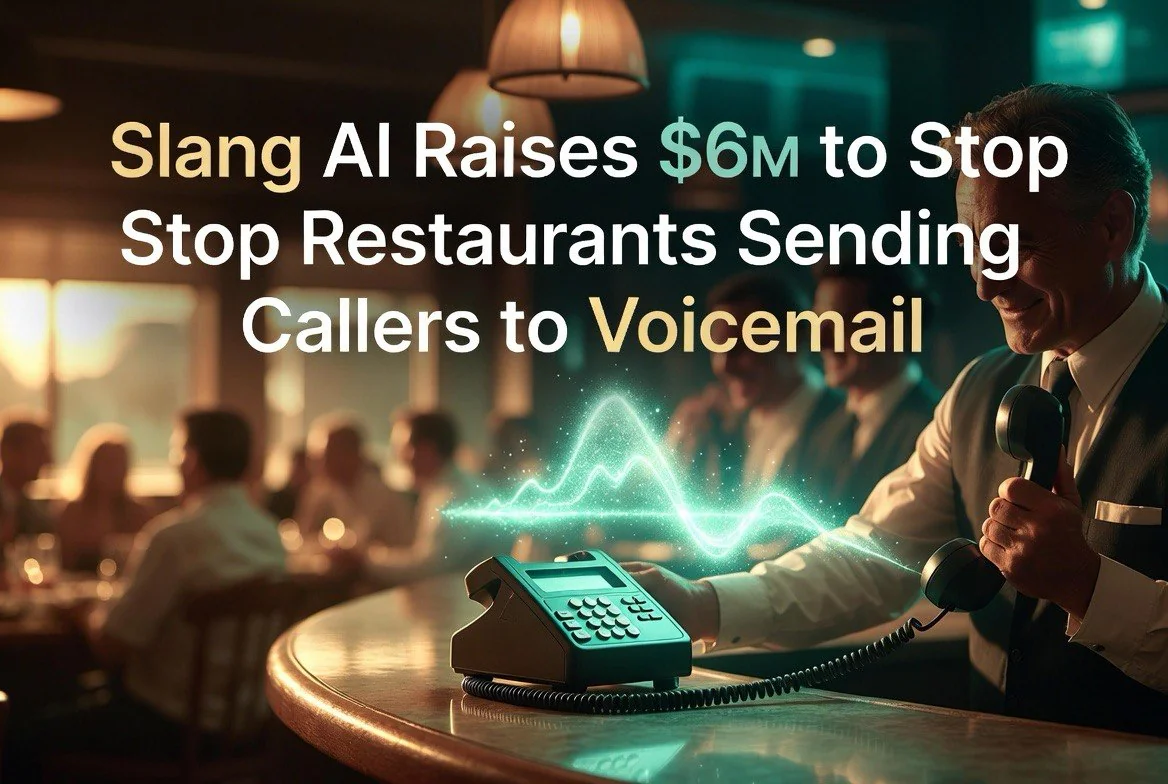
Slang AI Raises $36M to Stop Restaurants Sending Callers to Voicemail
⚡ Expert Summary: Slang AI, which builds AI-powered phone agents for restaurants, raised a $36M Series B in June 2026. The company’s AI handles incoming calls — reservations, takeout orders, questions about hours and menu items — so restaurant staff never have to put a caller on hold or let a call go to voicemail. For US independent operators who lose an estimated 20-30% of inbound calls during peak hours, this technology directly impacts revenue.
The Problem Slang AI Solves Is Remarkably Simple
If you’ve called a restaurant during dinner rush and got a busy signal, a voicemail, or a harried host who says “can I call you back?” — you’ve experienced the problem Slang AI was built to solve.
The restaurant industry in the United States loses millions in revenue every year to unanswered phone calls. During a typical Friday night service, a busy independent restaurant might receive 40-60 phone calls between 5 PM and 9 PM. With two people on the floor — one host, one server covering the front — the phone goes unanswered as often as it gets picked up.
Each missed call represents a missed reservation, a lost takeout order, a catering inquiry that goes nowhere, or a frustrated customer who calls the competitor down the street.
Slang AI’s phone agent answers every call, handles the conversation naturally, and routes only the calls that genuinely need human intervention — like “I have a severe allergy, can you confirm ingredients” — to restaurant staff. Everything else — reservations, order modifications, questions about hours, large party inquiries — gets handled end-to-end by AI.
The company positions itself as a direct replacement for the voicemail inbox that accumulates 20-50 messages during dinner service. Instead of checking voicemails at the end of the night and calling people back — most of whom have already made other plans — the AI captures every opportunity in real time. A customer calling at 7:30 PM on a Saturday to ask if there’s a wait is answered immediately and accurately. If there’s a 40-minute wait, the AI tells them so. If there’s a table open in 10 minutes and they want to book it, that gets recorded directly into the reservation system.
This real-time capture is the difference between an AI agent and any other solution. Voicemail defers the problem. Answering services relay information with delay. Online booking systems cover only one type of call. Slang AI’s agent handles the full spectrum of restaurant phone traffic as it happens.
AITR Posts Already Cover Slang AI’s Market Category
This isn’t the first time we’ve covered AI phone agents for restaurants on AI Table Review. Post 353 covered the broader restaurant AI phone market, and posts 315 and 280 covered similar tools. Slang AI’s Series B is notable because it’s the largest single funding round in this subcategory to date, which signals that the market is maturing beyond early adopter phase.
What sets Slang AI apart from earlier tools is its focus on natural-language conversation rather than scripted call flows. Earlier systems required callers to speak in specific formats or navigate menus. Slang AI’s approach — train the AI on millions of actual restaurant calls and let it handle whatever the customer says — is technically harder but produces dramatically better results.
The Series B Round: $36M and What It Means
Slang AI announced in June 2026 that it had closed a $36 million Series B round.[1] The funding was led by a group of investors focused on restaurant technology, including participation from existing backers.
The company has now raised approximately $60 million total since its founding. Slang AI was founded by a team with experience at DoorDash and Slack, and the company has been operating somewhat under the radar while focusing on product-market fit in the US restaurant market.
The $36 million Series B is significant for several reasons:
It validates the restaurant AI phone market as real. Investors are betting that AI phone agents for restaurants are not a novelty feature but a category-defining product. The scale of the Series B — not a seed round, not a small Series A — indicates conviction.
It funds competitive moat-building. Slang AI’s value comes from how well its AI understands restaurant-specific conversations — the slang (hence the name), the abbreviations, the special requests, the way a regular customer says “the usual” and the system knows what that means. The training data required to reach that level of comprehension is a significant barrier to entry.
It signals consolidation pressure. Restaurant phone AI is a crowded space with several startups competing. A $36M round gives Slang AI the war chest to acquire, outspend, or out-hire competitors in the next 12-18 months.
Why This Matters for Independent US Restaurant Operators
For the independent restaurant owner who handles phones personally during service, the value proposition of Slang AI is easy to calculate.
The National Restaurant Association estimates that the average independent US restaurant loses 20-30% of inbound calls during peak hours.[2] For a restaurant doing $1.2 million in annual revenue, a conservative estimate is that $50,000-80,000 of that comes from phone-originated orders — reservations that turn into diners, takeout orders, catering inquiries.
Losing 20-30% of that phone revenue means $10,000-24,000 per year walking out the door because nobody answered the phone.
Slang AI’s pricing is structured as a monthly subscription, typically $200-400 per month depending on call volume.[3] At that price point, the ROI breakeven happens in the first month if the system recaptures even a fraction of missed calls.
Beyond the direct revenue capture, there’s the operational benefit. A restaurant host or manager handling phones during a rush is multitasking between in-person guests, seating logistics, and callers. Every phone call they handle personally takes attention away from the people standing at the host stand. The intangible cost — slower service, longer wait times, less attentive hospitality — compounds with every call.
Slang AI’s agent doesn’t just answer more calls. It frees the human staff to focus on the people who are already in the building.
How Slang AI Compares to Alternative Solutions
Restaurant operators have been trying to solve the phone problem for years. Here’s how the existing options stack up:
Voicemail or answering service: The most common “solution.” Voicemail loses the call entirely. Answering services cost $300-800/month and require the operator to relay messages to the restaurant, adding latency and error.
Online reservation systems (OpenTable, Resy, Toast Reservations): These capture reservations but do nothing for takeout orders, questions about menu items, hours inquiries, or catering requests. Many phone calls aren’t about reservations.
Traditional IVR (automated phone tree): “Press 1 for reservations, press 2 for takeout” — universally hated by customers, frequently abandoned, and incapable of handling the natural-language requests that make up most restaurant phone calls.
AI chat on website: Useful but limited — many customers still prefer calling. A website chat widget doesn’t help the customer who finds the restaurant through Google Maps and hits “call.”
Slang AI’s approach — a natural-language AI agent that answers the phone, understands restaurant-specific requests, and handles the full transaction without transferring — is the first solution that actually replaces the human phone-answering function rather than routing around it.
What Restaurant AI Phone Agents Can and Can’t Do Yet
It’s important to set realistic expectations about what this technology delivers in mid-2026.
What Slang AI handles well:
- Reservations (party size, time, special occasion notes)
- Takeout orders (item selection, modifications, pickup time)
- Hours and location inquiries
- Menu questions (ingredients, spice level, dietary restrictions)
- Large party inquiries (routing to events coordinator)
What still needs improvement:
- Complex modifications (the AI sometimes misses nuanced substitution requests)
- Emotion detection (angry customers, sensitive complaints)
- Unscripted scenarios (a customer asking about a specific server’s schedule)
Slang AI’s pitch to operators is not that its AI is perfect. It’s that the AI is better than the current alternative — which in most restaurants is a voicemail inbox that nobody checks.
The Bottom Line
Slang AI’s $36 million Series B is a bet that the restaurant phone call problem is big enough to build a category around — and that AI has crossed the threshold where it can handle restaurant-specific conversations well enough to replace voicemail as the fallback.
For the US independent operator, the calculation is simple: if your restaurant takes inbound calls and some of those calls go unanswered, the ROI on an AI phone agent is almost certainly positive at current pricing.
A conservative example: a restaurant doing $1 million in annual revenue with 20% of calls missed during peak hours. If each answered call is worth $25-50 in reservation revenue or takeout orders, the AI recaptures $50-100 per peak shift. That’s $350-700 per week in recovered revenue on a $50-100 weekly AI subscription. The breakeven is measured in days, not months.
The technology has reached the point where the question is not “will it work” but “will it work well enough to pay for itself before the monthly bill arrives.” For most operators, the answer is yes.
Frequently Asked Questions
How much does Slang AI cost?
Slang AI typically costs $200-400 per month depending on call volume. Pricing is subscription-based with no long-term contract requirements for most plans.
Does Slang AI integrate with my existing POS?
Yes. Slang AI integrates with major restaurant POS systems including Toast, Square, Clover, and others. Reservations and orders captured by the AI are written directly into the POS.
Can customers tell they’re talking to AI?
Some customers can tell, especially on complex calls. Slang AI is designed to handle most calls naturally enough that customers complete their transaction without issue. The AI identifies itself as an automated assistant on the call.
Is Slang AI available in Spanish?
Slang AI supports English and Spanish, which is critical for US restaurants with bilingual customer bases. Support for additional languages is in development.
How is this different from a phone tree or IVR?
Traditional IVR requires callers to navigate menus by pressing numbers. Slang AI uses natural language understanding — the caller speaks naturally, and the AI interprets the request. This results in significantly lower call abandonment rates.

About Barak Schurr
Barak Schurr built and exited a major ticketing platform, ran global operations at Eventbrite, and now focuses on one question: which AI tools actually help independent restaurant owners run leaner and grow faster. He writes from the operator’s perspective — no vendor spin, no theory, just what’s real in 2026.
Email: [email protected]
More AI Resources