Get the AI Restaurant Quick-Start Guide — Free
The 5 AI tools independent US restaurant owners are using right now to cut labor costs and answer every call.
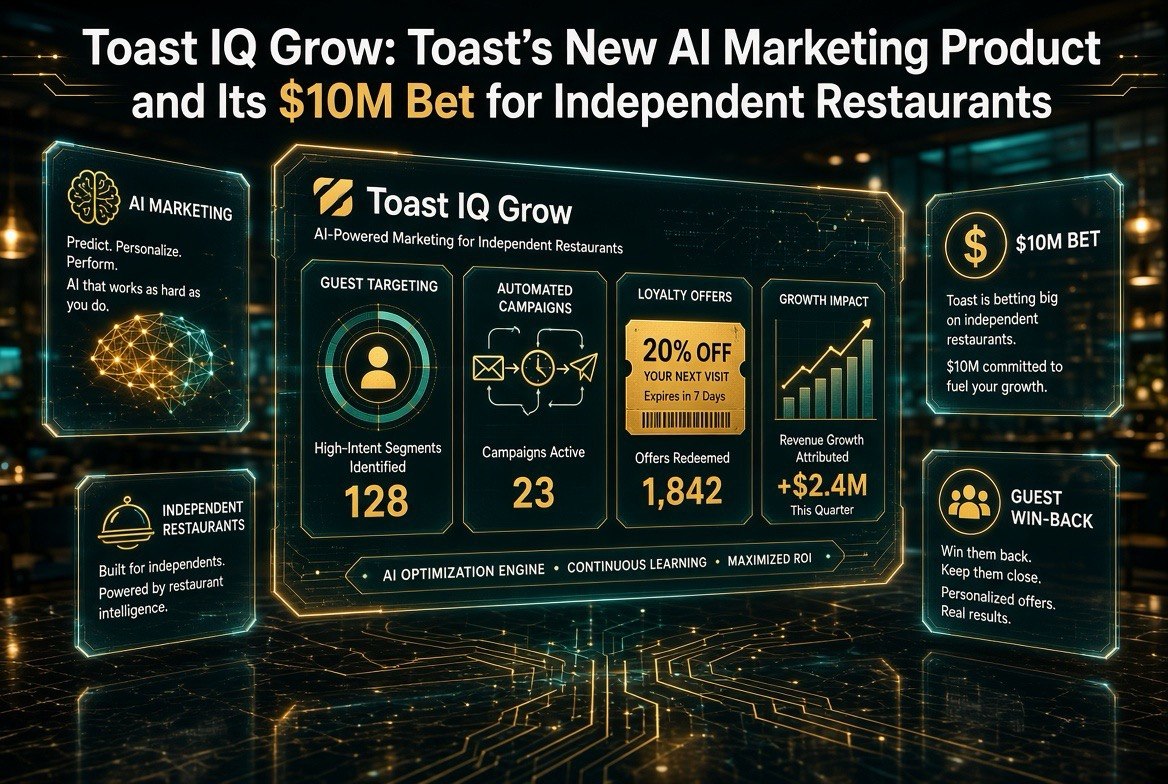
Toast IQ Grow: Toast’s New AI Marketing Product and Its $10M Bet for Independent Restaurants
EXPERT SUMMARY — What This Means for Your Restaurant
Toast now makes more money from software than from processing — and it wants to sell AI to independent restaurants as a product, not a feature. In Q2 2026, Toast doubled net income to $154 million on revenue up 23% to $1.91 billion, added a record 9,500 new locations (180,000 total), and name-checked its first AI workflow product, Toast IQ Grow — a marketing tool launched in May 2026 that executives expect to hit $10 million in annual revenue. The bigger signal for independent operators: CEO Aman Narang is publicly mapping an “agentic” roadmap that moves AI from dashboards into the day-to-day work of demand forecasting, labor scheduling, and food-cost management. This piece breaks down what’s real today, what’s coming, and what an independent owner should actually adopt now.
Why Today’s Toast Story Is Different From Every Earlier One
If you’ve read AITRe review before, you’ve seen Toast covered a lot — and honestly, that’s fair, because Toast keeps shipping. But the story that broke out of Toast’s Q2 2026 earnings call on August 7 is a different animal than the “Toast Is Baking AI Into Its POS” post from earlier in the month.
That earlier coverage was about features: conversational AI baked into the point of sale, an IQ assistant you can ask questions in plain English. This one is about product and ambition. Toast is no longer just layering AI onto software it already sells. It has shipped a standalone AI product — Toast IQ Grow — and its CEO is telling Wall Street that AI is the engine for taking over whole workflows a restaurant currently outsources: marketing, payroll, bookkeeping, demand planning, food costs.
The Restaurant Dive report (Aug. 10, 2026) captured the executives’ framing: “Most restaurants don’t have time to leverage AI tools,” and Toast intends to profit by removing that friction. It’s a positioning shift — from “AI is a feature of our POS” to “AI is the product.” For an independent owner, that’s a genuinely different decision than “should I turn on the assistant.”
The Numbers First: What Q2 2026 Actually Showed
Before any product talk, the financials matter, because they tell you whether Toast has the runway to keep building AI and whether this is a company you should be betting on as a platform. The Q2 results, reported on the August 7 earnings call, were strong:
| Metric | Q2 2026 | Q2 2025 | What It Means |
|---|---|---|---|
| Net income | $154M | $80M | Nearly doubled year over year |
| Revenue | $1.91B | $1.55B | Up 23% year over year |
| New locations added | 9,500 | — | Record quarter, ~180,000 total locations |
| Annualized recurring run-rate | $2.4B | — | Up 25%; subscription + payments revenue |
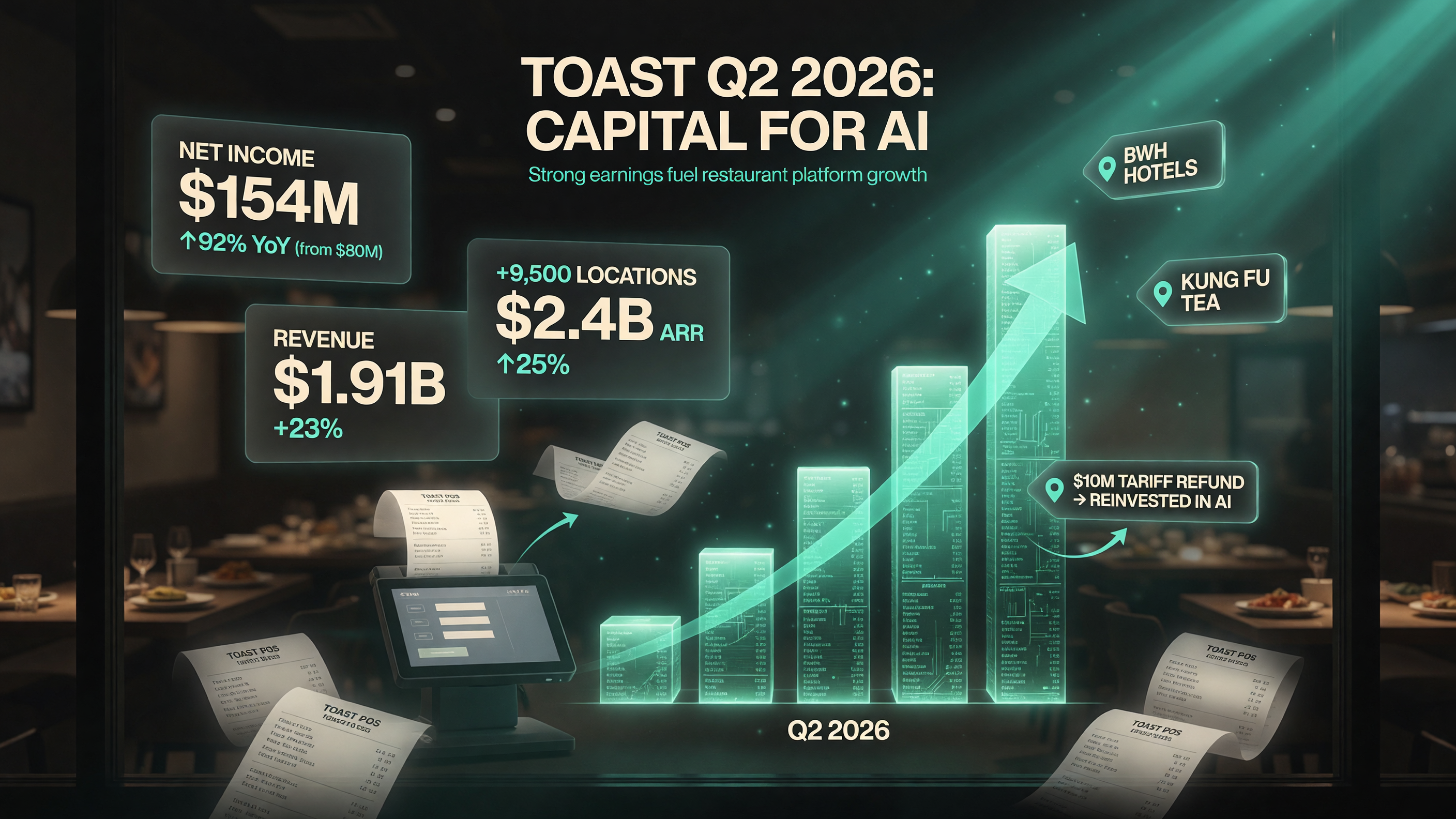
Toast’s Q2 2026 gave it the capital to invest aggressively in AI — net income nearly doubled and recurring revenue hit a $2.4B run-rate.
It’s an important context point for US owners: Toast’s growth is coming from adding locations and selling software — not from jacking up processing fees on existing customers. CFO Elena Gomez also noted the company took a $10 million federal tariff refund in the quarter and reinvested it into growth initiatives. The company also landed BWH Hotels (Best Western’s parent) and Kung Fu Tea as new customers, and its net income nearly doubled. That’s the balance-sheet story behind the AI push — Toast has the capital to invest aggressively and is choosing to spend it on AI.
One more number matters for an independent owner trying to read the tea leaves: Toast’s annualized recurring run-rate hit $2.4 billion, up 25% year over year. What that tells you is where Toast’s profit engine actually lives now. The company has spent years repositioning itself so that software subscriptions and value-added services — not just the per-transaction processing fee — carry more and more of the revenue. That is precisely why it can price AI as a standalone product rather than bury it as a free feature: the subscription model gives it a clean, predictable lane to monetize tools like IQ Grow.
It’s also why Toast can afford to be patient. Unlike a cash-strapped startup racing to monetize, Toast is adding customers at a record clip and reinvesting the profits straight back into the AI roadmap. For you, that means the AI tools you’re being pitched are backed by a funded, multi-billion-dollar platform that has an incentive to make them actually work — not by a vendor that needs to squeeze every dollar out of you this quarter to survive.
Toast IQ Grow: The First AI Workflow Product, Explained
The centerpiece of the fresh story is Toast IQ Grow, described by Toast as its first AI-enabled workflow product. It launched in May 2026, and executives expect it to become Toast’s fastest-growing product, projecting $10 million in annual revenue. The product is a digital-marketing tool that autonomously works across a restaurant’s online presence:
- Website optimization — adjusts site content and structure to lift conversions
- Search engine optimization — improves how you show up in local search
- Digital ordering — tunes your online order flow
- Social media presence — manages and posts to your channels
- Campaign creation — builds marketing campaigns from customer data
The key differentiator, per CEO Aman Narang: “Because we power the point of sale, we can close the loop with each campaign tied directly to the orders it drives.” That’s the pitch that matters. Unlike a standalone marketing tool that guesses at attribution, Toast can connect a campaign to actual orders because the orders run through its POS. Evercore ISI analysts, in a client note after the call, said Toast is “already finding a product-market fit with customers looking to drive better marketing campaigns, increase conversions, and generate higher same-store sales.”
To translate that into what a manager or owner would actually see day to day: instead of logging into three different tools to update your website, write a post for social, and check how your online ordering page converts, IQ Grow is meant to handle those loops from one workflow that draws on your real POS data. If a dish is selling well in a given region, the tool can lean into promoting it; if a channel is underperforming, it can shift spend and content toward what’s converting. It’s marketing executed from the source of truth — your actual orders — rather than from a guess about what your customers want.
The practical question most owners will ask is cost. Toast has not published a standard price list for IQ Grow, and pricing is typically quoted by your account representative based on location count and the features you enable. That makes the “is it worth it” test straightforward: ask for a pilot, tie the trial period to a real metric you already track (online orders, average ticket, or reservations), and let the data from your own operation decide. If it doesn’t move a number you can see, it’s not earning its place.
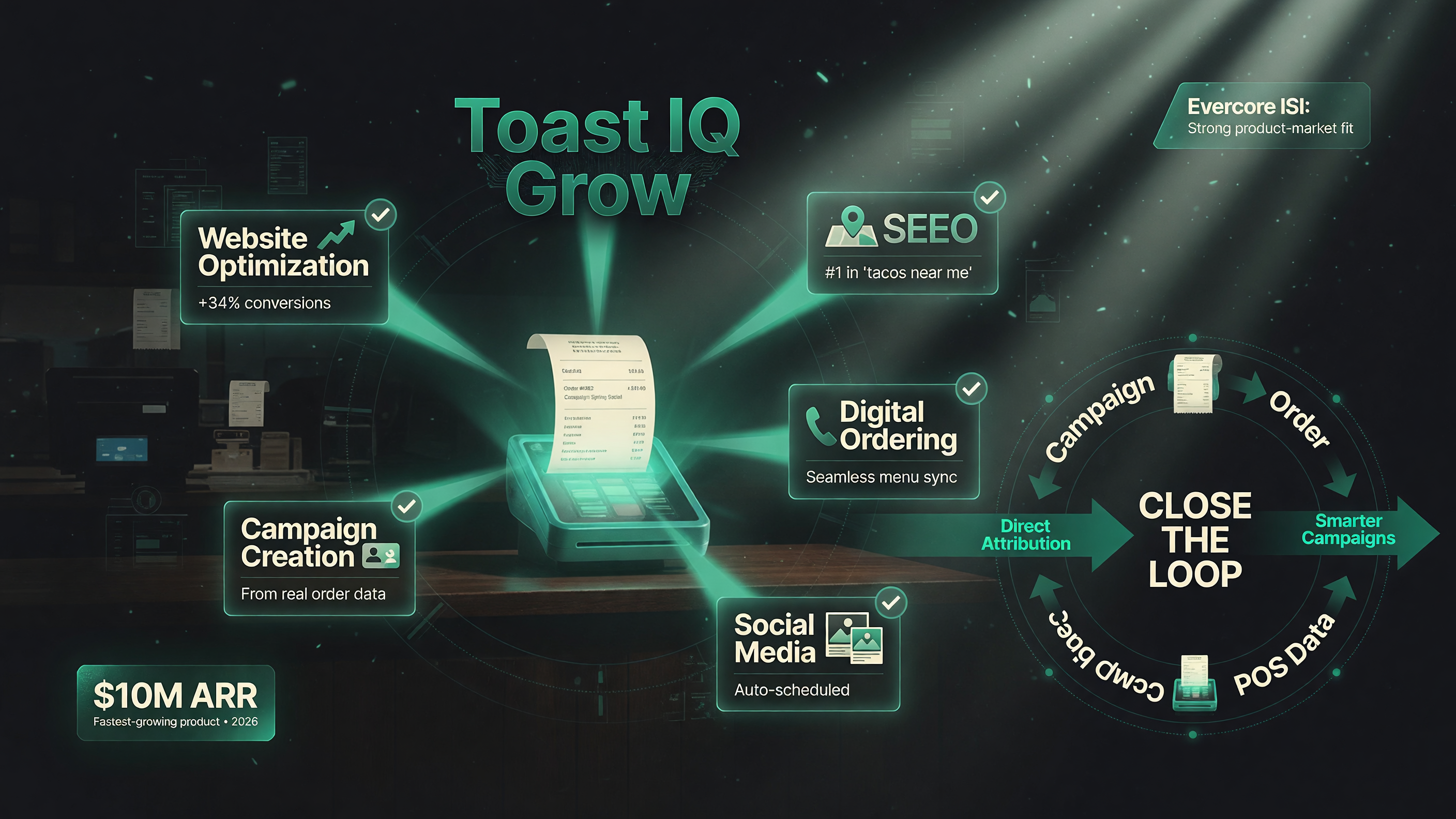
Toast IQ Grow works across your online presence and — because it runs on the POS — ties every campaign directly to the orders it drives.
What the “Agentic” Roadmap Means for Independent Operators
The most forward-looking part of the earnings call is where Narang said Toast will deploy “agentic products” across the functions a restaurant needs to run. He explicitly named: demand forecasting, labor schedules, income tax help, food costs and availability.
Why this matters for an independent owner: these are exactly the tasks you either do by hand at midnight or outsource to a service. If Toast delivers on this, the pitch changes from “here’s a dashboard with insights” to “here’s a system that forecasts your demand, builds your schedule, and flags food-cost drift — and adjusts on its own.” Narang’s framing to analysts: “That’s an incredibly exciting future, especially in an industry known for slim margins and long hours.”
Here’s a practical read of where the roadmap sits today versus where Toast says it’s going:
| Workflow Area | Shipped Today | On the Agentic Roadmap |
|---|---|---|
| Marketing | Toast IQ Grow (May 2026) | Deeper autonomous campaign management |
| Demand forecasting | Insights/reporting | Agent adjusts ordering and prep automatically |
| Labor scheduling | Schedule tools | Agent builds schedule from forecast + labor rules |
| Food costs | Cost reporting | Agent flags and reacts to cost drift |
The honest note for an owner: the agentic layer is a stated direction, not a shipped reality yet. What’s real right now is Toast IQ Grow for marketing. The rest (demand forecasting, labor, food costs as autonomous agents) is the roadmap Narang laid out. Don’t buy today on promises — but do watch, because Toast’s financials give it the room to actually build these.
The Labor Math an Owner Actually Feels
It’s easy to read “Toast is building AI” as a corporate story, so let’s ground it in the numbers that hit an independent operator’s P&L. The reason Toast keeps steering into marketing and forecasting is that those are the two biggest levers outside of the kitchen — and the two places a solo owner or a small team most often runs out of hours.
Consider what a typical independent restaurant in the US spends, and where AI products like IQ Grow target:
| Operating Lever | Manual Approach | With a Working AI Workflow |
|---|---|---|
| Local marketing | Owner or a paid agency, hours per week | Tool builds and runs campaigns from POS data |
| Menus / online ordering | Manual updates, missed optimization | Auto-optimized around what’s actually selling |
| Demand + labor planning | Spreadsheet guesswork, overtime leaks | Forecast-driven schedules (roadmap) |
| Food cost management | End-of-month surprise in the P&L | Real-time drift flags (roadmap) |
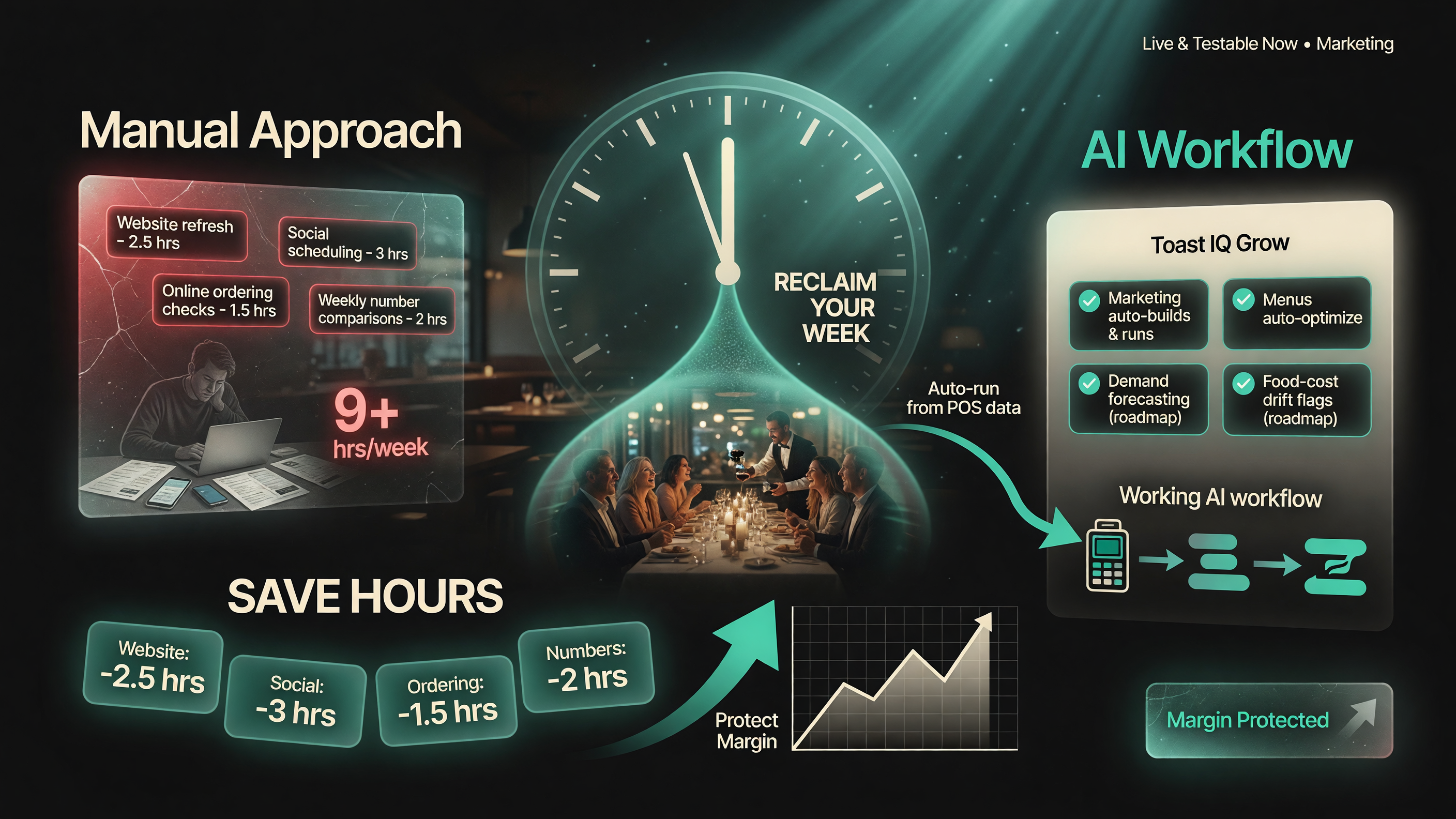
The labor math an owner actually feels: roughly 9+ hours a week on marketing and menus can be reclaimed once AI workflow auto-runs from POS data.
For an independent owner, the question isn’t “is Toast impressive?” It’s “does this save me hours and protect my margin?” The marketing piece is the one that’s demonstrably live now and testable. The rest is worth tracking but not yet a buying decision.
Let’s make that concrete with a typical week. A US independent owner with one or two locations often burns several hours a week just on the marketing and menu side: refreshing the website, responding to or scheduling social posts, checking how the online ordering page looks on mobile, and comparing last week’s numbers against this week’s. That’s time pulled away from the dining room and the kitchen — the two places it actually earns money. On a six-day operating week, even three to four hours of that is meaningful; spread across a month it becomes a part-time job nobody budgeted for.
That’s the real case for a tool like IQ Grow. It doesn’t replace the owner’s judgment about the menu or the guest experience, and it shouldn’t. What it’s designed to replace is the repetitive upkeep work that doesn’t need — and arguably shouldn’t demand — owner attention. Adopt it for the part that’s live today, keep your hand on the things that are still a roadmap, and you get the hours back without handing over decisions that are yours to make.
What an Independent US Owner Should Actually Do Now
Pull this together into a practical action list. The AI story around Toast is real and getting bigger, but not every piece of it is a “buy today” decision. Here’s the split:
- Test marketing automation if you’re already on Toast. Toast IQ Grow is a live product. If you’re paying for marketing help or doing it yourself and losing time, asking your Toast rep for the current pricing and a pilot is low-risk and targeted at exactly the revenue lever the product is designed for.
- Don’t pay a premium for roadmap promises. Demand forecasting, autonomous labor scheduling, and food-cost agents are stated direction — not shipped capability. Adopt what’s real, wait on what isn’t.
- Use the optimism as leverage, not pressure. Toast is investing heavily in AI because it expects to monetize it. That’s a reason to be a deliberate buyer, not a fast one. A tool that “closes the loop to orders,” as Narang put it, is only worth it if those orders come from a channel you weren’t already capturing.
The bottom line for independent restaurants in the US: Toast’s Q2 numbers prove it’s a stable, well-funded platform, and its first AI product is genuinely a product — not a feature buried in a POS. The agentic future is exciting and baked into the roadmap. Just buy what’s real today.
Frequently Asked Questions
What is Toast IQ Grow?
Toast’s first AI-enabled workflow product — a digital marketing tool that optimizes websites, SEO, digital ordering, and social media, launched May 2026.
What did Toast report for Q2 2026?
Net income of $154M (nearly double Q2 2025’s $80M), revenue up 23% to $1.91B, and a record 9,500 new locations (~180,000 total).
How much revenue does Toast expect from AI?
Executives project Toast IQ Grow to reach $10 million in annual revenue, expecting it to become Toast’s fastest-growing product.
Is Toast’s “agentic” AI available now?
Not yet. The agentic products for demand forecasting, labor scheduling, and food costs are a stated roadmap, not shipped capability.
Why does Toast’s AI POS integration matter?
Because Toast powers the POS, it can tie marketing campaigns directly to the orders they drive — better attribution than standalone marketing tools.