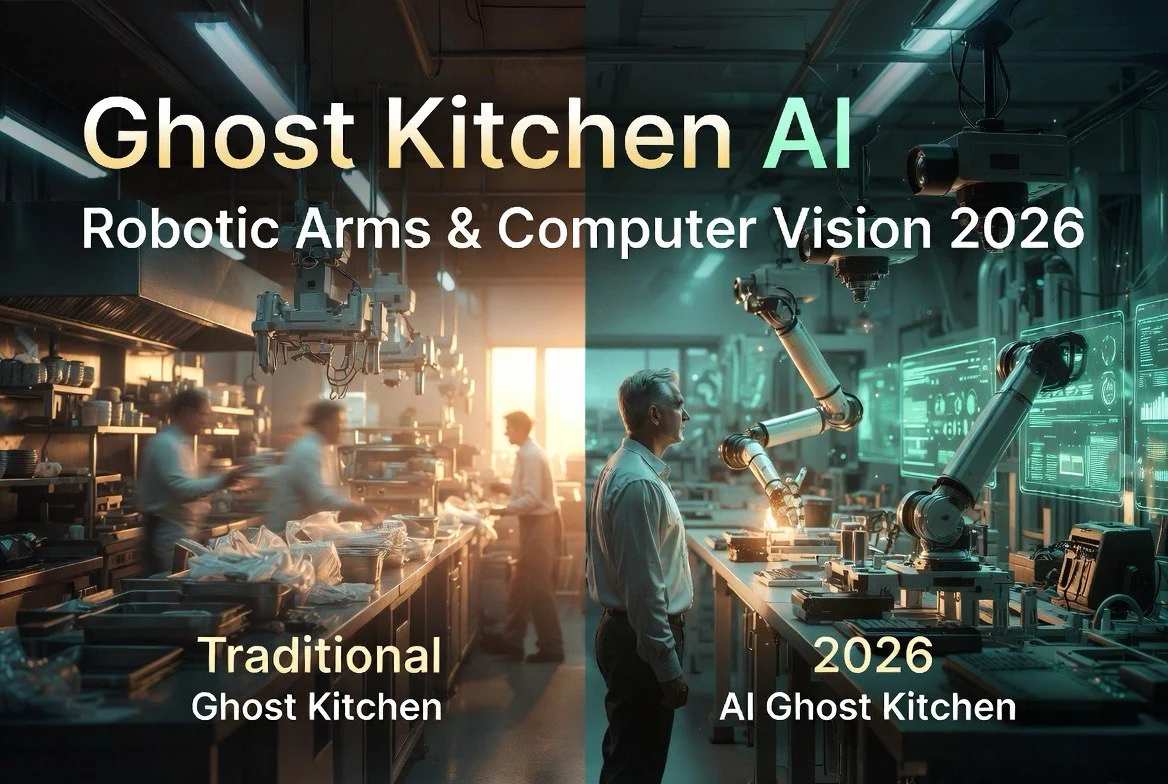
Ghost Kitchen AI: Robotic Arms and Computer Vision Are Taking Over Commercial Kitchens
u26a1 Expert Summary: AI-powered robotic kitchens are moving from pilot programs into commercial deployment across the United States. Chef Robotics has completed 100 million servings. Mezli operates a fully automated restaurant in San Francisco with no human cooks. Miso Robotics’ Flippy handles fry stations at chain locations. For independent restaurant owners, the question is shifting from “will this happen?” to “when do I need to care?”
The Automation Tipping Point
For years, restaurant automation was a concept with more press releases than deployments. Robotics companies would announce partnerships, open a pilot location, and go quiet. That pattern is changing in 2026.
The shift is driven by three converging factors: persistent labor shortages that keep wages high, AI models that have finally reached production reliability for food handling, and a growing body of evidence that automated kitchens can operate with 50-60% fewer staff than traditional restaurants of comparable volume.
According to the National Restaurant Association’s 2026 State of the Industry report, 62% of restaurant operators say recruiting and retaining employees is their top challenge, and labor costs now represent over 33% of average restaurant revenue. In that environment, a one-time capital investment in robotics that reduces ongoing labor needs by half starts to look like a survival strategy, not a science experiment.
Chef Robotics: 100 Million Servings and Counting
Chef Robotics has emerged as the most scaled player in restaurant automation. By April 2026, the company’s physical AI systems had completed over 100 million servings across facilities in the United States, Canada, and Europe.
Chef Robotics focuses on handling deformable ingredients u2014 the stuff that’s hardest to automate. Rice, chopped vegetables, sauced proteins, and assembled bowls all require precise handling that fixed-program robots can’t manage. Chef Robotics uses computer vision and reinforcement learning to adapt to ingredient variability in real time.
The company’s systems are deployed primarily in ghost kitchen and commercial food production facilities, not front-of-house operations. Each unit handles repetitive prep tasks u2014 portioning, assembly, packaging u2014 that would otherwise require 3-5 full-time kitchen staff per shift.
For an independent restaurant considering ghost kitchen expansion, Chef Robotics’ track record matters because it proves the technology works at scale. A system that’s handled 100 million servings is past the “will it burn the food?” stage and into the “what’s the ROI timeline?” stage.
Mezli: The Fully Automated Restaurant
Mezli operates a fully automated restaurant in San Francisco serving Mediterranean grain bowls with zero human cooks. Customers order through a kiosk or app, and the robotic system handles everything from ingredient dispensing to assembly to packaging.
Mezli isn’t a ghost kitchen u2014 it has a physical storefront. But the absence of human cooking staff makes it the closest real-world example of what a fully automated American restaurant looks like in 2026.
The key takeaway from Mezli is not that all restaurants will go cookless. It’s that the technology is reliable enough for a real business with real customers in a real city. The bowls are priced competitively with other fast-casual Mediterranean options, suggesting the automation savings aren’t just theoretical u2014 they’re translating into cost advantages that can be passed to customers or retained as margin.
Miso Robotics: Flippy at Scale
Miso Robotics’ Flippy has become the most visible brand in restaurant robotics, largely because it focuses on a single, high-volume task: the fry station. Flippy uses AI-powered computer vision to monitor fry baskets, adjust cooking times based on food type and volume, and coordinate with human staff on the rest of the line.
Flippy’s advantage is modularity. A restaurant doesn’t need to automate the entire kitchen u2014 it installs Flippy for the fry station and keeps human staff for everything else. The economics work because fry stations typically require dedicated staff during peak hours who are underutilized between rushes.
Miso’s deployments at chain locations across the United States have generated enough data to refine Flippy’s AI model significantly since its early pilots. The current generation handles menu complexity u2014 different fry times for different items, batch optimization for mixed orders, and real-time adjustment for volume surges.
Computer Vision and “Visual Taste”
At CES 2026, a new wave of kitchen robotics demonstrated “visual taste” u2014 computer vision systems that monitor food appearance during cooking and adjust parameters in real time. Companies like Nosh Robotics and Antamix showed systems that watch for browning levels, surface texture changes, and color shifts, then adjust heat, timing, or position automatically.
This is a significant upgrade from timer-based cooking, which assumes all ingredients of a given type cook identically. Any cook knows that two batches of fries can behave differently based on potato moisture, oil temperature, and batch size. Visual taste systems adapt to what’s actually happening in the fryer, not what the timer says should be happening.
For ghost kitchen operators running multiple virtual brands from a single facility, standardizing output quality across every order is critical. Computer vision-based cooking control ensures consistency regardless of which staff (or robot) is handling production at any given time.
What This Means for Independent Restaurants
The ghost kitchen robotics trend has different implications depending on where your restaurant is today:
For full-service independents: The direct impact is limited. Robotic arms and computer vision systems are currently optimized for the limited menus and high throughput of quick-service and fast-casual operations. If you run a full-service restaurant with made-to-order plates and customer interaction as part of the experience, the current generation of kitchen robotics isn’t replacing your chef.
For quick-service and fast-casual independents: This is where the automation wave hits first. If your menu consists of bowls, burgers, sandwiches, or pizza u2014 items with standardized assembly u2014 robotics can handle significant portions of your prep line. The economics will get better over the next 12-24 months as costs drop and reliability improves.
For ghost kitchen operators: You’re the primary target market. Chef Robotics, Miso, Picnic Works (pizza automation), and others are building systems specifically for delivery-only facilities where customer experience is defined by speed and accuracy, not ambiance and service.
For all independents: The availability of commercial kitchen space for ghost kitchen expansion may become more competitive as automated systems make these facilities more efficient. If a ghost kitchen can operate with 60% fewer staff, it can offer lower prices to virtual brands or capture higher margins. That competitive pressure will eventually affect pricing and availability across the market.
The Cost Reality
Robotic kitchen systems are not cheap. A single Flippy unit costs approximately $30,000 as a one-time purchase or $3,000-5,000 per month on a lease model. Chef Robotics’ systems are priced per deployment based on volume and facility size. Mezli’s fully automated infrastructure required significant upfront capital.
For context, $30,000 is roughly the annual labor cost of one full-time kitchen employee in most US markets. If Flippy replaces 1-2 full-time fry station positions and operates for multiple years, the ROI is straightforward. For a small independent with five employees total, the upfront cost is harder to justify.
The lease model makes more sense for smaller operations. At $3,000-5,000 per month, Flippy replaces at least one full-time position at $35-45k/year (including taxes and benefits) in most markets. The cost is roughly neutral on day one, with the advantage being consistency, no turnover, and no scheduling conflicts.
The Bottom Line
AI-powered ghost kitchen robotics are real, deployed, and scaling in the United States in mid-2026. Chef Robotics’ 100 million servings, Mezli’s fully automated operation, and Miso’s expanding fleet all demonstrate that the technology has crossed from pilot to production.
For independent restaurant owners, the immediate takeaway is not to panic about robots replacing jobs next week. It’s to start watching the economics. If automated ghost kitchens can operate with 60% fewer staff and maintain consistency across every order, the competitive landscape for delivery and quick-service will shift significantly within 2-3 years.
The smart move today is understanding which of your menu items could be automated, what the cost structure would look like, and whether your current labor costs justify the investment. If you’re already struggling with staffing and your menu is built around standardized items, the math is closer to working than you might think.
Frequently Asked Questions
How many restaurants use robotic kitchen systems in 2026?
Exact numbers are hard to track, but Miso Robotics alone has deployments at dozens of chain locations. Chef Robotics systems operate in facilities across three continents. The technology is still early in overall restaurant penetration but scaling fast.
Can robotic systems handle complex menu items?
Current systems excel at standardized tasks u2014 frying, assembly, pizza making. Complex, made-to-order cooking with variable ingredients remains human territory.
How much does a kitchen robot cost?
Individual systems like Flippy run about $30,000 purchase or $3,000-5,000/month lease. Full facility automation with Chef Robotics or similar systems is priced per deployment.
Do kitchen robots work in existing restaurant spaces?
Yes, for modular systems like Flippy. Full automation works better in purpose-built ghost kitchen facilities where the layout is designed around robotic workflows.
Will kitchen robotics reduce food quality?
Early evidence suggests the opposite. Computer vision systems monitor cooking conditions more precisely than human staff and can maintain consistency across every batch.
What’s the ROI timeline for a small restaurant?
At current pricing, modular systems like Flippy typically break even within 12-18 months through labor savings, assuming they replace at least one full-time position.

About Barak Schurr
Barak Schurr built and exited a major ticketing platform, ran global operations at Eventbrite, and now focuses on one question: which AI tools actually help independent restaurant owners run leaner and grow faster. He writes from the operator’s perspective — no vendor spin, no theory, just what’s real in 2026.
Email: [email protected]
More AI Resources