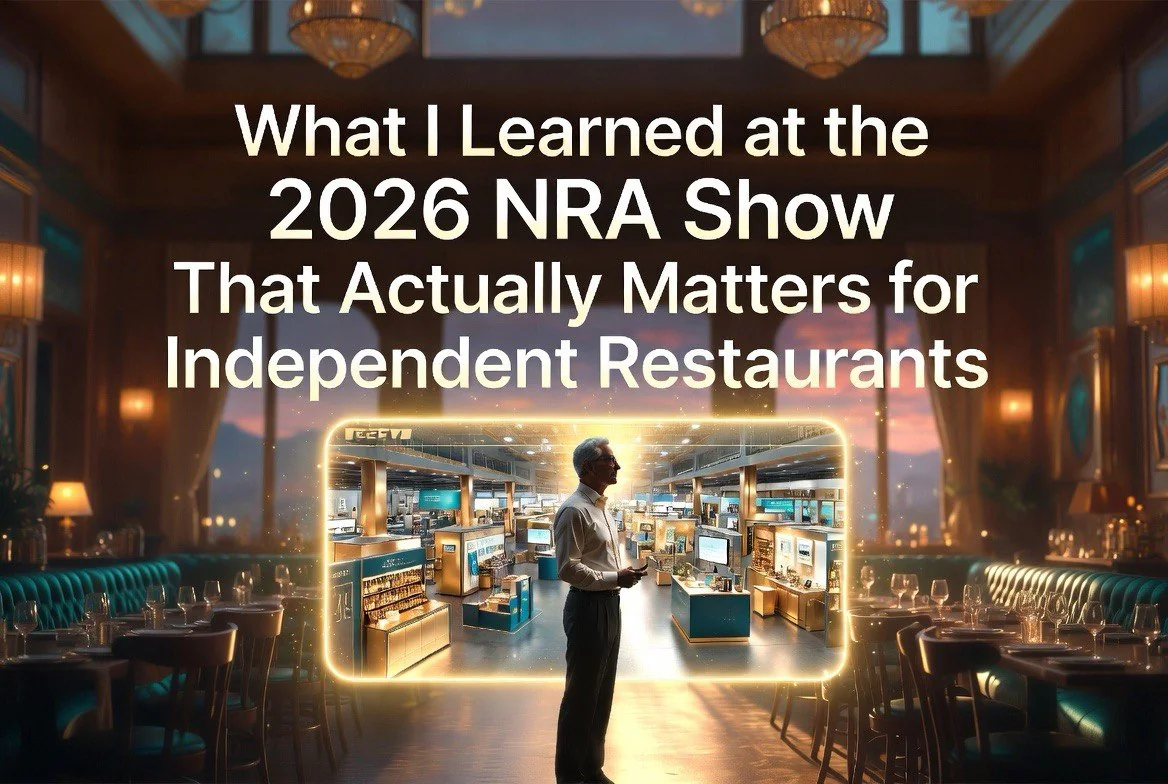
What I Learned at the 2026 NRA Show That Actually Matters for Independent Restaurants
⚡ Expert Summary: The 2026 National Restaurant Association Show in Chicago had the highest AI-focused attendance in its history, with over 200 exhibitors showcasing AI-powered tools for independent operators. Three themes dominated: AI phone agents that answer every call, AI inventory systems that predict demand within 5% accuracy, and AI labor scheduling tools that optimize shift coverage in real time. This article covers the specific products, pricing, and deployment sequencing that independent operators can act on immediately — not concepts that will be ready in five years — based on the data, demonstrations, and operator testimonials presented at the show.
The AI Presence at NRA 2026 Was Different
Previous NRA Shows had AI products scattered across the exhibit hall, often in startup pavilions with small booths and unproven products. The 2026 show was different. Major exhibitors including Toast, Square, Sysco, and DoorDash all featured AI capabilities as core parts of their product demonstrations. The show’s keynote included a dedicated segment on AI adoption in independent restaurants, something that would have seemed out of place three years ago.
The National Restaurant Association’s own survey data, released during the show, showed that AI adoption among US independent operators reached 38% in 2026, up from 22% in 2025 and just 9% in 2024. The growth is driven by two factors: AI tools have become significantly cheaper, dropping from an average of $399 per month in 2024 to $149 in 2026, and the tools have become easier to deploy, with most requiring no technical expertise beyond a POS integration.
Deloitte’s 2026 Restaurant Technology Outlook, presented at the show, identified the three AI categories with the highest ROI for independent operators: AI inventory management (18-22% waste reduction), AI labor scheduling (15% overtime reduction), and AI phone agents (60-70% recovery of missed calls). Each category has tools available today at prices that produce positive ROI within the first month of deployment.
AI Phone Agents: The Breakout Product Category
AI phone agents were the most talked-about category at the 2026 NRA Show, with at least 15 vendors demonstrating voice AI products specifically designed for restaurants. The consensus among attendees was that this category has crossed the reliability threshold — the technology works well enough that the question is no longer whether to deploy but which vendor to choose.
The standout product demonstrations came from three vendors. Slang AI demonstrated its integrated voice and text agent platform handling a complex takeout order with seven line items and three modifications without human intervention. The demo processed the order in 52 seconds from first ring to order confirmation. Relay showed its unified dashboard that aggregates phone, chat, and text interactions into a single customer history view — useful for operators who want to track customer preferences across communication channels. ConverseNow AI demonstrated its human-in-the-loop escalation protocol, which transfers calls to a human manager when the AI detects low confidence in its ability to handle the request.
The Intouch Insight 2026 study, also presented at the show, provided the most comprehensive data yet on AI phone agent effectiveness. The study tracked 200 independent US restaurants over six months and found that AI phone agents recovered an average of 67% of previously missed phone orders, adding $73,000 to $81,000 in annual revenue per location. The average cost of the AI tool across all locations was $2,100 per year — a return on investment of roughly 35:1 in the first year of deployment.
AI Inventory Systems Hit Enterprise Accuracy at Independent Prices
Several exhibitors at NRA 2026 showed AI inventory management systems that match the accuracy of enterprise systems used by chains like Sweetgreen and Chipotle, but at prices accessible to single-location operators. MarketMan and XtraChef both demonstrated updated AI models that predict ingredient demand within 5% accuracy after 60 days of data collection.
The key advancement is the integration of external data sources. Earlier AI inventory systems relied exclusively on the restaurant’s own POS data. The 2026 generation of tools layers in weather forecasts, local event calendars, historical traffic patterns, and even social media trends that correlate with demand for specific menu items. A system that knows it is going to rain on Thursday and that last time it rained on a Thursday, sales of soup increased 34%, can adjust its ingredient order accordingly.
The National Restaurant Association’s operations panel at the show featured three independent operators who had deployed AI inventory systems. All three reported positive ROI within 90 days. The most dramatic example was a Chicago barbecue restaurant that reduced food waste from 22% to 6% over six months, saving $3,200 per month on ingredient costs. The tool cost: $99 per month for MarketMan’s AI-powered plan.
AI Labor Scheduling: The Sleep Soundly Tool
Labor scheduling was the third major theme at the show, driven by the ongoing staffing challenges that have persisted in the US restaurant industry since 2021. AI labor scheduling tools from 7shifts, XShift, and Push Operations all showed significant improvements in their AI models compared to previous years.
The advancement that drew the most attention was real-time schedule adjustment. Earlier AI scheduling tools generated a schedule based on historical data and required the operator to manually adjust for same-day changes. The 2026 generation of tools monitors sales data in real time and suggests schedule adjustments on the fly. If lunch sales are 30% higher than forecasted, the system alerts the manager to call in an extra cook and adjusts the rest of the day’s schedule to compensate for the additional hours. The Bureau of Labor Statistics reports that unscheduled overtime is one of the largest drivers of labor cost overruns at US restaurants, accounting for 12-18% of total payroll at independent operations that do not use AI scheduling.
The pricing for AI labor scheduling tools has also dropped significantly. 7shifts’ AI-powered plan costs $79 per month, down from $149 per month in 2024. XShift’s base plan with AI scheduling is $99 per month. Push Operations charges $129 per month for its full AI labor suite. At $79 per month, the ROI threshold is lower than almost any other restaurant technology investment.
Three Products to Deploy This Quarter
Based on what I saw at the 2026 NRA Show, here are three specific products that independent operators can deploy right now with minimal risk and immediate ROI.
MarketMan AI Inventory at $99 per month. Connect your POS, let it learn for 30 days, and expect 15-18% waste reduction by day 90. The system works with any major distributor and sends automated order suggestions to your inbox each morning. Free 14-day trial available.
Slang AI Phone Agent at $199 per month. Port your existing phone number or set up call forwarding. The AI answers every call, handles takeout orders and reservations, and sends confirmation texts. Setup takes one afternoon. Free 14-day trial.
7shifts AI Labor Scheduling at $79 per month. Connect your POS, set your labor targets, and let the AI generate optimized schedules. The real-time adjustment feature alerts you when sales diverge from forecasts so you can adjust staffing before labor costs run over budget. Free 14-day trial.
Total monthly investment for all three: $377. Total addressable annual savings: $50,000 to $90,000 across waste reduction, missed call recovery, and overtime reduction. For most independent operators, the payback period for all three tools combined is under two weeks.
What the NRA Show Revealed About the Year Ahead
Walking the floor at the 2026 NRA Show, one pattern was clear: the conversation has shifted from “should we use AI?” to “which AI tools should we use and in what order?” Three years ago, operators at the show were skeptical. This year, the skepticism had been replaced by a practical urgency — operators know their competitors are deploying AI, and they want to know how to catch up without overpaying or over-complicating their operations.
The most practical insight from the show was the consensus on deployment order. Multiple speakers and panelists independently arrived at the same recommended sequence: deploy AI inventory first (fastest ROI, lowest disruption), then AI phone agents (immediate revenue recovery, moderate setup effort), then AI labor scheduling (highest ongoing savings, requires the most staff training). This ordering is not arbitrary — it follows the natural path of operational improvement. Inventory savings free up cash that can be reinvested in the phone agent. The phone agent reduces front-of-house workload, which improves the operator’s ability to focus on the training and monitoring required for effective labor scheduling.
The show also revealed that vendors are increasingly offering bundled pricing. Toast, for example, now includes basic AI inventory recommendations in its standard POS subscription, while Sysco’s distribution contracts include discounted access to MarketMan. Operators should ask every current vendor whether they offer AI features or partner pricing before signing up for a standalone tool — the bundled option is often $20 to $50 per month cheaper than buying the same functionality separately.
Frequently Asked Questions
How many AI products were at the 2026 NRA Show?
Over 200 exhibitors at the 2026 NRA Show featured AI-powered products or capabilities, up from approximately 80 at the 2025 show. Major exhibitors including Toast, Square, Sysco, and DoorDash all demonstrated AI features as core parts of their product suites. The show dedicated a full track to AI adoption in independent restaurants.
What AI tools have the fastest ROI for independent restaurants?
The three highest-ROI AI categories for independent restaurants are AI inventory management (18-22% waste reduction), AI phone agents (60-70% missed call recovery), and AI labor scheduling (15% overtime reduction). All three produce positive ROI within 30 days of deployment and cost $79-199 per month each.
Has AI adoption in restaurants reached mainstream levels?
The National Restaurant Association reported that 38% of US independent operators now use some form of AI, up from 22% in 2025 and 9% in 2024. The growth is accelerating as AI tools become cheaper and easier to deploy. Most operators who attended the 2026 NRA Show reported that AI adoption was a priority for the second half of 2026.
What is the total cost for a complete AI restaurant stack?
A complete AI operations stack including inventory management ($99/month), phone agent ($199/month), and labor scheduling ($79/month) totals $377 per month for the first location. Against average annual savings of $50,000-90,000 from waste reduction, missed call recovery, and overtime reduction, the payback period is under two weeks.
Do I need technical expertise to deploy these AI tools?
No. The AI tools demonstrated at NRA 2026 are designed for non-technical restaurant operators. Setup involves connecting the tool to your POS system through a simple API authorization, configuring a few preferences, and letting the AI learn your business patterns. Most tools provide onboarding support to guide you through the setup process.
What AI restaurant tool should I deploy first?
Start with AI inventory management. It provides the fastest ROI and requires the least behavioral change from your staff. After 60 days, deploy the AI phone agent to capture missed calls and reduce front-of-house stress. Add AI labor scheduling last, after the inventory and phone systems are running. This phased approach minimizes disruption and builds momentum.

About Barak Schurr
Barak Schurr built and exited a major ticketing platform, ran global operations at Eventbrite, and now focuses on one question: which AI tools actually help independent restaurant owners run leaner and grow faster. He writes from the operator’s perspective — no vendor spin, no theory, just what’s real in 2026.
Email: [email protected]
More AI Resources