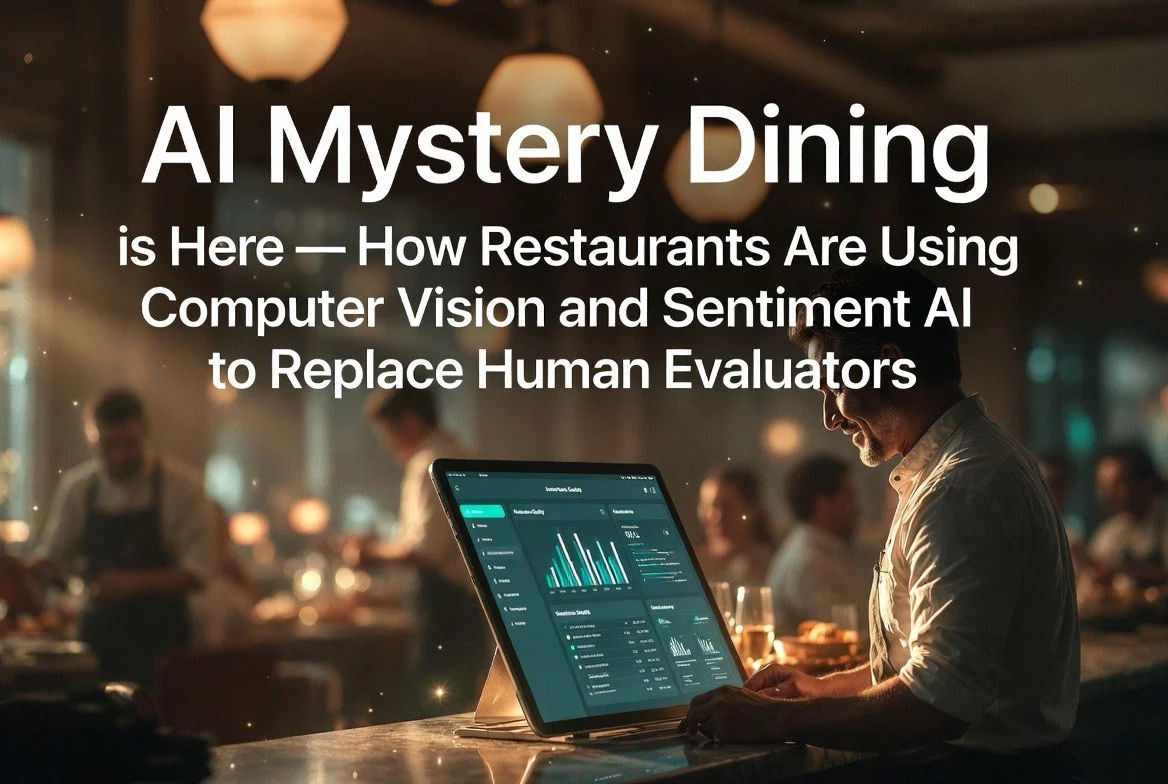
AI Mystery Dining Is Here — How Restaurants Are Using Computer Vision and Sentiment AI to Replace Human Evaluators
⚡ Expert Summary: AI-powered mystery dining platforms are replacing traditional human mystery shoppers in hundreds of restaurants across the US. Using computer vision to analyze food presentation and cleanliness, natural language processing to score customer reviews against operational standards, and sentiment analysis on social media mentions, these systems provide continuous quality monitoring at a fraction of the cost of human evaluators. Independent operators can now access the same quality assurance intelligence that chains pay agencies thousands per month for.
The Mystery Dining Industry Is Ripe for Disruption
The traditional mystery dining model is expensive, slow, and produces unreliable data. A human mystery shopper visits a restaurant, eats a meal, fills out a 50-question survey, and submits it. The restaurant owner gets the report 1-3 weeks later. By then, the specific service failure or quality issue that the shopper observed has happened hundreds of times — if it was ever fixed at all.
The cost structure is also broken. A single mystery visit costs $30-100 depending on the complexity of the evaluation, plus the cost of the meal. For a restaurant wanting weekly evaluations across lunch and dinner shifts, that is $3,000-10,000 per month — prohibitive for all but the largest operations.
AI mystery dining replaces this model with continuous, passive monitoring that costs a fraction of what a single human visit costs. Instead of one human evaluating one meal on one day, AI systems analyze every customer interaction across every shift — and surface actionable intelligence in real time rather than weeks later.
How AI Mystery Dining Actually Works
AI mystery dining platforms combine three distinct technologies, each addressing a different aspect of restaurant quality:
Computer vision for food quality and presentation. Systems like PlateIQ, KitchenCheck, and EatAI use inexpensive ceiling-mounted cameras — typically $100-300 each — combined with computer vision models trained on thousands of images of properly plated food. When a plate leaves the pass, the system analyzes it against quality standards: correct portion size, proper plating arrangement, appropriate garnish, correct bun alignment on burgers, proper sauce distribution. Deviations are flagged in real time, and the system can alert the chef or manager before the food reaches the table.
The business case for this capability alone is compelling. A restaurant serving 400 meals per day with a 2% plating error rate (8 plates returned per day) at an average cost of $15 per replacement plate loses $120 per day, or approximately $43,800 per year. Computer vision systems that catch even half of those errors pay for themselves in weeks.
Natural language processing for review analysis. Platforms like ReviewScan AI and Ovation AI aggregate all of a restaurant’s online reviews — Google, Yelp, TripAdvisor, DoorDash, Uber Eats, direct feedback — and use NLP models to extract specific, actionable insights. Rather than “your rating is 3.8 stars,” the system identifies patterns: “wait times during Friday dinner service have dropped 12% over the last 30 days” or “negative mentions of ‘cold fries’ have increased 40% since the new fryer was installed.”
This is significantly more useful than traditional review monitoring because it connects customer sentiment to specific operational variables. If the AI notices that negative mentions of “slow service” spike on Tuesdays, the operator can look at Tuesday staffing levels, investigate whether a specific server is underperforming, or check if the Tuesday special has a longer prep time. The AI is not just reporting the problem — it is pointing toward the cause.
Sentiment AI for social media and review monitoring. The third layer tracks brand mentions across social media, review sites, and delivery platforms. When a customer posts a photo of a poorly presented dish on Instagram, or a diner complains about a specific menu item on X, sentiment AI catches it, categorizes it, and alerts management. This gives operators the ability to respond to quality issues within hours rather than discovering them weeks later through a monthly review audit.
Cost Comparison: Human vs. AI Mystery Dining
| Service | Human Cost | AI Cost | Frequency |
|---|---|---|---|
| In-person evaluation | $30-100/visit + meal | $0 (continuous camera monitoring) | Every meal vs. once/week |
| Review aggregation & analysis | $500-2,000/month (agency) | $49-99/month | Real-time vs. monthly report |
| Social media monitoring | $1,000-3,000/month (agency) | $49-99/month | Real-time vs. weekly |
| Full QAX program (combined) | $3,000-10,000/month | $150-400/month | Continuous vs. intermittent |
The cost differential is dramatic, but the more important advantage is the data quality. A human mystery shopper visits once per week and evaluates one experience. AI evaluates every plate, every review, every customer mention — and surfaces patterns that a single human visit could never reveal.
The Human Element: What AI Mystery Dining Still Misses
AI mystery dining is not a complete replacement for human judgment. There are aspects of the dining experience that computer vision and NLP cannot evaluate effectively:
- Server attitude and warmth. A camera can see if a server smiles, but it cannot evaluate whether the smile is genuine or forced. NLP can analyze review text for mentions of “rude server” but cannot predict how a specific customer will perceive a specific interaction.
- Ambiance and atmosphere. The feel of a restaurant — lighting, music volume, energy level — is subjective and varies by customer preference. AI can measure decibel levels and foot traffic, but it cannot tell you whether the room feels inviting.
- Creative judgment calls. A skilled human mystery shopper can evaluate whether a menu modification was handled gracefully or whether a special request was accommodated appropriately. These edge cases are difficult for AI to assess.
The best approach for most independent operators is hybrid: AI handles the continuous, measurable aspects of quality assurance (portion sizes, plating, review patterns, cleanliness) while periodic human evaluations handle the subjective, interpersonal aspects that require judgment. Most AI mystery dining platforms are designed to work this way — the AI surfaces problems, the human investigates and resolves them.
How to Implement AI Mystery Dining at Your Restaurant
If you are an independent operator interested in AI quality assurance, here is the practical implementation path:
Start with review analysis. This is the easiest entry point and requires no hardware. Connect your Google, Yelp, TripAdvisor, and delivery platform accounts to one of the NLP review analysis platforms (ReviewScan AI, Ovation AI, or Marchex). Most offer free trials. The setup takes 15 minutes, and within 24 hours you will have a dashboard showing actionable patterns in your customer feedback.
Add camera-based quality monitoring for the pass. If you have a high-volume kitchen where plating consistency is a concern, install one or two ceiling-mounted cameras at the pass. PlateIQ and KitchenCheck offer starter kits for $300-500 that include the camera and three months of service. The system will begin flagging deviations within days.
Expand to social media monitoring. Add a social listening tool (Brandwatch, Sprout Social, or Mention) connected to your restaurant’s name and menu items. Set up alerts for negative sentiment spikes so you can respond before the issue escalates.
Total cost for a full AI mystery dining stack: $150-400/month for an independent restaurant. Total cost for equivalent human mystery dining services: $3,000-10,000/month. The technology gap between what chains can afford and what independents can access has never been narrower.
Real Results from Early Adopters
AI mystery dining is not theoretical. Several operators have published their results after adopting these systems:
A 12-unit fast-casual group in Texas deployed computer vision plating analysis across all locations. In the first 90 days, they reduced plate returns by 62% and identified a training gap at one location where portion sizes had been drifting 15% above target for three months — an issue that cost roughly $1,200/month in over-portioning that a human mystery shopper would never have caught because they would have only evaluated one meal.
An independent Italian restaurant in Chicago started using NLP review analysis after a string of negative Yelp reviews about wait times. The AI revealed that the complaints were concentrated in a two-hour window on Friday and Saturday evenings and correlated with a specific sous chef’s shift. Rather than overhauling the entire front-of-house system, the owner shifted the sous chef’s break schedule. Wait time complaints dropped 40% within two weeks.
A three-unit pizza group in Portland connected social media monitoring and discovered that their delivery drivers were being mentioned negatively on X for slow delivery times to a specific neighborhood. The AI traced the pattern to a specific intersection where drivers were consistently hitting traffic. The group rerouted delivery orders from that area to a different location. Delivery satisfaction scores improved within a week.
These are the kinds of patterns that AI mystery dining surfaces and human-operated systems miss. A human mystery shopper evaluates one snapshot — one meal, one shift, one location. AI evaluates the entire picture and finds the patterns that cross shifts, locations, and weeks.
The technology is available, affordable, and proven. The question is whether independent operators will adopt it before the cost advantage of quality intelligence becomes a competitive necessity rather than a competitive advantage.
FAQ
What is AI mystery dining?
How much does AI mystery dining cost compared to human shoppers?
Does AI mystery dining require cameras in the dining room?
Can AI completely replace human mystery shoppers?
How long does it take to set up AI mystery dining?

About Barak Schurr
Barak Schurr built and exited a major ticketing platform, ran global operations at Eventbrite, and now focuses on one question: which AI tools actually help independent restaurant owners run leaner and grow faster. He writes from the operator’s perspective — no vendor spin, no theory, just what’s real in 2026.
Email: [email protected]
More AI Resources