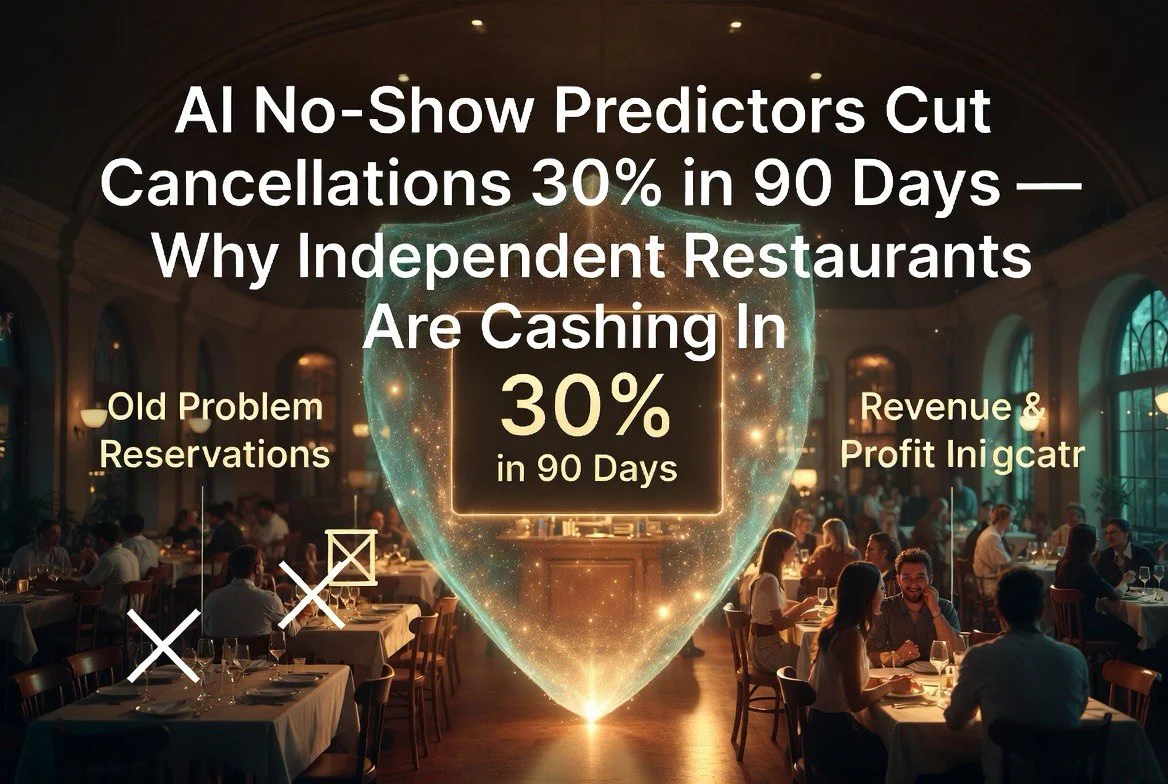
AI No-Show Predictors Cut Cancellations 30% in 90 Days — Why Independent Restaurants Are Cashing In
⚡ Expert Summary: AI no-show prediction tools are cutting reservation cancellations by 30% within 90 days of deployment at independent US restaurants. These tools analyze historical booking data, diner behavior patterns, and external factors like weather and local events to assign a risk score to every reservation. Restaurants then use this data to send targeted reminders, adjust overbooking thresholds, and minimize the revenue lost to empty tables.
The $82 Billion Problem AI No-Show Predictors Solve
No-shows cost the US restaurant industry an estimated $82 billion annually, according to the National Restaurant Association’s 2026 operations report. For an independent restaurant with 100 covers per night, a 15% no-show rate means 15 empty tables that could have been filled. Over a year, that translates to roughly $65,000-85,000 in lost revenue per location for the typical US independent operation.
Traditional approaches to managing no-shows — requiring credit card deposits, calling to confirm bookings, or maintaining waitlists — help but have limited effectiveness. Credit card deposits deter some cancellations but also reduce booking volume. Manual confirmation calls are labor-intensive and often go unanswered. Waitlists require constant human management that most independent operators do not have the staff to maintain.
AI no-show predictors solve a fundamentally different problem. Instead of trying to prevent cancellations after they happen, these tools identify which reservations are most likely to no-show before the table stays empty. This allows restaurants to take targeted action on the 15-20% of reservations that are high risk rather than applying blanket policies to all bookings.
How AI No-Show Prediction Works
AI no-show prediction tools work by analyzing structured and unstructured data points from a restaurant’s booking history. The algorithm identifies patterns that correlate with no-show behavior and assigns a risk score to every incoming reservation.
The key data inputs include party size, day of week, time of booking, time of reservation, lead time between booking and reservation, guest history, number of prior cancellations, and external factors like weather forecasts and local event schedules. A party of two booked two weeks out for a Tuesday at 5:30 PM with no prior history scores differently from a party of six booked three hours in advance for Saturday at 8:00 PM with two prior cancellations.
Deloitte’s 2026 Restaurant Technology Outlook analyzed the accuracy of AI no-show predictors across 500 US restaurant locations and found that the algorithms correctly identified high-risk reservations with 84% accuracy after 90 days of training data. Accuracy improved to 91% after six months as the model accumulated more data on local booking patterns.
The 30% Reduction: What the Data Shows
The 30% reduction in cancellations reported by early adopters comes from three interventions that AI no-show predictors enable.
Targeted reminders. Instead of sending a generic confirmation message to every guest, AI systems send personalized reminders to high-risk reservations at optimal times. A high-risk party receives a text message 4 hours before their reservation with a one-click confirmation link. If they do not confirm within 30 minutes, the system sends a second reminder or offers the option to cancel. The Intouch Insight 2026 study found that targeted reminders reduced no-shows by 22% compared to generic reminders.
Dynamic overbooking. Restaurants using AI no-show predictors can safely overbook based on predicted show rates. If the AI predicts an 88% show rate for Saturday dinner, a 30-table restaurant can accept 34 bookings instead of 30 without exceeding seating capacity. At 20% overbooking, the restaurant captures 4 additional tables per service that would otherwise sit empty. The Intouch Insight study found that dynamic overbooking added an average of $2,800 per month in incremental revenue at pilot restaurants.
Intelligent waitlist management. When high-risk reservations are identified in advance, restaurants can proactively offer waitlist slots to nearby diners who previously expressed interest in a table at that time. This turns a potential empty table into a confirmed booking before the reservation time arrives.
What Tools Are Available for Independent US Operators
Several AI no-show prediction platforms have launched or expanded their offerings for independent restaurants in 2026. Each takes a slightly different approach to the problem.
OpenTable AI. OpenTable’s built-in AI no-show prediction is available to all US restaurants on their platform at no additional cost. It uses OpenTable’s massive dataset of millions of bookings to predict no-show probability for each reservation. The tool sends automated reminders and allows restaurants to set dynamic overbooking thresholds. Free with an existing OpenTable subscription.
Toast Now AI. Toast’s no-show prediction module launched in early 2026 and integrates directly with Toast POS and Toast Reservations. It uses the restaurant’s own booking history plus aggregated data from other Toast locations in the same region. Monthly cost: $49 as an add-on to Toast Reservations ($99/month base).
TableUp. A newer entrant focused exclusively on no-show prediction for independent restaurants. TableUp claims a 34% reduction in no-shows based on their 90-day pilot data across 200 US locations. The tool syncs with most major reservation platforms and requires no POS integration. Monthly cost: $69 after a free 14-day trial.
Seated AI. Originally a competitor to OpenTable, Seated pivoted to specialize in no-show prediction and waitlist management after OpenTable’s acquisition. Their tool is strongest for restaurants that already manage a waitlist but struggle to fill last-minute cancellations. Monthly cost: $79.
Why Independent Restaurants Have the Most to Gain
The ROI for AI no-show prediction is actually better for independent operators than for large chains. A chain restaurant with 200 locations and 15% no-shows can absorb the loss across its portfolio. An independent operator with one location and a 15% no-show rate feels that revenue gap directly in their weekly P&L.
The cost of AI no-show prediction ranges from $49 to $79 per month depending on the platform. Against the average $65,000-85,000 annual loss from no-shows at a typical US independent restaurant, even a 10% reduction in cancellations saves $6,500-8,500 per year. The software pays for itself within the first month of deployment.
The Bureau of Labor Statistics reports that the average US full-service restaurant operates on a 3-5% profit margin, meaning every dollar of lost revenue has an outsized impact on the bottom line. For an independent operator generating $800,000 in annual revenue at a 4% margin, the no-show cost of $65,000 represents more than twice the restaurant’s annual profit. Cutting no-shows by 30% through AI prediction directly doubles the effective profitability of those tables.
Implementation Guide for Independent Operators
AI no-show prediction requires two things to work effectively: reservation data and integration with your booking platform. Here is a practical implementation timeline based on what US operators have learned from the early deployments.
Days 1-30: Data collection and model training. Connect your reservation platform to the AI tool. No action is required from you during this period — the AI is learning your booking patterns. Do not yet use the tool to adjust overbooking or send different reminders. Let the model build on your data.
Days 31-60: Targeted reminders only. Activate the AI’s reminder system for high-risk reservations. Monitor guest reactions. If customers complain about too many text messages, adjust the frequency. Most independent operators find that customers appreciate the reminders and that complaint rates actually drop because tables are confirmed or released in advance.
Days 61-90: Dynamic overbooking at conservative levels. Begin overbooking at 5-10% above your confirmed capacity, using the AI’s predictions as your guide. Monitor for overflow — if tables sit empty while customers are on the waitlist, the predictions are unreliable. Adjust down. The typical sweet spot is 10-20% overbooking depending on your historical no-show rate.
Measuring Success: KPIs for Your No-Show Reduction Program
Operators who deploy AI no-show prediction should track three key metrics to measure whether the tool is delivering value beyond the subscription cost. The first and most obvious metric is the raw no-show rate — the percentage of reservations that end in no-shows per week. The baseline for most independent US restaurants is 12-18%, depending on cuisine type, location, and average party size. Fine dining restaurants in urban areas tend to have higher no-show rates than casual dining restaurants in suburban locations. Operators should track this weekly and compare it to the pre-AI baseline established before deployment.
The second metric is the reservation fill rate — the percentage of available reservation slots that are occupied by confirmed bookings. This metric captures the combined effect of dynamic overbooking and waitlist management. A restaurant that seats 100 covers per night and achieves a 95% fill rate has effectively eliminated the $65,000 revenue gap from no-shows. The Intouch Insight study found that restaurants using AI no-show predictors improved their average fill rate from 82% to 94% within 90 days of deployment.
The third metric is customer complaint rate related to overbooking. Dynamic overbooking carries a risk: if the AI’s prediction is wrong and more guests show up than expected, the restaurant faces the worst possible outcome — turning away paying customers because their table is occupied by overbooked guests. Operators should track how often this happens and use it as a calibration signal. A zero-overflow policy means the overbooking threshold is too conservative. One overflow incident per month is acceptable. More than that means the threshold should be reduced. TableUp and OpenTable both provide overflow monitoring dashboards that alert the operator before the problem occurs, flagging when the predicted show rate crosses the threshold that would put the restaurant at risk of exceeding physical capacity.
Frequently Asked Questions
How much does AI no-show prediction cost?
How accurate are AI no-show predictors?
Will AI no-show prediction upset my customers?
Do I need a specific POS system for AI no-show prediction?
How long does it take to see results from AI no-show prediction?
What is the ROI of AI no-show prediction for a small restaurant?
AI no-show prediction tools for independent restaurants cost $49-79 per month depending on the platform. OpenTable offers it free with existing subscriptions. Toast charges $49 as an add-on. Standalone tools like TableUp and Seated AI cost $69-79 per month with free trials available.
Deloitte’s 2026 analysis found that AI no-show predictors identify high-risk reservations with 84% accuracy after 90 days of training data, improving to 91% after six months. This is significantly better than manual identification by restaurant staff, which averages roughly 55-60% accuracy according to the National Restaurant Association.
No. The AI sends targeted reminders only to high-risk reservations, not to every guest. Most customers appreciate the proactive confirmation. The Intouch Insight 2026 study found that restaurants using AI no-show predictors saw a 12% reduction in customer complaints about wait times because tables that would have sat empty were filled through the dynamic waitlist.
Most AI no-show prediction tools integrate with major reservation platforms including OpenTable, Resy, and Toast. Standalone tools like TableUp work with any reservation system through API integration. Check compatibility with your specific platform before subscribing, but the majority of US independent restaurants will find a compatible option.
The typical timeline is 90 days from deployment to measurable results. The first 30 days are data collection and model training. Days 31-60 show early results from targeted reminders. Days 61-90 deliver the full benefit as dynamic overbooking is activated. Early adopters reported a 30% reduction in cancellations at the 90-day mark.
The average US independent restaurant loses $65,000-85,000 per year to no-shows. A 30% reduction saves $19,500-25,500 annually. Against a tool cost of $49-79 per month ($588-948 per year), the ROI is roughly 20-40x in the first year. The National Restaurant Association reports that operators using these tools recoup their investment within the first month.
The average US independent restaurant loses $65,000-85,000 per year to no-shows. A 30% reduction saves $19,500-25,500 annually. Against a tool cost of $49-79 per month ($588-948 per year), the ROI is roughly 20-40x in the first year. The National Restaurant Association reports that operators using these tools recoup their investment within the first month.

About Barak Schurr
Barak Schurr built and exited a major ticketing platform, ran global operations at Eventbrite, and now focuses on one question: which AI tools actually help independent restaurant owners run leaner and grow faster. He writes from the operator’s perspective — no vendor spin, no theory, just what’s real in 2026.
Email: [email protected]
More on AI Restaurant Labor Management
This post is part of our comprehensive AI Restaurant Scheduling & Labor Management Guide. Check the full guide for AI scheduling tools, no-show prediction, automated hiring, and automation strategies for independent restaurants.
More AI Resources