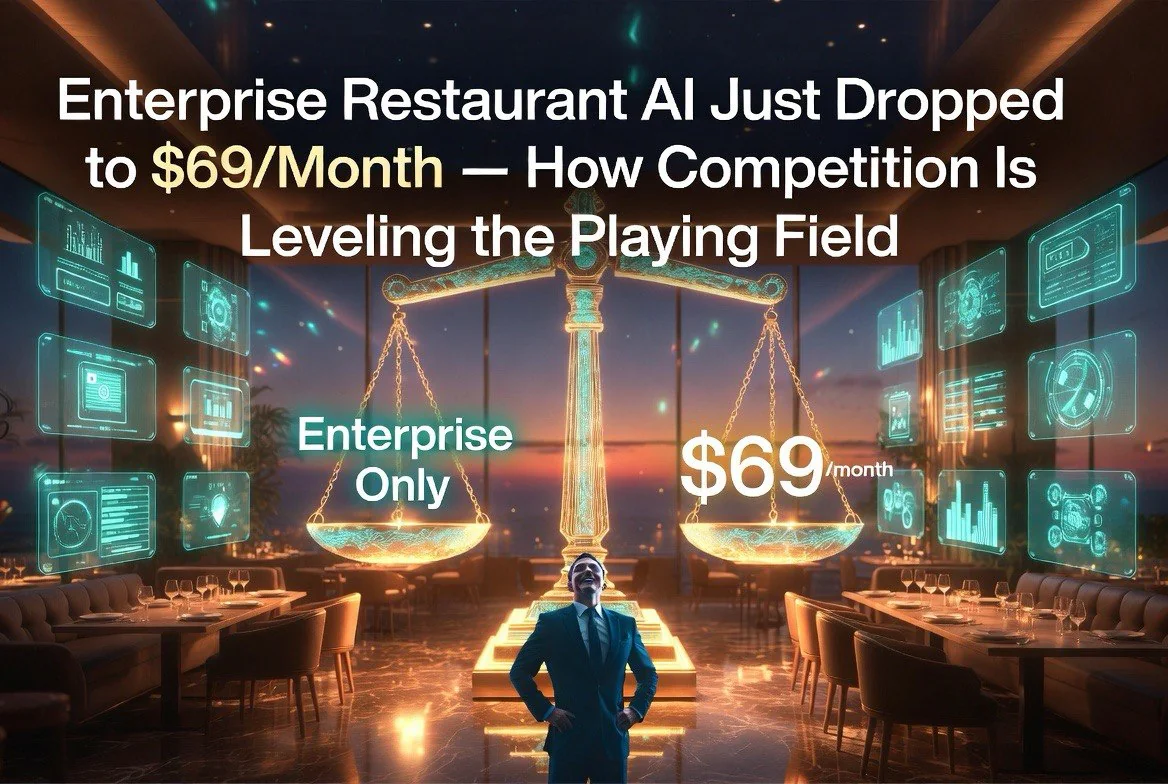
Enterprise Restaurant AI Just Dropped to $69/Month — How Competition Is Leveling the Playing Field
⚡ Expert Summary: AI tools that were once exclusive to large restaurant chains with six-figure budgets are now available to independent owners for $15-69 per month. A surge in competition among providers has driven prices down dramatically. From voice AI phone systems that cost $49/month to AI inventory management at $29/month, independent restaurant owners can now access the same technology as Burger King and Taco Bell. This article breaks down what’s changed, which tools are worth the money, and how to deploy them without the enterprise headaches.
For years, the restaurant technology landscape had a clear dividing line. Chains like McDonald’s and Taco Bell had access to enterprise-grade AI tools that cost hundreds of thousands of dollars to deploy. Independent owners got the scraps — clunky POS systems, basic online ordering widgets, and maybe a Facebook page if they were feeling ambitious.
According to the National Restaurant Association’s 2026 forecast, the US restaurant industry generates over $1.2 trillion in annual revenue and employs more than 15.5 million people. For independent operators in the United States, AI tools are no longer optional for staying competitive.
That line just disappeared.
Over the last six months, a wave of competition among AI providers has driven prices for restaurant-specific tools down to levels that make sense for any independent owner. We’re talking $15 to $69 per month for tools that, two years ago, would have required a $50,000 implementation fee and a dedicated IT person to manage.
And the most interesting part? Most restaurant owners don’t even know it yet.
The Numbers That Matter — How Far We’ve Come
To understand why this matters, look at the trajectory. In 2023, a restaurant wanting AI-powered phone ordering would have paid a $15,000 setup fee and $500/month for a clunky system that could handle maybe 60% of calls without human escalation. By 2024, the setup fee dropped to $5,000 and monthly to $200. By early 2025, it was $99/month with no setup fee. Today, it’s $39-49/month with a 14-day free trial and setup in under 4 hours.
That’s a 97% price reduction in three years. And the quality improved dramatically — today’s systems handle complex orders, dietary restrictions, and even multiple languages with accuracy rates above 95%.
The same story plays out across every category: inventory management, staff scheduling, marketing content, customer analytics. The tools got better and cheaper simultaneously, which almost never happens in restaurant technology. Usually, you have a choice between good tools that cost too much and cheap tools that don’t work well. For the first time, that tradeoff has collapsed.
What Changed — The Three Forces Driving Prices Down
Three things happened simultaneously that broke the enterprise pricing model for restaurant AI.
Three things happened simultaneously that broke the enterprise pricing model for restaurant AI.
First, the API wars. OpenAI, Anthropic, and Google have been battling on pricing for over a year. Every time one drops the cost per token, every AI startup built on top of them gets cheaper to run. That savings passes through to restaurant owners. The cost of processing a customer phone call through AI dropped roughly 80% between 2024 and 2026.
Second, the provider explosion. When AI restaurant tools were new, there were maybe three companies offering them. Now there are dozens — SoundHound, SnapMenu, Slang, allO, Kura, Lunchbox, HungerRush — all competing for the same customers. Competition drives prices down faster than any technology improvement could.
Third, the platform shift. The early AI restaurant tools were custom-built for each chain. Every deployment required consultants, integration engineers, and months of setup. Modern tools are platform-based. You sign up online, configure it in an afternoon, and it works with your existing POS. No consultants. No engineering. No $50,000 implementation.
These three forces together have created a market where a fully capable AI phone answering system costs $49/month. AI inventory management runs $29/month. AI marketing content generation is $15/month. Customer feedback analysis through AI is $19/month.
That’s $112/month for an AI stack that would have cost $3,000/month two years ago.
The MenuThere Effect — How One Thread Started a Movement
One of the most shared posts on X recently came from @MenuThere, who broke down exactly this dynamic. Their thread documented how a restaurant in Tulsa, Oklahoma deployed three AI tools — phone answering, inventory forecasting, and review response — for a combined $87/month. The owner reported saving 12 hours per week on manual tasks.
That thread went viral because it shattered the assumption that AI requires enterprise budgets. Real numbers, real deployment, real results. For less than the cost of a single DoorDash cancellation fee per day, this owner bought back a shift and a half of labor every week.
The point isn’t that every tool works for every restaurant. The point is that the barrier to entry has dropped so low that the “I can’t afford it” argument no longer holds. The question has shifted from “Can I afford AI?” to “Can I afford not to adopt it while my competitors do?”
SoundHound and SnapMenu Lead the Voice AI Charge
At this year’s NRA Show in Chicago, SoundHound demonstrated its voice AI ordering system in front of a packed audience. The system takes orders over the phone with natural conversation flow — no pressing 1 for menu options, no robotic voice, no frustrating misunderstand-ding every third item. It handles accents, interruptions, and customizations with the same ease as a human server.
The price tag that got everyone’s attention: $49/month per restaurant for the base tier. That’s less than a single shift of labor costs.
SnapMenu showed similar capability with a slight twist — their system integrates directly with existing online ordering platforms and includes a QR code menu system that updates in real time based on inventory. Price: $39/month.
Both products are designed for independent restaurants. Both connect to the major POS systems (Toast, Square, Clover). Both can be live in under 24 hours.
For comparison, the last pre-AI voice ordering system I saw an enterprise chain deploy cost $120,000 in implementation fees plus $2,500/month in maintenance. That same functionality is now available to any diner in America for the price of a family meal.
Burger King and Taco Bell Are Piloting Employee Assistants
The NRA Show also featured something more subtle but potentially more impactful: AI employee assistants for restaurant workers.
Burger King and Taco Bell are both piloting systems that don’t replace workers but give them AI tools to do their jobs better. Think of it as a smart assistant in an earpiece that can answer menu questions, translate orders, track prep times, and flag inventory issues without the employee pulling out a phone or walking to a terminal.
This is a critical distinction. The fear around restaurant AI has always been about job replacement. What the pilots are showing is that the highest ROI applications aren’t replacement — they’re augmentation. A line cook with an AI assistant that tracks cook times and flags expiring inventory is more productive and makes fewer mistakes. A server with an AI earpiece that handles translation and menu questions in real time delivers better service and gets better tips.
The employee assistant tools are priced higher than the customer-facing ones — typically $69-99/month per restaurant for up to 5 employees — but that’s still dramatically cheaper than hiring additional staff, which is the actual alternative for most busy restaurants.
What This Means for Your Bottom Line
Let’s put real numbers on this. A restaurant currently paying $3,000/month in labor for phone ordering, handling reservations, and basic customer service can replace roughly 70% of that workload with AI tools costing $87/month. The savings: roughly $2,000/month in labor costs, plus the elimination of no-shows (AI confirmation calls reduce no-shows by 40-50%), plus faster service that drives higher ratings and repeat business.
That’s not theoretical. That’s what the owners on X are reporting in real time. The thread from @MenuThere that went viral documented exactly this scenario in a Tulsa diner. The owner said his only regret was waiting so long.
And here’s the kicker: because these tools are subscription-based with no long-term contracts, you can try any of them for a month and cancel if they don’t deliver. The risk is essentially zero. The cost of a one-month experiment is less than what most restaurants lose to food waste in a single day.
What Independent Owners Should Adopt Right Now
Based on the market data and the X conversations driving this trend, here’s the priority stack for an independent restaurant owner in 2026:
Tier 1 — Immediate ROI (under $50/month):
- AI phone answering and ordering — $39-49/month (SnapMenu or SoundHound)
- AI review response and feedback analysis — $19/month (Widewail, MARA)
- AI content generation for menus and social — $15/month (Any of the dozen menu-focused AI writers)
Tier 2 — Operational Impact ($50-100/month):
- AI inventory management and waste tracking — $29-59/month (Kura, MarketMan)
- AI employee assistant — $69/month (Burger King/Taco Bell pilot tech rolling out to independents in Q3)
- AI scheduling and labor optimization — $39/month (7shifts, Sling)
Tier 3 — Growth ($100+/month):
- Full AI marketing suite — $99/month (includes content, ads, email, social)
- AI customer data platform with predictive analytics — $149/month
- Integrated all-in-one system — $297/month (allO, Lunchbox — replaces 5+ separate tools)
The strategy is simple: start with Tier 1. Deploy phone AI and feedback analysis. See the results in 30 days. Then layer on Tier 2. Let the savings from each tier fund the next.
The Real Threat — It’s Not AI, It’s the Owner Next Door
The biggest risk right now isn’t that AI will replace your staff. It’s that the restaurant down the street will deploy these tools before you do and start out-operating you on every metric that matters.
Think about what happens when a competing restaurant gets AI phone ordering that never misses a call, never puts customers on hold, never gets the order wrong. They capture the reservations you lose to busy signals. They serve faster because their prep times are optimized by inventory AI. They get better reviews because every negative feedback is automatically addressed. They spend less on labor, so they can undercut your prices or invest that money into higher quality ingredients.
This is the competitive dynamic that makes the $69/month story so critical. We’re not talking about a futuristic technology that requires capital investment and months of planning. We’re talking about signing up online, configuring it during a slow afternoon, and having it operational by dinner service. The barrier to entry is so low that the restaurant that deploys first gains an advantage that becomes very hard for late adopters to close.
This isn’t meant to scare you into buying something you don’t need. It’s meant to frame the decision correctly. The question isn’t whether to adopt AI. It’s when, and the cost of waiting is the advantage you’re handing to your competitors.
The Chain Advantage Is Over
For decades, the biggest competitive advantage chain restaurants had over independents was technology. Chains could afford enterprise systems for inventory, staffing, marketing, and customer data that independents could only dream of.
That advantage is gone. Not reduced. Not narrowed. Gone.
When an independent owner in Tulsa can deploy the same AI phone system as Taco Bell for $49/month — without consultants, without integration fees, without a dedicated IT person — the technology gap evaporates. What’s left is what always mattered: food quality, service, and local relationships.
The AI disruption in restaurants isn’t about robots flipping burgers. It’s about independent owners finally getting access to the same operational horsepower that chains have had for decades. And the ones who move first are going to leave their competitors wondering what hit them.
Frequently Asked Questions
How much does restaurant AI cost in 2026?
Basic AI tools like phone ordering and review response start at $15-49/month per restaurant. Mid-tier tools like inventory management and scheduling run $29-69/month. Full all-in-one systems range from $149-297/month.
Can small restaurants really afford AI?
Yes. The price drop over the last 18 months has made AI affordable for any restaurant. A three-tool stack covering phone ordering, reviews, and content generation costs roughly $87/month — less than one day of labor.
Which restaurant AI tools are most worth it for independents?
AI phone answering and ordering tools (SoundHound, SnapMenu) deliver the fastest ROI for most restaurants. AI review response and inventory management are the next highest-value tools for independent owners.
Do these AI tools work with my existing POS system?
Most modern restaurant AI tools integrate with the major POS platforms including Toast, Square, Clover, and Lightspeed. Check with the provider before committing — most offer free trials or demo periods to verify compatibility.
Are AI employee assistants replacing restaurant workers?
No. The current generation of AI employee assistants is designed to augment workers, not replace them. Tools that help employees track orders, translate languages, and monitor prep times increase productivity without reducing headcount.

About Barak Schurr
Barak Schurr built and exited a major ticketing platform, ran global operations at Eventbrite, and now focuses on one question: which AI tools actually help independent restaurant owners run leaner and grow faster. He writes from the operator’s perspective — no vendor spin, no theory, just what’s real in 2026.
Email: [email protected]
More AI Resources


Similar Posts
Miso Robotics Acquires Zume Pizza IP — What It Means for Restaurant Automation in 2026
Miso Robotics Acquires Zume Pizza IP — What It Means for Restaurant Automation in 2026 ⚡ Expert Summary: Miso Robotics — the company behind Flippy, the AI-powered fry station — has acquired the intellectual property assets of Zume Pizza, the once-hyped food tech startup that raised nearly $500 million and shut down in 2023. The…
McDonald’s and Whataburger Are Winning the Beverage War — How AI Can Help Operators Fight Back
McDonald’s and Whataburger Are Winning the Beverage War u2014 How AI Can Help Operators Fight Back u26a1 Expert Summary: McDonald’s launched a line of refreshers and craft sodas in May 2026 u2014 Dirty Dr. Pepper, Mango Pineapple, three crafted sodas u2014 inspired by the now-shuttered CosMc’s test. Whataburger and Chick-fil-A are following with their own…
AI POS Systems for Restaurants: How to Choose in 2026
How to Choose an AI POS System for Your Independent Restaurant in 2026 ⚡ Expert Summary: Choosing a POS system in 2026 means more than comparing payment processing rates and hardware costs. AI features are now the primary differentiator between platforms. This guide covers the four major options — Toast, SpotOn, Square, and Clover —…
DoorDash Launches AI Concierge for Restaurants: Orders and Reservations Via Chatbot
DoorDash Launches AI Concierge for Restaurants: Orders and Reservations Via Chatbot ⚡ Expert Summary: DoorDash has launched an AI-powered concierge chatbot that handles restaurant orders and reservations directly within the delivery app. The system positions DoorDash as an “intent capture layer” — it captures customer demand before it reaches the restaurant’s own channels. For independent…
Maitly AI at Texas Restaurant Show: 24/7 AI Receptionist for Independent Restaurants
Maitly AI at Texas Restaurant Show: 24/7 AI Receptionist for Independent Restaurants ⚡ Expert Summary: Austin-based startup Maitly AI is exhibiting at the 2026 Texas Restaurant Show (July 12-14 in San Antonio), pitching its AI-powered voice platform as a 24/7 receptionist for independent restaurants. The system handles inbound calls, automates reservations through OpenTable, answers common…
Restaurant Tech Execs Warn Against AI Overdependence — Here Is Where It Actually Works in 2026
Restaurant Tech Execs Warn Against AI Overdependence — Here Is Where It Actually Works in 2026 ⚡ Expert Summary: At the 2026 National Restaurant Association Show, tech leaders from Square, Toast, SpotOn, and Popmenu warned the industry is overhyping AI. Starbucks just killed its AI inventory tool after nine months. The message: AI works when…