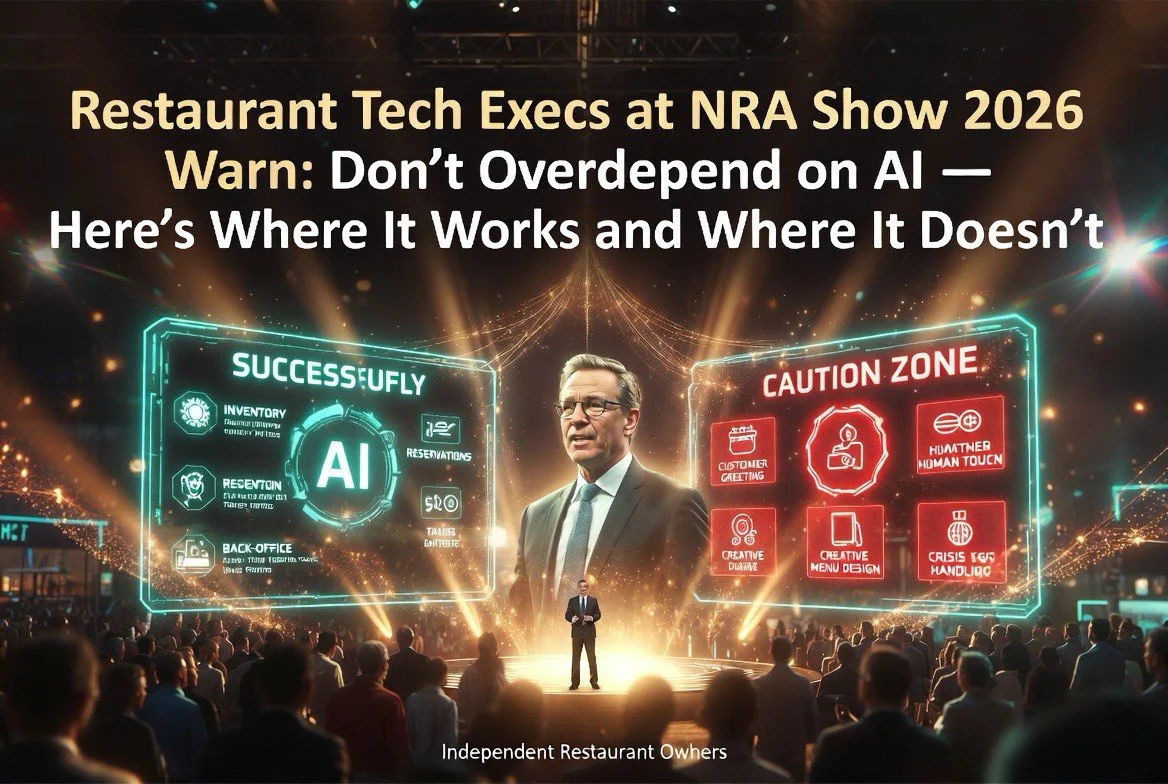
Restaurant Tech Execs at NRA Show 2026 Warn: Don’t Overdepend on AI — Here’s Where Works and Where It Doesn’t
⚡ Expert Summary: At the 2026 National Restaurant Association Show in Chicago, technology executives from Square, Toast, SpotOn, and Popmenu delivered a sobering message to independent restaurant owners: AI is powerful, but over dependence on it can hurt your business. The executives stressed that AI should augment existing systems — not replace core hospitality elements. With voice AI, kitchen automation, and predictive tools flooding the market, knowing where AI works and where it falls short is more important than ever for independent operators trying to protect their margins without sacrificing guest experience.
The 2026 National Restaurant Association Show drew tens of thousands of attendees and more than 2,200 exhibitors to Chicago’s McCormick Place this May. AI was everywhere — voice ordering systems, kitchen automation platforms, predictive inventory tools, and AI-powered loyalty programs dominated the show floor. For independent restaurant owners in the United States evaluating AI tools, the specific use case and integration complexity matter far more than the underlying model technology.
But the most important conversation at the NRA Show wasn’t about what AI can do. It was about what it can’t.
In a series of panels and interviews covered by Restaurant Dive, technology executives from the biggest names in restaurant tech — Square, Toast, SpotOn, and Popmenu — warned independent owners against overdepending on artificial intelligence. The message was consistent: AI is a powerful tool, but it’s not a replacement for the human elements that make a restaurant work.
The Scale of AI in Restaurants Today
To understand why the overdependence warning matters, it helps to know just how fast AI has penetrated the restaurant industry. Voice AI adoption in restaurants hit 34% in 2025 according to industry research cited at the show, and that number has continued climbing through 2026. Kitchen automation platforms, AI-powered inventory systems, and predictive scheduling tools have followed a similar trajectory.
The NRA Show’s own research, cited during opening remarks, shows nearly 90% of operators expect food and labor costs to continue increasing through 2026, while 80% of consumers say overall value remains their top priority when dining out. Against that backdrop, AI looks like a lifeline. But the technology executives on the show floor are seeing a pattern they don’t like: restaurant owners adopting AI tools out of panic rather than strategy.
According to the National Restaurant Association’s 2026 State of the Industry report, 68% of US operators say technology investments are critical to staying competitive, up from 42% just two years ago.
Restaurant Dive’s coverage of the NRA Show highlighted a notable shift in tone from previous years. In 2024 and 2025, the conversation around restaurant AI was largely bullish — adopt now, figure out the details later. In 2026, the conversation has matured, and the executives who build and sell these tools are the ones pumping the brakes.
Their concerns fall into four categories:
1. Reliability Gaps
AI systems — especially generative AI and voice AI — are not reliable enough for unsupervised operation in a restaurant environment. A voice ordering system that misunderstands a customer’s accent or a busy background noise could take an order wrong. A kitchen automation system that misfires during a dinner rush creates chaos. The executives stressed that AI should augment human workers, not replace them, and that any system deployed without human oversight is a liability.
This isn’t theoretical. Multiple exhibitors at the show demonstrated systems that worked beautifully in controlled settings but acknowledged significant accuracy drops in real-world restaurant conditions — high noise, overlapping conversations, non-standard menu items, and the hundred other variables that make a restaurant different from a call center.
2. Data Quality Problems
“AI is only as good as the data it’s trained on” was a recurring phrase on the show floor. For restaurant owners, this means AI tools trained on generic data will deliver generic — and often wrong — results. A predictive inventory tool trained on national averages might not account for local preferences. A pricing optimization model might miss seasonal events unique to your area.
The executives emphasized that restaurant owners need to invest in their own data collection before they can get value from AI tools. Without clean, restaurant-specific data, even the most sophisticated AI will produce misleading outputs.
3. Complexity Overload
One of the most practical warnings from the show: don’t add AI tools that make your operations more complex. The point of restaurant technology should be to reduce complexity, not increase it. If your staff needs to manage three different AI platforms alongside your POS, scheduling system, and inventory tools, you’ve created a net negative.
Square and Toast both emphasized that the best AI implementations are invisible. They work inside existing platforms, not as separate systems that require new logins, training, and management overhead.
4. The Hospitality Trade-Off
This was the most important point from the NRA Show conversations, and it came up repeatedly: technology can optimize operations, but it cannot replace hospitality. Guests return to restaurants for the experience — the human interaction, the atmosphere, the feeling of being cared for. Every AI system that removes a human touchpoint needs to be evaluated against that core truth.
“The irreplaceable role of human hospitality” was the phrase that summed up the sentiment across multiple panels. AI can handle reservations, process payments, and optimize schedules. It cannot make a guest feel welcome in the way a skilled server or host can.
Where AI Actually Works in Restaurants Right Now
The executives weren’t anti-AI. They were pro-smart-AI. And they identified several areas where AI is delivering measurable results for independent restaurants in 2026:
Predictive inventory management. AI tools that analyze historical sales data to predict ingredient needs are reducing food waste by 25-35% in restaurants that implement them properly. This is a low-risk, high-reward use case because it doesn’t touch the guest experience directly.
Labor scheduling optimization. AI scheduling tools that factor in historical traffic patterns, weather data, local events, and staff availability are reducing labor costs by 10-15% while maintaining coverage. Again, this is a behind-the-scenes application with minimal guest-facing risk.
Customer service for common queries. AI chatbots and voice systems that handle reservation bookings, answer common questions about hours and menu items, and manage waitlist updates are working well — as long as they can escalate to a human when the query goes beyond their capabilities.
Loyalty program personalization. AI-powered loyalty engines like Sauce (featured prominently at the show) are driving reorder rates up by as much as 30% through personalized incentives based on individual customer behavior.
Where AI is not ready: full-service voice ordering for complex menus, unsupervised kitchen automation, and any customer-facing interaction that requires judgment, empathy, or handling of edge cases.
Case Studies: When Restaurant AI Went Wrong
The warnings from the NRA Show aren’t abstract. Multiple exhibitors shared anonymized case studies of restaurant AI deployments that backfired, and the patterns are instructive for any owner considering new technology.
The Voice Ordering Nightmare. A regional fast-casual chain deployed an AI voice ordering system across 15 locations. The system handled standard orders well but failed catastrophically on modifications, special requests, and orders placed in noisy environments. Within three months, the chain had to staff human order-takers alongside the AI system, effectively doubling their front-of-house labor costs during peak hours. The AI was handling about 35% of calls independently, but the human overhead to handle the remaining 65% erased any savings.
The Kitchen Display Chaos. An independent fine-dining restaurant installed an AI-powered kitchen display system that used computer vision to track cook times and plate completion. The system kept misidentifying ingredients and sending incorrect timing alerts. Line cooks started ignoring the alerts entirely, and the kitchen reverted to manual timing within two weeks. The restaurant was out $8,000 for the hardware and software and saw no improvement in ticket times or order accuracy.
The Loyalty Program That Annoyed Everyone. A neighborhood Italian restaurant launched an AI-driven personalized loyalty program that sent automated offers based on customer purchase history. The problem: the AI didn’t understand context. It sent a pasta deal to a customer who had just dined there with their family for a funeral repast. It sent a wine promotion to a regular who was pregnant and had stopped drinking. The restaurant’s manager spent more time managing AI-generated complaints than they would have spent manually managing the loyalty program.
These stories illustrate the executives’ core concern. AI can optimize known patterns, but it cannot understand context, handle exceptions, or exercise judgment. In a restaurant — where every day is different and every guest has unique needs — those limitations matter enormously.
The NRA Show’s Other Big AI Stories
Beyond the over dependence warning, the NRA Show featured several AI developments worth noting:
SoundHound AI’s expanded platform. SoundHound showcased its conversational AI platform for restaurant ordering and guest interactions. Ben Belletini, SVP of Sales at SoundHound AI, told attendees that the show is “an opportunity for us to not only demonstrate how AI voice is changing restaurant operations, but to gather critical insights from the industry community.” The company’s system now handles multi-language ordering with real-time translation capabilities.
Sauce AI-powered loyalty engine. Sauce launched an AI cashback loyalty system designed to boost restaurant reorders by up to 30%. The platform uses machine learning to personalize incentives at the individual customer level, moving beyond one-size-fits-all loyalty programs.
Wonder’s AI restaurant factory. Marc Lore, founder of Wonder, described “Wonder Create” — an AI tool that allows anyone to launch a virtual restaurant brand in under a minute. The system generates names, branding, recipes, and pricing from a single prompt, operating across Wonder’s network of programmable robotic kitchens. It’s the most ambitious example of AI-enabled restaurant creation on the market, and it attracted significant attention at the show.
What This Means for Independent Restaurant Owners
If you’re an independent restaurant owner trying to decide which AI tools to adopt in 2026, the NRA Show’s message is clear:
Start with back end tools. Inventory management, scheduling, and back-office analytics are the lowest risk, highest return AI applications. They don’t touch your guests, they reduce your costs, and they’re easy to measure.
Be cautious with guest-facing AI. Test voice AI and chatbot tools during low-traffic periods before rolling them out at scale. Have a human backup ready at all times. Monitor guest satisfaction scores closely — a small drop can wipe out any cost savings from the AI deployment.
Audit your AI stack quarterly. Every three months, review each AI tool you’re paying for. Is it still delivering value? Is the accuracy acceptable? Has your staff figured out workarounds that mean the tool isn’t actually needed? Cut the tools that don’t pass this review.
Invest in data hygiene first. Before you add more AI tools, make sure your existing data — sales records, inventory counts, customer preferences, labor hours — is clean and organized. AI can’t fix bad data. It just amplifies it.
The Bottom Line
The 2026 NRA Show was a turning point for restaurant AI. After two years of hype and rapid adoption, the industry’s leading technology voices are urging a more measured approach. AI works — but only in the right applications, with the right data, and with the right human oversight.
The restaurants that win in 2026 won’t be the ones with the most AI tools. They’ll be the ones that use AI intelligently, protect their hospitality, and measure their results honestly.
Frequently Asked Questions
How do I choose the right AI tool for my restaurant?
Start by identifying your biggest operational pain point — labor scheduling, inventory waste, review management, or customer retention. Most AI platforms offer free trials, so test two or three tools against your specific workflow before committing.
Do small restaurants need AI tools?
Yes. Independent restaurants operate on thinner margins and have fewer staff than chains, which means AI tools deliver a higher relative ROI by automating tasks that would otherwise fall on an overworked owner or manager. Many tools start under $100 per month.
How long does it take to implement AI in a restaurant?
Most AI tools for restaurants can be set up in under an hour with no technical expertise required. Integration with existing POS and reservation systems typically takes an additional 30 minutes. Full adoption by staff usually happens within two weeks.
Is AI secure for restaurant customer data?
Reputable AI restaurant platforms comply with PCI DSS for payment data and SOC 2 for operational data. Always verify a tool’s security certifications before integrating with your POS or reservation system. Most major platforms publish their compliance documentation publicly.
Will AI tools replace my restaurant staff?
No. AI handles data analysis, scheduling optimization, and routine customer responses — tasks that currently consume 30-40% of a manager’s time. This frees your team to focus on food quality, guest experience, and operational excellence, which AI cannot replicate.
More AI Resources