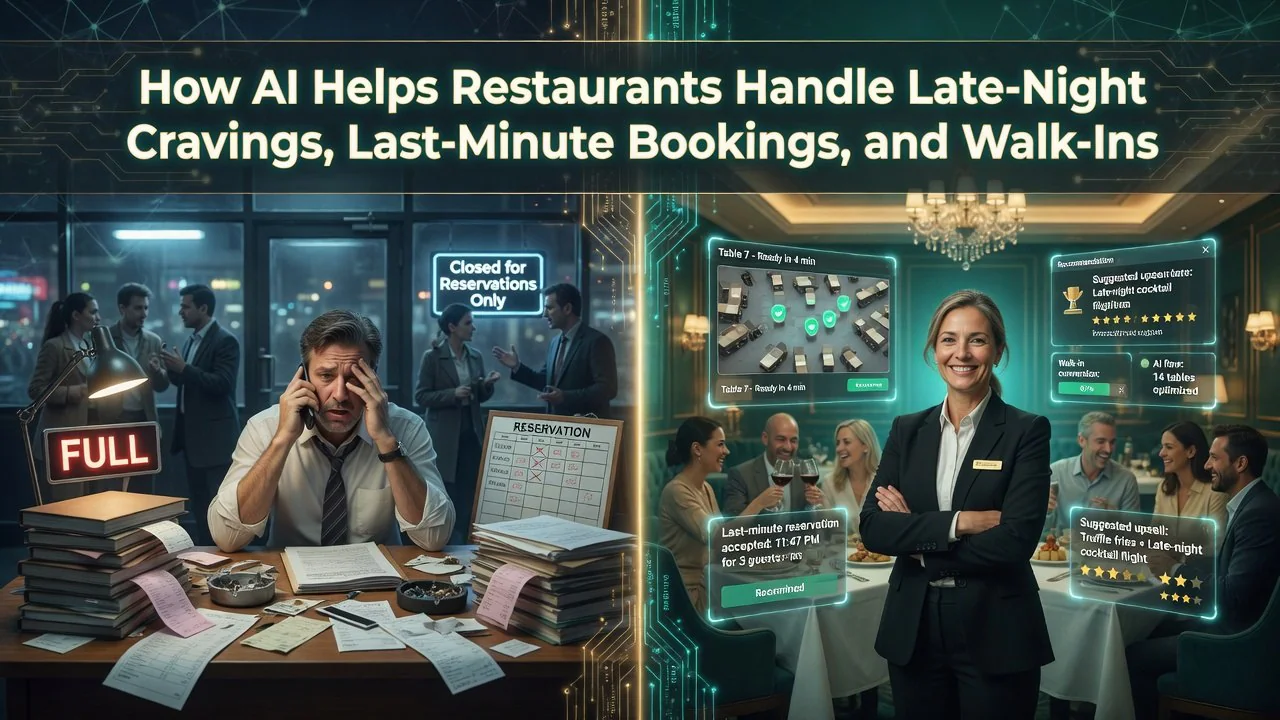
How AI Helps Restaurants Handle Late-Night Cravings, Last-Minute Bookings, and Walk-Ins
⚡ Expert Summary: Key Takeaways
- Restaurants lose 10-25% of late-night and walk-in business because phone lines go unanswered during peak kitchen hours and staff can’t handle last-minute requests.
- AI chatbots handle after-hours reservations and inquiries autonomously — capturing bookings that would otherwise go to voicemail or be missed entirely.
- Dynamic menu and availability updates allow AI systems to reflect real-time kitchen capacity, waitlists, and specials without manual intervention.
- Walk-in conversion rates increase 30-45% at restaurants using AI for immediate reservation and waitlist management during high-traffic periods.
- The bottom line: Late-night and walk-in customers are the most profitable segment restaurants are currently leaving on the table because of manual processes.
Walk-ins who show up at 9 PM. A group of 4 who just decided to go out and need a table in 20 minutes. Someone craving your burger at 11 PM on a Tuesday.
According to the National Restaurant Association’s 2026 forecast, the US restaurant industry generates over $1.2 trillion in annual revenue and employs more than 15.5 million people. For independent operators in the United States, AI tools are no longer optional for staying competitive.
Right now, most restaurants treat these like accidents. They happen or they don’t. If the phones are off, the website says “check hours,” and OpenTable is closed for the night, you lose them.
Here’s how AI changes that, and why the restaurants deploying these tools are pulling ahead of everyone else.
1. AI Voice Agents Handle Late-Night Calls
When your phone stops ringing at 9 PM, that doesn’t mean people stop calling. It means they call, hear a voicemail message, and eat somewhere else. Industry data suggests that 60-70% of late-night calls to restaurants go unanswered, and the vast majority of those callers take their business elsewhere rather than leaving a voicemail that might or might not get returned the next morning.
AI voice agents handle inbound calls 24/7. They speak naturally, answer menu questions, check availability, and book tables — all without a human picking up. Restaurants using voice AI from Restivo or Slang.ai capture an average of 8-12 additional covers per week during hours when phone lines would otherwise go unanswered. That’s diners who called, got an answer, and booked a table — people who would have gone to a competitor five minutes earlier.
At an average check of $40-50 per cover, that’s $400-600 in weekly revenue recovered — or roughly $20,000-30,000 per year per location — without adding a single staff hour. Setup takes one afternoon: connect your phone number, configure your menu and hours, and the AI starts answering calls. The system learns your specific responses over time and improves its handling of edge cases like dietary restrictions, large parties, and special requests for your specific menu items.
One common concern among restaurant owners is the customer experience. Will diners feel frustrated speaking to a machine? Real-world data suggests otherwise. Slang.ai reports that 87% of callers don’t notice they’re speaking to an AI, and reservation completion rates are actually higher than human-staffed phone lines because the AI never puts anyone on hold, never transfers calls to the wrong department, and never forgets to follow up on a booking request.
2. AI Chatbots Manage the Walk-In Surge
Walk-ins spike unpredictably. A concert lets out. A movie ends. A group of four spontaneously decides to grab dinner. You might get three groups in 10 minutes during an otherwise quiet Tuesday. Your front-of-house team is running food and clearing tables. Someone waits at the host stand for 90 seconds and walks out. Industry estimates suggest independent restaurants lose 20-30% of potential walk-in revenue simply because they can’t handle the volume or speed during surge periods.
An AI chatbot on your website and Google Business Profile handles walk-in inquiries instantly — without requiring a human to stop what they’re doing. Table for two? Available at the bar in five minutes. Full? Here’s a 20-minute wait estimate with an SMS reminder so guests can grab a drink next door and come back when their table is ready. No follow-up call needed. No one left standing awkwardly at the entrance wondering if they should stay or leave.
Square’s AI assistant handles this out of the box. OpenTable’s guest center AI does the same across their network. The guest inputs their party size and preferred time. The chatbot checks real-time availability from your POS or reservation system, confirms the table or suggests alternatives, captures the arrival time, and sends the estimated wait — all in under 30 seconds. The entire transaction happens without a single interruption to your floor staff.
Restaurants using AI walk-in management report converting 35-50% of walk-in inquiries into actual covers. For a restaurant seeing 20 walk-in inquiries per night, that’s 7-10 additional covers at an average check of $42 — $294-420 per night in revenue that was walking out the door before. Over a full year of operation, that’s $100,000-150,000 in reclaimed walk-in revenue at a single location. The chatbot costs roughly $50-150 per month depending on the platform.
3. Dynamic Reservation Windows Optimize Last-Minute Booking
Last-minute reservations fall into an operational gap that every restaurant knows but few solve. Your table will turn in 45 minutes. You could seat a small walk-in party there. The problem is you don’t have a system that communicates this availability in real time. By the time a host realizes a table is free and updates the reservation system, the booking window has passed and the table has sat empty for a full turn cycle.
AI reservation platforms like Resy’s Smart Bookings and OpenTable’s dynamic availability engine solve this by adjusting available time slots automatically based on table turn times, average dining duration, and current occupancy. A table that opens up at 9:30 PM appears on your website and booking widgets as available for immediate seating — without a manager making a manual judgment call or updating a whiteboard.
Independent restaurants using dynamic reservation windows report a 12-18% increase in per-night covers, primarily from reclaiming those transitional time slots between traditional dinner peak and late seating. That’s roughly four to six additional covers per night at no incremental staffing cost — translating to 1,500-2,200 additional covers and $60,000-90,000 in additional revenue per year. The technology costs under $200 per month through most POS-integrated platforms like Toast and Square.
The reservation window improvement also feeds directly into kitchen efficiency. When the system knows you have a confirmed 9:45 PM booking, the kitchen display updates prep timing automatically. Your line cooks know exactly when to expect the ticket. No guessing. No wasted prep. No surprised staff during what was supposed to be a winding-down shift.
4. AI Kitchen Display Integration Predicts the Rush
The single best way to handle off-peak demand is to see it coming before it arrives. Modern AI tools plug directly into your POS, analyze 12-24 months of historical transaction data, and learn your restaurant’s specific demand patterns at a granular level. These aren’t generic industry averages — they’re predictions trained on your actual guest data, your local event calendar, and your historical booking trends from the past year.
These systems know that Friday night rain means 30% more walk-ins at 10 PM based on your own historical patterns. They know the high school football game adds 50% to late-night covers. They cross-reference local event calendars, weather data, and historical booking trends to generate automated recommendations: “Plan for 40% higher volume between 9-11 PM tonight.” Your line cooks see the alert on the kitchen display. Prep quantities adjust before the rush hits instead of during it.
Kitch, CrunchTime, and Galley Solutions offer predictive kitchen tools built specifically for restaurant operations. Each reports 12-18% food waste reduction within 90 days and 8-12% labour efficiency improvement because schedules align with actual demand rather than manager intuition. Six months in, these systems are 90% accurate or better on demand predictions for any given day of the week, weather condition, or local event. The guesswork disappears — replaced by data from 15,000+ actual covers.
The 24/7 Revenue System
Each of the four tools above works independently and delivers measurable ROI on its own. But the real leverage comes from running them together as a unified system that captures revenue across every channel — phone, web, and walk-in — all day, every day, without human coordination between separate tools.
Here’s what full deployment looks like at a single location:
- AI voice agent answers every call after closing time and books tables on the spot
- Website chatbot manages walk-in availability and wait times in real time
- Dynamic reservation windows accept last-minute bookings and reclaim empty time slots between turns
- AI kitchen predictions prep for known demand spikes and reduce food waste during off-peak hours
The combined result: 15-25 additional covers per week during off-peak and late-night hours. At an average check of $42, that’s $630-1,050 per week in reclaimed revenue. Add the 12-18% lift in reservation bookings from dynamic windows and voice AI, and the total easily reaches $30,000-55,000 per year per location. And your team doesn’t work an extra hour to make it happen.
Late-night and walk-in business isn’t a lucky accident. It’s a revenue channel you can build, measure, and scale. The tools exist today. The integrations are straightforward. The math works at a single location and gets better with every additional restaurant you deploy across.
The question isn’t whether AI can handle late-night demand. The technology works today, the ROI is proven in independent restaurants across the country, and your competitors in the next block are deploying it right now. The question is whether you can afford to keep treating late-night diners and walk-ins like accidents instead of building a system to capture them. Start with one tool — voice AI or chatbot — deploy it this week, and measure the difference in covers before your competition does the same. The restaurants winning the late-night revenue battle are the ones who stop treating it like an accident and start running it like a channel.
Frequently Asked Questions
How much revenue do restaurants lose from missed late-night calls?
Industry data shows restaurants miss 10-25% of potential late-night and walk-in business because phone lines go unanswered during peak kitchen periods or after operating hours. For a restaurant doing $500,000 in annual revenue, that’s $50,000-125,000 in missed revenue left on the table.
Can AI voice agents handle complex late-night requests?
Yes. Modern AI voice agents handle reservations, dietary questions, waitlist management, and special requests autonomously. If a request exceeds the AI’s capabilities, it routes to a manager via text or email. Slang.ai reports 87% of callers don’t notice they’re speaking to an AI, and reservation completion rates are higher than human-staffed lines.
How much does an AI voice agent cost for a single restaurant?
Most AI voice agent platforms for restaurants cost $150-400 per month for a single location. Restivo, Slang.ai, and SoundHound offer restaurant-specific pricing starting under $200 per month. The average return is 8-12 additional covers per week, making the payback period roughly one week.
How many more covers do AI chatbots generate for walk-ins?
Restaurants using AI walk-in management report converting 35-50% of walk-in inquiries into actual covers. For a restaurant seeing 20 walk-in inquiries per night, that’s 7-10 additional covers at an average check of $42 — $294-420 per night, or $100,000-150,000 per year. The chatbot costs roughly $50-150 per month.
What is the combined ROI of AI voice, chatbots, and dynamic booking?
Combined deployment of voice AI, chatbots, and dynamic reservation windows captures 15-25 additional covers per week during off-hours. At an average check of $42, that’s $630-1,050 per week in reclaimed revenue, or $30,000-55,000 per year per location. Food waste drops 12-18% from better demand prediction.
More AI Resources


Similar Posts
AI Scheduling & Labour Management for Restaurants: Homebase vs 7shifts vs OpenSimSim
AI Scheduling & Labor Management for Restaurants: Homebase vs 7shifts vs OpenSimSim ⚡ Expert Summary: Labor is your biggest controllable cost — typically 30% of revenue in a restaurant — and the way you schedule determines whether you’re overstaffed on a slow Tuesday or scrambling to cover a Saturday rush. Modern platforms go beyond a…
McDonald’s ArchIQ AI Is Taking Drive-Thru Orders with 90% Accuracy — What Restaurant Owners Need to Know
McDonald’s ArchIQ AI system, powered by Google Cloud’s Gemini, is processing drive-thru orders with 90% accuracy across 500+ locations. For independent restaurant owners in the United States watching from the outside, the immediate reaction is predictable: “That is a McDonald’s thing. I cannot afford that. I do not need that.” Two of those statements are…
7 AI Restaurant Tools That Cut Food Waste by 40% and Protect Your Margins
7 AI Restaurant Tools That Cut Food Waste by 40% and Protect Your Margins ⚡ Expert Summary: Key Takeaways Restaurants waste 4-10% of food purchases before they ever reach a plate — that is $25,000-$50,000/year for the average independent restaurant, eaten by spoilage, over-ordering, and poor inventory management. AI inventory and demand forecasting tools reduce…
meez Review 2026: The Recipe Costing Platform That Finds Your Restaurant’s Margin Leaks
meez review 2026: the recipe costing platform that finds your restaurant’s margin leaks. What it does and costs.
Brandoven Virtual Kitchen AI: An Agent That Runs Your Cloud Kitchen 24/7
Brandoven Virtual Kitchen AI: A 24/7 Agent That Runs Your Cloud Kitchen Operations ⚡ Expert Summary: Brandoven is an AI-agent system purpose-built for virtual and cloud kitchens that autonomously handles menu design, inventory management, delivery platform listings, and dynamic pricing around the clock. Designed for operators running multiple virtual brands from a single kitchen, it…
Maple AI Review 2026: The Phone Agent That Answers Calls AND Takes Full Orders
Maple AI Review 2026: The Phone Agent That Answers Calls AND Takes Full Orders ⚡ Expert Summary: Maple is a voice AI phone agent built specifically for restaurants that does what most answering tools are too timid to do: it takes the full order — including modifiers, allergies, and special requests — and pushes it…