Get the AI Restaurant Quick-Start Guide — Free
The 5 AI tools independent US restaurant owners are using right now to cut labor costs and answer every call.
meez Review 2026: The Recipe Costing Platform That Finds Your Restaurant’s Margin Leaks
⚡ Expert Summary: meez is a recipe management and food costing platform built by a chef, now used by 35,000+ culinary professionals, with a database of 3,000+ ingredients that carry built-in yields and unit conversions. The point is brutally simple: most independent restaurants cost their plates by guesswork, and that guess is usually wrong by enough to hide thousands of dollars a month. meez calculates real cost per portion by factoring prep loss, yields, and unit conversions automatically, then updates every recipe the moment an ingredient price changes. Starter is $19/month billed annually ($24 monthly) — a price point that finally puts real costing within reach of a single-location operator, not just multi-unit chains with a finance team.
What does it cost you to put the salmon dish on the plate?
Not the menu price. The actual cost — the fillet, the trim you lose breaking it down, the oil it cooks in, the lemon butter, the garnish that goes on every plate and the half of it that comes back. If you cannot answer that question to the penny right now, you are not alone, and you are not running a restaurant badly. You are running it the way almost every independent operator runs it: on feel, memory, and a cost sheet somebody built two years ago when chicken was a different price.
That gap is not a bookkeeping problem. It is a margin problem, and it compounds quietly. Every week the gap stays open, you’re making pricing, portioning, and menu decisions on numbers that stopped being true a long time ago.
This is the exact problem meez was built to close. And because the news cycle in restaurant tech has been thin and repetitive — the same kiosk announcements and the same funding rounds — this is a better use of your attention than another headline. Here is what the platform actually does, what it costs, and whether it belongs in your kitchen.
Why Plate Cost Is the Leak Nobody Watches
Ask an independent operator what their food cost percentage is and most will give you a number. Ask how they got it, and the honest answer is usually some version of dividing a monthly invoice total by monthly sales. That gives you one aggregate number for the whole restaurant.
Aggregate food cost tells you something went wrong. It never tells you what.
The problem is that a restaurant does not have one food cost. It has a couple of hundred of them — one per dish — and they move independently. Chicken thighs jump 18% in a quarter. Your oil supplier quietly changes the pack size. A new prep cook over-portions the protein by half an ounce because the scale isn’t in the habit yet. A produce item starts arriving at 88% yield instead of the 92% your cost sheet assumed. None of those events announce themselves. They just shift the real cost of specific dishes while your aggregate number sits there looking roughly normal.
So you keep selling the dish. And if that dish is one of your top two sellers, you are now losing money faster on your best item than on your worst — which is the single most expensive blind spot in an independent restaurant.
The other half of the leak is prep loss. If you buy a whole tenderloin and cost it per pound as-purchased, every plate is understated, because you paid for trim you cannot sell. The same is true of breaking down whole fish, trimming artichokes, peeling and cutting squash, or clarifying butter. Those yields can eat 10% to 30% of the product you paid for, and if your recipe cost ignores them, your margins are fictional.
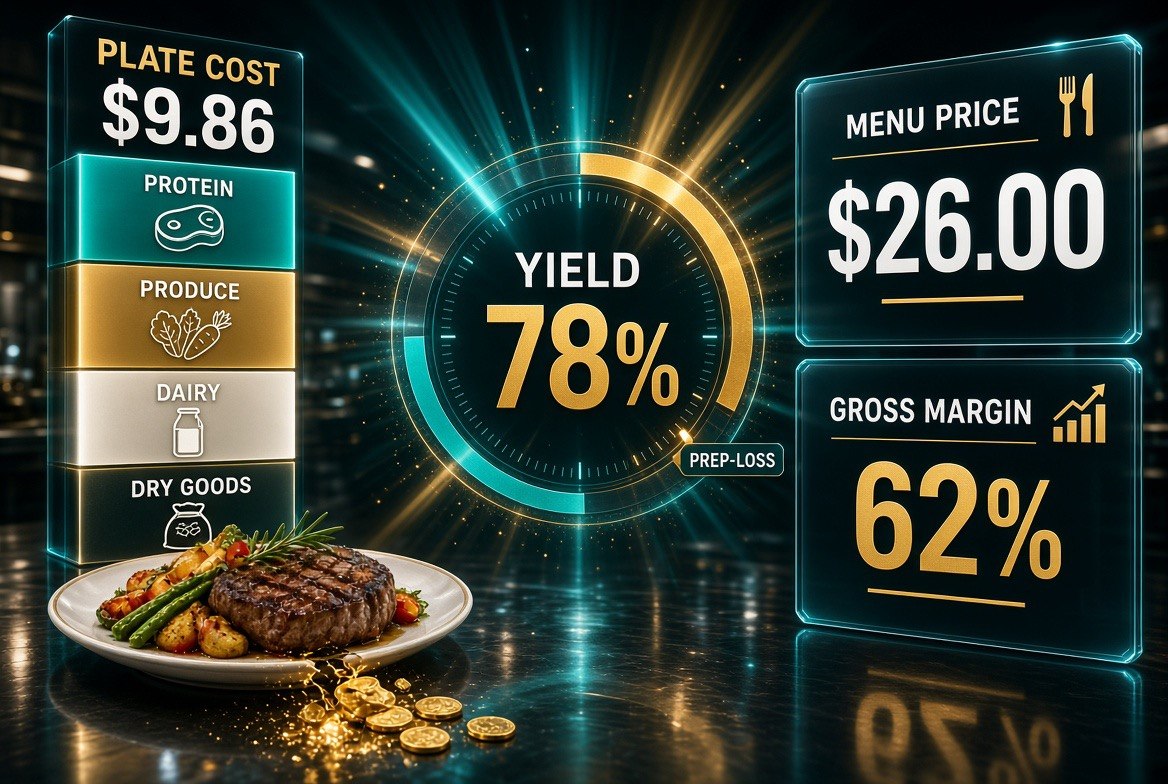
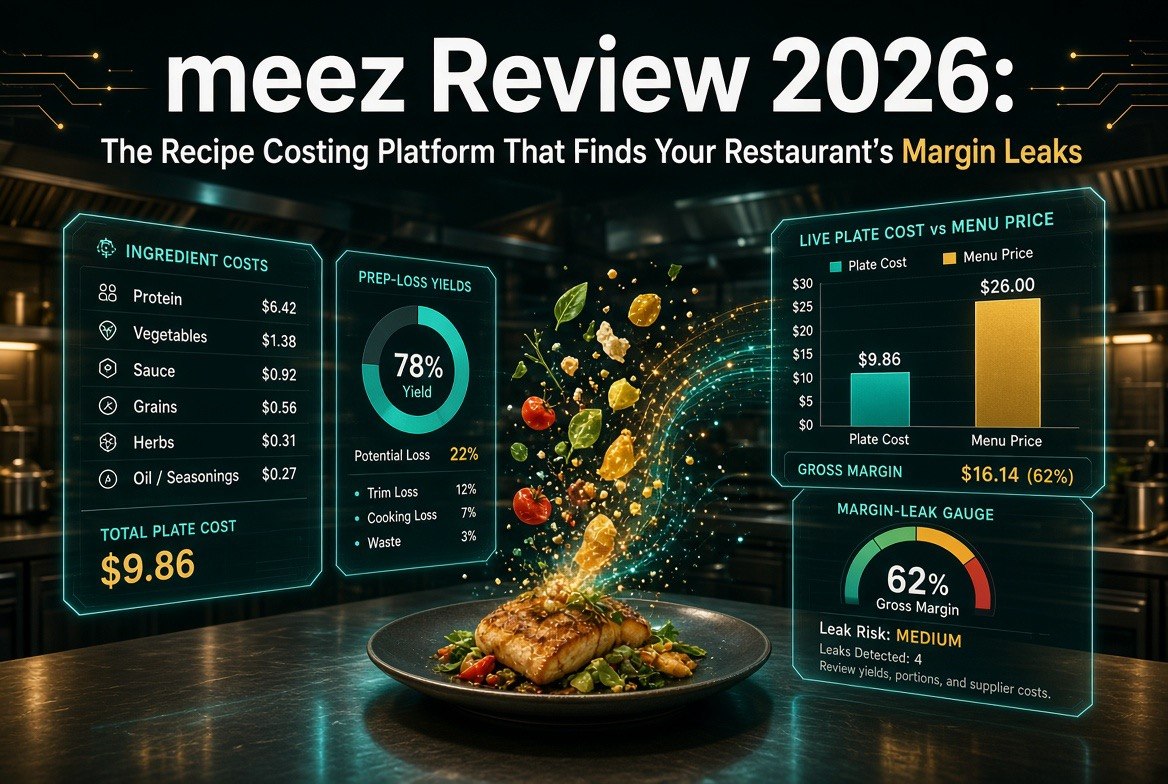
How meez builds a real plate cost: each dish is costed from its actual ingredient quantities at current prices, adjusted for the 78% yield you get after prep loss, then measured against the menu price. On this example the gap between $9.86 in ingredients and a $26.00 menu price is a 62% gross margin — and that is the number a guessing kitchen never actually knows.
What meez Actually Does
meez is recipe software with costing wired through it, not accounting software with a recipe module bolted on. That distinction matters, because it changes what the tool is good at.
The core of the platform is a structured ingredient database of 3,000+ items, and each ingredient ships with built-in yields and unit-of-measure conversions. That means when you build a recipe, the software already knows that your pound of carrots is not all usable yield, and that a gallon of oil converts to the units your recipe actually calls for. You are not maintaining that math by hand, and more importantly, you are not maintaining it differently than the person who worked the station before you.
Getting your recipes in is deliberately low-friction. You paste from almost any file type — Google Docs, PDFs — and the AI importer auto-formats it into a structured recipe. It also handles typed entry with predictive text built off the ingredient database. For operators sitting on a binder of legacy recipes, that removes the biggest reason these projects die: nobody wants to retype 140 recipes by hand.
From there, the functionality stacks in a logical order:
- Recipe scaling: scale by batch, by yield target, or by the quantity of a single ingredient, with unit conversions handled automatically. You need 40 portions, not the 32 the recipe card assumed — the software does that math.
- Yield-aware costing: cost reflects prep loss and conversions, so the number on screen is the real cost per portion rather than an as-purchased approximation.
- Margin calculator: every recipe shows its food cost and margin, so you can see which dishes carry the menu and which ones quietly just take up a slot.
- Automated allergen tagging: allergens populate from the ingredient database, and disclosures update when an ingredient changes — without a second round of manual entry.
- Prep step slideshows: recipes become picture-and-video training documents, which is the mechanism behind the company’s claim of training teams 70% faster.
Where it gets genuinely interesting for a multi-location operator is the costing feed. Connect your back office system — Restaurant365, MarginEdge, MarketMan, Ottimate — and ingredient prices update from your actual invoices on a daily feed. Every recipe that uses that ingredient re-costs itself. You stop maintaining a cost sheet that goes stale the week you build it.
meez is also explicit about what it is not. The company positions itself as complementary to accounting and inventory systems rather than competitive, calling itself the missing culinary data layer. That is a fair description. Restaurant365 and MarginEdge are strong at finance and inventory workflows where recipes are secondary; meez is recipe-first, and hands structured recipe data back upstream. If you already run one of those systems, meez is an addition rather than a replacement — and the integration pricing reflects that.
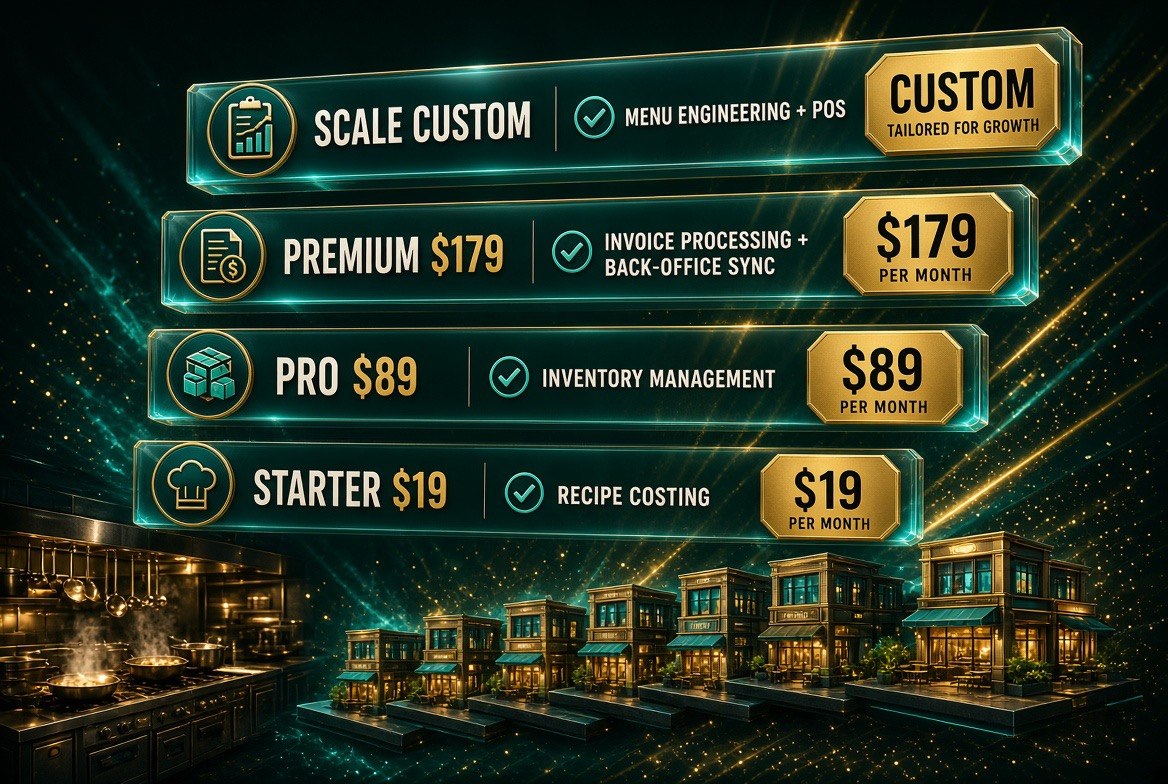
The four published meez tiers. Starter at $19 a month covers recipe costing itself, which is the floor that makes this reachable for a single independent location — Pro at $89 adds inventory management across devices, Premium at $179 brings invoice processing and back-office sync with Restaurant365, MarginEdge, MarketMan and Ottimate, and Scale is custom-priced for multi-unit menu engineering and POS integration.
meez Pricing: What You Actually Pay
Pricing is where most restaurant tech conversations fall apart, so here are the real published numbers, billed annually versus monthly.
| Plan | Annual (per month) | Monthly | Who It Fits |
|---|---|---|---|
| Starter | $19 | $24 | Individual chef or single operator who wants real recipe costs; 2 active devices |
| Pro | $89 | $119 | Single kitchen team focused on training, prep, and basic food costing; 5 devices + inventory |
| Premium | $179 | $199 | Small teams scaling recipe consistency with real-time costing; adds invoice processing + back-office sync + 1 costing feed |
| Scale | Custom | Custom | Multi-location groups: menu engineering, USDA nutrition labels, POS integration, purchase reporting |
The add-ons are where the real cost lives if you go deeper, and you should know them before you assume Starter is the whole story:
- Additional recipe viewer locations: $60/month per location
- Additional costing feed locations: $179/month per unique costing location
- Restaurant365 data sync: $199/month plus a setup fee
- Inventory counting: $50/month per location (requires a cost feed)
- Data warehouse sync / MCP server: from $489/month
- Onboarding help: from $50/hour, 5-hour minimum, or $229/month in dedicated monthly support
There are no setup fees to get going on the standard plans. Setup fees apply only to invoice processing, direct purchase feeds, or back-office recipe sync — the integrations that require real engineering.
The honest read on the numbers: a single independent restaurant with one kitchen of devices can capture most of the value at $19/month. The moment you want invoice-driven live costs rather than the ability to update costs in bulk by spreadsheet, you move to Premium at $179 billed annually — and that is a real jump that deserves a real justification. If your monthly food spend is $20,000, then a genuine 2% cost improvement is $400 a month. That decision is not hard. If your food spend is $4,000 a month, run the spreadsheet import path on Starter first and prove the value to yourself before upgrading.
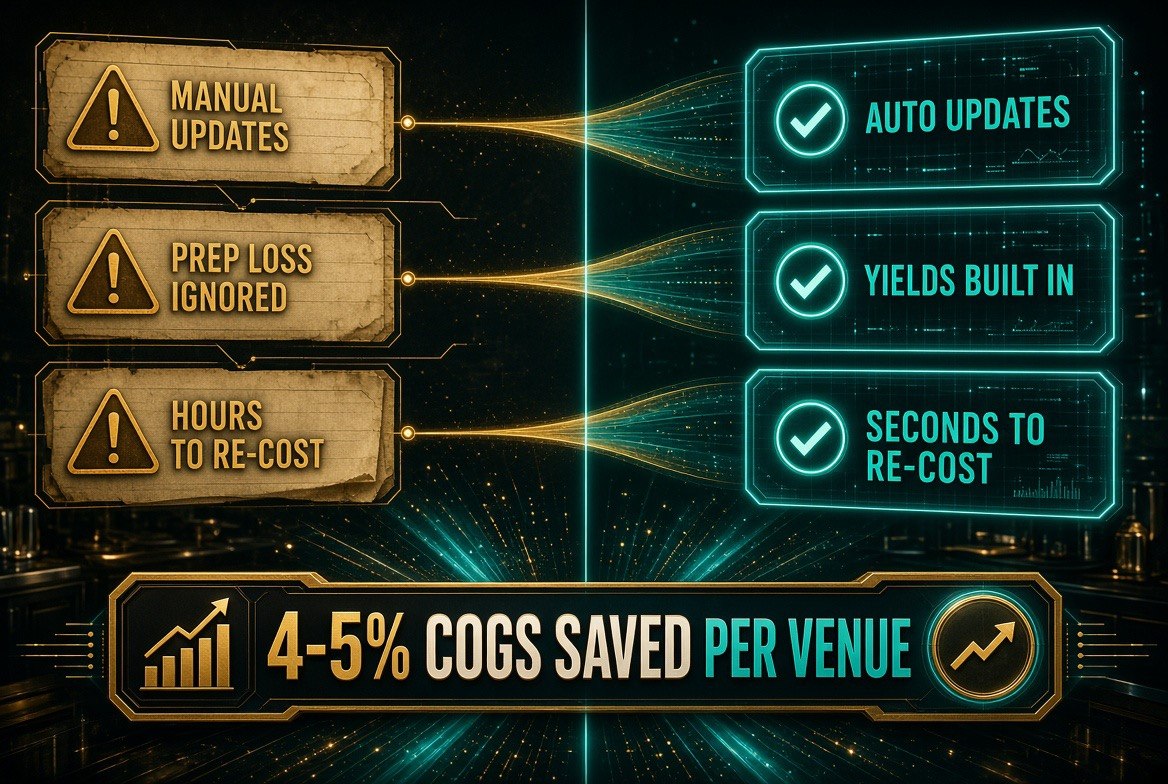
Your real competitor is not another app, it is the spreadsheet you already have. Left column is the status quo — ingredient costs re-entered by hand and stale within weeks, prep loss ignored or reduced to one rough percentage, and hours to re-cost a single recipe. Right column is what meez changes: costs update automatically when a price moves, usable yield is built into the ingredient database, and re-costing takes seconds. Multi-venue operators running this way report holding 4-5% COGS reduction across each venue.
meez vs the Alternatives: Side by Side
This is the comparison that actually decides the question, because you already have a system for recipe costs. It is just called a spreadsheet.
| Factor | Spreadsheets (the status quo) | meez |
|---|---|---|
| Ingredient cost updates | Manual re-entry; goes stale within weeks | Automatic — updates every affected recipe when a price changes |
| Prep loss and yields | Typically ignored or a single rough percentage per item | Built into the ingredient database; cost reflects usable yield |
| Time to re-cost a recipe | Hours per batch, so it happens rarely | Seconds, with no spreadsheet rebuild |
| Cost across multiple locations | Version chaos — nobody knows which file is current | One source of truth; every kitchen reads the same live recipe |
| Staff training | Verbal, inconsistent, lost when someone quits | Visual step-by-step recipes with photos and video |
| Allergen tagging | Manual, error-prone, rarely updated when a recipe changes | Automated from the ingredient database; updates on change |
| Monthly cost, single site | $0 in software, thousands in unmeasured margin drift | $19-24/month for Starter |
The spreadsheet column has one genuine advantage worth naming: it costs nothing, and it already exists. If you have run a profitable restaurant off a well-maintained cost sheet for fifteen years, you have earned the right to keep it. But be honest about the word “well-maintained.” A cost sheet is only as good as the last time somebody updated it, and the reason most of them are stale is structural, not personal — the work of maintaining it is dull, recurring, and invisible until it fails.
The clearest real-world signal on the value comes from a multi-venue operator who reported meez helping hold profits steady through rising costs and inflation, with 4-5% COGS reduction in menu cost across each venue and one concept seeing a 2% reduction in menu cost year over year, while rolling menus and training across 14 locations.
Put that number against your own food spend. On a restaurant doing $350,000 a year in food purchases, a 2% reduction is $7,000 a year — against $228 a year for a Starter subscription billed annually. Even if you capture a fraction of that, the arithmetic is not close.
Where meez Fits and Where It Does Not
This is a tool with a specific shape, and being clear about its limits is more useful than another list of features.
It fits you if: you are a single-location operator who genuinely does not know your per-dish costs and suspects your margins are thinner than your POS suggests. You also fit if you run two to twenty locations and recipe inconsistency is the thing quietly costing you money — different kitchens making the same dish six different ways, with no shared cost truth. And you fit if you are opening another unit: the operator quote about opening two restaurants on the same day, only possible because every recipe was readily available, is the real commercial case for getting recipe data structured before you scale, not after.
It does not fit you if: you are looking for accounting or bookkeeping software. meez is not that, and the company says so itself. If your actual problem is that you do not know whether you made money last month, the answer is a bookkeeping system, not a recipe platform. It also does not fit if your menu is genuinely small and stable — a focused counter-service concept with fifteen items that change twice a year can maintain a cost sheet by hand and not feel it. And it does not fit if nobody in the building will actually log in. A recipe platform with no adopted recipes is a subscription, not a system, and adoption is the precondition for every number in this article being true for you.
There is also one small operational note worth flagging: meez currently runs in the browser on computer, tablet, and mobile, and there is not yet a native iOS or Android app. For a kitchen that wants line cooks pulling recipes up on a phone, the mobile browser experience works but is worth testing on your own devices during a trial rather than assuming.
The Bottom Line for Independent Restaurants
Restaurant tech has spent two years selling you things that touch the guest — voice agents answering the phone, kiosks taking the order, loyalty programs chasing the return visit. All of that matters. None of it fixes a menu where two or three high-volume dishes are priced off a cost sheet that has not been true since last spring.
That is why meez is worth an hour of your attention even though it is not news. It is a boring, useful tool aimed at the least glamorous number in your restaurant: the real cost of a plate. The platform carries a 3,000+ ingredient database with built-in yields and conversions, automated allergen tagging, visual training recipes, and — at the Premium tier and above — invoice-driven cost feeds that keep every recipe current without anyone opening a spreadsheet.
The practical path, if you want to test this without committing much: start with the $19/month Starter plan billed annually, load the ten dishes that drive most of your revenue — not all 140, just the ten — and cost them properly with real yields. Bring the numbers to your next weekly meeting. If the per-dish costs match what you believed, you have spent $19 and confirmed your instinct. If they do not match, you have just found the leak, and you found it for less than the cost of one case of protein.
Three questions decide whether any costing tool is worth paying for. Does it use real yields instead of as-purchased prices? Does it update itself when prices move, or do you have to remember to? And will your chef actually use it on a Friday night? meez answers the first two with its ingredient database and invoice feeds. The third is on you — and it is the only one that ultimately decides whether you keep the margin or hand it back one plate at a time.
Frequently Asked Questions
What is meez and what does it do for a restaurant?
meez is recipe management and food costing software used by more than 35,000 culinary professionals. It stores recipes in a structured, searchable format, calculates real cost per portion using built-in yields and unit conversions from a database of 3,000+ ingredients, scales recipes by batch or ingredient quantity, automates allergen tagging, and turns recipes into visual training documents for kitchen staff.
How much does meez cost for an independent restaurant?
The Starter plan is $19 per month billed annually or $24 month-to-month, covering unlimited recipes, AI recipe import, the ingredient database, recipe scaling, automated yield calculations, and a recipe margin calculator for an individual chef or single operator with 2 active devices. Pro is $89 per month annually for a single kitchen team with inventory management and 5 devices, and Premium is $179 per month annually with invoice processing, back-office sync, and one costing feed.
How is meez different from a spreadsheet for recipe costing?
A spreadsheet requires manual re-entry and goes stale within weeks, and it rarely accounts for prep loss. meez uses an ingredient database that carries built-in yields and unit conversions, so cost reflects usable yield rather than as-purchased price, and it updates every affected recipe automatically when an ingredient price changes. Re-costing a recipe takes seconds instead of hours.
Is meez accounting or inventory software?
No. meez describes itself as complementary rather than competitive with accounting and inventory systems, calling itself the missing culinary data layer. It connects to back-office platforms like Restaurant365, MarginEdge, MarketMan, and Ottimate to pull in purchase costs, but its core is recipe-first: structured recipes that produce accurate costing and consistent execution. Operators who need bookkeeping still need a bookkeeping system.
How do I get my existing recipes and costs into meez?
There are three ways to load recipes: copy and paste from almost any file type including Google Docs and PDFs so the AI importer auto-formats them, type them with predictive text built off the ingredient database, or have the meez team upload them for you as a paid service. Purchase costs can be added per ingredient, imported in bulk from a spreadsheet template, digitized through invoice processing, or pulled automatically by connecting a back-office system.
Does meez work for a single-location independent restaurant?
Yes, and that is where the Starter plan makes the most sense. A single-location operator who does not know their true per-dish costs can start at $19 per month billed annually, load only the highest-revenue dishes rather than the full menu, and cost them properly with real yields. The platform is built for teams running more than one location, where recipe inconsistency across kitchens is expensive, but multi-location support is an advantage rather than a requirement.

About Barak Schurr
Barak Schurr built and exited a major ticketing platform, ran global operations at Eventbrite, and now focuses on one question: which AI tools actually help independent restaurant owners run leaner and grow faster. He writes from the operator’s perspective — no vendor spin, no theory, just what’s real in 2026.
Email: [email protected]
More AI Restaurant Resources