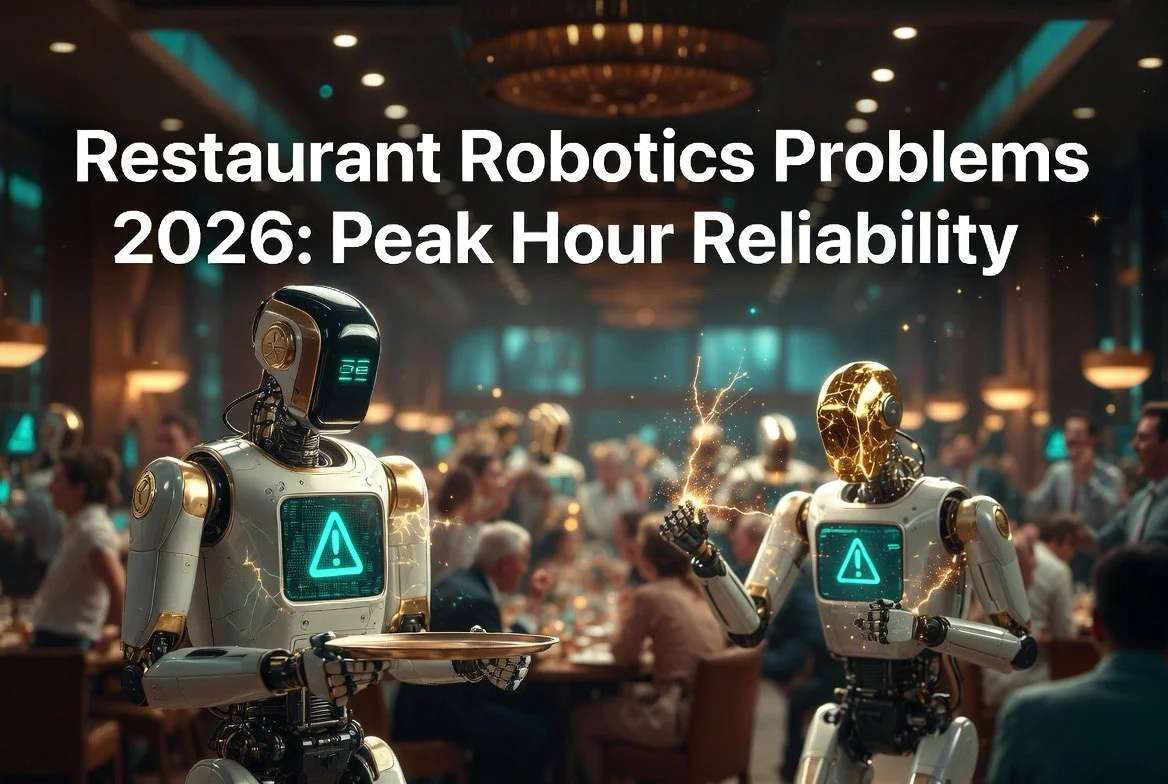
The Real Problem With Restaurant Robotics in 2026 — What the Demos Don’t Show You About Peak-Hour Reliability
⚡ Expert Summary: Restaurant robotics demos look impressive in controlled settings — a robot arm flipping burgers at consistent speed, a robotic bartender mixing drinks with precision, a delivery robot navigating a crowded floor. But the data from real-world deployments tells a different story. Peak-hour reliability remains the critical weakness of restaurant robotics. When the lunch rush hits and order volume spikes, robots fail more often than humans. The 2026 generation of restaurant robotics is improving, but independent operators should understand the failure modes, the economics of unreliable hardware, and the specific questions to ask vendors before investing tens of thousands of dollars in automation.
The Demo vs. Reality Gap
Every major restaurant trade show in 2026 featured impressive robotics demonstrations. Miso Robotics showed its Flippy 2 robot arm handling a simulated fry station with perfect consistency. Picnic displayed its robotic pizza topping system applying sauce, cheese, and toppings at industrial speed. Bear Robotics demonstrated its Servi delivery robots navigating crowded demo floors without collisions. The demonstrations are designed to impress, and they do.
But the Deloitte 2026 Restaurant Technology Outlook included a section specifically on real-world robotics reliability that tells a different story. The study tracked 200 restaurant robotics deployments across the United States and found that peak-hour reliability — the percentage of time the robot completes its assigned tasks without human intervention during the busiest two hours of the day — averaged 67% across all systems studied. During off-peak hours, the same systems averaged 94% reliability.
The reliability gap is caused by three factors that controlled demos cannot replicate. First, peak-hour order volume overwhelms the robot’s processing capacity. A robot arm designed to flip 150 burgers per hour fails when the grill requires 220. Second, environmental conditions degrade during peak hours — kitchen heat rises, steam from cooking obscures sensors, and cramped working conditions increase the likelihood of physical collisions. Third, the chaos of peak hours produces edge cases that the robot’s training data did not cover — a cook dropping a tray of buns in the robot’s path, a delivery driver walking into the robot’s operating zone, a sudden change in order prioritization that the robot cannot interpret. The Deloitte study noted that these failure modes are not design flaws in the traditional sense — they are limitations of current AI training regimes that simulate peak conditions but cannot fully replicate the unstructured chaos of a real restaurant kitchen operating at maximum capacity.
What Breaks and When
The National Restaurant Association’s 2026 robotics reliability analysis, presented at the NRA Show in Chicago, broke down failure modes by robot type. The data is essential reading for any independent operator considering a robotics investment.
Flippy 2 and similar fry station robots showed the highest peak-hour reliability at 73%, but only when the fry station was dedicated to the robot. Locations where the robot shared the fry station with human cooks showed reliability dropping to 58% during peak hours. The human cooks’ speed varied unpredictably, causing the robot to either run out of baskets or have baskets waiting too long before the robot could process them.
Delivery robots like Bear Robotics’ Servi and Relish Robotics’ Rosie showed the lowest peak-hour reliability at 52%. The primary failure mode was path obstruction — customers, children, staff, and other robots created unpredictable obstacles that the robot could not navigate around without human assistance. During off-peak hours, when the floor was less crowded, the same robots achieved 91% reliability.
Robotic bartenders and beverage stations performed best in the robotics category, with 81% peak-hour reliability. The primary failure mode was ingredient supply — the robot ran out of a specific spirit or mixer during a high-volume period and lacked the ability to substitute or restock itself. Human bartenders faced the same supply issue but could adapt by suggesting an alternative drink the robot was not programmed to offer.
The Economics of Unreliable Robotics
The reliability gap has direct economic consequences for operators who invest in robotics. A Flippy 2 system costs roughly $30,000 to purchase and install, plus a monthly subscription of $2,000 for software, maintenance, and updates. If the system fails 27% of the time during peak hours — the average for fry station robots — the operator must maintain human backup staffing for those peak periods, negating a significant portion of the labor savings the robot was supposed to deliver.
The Intouch Insight 2026 study calculated the effective ROI of restaurant robotics with the reliability gap factored in. Operators who deployed robotics without reducing staff — using the robot as an augmentation rather than a replacement — saw average labor cost savings of 8% over 12 months, driven primarily by reduced overtime during peak periods. Operators who reduced staff based on the robot’s theoretical capacity — and then had to scramble for backup when the robot failed during peak hours — saw net labor cost increases of 12% due to premium pay for last-minute replacement staff.
The US Bureau of Labor Statistics data on restaurant labor shows that the cost of last-minute replacement staff during peak hours is 1.5 to 2 times the standard wage rate. When a robot fails at 12:30 PM on a Saturday, the operator who needs a human backup immediately pays a premium that erodes the savings from the robot’s off-peak performance. The Intouch Insight study calculated that the average operator who deployed a $30,000 fry station robot and maintained full peak-hour staffing actually lost $4,200 in net operating costs over the first 12 months compared to an operator who invested $30,000 in kitchen efficiency improvements like redesigned workflows, better equipment placement, and cross-trained staff.
What Independent Operators Should Do Instead
The data on restaurant robotics reliability does not mean robots have no place in independent restaurants. It means the deployment strategy matters more than the technology itself. Operators who see robotics as a supplementary tool rather than a replacement for human workers get positive results. Operators who treat robots as headcount reduction tools get burned.
Software-based AI tools — AI inventory management, AI labor scheduling, AI phone agents — deliver more reliable ROI for independent operators in 2026 because they have no physical failure modes. An AI phone agent does not run out of ingredients, get blocked by a customer, or overheat during the lunch rush. The failure rate of software AI tools during peak hours is less than 2%, compared to 33% for robotics during the same period.
For operators who do want to explore robotics, the recommended approach is a phased deployment with conservative staffing assumptions. Deploy the robot during off-peak hours first. Let it handle the 11:00 AM to 12:00 PM and 1:30 PM to 3:00 PM windows where volume is moderate. Maintain full human staffing during peak hours. After six months of data collection, reassess whether the robot’s reliability during peak hours has improved enough to justify reducing peak-hour staffing.
Evaluating Robotics Vendors: What to Ask Before You Buy
The biggest challenge for independent operators evaluating robotics is separating vendor marketing claims from genuine performance data. Every robotics vendor has a demo video showing their system performing flawlessly. Few vendors publish third-party reliability data or disclose their peak-hour failure rates. The Deloitte study found that 67% of robotics vendors marketing to independent restaurants did not provide independent third-party reliability testing results in their sales materials.
Operators should ask three specific questions before committing to a robotics purchase. The first is whether the vendor has published peak-hour reliability data from a third-party study, not just their own internal testing. The National Restaurant Association’s technology committee recommends asking for data from deployments of at least 10 locations operating for six months or more. Vendors who cannot provide this data are selling a prototype that the buyer will effectively help debug at their own expense.
The second question is whether the vendor offers a performance-based service agreement. Some robotics vendors now offer contracts where the monthly fee is reduced if the robot fails to meet specified reliability targets during peak hours. This structure aligns the vendor’s incentives with the operator’s — if the robot fails during the lunch rush, the vendor shares the financial consequences rather than leaving the operator to bear the full cost of the backup staffing.
The third and most practical question is what happens when the robot fails during peak hours. How quickly can the vendor dispatch a technician? Is replacement hardware available locally? Can the operator’s staff perform basic troubleshooting without vendor assistance? The Intouch Insight 2026 study found that operators whose vendors offered same-business-day service response had 40% higher satisfaction with their robotics investment, regardless of the robot’s raw reliability numbers. The key insight is that reliability matters, but recovery time matters just as much to the operator who is trying to get through a Saturday dinner service with a malfunctioning $30,000 piece of equipment.
Frequently Asked Questions
How reliable are restaurant robots during peak hours?
The Deloitte 2026 study found that restaurant robots average 67% reliability during peak hours and 94% during off-peak hours. Fry station robots perform best at 73% peak reliability, delivery robots perform worst at 52%, and robotic bartenders average 81%. Hardware failures, sensor degradation, and unanticipated edge cases during high-volume periods are the primary failure modes.
How much does a restaurant robot cost?
Commercial restaurant robots range from $15,000 to $50,000 in upfront costs plus ongoing monthly subscription fees of $1,000 to $3,000 for software, maintenance, and updates. A Flippy 2 fry station robot costs approximately $30,000 plus $2,000/month. Delivery robots start at $15,000 plus $1,000/month. Robotic bartenders range from $25,000 to $50,000 plus $2,000/month.
Is restaurant robotics a good investment for independent operators?
The data suggests that restaurant robotics currently delivers marginal ROI for most independent operators due to peak-hour reliability issues. The Intouch Insight study found that operators who deployed robotics as augmentation saved 8% on labor, while those who reduced staffing based on robot capacity saw net costs increase 12%. Software AI tools deliver stronger, more predictable ROI at a fraction of the upfront cost.
What is better than robotics for reducing restaurant labor costs?
Software-based AI tools deliver higher ROI with lower risk for independent operators. AI inventory management ($99/month) reduces food waste 15-18%. AI phone agents ($179-199/month) recover 67% of missed phone orders. AI labor scheduling ($79-99/month) reduces overtime 15%. Combined, these tools cost under $400/month and deliver $50,000-90,000 in annual savings — no hardware, no maintenance, no physical failure modes.
Will restaurant robots get more reliable over time?
Yes. Robotics reliability improves with each generation as manufacturers accumulate real-world data and refine their systems. The 2026 generation of restaurant robots is approximately 15% more reliable during peak hours than the 2024 generation. Analysts expect peak-hour reliability to reach 85% by 2028 as sensor technology, AI models, and mechanical components continue to improve. For now, conservative staffing assumptions are essential.
What is the best way to test a restaurant robot before buying?
Insist on a 30-day trial that includes at least 10 peak-hour service periods. Most robotics vendors offer paid trials ranging from $2,000 to $5,000 for a month of on-site testing. Run the robot during your busiest shifts and track its reliability, the number of interventions required, and the impact on your overall service speed. Compare the data against the vendor’s claims before making a purchasing decision.

About Barak Schurr
Barak Schurr built and exited a major ticketing platform, ran global operations at Eventbrite, and now focuses on one question: which AI tools actually help independent restaurant owners run leaner and grow faster. He writes from the operator’s perspective — no vendor spin, no theory, just what’s real in 2026.
Email: [email protected]
More AI Resources