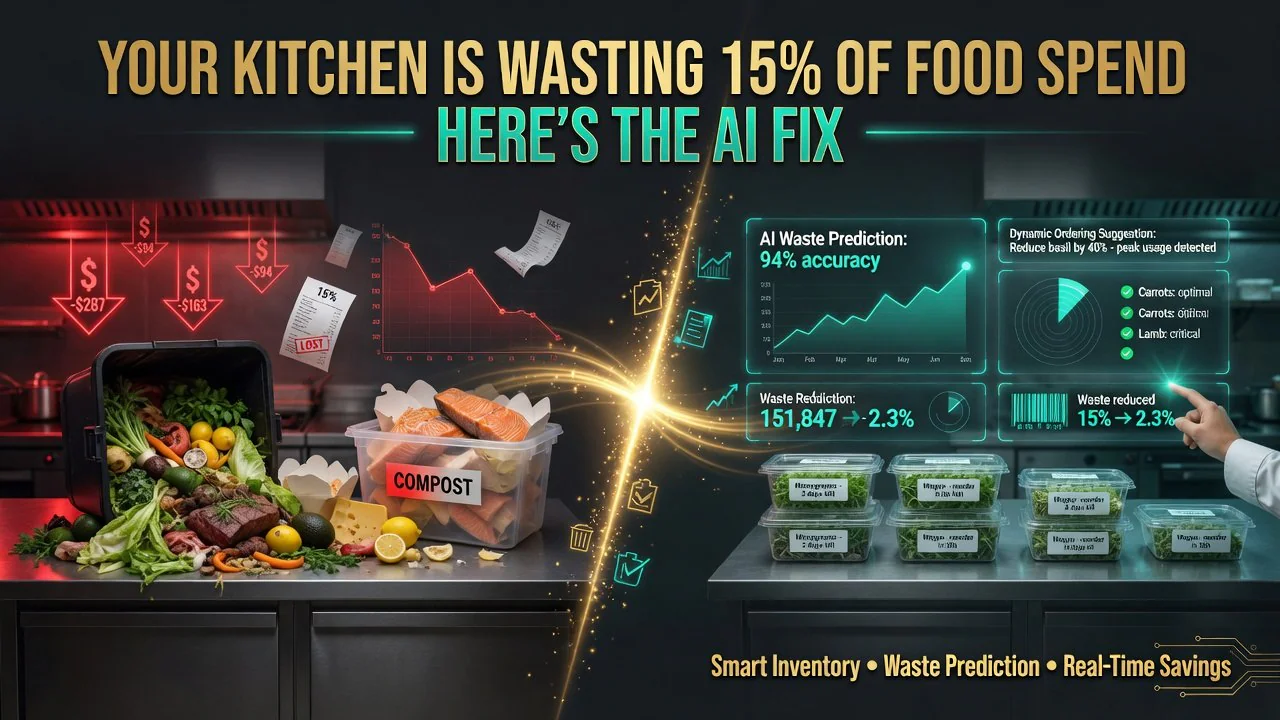
Your Kitchen Is Wasting 15% of Food Spend — Here’s the AI Fix
⚡ Expert Summary: Key Takeaways
- Restaurants waste 10-15% of food spend on average — with up to 80% of that waste being preventable through AI inventory management and predictive ordering systems.
- AI inventory tools reduce food waste by 40-60% by tracking shelf life, predicting demand by day and season, and generating optimized order quantities that minimize spoilage.
- Computer vision systems in smart fridges and storage areas automatically track inventory levels in real time — flagging expiring items and suggesting usage priorities before food goes bad.
- The average independent restaurant saves $15,000-40,000 per year after implementing AI food waste reduction tools — with most systems paying for themselves within 60-90 days.
- The bottom line: Your kitchen is wasting 15% of what you buy — AI inventory management stops that leak without changing your menu or portion sizes.
Most restaurant operators don’t see food waste as a technology problem. They see it as a kitchen problem — portion sizes, prep errors, overordering, the line cook who doesn’t rotate stock, the prep cook who overproduces on slow days, the server who doesn’t check pars before running to the walk-in. They assume the solution is more training, better supervision, or a stricter manager watching inventory like a hawk.
But here’s the thing: those are management problems wearing operational clothes. And AI now solves them better than any manager or chef can, because it tracks what actually happens — not what you think happens, not what the staff reports, not what the inventory sheet says when it’s filled out at the end of a 14-hour shift. AI tracks the truth, dish by dish, ingredient by ingredient, shift by shift. It sees patterns no human can see because no human has the time or the patience to track 40 menu items across 14 shifts per week across 200 individual ingredients.
The Real Cost of Food Waste
Let’s start with what this actually costs you. The average restaurant loses 4-10% of total revenue to food waste. Not to the cost of goods sold. Not to the ingredients that go into dishes that customers pay for. To waste — food that walked into your restaurant and left through the trash. For a restaurant doing $1.5M annually, that’s $60,000-150,000 lost every year. Not to spoilage in any single obvious batch that would catch your attention. Not to a dropped case of tomatoes that you write off as a bad night. To waste that doesn’t register because it happens in small increments — a quarter cup of sauce here, half a portion of fries there, six ounces of protein that didn’t make it to the plate.
The National Restaurant Association estimates that food waste costs the US restaurant industry $57 billion annually. The average full-service restaurant discards 8-12% of the food it purchases. That’s $30,000-50,000 per year on a $1.5M revenue restaurant — every dollar of which sits above your cost of goods sold. It is pure loss. You paid for the ingredient. You paid for the labour to prep it. You paid for the energy to store it. And then you threw it away.
The World Wildlife Fund has done extensive research on restaurant food waste and found that more than 80% of waste is preventable. That means the food you throw away is not random spoilage from bad luck. It is a systematic problem caused by how you order, how you prep, how you portion, and how you schedule production. Every one of those variables is something you control.
Why Traditional Solutions Do Not Work
The standard response to food waste is “train staff better.” Every operator has tried this. You talk about portion control in the morning meeting. You post par sheets on the wall. You tell the new line cook to stop overfilling the fry basket. You write a note about FIFO rotation and tape it to the walk-in door.
And two weeks later, waste is back where it started. Because training doesn’t track what is happening in real time. Training is a one-time input that degrades over time as staff turnover hits, new people come in, and old habits reassert themselves. Training also depends on people noticing waste in the moment — which they don’t, because they are busy cooking dinner for 80 people.
The core problem is visibility. You cannot manage what you do not measure, and most restaurants do not measure food waste at all. They guess. They estimate. They look at the P&L at the end of the month and see that food cost is higher than it should be, but they cannot tell you whether the problem is waste, theft, overportioning, or supplier pricing.
Training doesn’t tell you which menu item has the highest waste per plate. It doesn’t flag that your Tuesday supper club produces 40% more waste than your Wednesday regular service because of one menu item’s unique prep requirements. It doesn’t show you that your weekly fish order has been 25-30% too high for the last two years because you are ordering for a Friday that never materialises. It doesn’t tell you that the walk-in temperature rises 3 degrees during lunch service because the door opens 40 times, and that one degree of variance reduces dairy shelf life by a day.
That kind of visibility requires data — the kind no human is collecting at scale. Not because they don’t want to, but because tracking individual ingredient waste for 40 menu items across 14 shifts per week is a full-time job that nobody has budget for. You would need three hours a day of a manager’s time to track waste manually. Your manager already does not have three hours for everything else on the to-do list.
What AI Actually Does in Your Kitchen
AI inventory systems track every ingredient from delivery to plate. They connect to your POS, your inventory management system, and your waste tracking process, and they compare what you ordered against what you sold against what you threw away — automatically, without anyone filling out a spreadsheet.
Here is what the output looks like in practice. After two weeks of AI tracking, you get a report that tells you:
– Which menu items have the worst yield ratio. Your signature appetiser accounts for 12% of sales but wastes 21% of its ingredient cost because of how it is prepped. The yield on that dish is 79% — 21 cents of every ingredient dollar goes into the trash. You did not know this because you never tracked waste by plate. Every other menu item in that category runs at 88-92% yield. One dish is bleeding margin.
– Which dayparts produce the most waste. Friday lunch waste is 5% of food cost. Tuesday lunch waste is 15%. The gap traces back to one prep cook who overproduces on Tuesday mornings because they learned the production schedule from a previous chef who ran a higher-volume concept. AI catches patterns that human observation misses because it tracks data across shifts, not across what one person remembers happening two weeks ago.
– Which suppliers give you the shortest shelf life. The romaine from Vendor A lasts 4 days on average before it wilts. The same product from Vendor B lasts 6 days. The price difference is negligible — 15 cents per case. The waste difference is 50%. You switch vendors, and one supply chain change reduces your total produce waste by 12%. That is $6,000 a year saved by changing nothing except which supplier gets your weekly order.
– When your pars are consistently wrong. The AI notices that your chicken tender par level is set for a 40-cover Saturday — every day of the week. Your actual Saturday traffic averages 28 covers. You have been overordering 42% on chicken tender inventory every single day for months. The fix takes two minutes. The savings are $200 per week.
– Which staff members correlate with higher waste. The AI does not name names, but it shows waste patterns by shift. You notice that lunch shifts with Staff Member A consistently produce 15% more waste than lunch shifts with Staff Member B. Same menu. Same prep. Same par levels. The difference is in technique. Now you know who needs retraining and who should be training others.
One independent operator in the Midwest cut waste by 22% in eight weeks after implementing AI tracking. The system flagged that their Tuesday fish order was consistently 30% higher than Tuesday sales. The supplier minimum was set to a quantity that matched the busiest day of the week, not the actual Tuesday traffic. The fix was trivial — they called the supplier and dropped the minimum from 25kg to 18kg. No human caught that in two years because no human was looking at Tuesday fish sales versus Tuesday fish waste as a data set. They were ordering what they always ordered because that is how the system was set up.
Another operator discovered that 18% of their most popular salad prep was ending up in the compost bin. The reason: the prep cook was portioning salad for the largest bowl size — the 12-inch platter that accounts for 15% of salad sales — while the 8-inch bowl, which accounts for 65% of sales, requires 40% less dressing and fewer toppings. The kitchen was prepping for a customer that mostly did not exist. When they adjusted the prep standards to match actual sales mix, salad waste dropped by half in the first week.
A third operator found that their walk-in cooler had a temperature spike between 11am and 1pm every day — the door was opening 50+ times during the lunch rush, and the cooler was too small to recover. Dairy products that should have lasted 7 days were spoiling in 4. The fix was not a new cooler. It was reorganising the walk-in so that high-turnover items were near the door and low-turnover items were in the back, reducing the time the door stayed open. The AI detected the temperature pattern. A human would have noticed only after the third dairy order went bad.
The Real-World Setup
You do not need a full technology stack overhaul. You need one AI layer on top of your existing POS and inventory management system. The tools that do this are designed to sit on top of what you already own. They connect to your existing systems and start analysing from the data you already have sitting in your POS.
Winnow is the market leader in kitchen waste tracking, used by major hotel chains and independent operators across 40 countries. Their system uses a connected scale and camera setup that tracks what goes into the waste bin and matches it to your menu items. Compass and Galley focus more on the inventory and purchasing side, connecting to your supplier system and POS to give you end-to-end visibility from order to waste bin. All three integrate with Toast, Square, Micros, and Aloha. Setup takes days, not months.
The cost is $200-500 per month for a single location, depending on the depth of tracking. The payback period is under 12 weeks. Three months to recover the investment and start saving $20,000-50,000 per year per location. That’s a 5-10x annual return on investment for most operators.
Three Specific Changes AI Makes in the First Four Weeks
1. Par optimisation. Every kitchen operates on pars — predetermined stock levels you maintain for each ingredient. Most par levels are set once when the menu launches and adjusted only when a problem becomes obvious enough that someone acts. AI adjusts par levels dynamically based on historical sales, day of week, seasonality, weather, local events, and your actual usage rate. No more ordering for a full Tuesday when you only do 40 covers. No more chicken tender pars designed for a Saturday that happens once a month.
2. Menu engineering for yield. If a dish consistently wastes 18% of its ingredients and accounts for only 5% of sales, AI flags it with a specific recommendation. You have three options: adjust the portion size to reduce waste, change the prep method to improve yield, or remove the item from the menu if the waste-to-revenue ratio is unsalvageable. Most operators adjust the portion and recover 60-70% of the waste within two weeks. The menu item stays, customers do not notice, and the margin improves.
3. Supplier scoring. AI tracks which suppliers deliver items with the shortest usable shelf life. It builds a real-time scorecard for every supplier based on freshness at delivery, shelf life achieved in your kitchen, and delivery accuracy. You switch your herb supplier from the one whose basil dies in two days to the one whose basil lasts five. The cost difference is 8%. The waste reduction on fresh herbs is 60%. You start saving money on everything that spoils faster than it should — and the AI tracks this in real time so you know when a supplier’s quality drops.
Why This Matters More in 2026 Than It Did in 2020
Food costs have risen 20-30% across most categories since 2020. The same waste percentage that cost you $40,000 in 2020 costs you $55,000 today. You are losing more money to the same percentage of waste because the underlying cost of ingredients is higher. Every point of food cost reduction is worth more than it was five years ago.
On top of that, labour costs have risen faster than menu prices in most markets. You cannot cut your way to profitability on labour alone anymore — you have already cut as much as you can without hurting service. The operators who survive the current margin compression will be the ones who control every cost line. And food cost is the biggest controllable line after labour.
Add to that the fact that customers are more price-sensitive than they were in 2020. You cannot simply raise menu prices to cover waste. If you are throwing away 10% of what you buy, that 10% has to be recovered through higher menu prices — prices that are already pushing against what the market will bear. Cutting waste lets you keep prices competitive while improving margin. That is a structural advantage that compounds over time.
The Bottom Line
Food waste is not a kitchen problem. It is an information gap. You are making purchasing decisions based on last week’s memory when AI can give you this week’s prediction based on 12 months of your own data. The gap between what you think is happening in your kitchen and what is actually happening is the difference between leaving $50,000-150,000 on the table and recovering it.
Most operators recover their investment in three months and keep saving $25,000-50,000 per location per year after that. The tools exist. The integration is simple. The data is already sitting in your POS.
The only question is whether you keep losing that money until you decide to track what is actually happening in your kitchen.
Get the full breakdown on AI for restaurants — including 500+ tested prompts for operations, marketing, finance, and kitchen management.
What is the cheapest AI tool for reducing restaurant food waste?
For restaurant operators across the United States who are serious about protecting their margins, AI-powered food waste tracking is no longer optional — it is becoming a competitive requirement. American independent restaurants that implement these systems are consistently outperforming their peers on food cost percentages.
FAQ
How much money can AI food waste tracking save a restaurant?
Independent restaurants using AI food waste tracking typically save 8-15% on food costs within the first 90 days. For a restaurant doing $500,000 in annual food purchases, that translates to $40,000-$75,000 per year in recovered margin. The US restaurant industry overall wastes an estimated $162 billion in food annually.
What is the best AI food waste system for small restaurants?
For independent US restaurants, Winnow leads the market with computer vision systems that automatically identify what is being thrown away. Leanpath offers a more hands-on digital scale approach. For smaller budgets, Kitro provides a lighter-weight solution. The best choice depends on your kitchen volume and budget.
How long does it take to set up AI food waste tracking?
Most AI food waste systems can be installed and operational within one to three days. Hardware setup involves placing cameras or scales near waste bins, and software configuration takes a few hours. American restaurants typically see actionable data within the first week of operation.

About Barak Schurr
Barak Schurr built and exited a major ticketing platform, ran global operations at Eventbrite, and now focuses on one question: which AI tools actually help independent restaurant owners run leaner and grow faster. He writes from the operator’s perspective — no vendor spin, no theory, just what’s real in 2026.
Email: [email protected]
More AI Resources