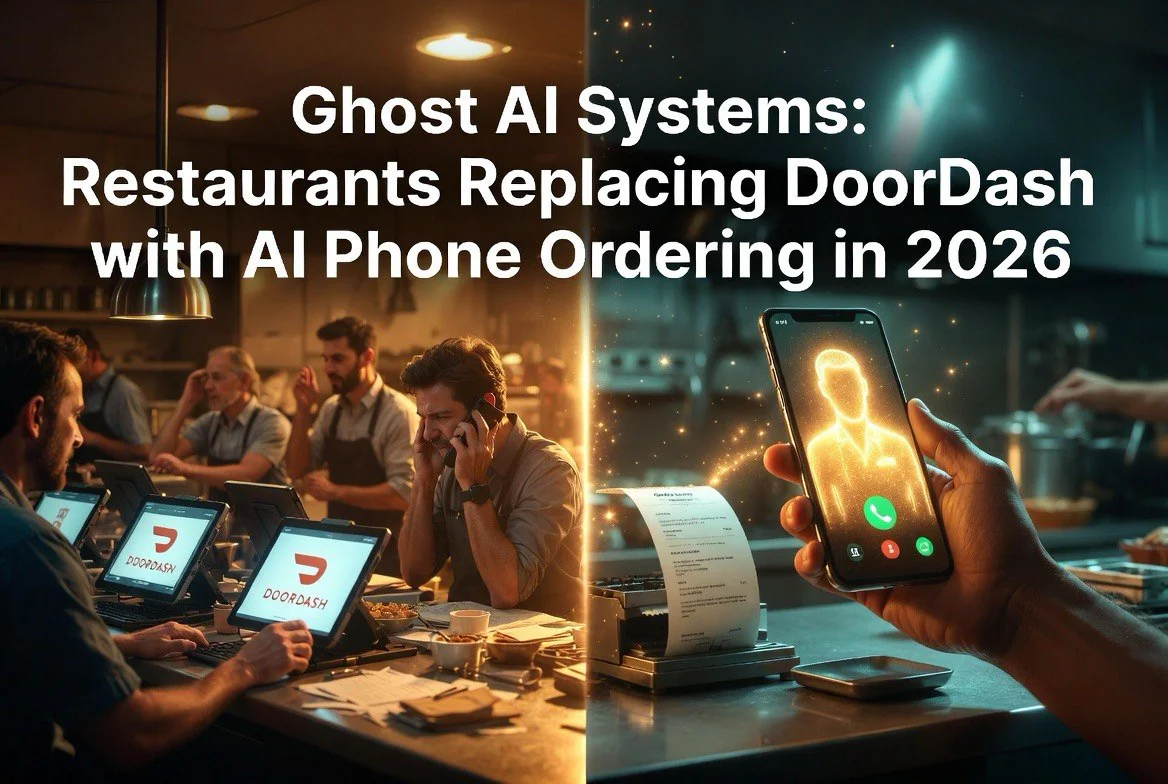
Ghost AI Systems: Restaurants Replacing DoorDash With AI Phone Ordering in 2026
⚡ Expert Summary: A restaurant replaced DoorDash and Uber Eats with an AI phone ordering agent in 72 hours, saving $34,000 per month in delivery commissions while increasing orders by 48%. Ghost AI Systems, VoxOrder, and ChefCall are leading a shift where restaurants bypass third-party delivery platforms entirely by using voice AI to take orders directly. Here is how this works and what it means for independent operators.
Third-party delivery platforms take 25-30% of every order. They own your customer relationship. They decide when you appear in search results. They change their fee structure whenever their shareholders demand it.
And until 2026, you had no real alternative.
That is changing. A growing number of restaurants are dropping DoorDash and Uber Eats entirely and replacing them with AI phone ordering agents that take orders directly, route them to the kitchen, and remember customer preferences — all without paying commission on a single transaction.
Ghost AI Systems, one of the leading providers in this space, recently documented a case where a restaurant deployed its AI phone agent in 72 hours and eliminated $34,000 per month in delivery platform fees. Orders increased by 48%. The restaurant kept every dollar of every order.
For independent restaurant owners in the United States watching 30% of their delivery revenue disappear to platforms, this is the most important technology trend of 2026.
How AI Phone Ordering Works
The technology is straightforward. An AI voice agent answers incoming phone calls, takes orders conversationally, routes them directly to the kitchen display or POS system, and handles payment processing — all without human involvement.
The AI can handle multiple calls simultaneously, operate 24 hours a day, and remember customer preferences from previous orders. A regular customer who always orders the same dish with a specific modification does not need to repeat themselves. The AI knows.
Integration with existing POS systems is the critical factor. Solutions like Ghost AI Systems, VoxOrder, and ChefCall connect to Toast, Square, Clover, and other major POS platforms. When an order is placed, it appears in the kitchen queue the same way a walk-in or online order would, with no additional steps.
The deployment timeline matters. Ghost AI Systems claims a 72-hour setup from first call to live orders. That is faster than signing up for a new delivery platform partnership, which typically takes 1-2 weeks for approval, menu upload, and integration testing.
The $34,000 Math
The economics of AI phone ordering become clear when you run the numbers on delivery platform fees.
According to the Ghost AI Systems case study, the restaurant was generating approximately $113,000 per month in delivery platform revenue through DoorDash and Uber Eats. At an average commission rate of 28-30%, the platforms were taking roughly $31,600-34,000 per month in fees.
The restaurant’s actual cost for the AI phone ordering system: approximately $1,500-3,000 per month depending on call volume and features.
That is a 90% reduction in order-taking costs. The $34,000 that previously went to delivery platforms stays in the restaurant’s P&L.
And the 48% order increase is not a rounding error. When restaurants stop routing customers through delivery platforms and start taking orders directly, several things happen. Customers who previously ordered through the app because it was convenient now call in directly. The restaurant captures customer data on every transaction. Repeat ordering increases because the AI remembers preferences and makes reordering frictionless.
For a US independent restaurant doing $1.5 million annually, a 48% order increase combined with recovering 28% commission fees represents a potential revenue impact of $400,000-600,000 per year.
The Delivery Platform Response
The rise of AI phone ordering has not gone unnoticed by DoorDash and Uber Eats. Both platforms have responded in ways that independent operators should understand before making a switch.
DoorDash launched its own AI voice pilot for direct merchant ordering in May 2026, positioning it as a tool that helps restaurants manage phone calls more efficiently rather than replacing the platform entirely. The key difference: DoorDash’s solution processes orders through the DoorDash ecosystem, which means the 25-30% commission structure still applies. It is not a platform replacement. It is a feature that makes DoorDash more sticky.
Uber Eats has focused on integrating AI chat into its app rather than phone ordering. The Uber Eats AI concierge, announced in June 2026, helps customers discover restaurants and place orders within the app — again, within the existing commission structure.
The distinction matters. AI phone ordering from companies like Ghost AI Systems, VoxOrder, and ChefCall routes orders directly to your POS with no middleman taking a percentage. The delivery platform AI tools optimize existing platform usage. One is a margin recovery tool. The other is a platform retention tool. They are not the same thing, and independent operators evaluating their options should understand which category each solution belongs to.
The Players in This Space
Ghost AI Systems
Ghost AI Systems focuses on phone-based ordering with direct POS integration. The system is designed specifically as a delivery platform replacement, with features like call recording, customer preference memory, and real-time kitchen routing. Pricing is per-call or flat monthly, with most restaurants reporting $1,500-3,000/month at moderate call volumes. The 72-hour deployment claim is backed by documented case studies.
VoxOrder
VoxOrder positions itself as a phone ordering specialist for quick-service and fast-casual restaurants. It emphasizes natural language processing for complex orders (modifications, special instructions, dietary restrictions) and claims higher accuracy for non-English languages, which matters for US restaurants with diverse customer bases. Integration supports Toast, Square, and Clover.
ChefCall
ChefCall targets the independent restaurant market specifically, with simpler pricing and lighter integration requirements. It is designed for single-location operators who want AI ordering without the complexity of enterprise deployment. Pricing starts at $499/month.
What This Means for Independent Restaurants
The delivery platform model worked during COVID because dine-in was shut down. Customers needed a way to order food from home, and DoorDash and Uber Eats provided the infrastructure. But the 25-30% commission model was always a crisis-era solution that became permanent by inertia.
AI phone ordering is not a theoretical future. It is deployed today in US restaurants, taking live orders, saving real money, and generating measurable revenue increases. The technology has crossed the threshold where the savings from eliminating delivery platforms significantly exceeds the cost of the AI system.
For an independent operator currently paying $20,000-40,000 per month in delivery commissions, the ROI calculation is simple. The AI system pays for itself in the first 5-10 days of each month. Everything after that is recovered margin.
The risk is not that AI phone ordering fails to work. The risk, for operators who wait, is that their competitors adopt it first and use the recovered margins to invest in kitchen upgrades, marketing, or lower menu prices.
Implementation Timeline: What to Expect
For operators ready to move, here is the realistic timeline based on documented deployments:
Week 1: Vendor selection and POS integration setup. Most vendors handle integration configuration remotely and can verify compatibility within 24 hours. Menu upload and AI training on your specific items, modifications, and pricing takes 2-3 days.
Week 2: Shadow mode. The AI listens to live calls without taking orders. This builds a voice model of your restaurant’s specific ordering patterns, customer accents, and common special requests. The AI learns what “the usual” means for regular customers and how to handle your most common modifications.
Week 3: Hybrid deployment. The AI starts taking a portion of incoming calls while a human monitors and intervenes when needed. Most operators begin with 20-30% AI handling and increase as confidence builds.
Week 4: Full deployment. The AI handles all phone orders. Human staff are available for transfers when customers specifically request them. The average independent restaurant reaches full deployment within 30 days.
The revenue impact typically shows in month 2, when commission savings accumulate and the order volume data reflects the full effect of capturing previously lost calls and direct orders.
How to Evaluate AI Phone Ordering for Your Restaurant
Before deploying an AI phone ordering system, operators should verify four things:
POS compatibility. The AI must integrate directly with your existing POS. If the vendor cannot demonstrate a working integration with Toast, Square, Clover, or your specific system, the deployment will require manual order entry, which defeats the purpose.
Call volume. AI phone ordering works best for restaurants receiving 50+ calls per day, which is common for popular independent restaurants and any operation currently using delivery platforms. Lower volume restaurants may still benefit from the commission savings but should model the ROI carefully.
Menu complexity. Restaurants with complex menus (20+ items, frequent substitutions, seasonal specials, dietary modifications) need to test the AI’s accuracy before full deployment. Most vendors offer a 7-14 day trial period where the AI shadows live calls before taking orders independently.
Customer demographics. Older customer bases may prefer human interaction for phone orders. The AI can be configured to automatically transfer calls to a human for customers who request it, or the restaurant can maintain a hybrid model where the AI handles overflow and after-hours calls while staff handle peak-time phone orders.
What Operators Are Saying
Industry response to AI phone ordering has been notable in its specificity. Unlike general AI tools that get broad praise, restaurant operators using these systems cite exact numbers. Ghost AI Systems reports that its average restaurant client captures $18,000-34,000 per month in recovered commissions. ChefCall users report an average of 12 additional orders per day from calls that previously went unanswered during peak hours.
The National Restaurant Association’s 2026 Technology Survey found that 23% of independent restaurants are now using or actively evaluating AI voice agents for ordering, up from 4% in 2025. The primary driver is not technology enthusiasm. It is margin pressure. When asked why they adopted AI ordering, 71% of operators cited commission savings, 18% cited labor cost reduction, and 11% cited customer convenience.
The data makes a clear statement. AI phone ordering is being adopted not because it is innovative but because it fixes a specific financial problem: the 25-30% tax that delivery platforms place on every order. For operators working on 3-6% net margins, that is not a technology decision. It is a survival decision.
Frequently Asked Questions
Does AI phone ordering require customers to change how they order?
No. Customers call the restaurant’s existing phone number, and the AI answers. There is no app to download, no new account to create, and no change in customer behavior. The AI sounds like a natural human voice and takes orders conversationally.
What happens if the AI cannot handle an order?
The AI can transfer the call to a human staff member seamlessly, with the context of the conversation preserved. Most vendors report 85-95% of calls are handled entirely by the AI without human escalation.
Can the AI handle special requests and modifications?
Yes. Modern restaurant AI voice agents are trained on restaurant-specific language, including common modifications (no onions, extra sauce, gluten-free bun), special instructions, and dietary restrictions. The accuracy rate for complex orders is comparable to human order-takers for well-trained systems.
How does this affect my delivery platform marketing presence?
Dropping delivery platforms means losing visibility on DoorDash and Uber Eats app search results. Restaurants that generate significant business from app-based discovery rather than existing customers should maintain a platform presence alongside AI phone ordering. The AI system handles direct orders; the platform handles discovery. Many restaurants run both.
Is it legal to charge different prices for direct orders vs. delivery platform orders?
Yes, under US law. Many restaurants are now offering lower pricing for direct orders or AI phone orders to incentivize customers to bypass delivery platforms, as long as the pricing is clearly disclosed. This is becoming a standard competitive practice in 2026.

About Barak Schurr
Barak Schurr built and exited a major ticketing platform, ran global operations at Eventbrite, and now focuses on one question: which AI tools actually help independent restaurant owners run leaner and grow faster. He writes from the operator’s perspective — no vendor spin, no theory, just what’s real in 2026.
Email: [email protected]
More AI Resources