AI Slop Menus: Restaurants Selling Food That Does Not Exist
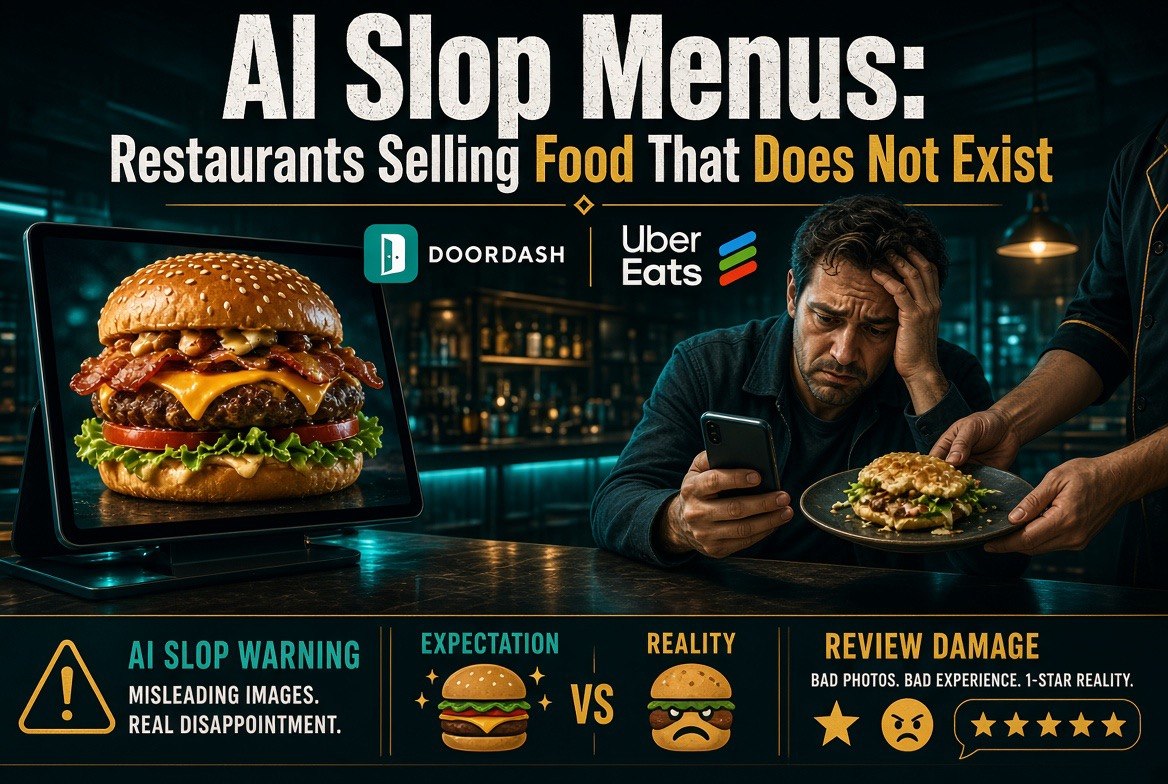
⚡ Expert Summary: Restaurants across the Chicago area and beyond are putting AI-generated food images on menus, signage, and delivery listings — burgers with impossible bun patterns, burritos with holes, rice that looks like maggots, cheese dripping in suspicious symmetry. The Chicago Tribune documented the trend in a 21 October 2026 report that operators themselves describe as both “off-putting” and “a fine tool.” The problem is not the technology. The problem is that a photograph on a menu is a promise, and AI slop breaks it before the food arrives. For independent restaurant owners in the US, the risk is concrete: DoorDash and Uber Eats customers order with their eyes, and a plate that arrives looking nothing like the picture is a refund request, a one-star review, and a customer who does not come back.
Walk down a commercial street in almost any American neighborhood and it has become hard to escape some form of suspect food imagery. Burgers with bun patterns that no bakery would produce. Burritos that induce trypophobia. Rice that reads, at a glance, as maggots. Cheese dripping over a sandwich in a symmetry so perfect it announces itself as fake before you have finished looking at it.
This is what the industry has started calling AI slop — a term for content of dubious origin, generated cheaply and at volume, and increasingly used to sell things people intend to eat.
What Restaurant Owners Are Actually Doing
The economics are obvious and slightly depressing. A proper food shoot costs money: a photographer, a stylist, a day of prep, hundreds of plates cooked and thrown away to get the twelve that work. It takes weeks. For an independent operator running a single location on thin margins, the budget often does not exist at all.
So the menu gets built with whatever is free. A language model writes the descriptions. An image generator produces the pictures. The result is a menu that looks professionally shot and depicts food that has never existed in that kitchen — or in any kitchen.
What makes this different from the old stock-photo problem is scale and credibility. Stock photos are generic but real. AI food images are specific and fake: they show your burger, your restaurant’s name on the wrapper, in a configuration no cook on your line could reproduce. The customer has been told something false about a product they are about to pay for, by a machine that does not know it is lying.
The Specific Failures: What AI Slop Actually Looks Like
The tell is almost always structural. Image models understand what food looks like in aggregate and fail at the physical logic that makes food real.
- Impossible geometry — a bun with a lattice pattern no dough can hold, a burrito sealed along a seam that does not exist, a taco shell that curves in two directions at once.
- Wrong physics of melting — cheese that drips in perfect parallel lines, sauce that pools in a ring with no gravity source.
- Texture collapse — rice that reads as uniform beads, meat with no grain, produce with leaves that repeat in a tiling pattern.
- Scale exaggeration — portions three times the size of anything the kitchen serves, with a garnish count no line cook has time for.
- Nonsense text — a menu board or wrapper with lettering that looks like a brand and resolves into nothing when you read it.
None of these are subtle once pointed out, and all of them are invisible to a hungry person scrolling a phone at 7pm.
The Operator’s Defense — And Why It Does Not Hold
Operators quoted in the reporting do not see it as fraud. They see it as a tool that solves a real problem, and several describe it as “a fine tool” — the honest position of someone who cannot afford a photographer and has a menu to publish tomorrow.
That defense deserves to be stated fairly, because the alternative for many of these owners is not a beautiful photo shoot. It is no photo at all, on a delivery platform where listings without images get passed over.
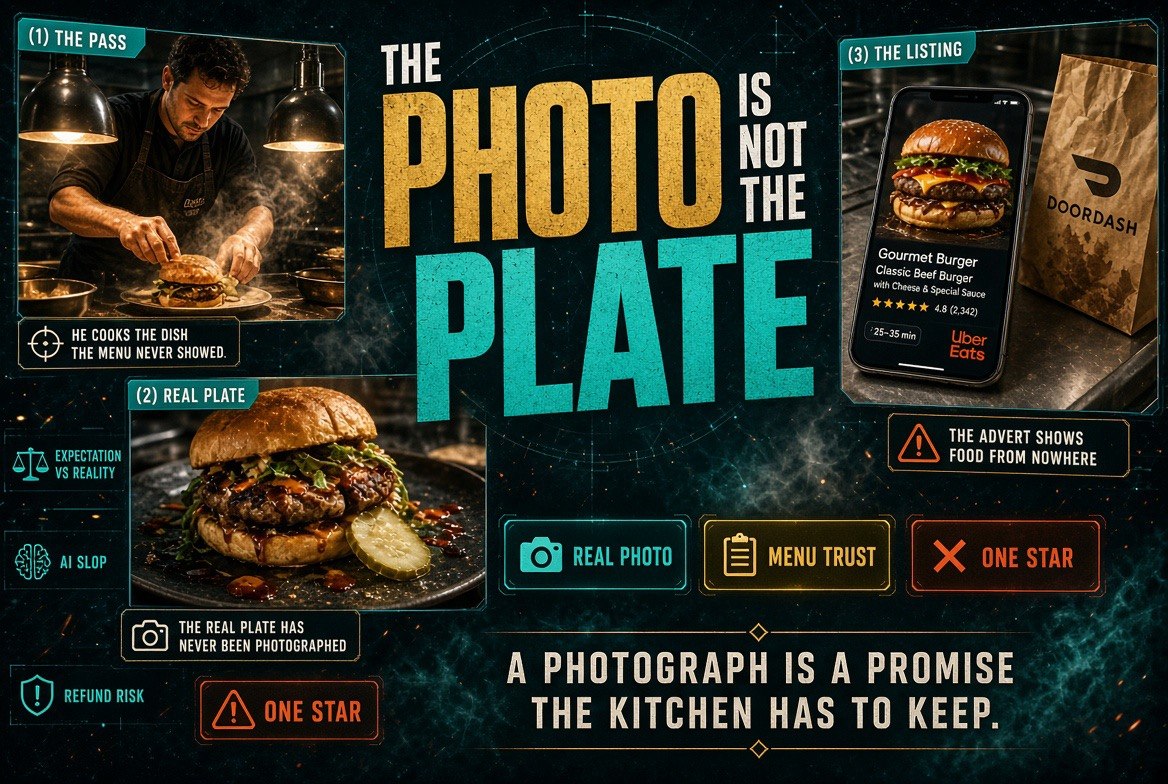
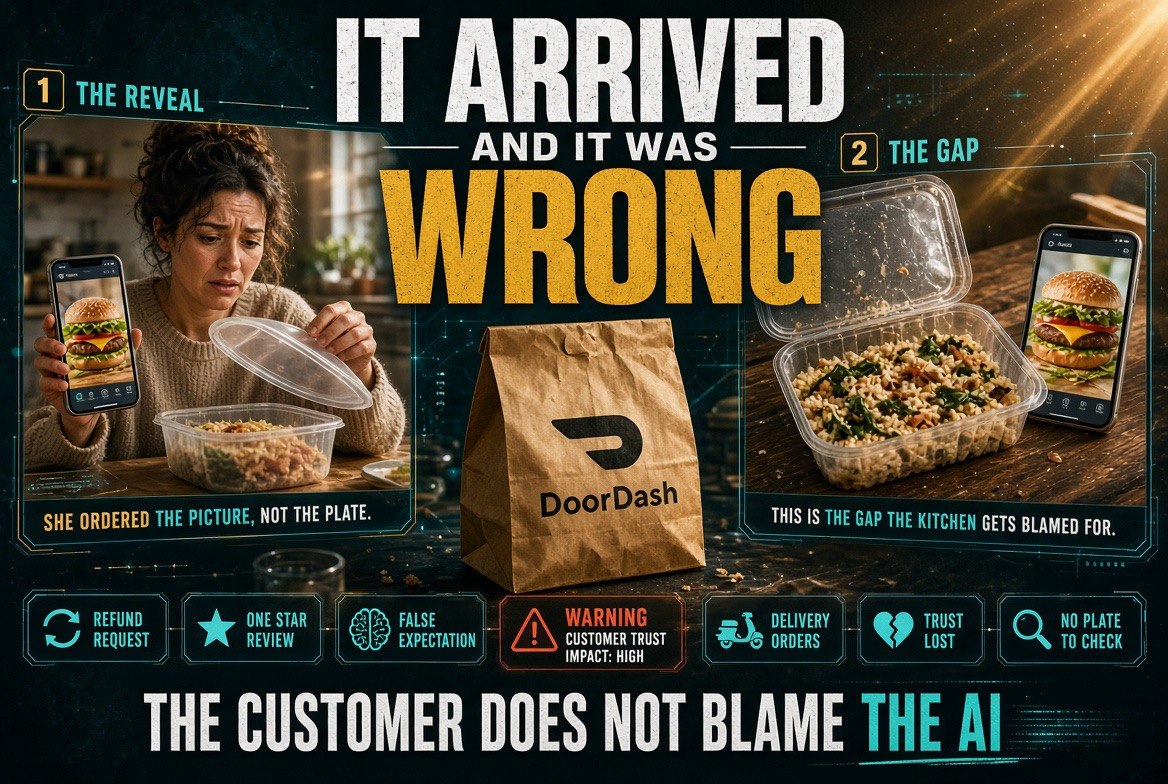
But the defense collapses at the point of delivery. A photograph on a menu is not decoration; it is a representation of the thing being sold. When the plate arrives and it is smaller, paler, and differently arranged, the customer does not think “that operator used an AI tool under budget pressure.” They think they were lied to.
| Approach | What the Customer Sees | Risk to the Operator |
|---|---|---|
| AI-generated food imagery on the menu | A flawless plate that never existed | Refunds, review damage, trust loss on arrival |
| AI-generated imagery, clearly disclosed | A stylised illustration, understood as such | Low — expectation is set honestly |
| Phone photo of the actual plate | Real food, imperfectly lit | Near zero — nothing to disappoint |
| Professional shoot of actual dishes | The best version of what will arrive | Cost only |
Why Delivery Platforms Make It Worse
Third-party delivery changed the mathematics of the food photograph. On DoorDash or Uber Eats, the photo is often the only thing the customer will ever see before deciding. There is no plate to inspect, no smell, no room. The listing is the restaurant.
That makes image quality directly convertible into order volume — and it makes image honesty a business risk that arrives weeks later, as a pattern of complaints rather than a single incident.
The platforms themselves have an interest here that nobody is currently enforcing carefully. A marketplace full of listings that misrepresent the product trains customers to distrust the whole marketplace, which eventually costs the platform more than any single operator’s photography budget.
What This Costs the Independent Operator
The cruel part is who gets hurt. Chains can absorb a bad review cycle. An independent restaurant has a handful of reviews that matter, and a food-arrival complaint is one of the most damaging kinds: it is specific, it is verifiable, and it is about the product itself.
There is a second-order cost that nobody priced in. When customers learn that menu photos are unreliable, they stop using photos to choose — which removes the advantage that AI slop was bought to create. The tactic degrades the signal it was designed to exploit.
A Practical Standard That Actually Works
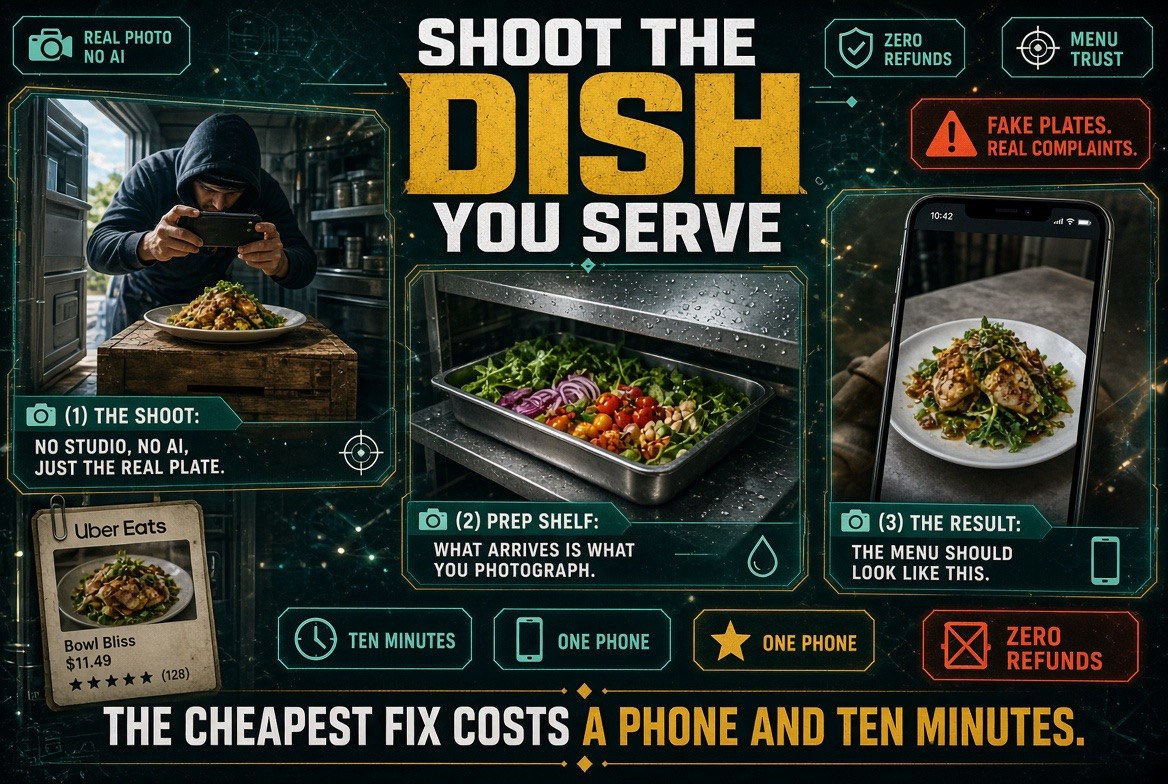
None of this requires abandoning AI. It requires one distinction: AI may describe the food, and AI may not depict it as photographic truth.
1. Use AI for copy, not for photographs of your food
Menu descriptions, allergen notes, marketing emails, social captions — all fair game. A generated image standing in for a photograph of a dish you sell is a different category of claim.
2. If you cannot afford a shoot, shoot it yourself
A phone photo of the actual plate, taken near a window, beats a perfect generated image on every metric that survives contact with a customer. It is real, it is defensible, and it costs nothing.
3. Reserve generated imagery for things that are honestly illustrations
Illustrated menu headers, pattern backgrounds, seasonal graphics, icon sets — these are decorative and understood as such. The line is crossed when the image claims to be the product.
4. Watch what the delivery platforms carry
If your listings were built from a library of generated images, audit them. The listing photo is what a customer will compare against the container in their hand.
5. Treat a food complaint as data, not noise
If customers repeatedly mention that the plate looked different, the imagery is the problem, not the kitchen.
| Use Case | AI Appropriate? | Why |
|---|---|---|
| Menu item descriptions | Yes | Text about food is not a claim the food exists in that exact form |
| Decorative section headers | Yes | Clearly ornamental, understood as design |
| Photos of dishes you sell | No | The customer compares the plate to the picture |
| Delivery listing hero images | No | Highest-stakes photo in the business — no plate, no room, no smell |
The Bigger Question: Who Is Responsible for a Fake Menu?
There is no rule that says a restaurant menu photo must depict the actual dish. Nobody audits it. The delivery platforms have terms of service broad enough to cover it but enforce them rarely, and only after complaints accumulate.
Which means the standard, for now, is set entirely by the operator’s own judgment — and the operator is the party with the strongest incentive to exaggerate and the least capacity to absorb the cost of a proper shoot.
That is not a stable arrangement. It resolves one of two ways: operators self-regulate because the customer eventually does the regulating for them, or a platform or regulator steps in and writes a rule that will be clumsier than the one operators would have written themselves.
The Takeaway for Independent Restaurant Owners
AI slop on a menu is a small, cheap decision made under pressure, and it converts into a large, expensive problem at the point of delivery. The technology is not the villain here and the operators using it are not fraudsters — they are owners solving a photography budget problem with the only tool they can afford.
But the customer does not experience the budget problem. They experience the gap between the picture and the plate, and that gap is where trust in an independent restaurant gets spent. The fix is cheap in every sense except pride: put a real photo of the real plate on the menu, and let the food do the selling it was always going to have to do anyway.
The Menu Photograph as a Contract
There is a reason the food photograph carries more weight than any other marketing asset a restaurant owns. It is the only piece of advertising that gets checked against the physical product by the same person, in the same hour, with the evidence in their hands.
A radio spot cannot be falsified. A billboard is understood as an impression. Even a review is another customer’s opinion. But the photograph of the burger is a specific claim about a specific object that will arrive at a specific address, and the customer will compare them side by side without being asked to.
That is why the small lies matter more here than anywhere else in restaurant marketing. An operator who exaggerates the size of a portion in generated art is not making a creative choice — they are writing a promise the kitchen cannot keep, and the kitchen will be blamed for breaking it.
There is also an asymmetry nobody warns operators about. The customer who is disappointed by a plate does not usually complain about the image. They describe the food as bad, because that is what they experienced. The generated image quietly poisons the reputation of a kitchen that cooked the dish correctly.
What Operators Are Actually Saying
The coverage of this trend has been notably free of villains, and that is the honest reading of it. Operators describe the tools in exactly the terms you would expect from people running a business on tight margins: useful, cheap, imperfect, hard to resist.
Several frame it as a stopgap — something that fills the menu today while a real shoot waits for a budget that keeps not arriving. That is a reasonable position for an owner to hold and a poor position for a business to rest on, because the stopgap has a way of becoming the standard once nobody is forced to revisit it.
The operators who get this right tend to arrive at the same conclusion by a different route: they keep the cost down by shooting the food themselves, and they keep the honesty by shooting the food they actually serve. It is slower than generating an image and faster than hiring a photographer, which puts it in the narrow band where an independent restaurant can actually operate.
Frequently Asked Questions
What is AI slop on a restaurant menu?
AI slop is generated imagery used to represent food a restaurant sells, where the picture depicts a dish that does not exist as shown. Common tells include impossible bun patterns, melting that ignores gravity, and rice or meat with repeating texture.
Is using AI images on a menu illegal?
There is no specific rule requiring menu photographs to depict the real dish, and enforcement is rare. That does not make it safe commercially — a plate that does not match the picture drives refunds and review damage, which is where the real cost lands.
Why do restaurants use AI food images instead of real photos?
Cost and speed. A professional food shoot requires a photographer, stylist, and a day of cooking; generated images are free and instant. For independent operators on thin margins, that gap is the entire reason the practice spread.
Does AI slop hurt delivery orders?
Yes, indirectly. On DoorDash and Uber Eats the listing image is often the only thing a customer sees before ordering, so an inaccurate picture converts into complaints about the food that arrived rather than about the image that sold it.
What should a restaurant owner do instead?
Use AI for menu copy and decorative graphics, and use real photographs for anything depicting a dish you sell. A phone photo of the actual plate near a window will outperform a generated image on the only metric that matters after delivery.
How can a customer spot an AI food image?
Look for physical impossibilities: seams that do not exist, cheese and sauce that drip in parallel lines, repeating leaf patterns, and text on wrappers or boards that resolves into nonsense.
About Barak Schurr
Barak Schurr built and exited a major ticketing platform, ran global operations at Eventbrite, and now focuses on one question: which AI tools actually help independent restaurant owners run leaner and grow faster. He writes from the operator’s perspective — no vendor spin, no theory, just what’s real in 2026.
Email: [email protected]
More Resources for Restaurant Operators