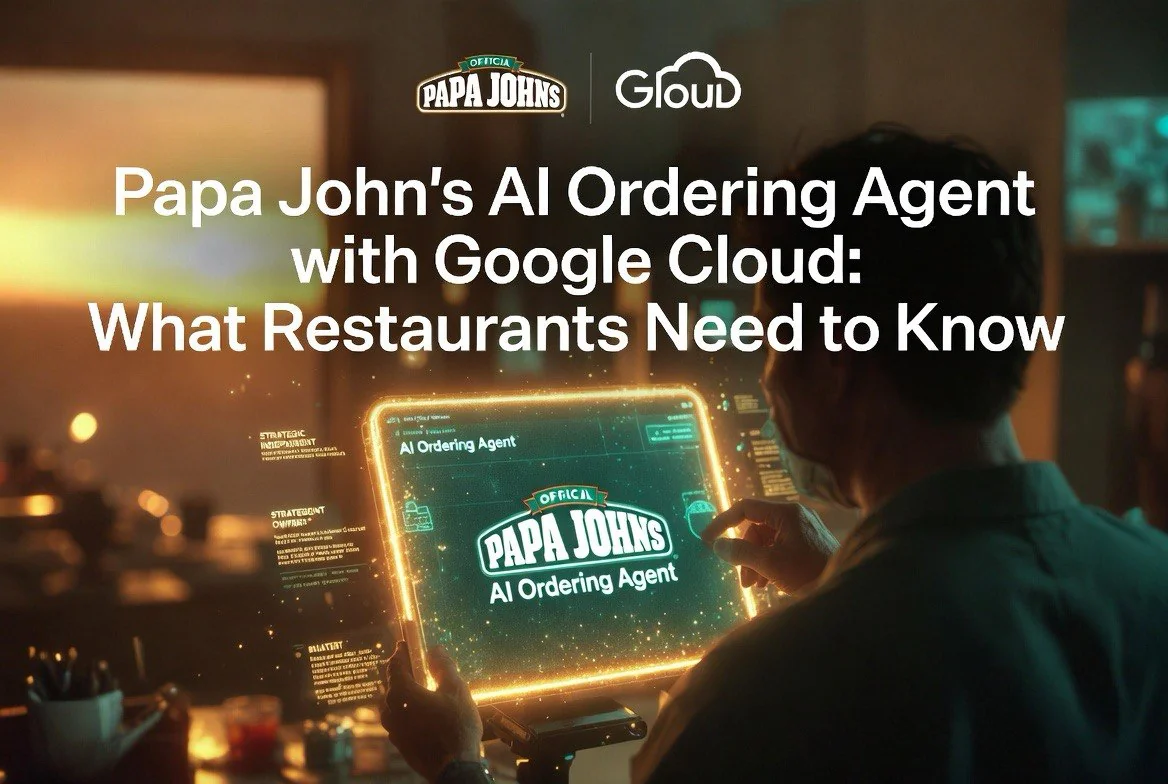
Papa John’s AI Ordering Agent With Google Cloud: What Restaurants Need to Know
u26a1 Expert Summary: Papa John’s launched an AI-powered omnichannel food ordering agent built on Google Cloud’s Gemini Enterprise platform, becoming the first quick-service restaurant to deploy Google’s Food Ordering agent for unified voice and text ordering. The system handles orders through mobile apps, websites, phone calls, kiosks, and in-car systems with real-time personalization. For independent operators, the technology signals that AI ordering is no longer a chain-only luxury.
Papa John’s just became the first quick-service restaurant to deploy Google Cloud’s Food Ordering agent u2014 a fully agentic AI system that handles voice and text orders across every channel your customers use to order food.
Announced at NRF 2026 in January and currently in pilot deployment, the system represents a significant shift in how restaurants handle remote ordering. Instead of routing phone calls through a central call center or relying on third-party delivery apps for customer interaction, Papa John’s now uses Google’s Gemini Enterprise platform to handle orders directly through its own channels.
The rollout is expected across Papa John’s system by the end of 2026, covering approximately 3,400 North American locations and 1,500 international units serving 150 million customers annually.
What the Google Cloud Food Ordering Agent Does
The system goes beyond a basic chatbot. It is an agentic AI that handles the full ordering conversation u2014 taking orders by voice or text, building a cart with accurate items and modifications, offering personalized recommendations based on past orders, processing payments, and confirming delivery or pickup timing.
Because it runs on Google Cloud’s Gemini Enterprise platform, the agent can operate across multiple channels seamlessly. A customer can start an order through voice on their phone, pause it, and finish it later through text on the website. The agent maintains context across channels and sessions.
For Papa John’s, the key operational advantage is labor independence. Phone orders traditionally require a staff member to take the order while managing in-store customers, food preparation, and other duties. The AI agent handles phone orders autonomously, freeing that staff member for kitchen work or front-of-house service u2014 a major benefit during peak dinner rushes when phone orders spike alongside in-store and delivery traffic.
Lou AI: Papa John’s In-House AI Assistant
Alongside the Google Cloud integration, Papa John’s also introduced Lou AI u2014 an in-app AI assistant named after the brand’s founder, John “Papa” Schnatter, and the company’s “Better Ingredients. Better Pizza.” slogan. Lou AI handles in-app ordering, deal finding, group ordering coordination, and customer service within the Papa John’s mobile app.
The combination of Lou AI for in-app ordering and Google Cloud’s Food Ordering agent for omnichannel coverage gives Papa John’s a dual-layer AI ordering system. Lou AI handles the app-specific experience with deep menu knowledge and loyalty integration. Google’s agent handles cross-channel ordering, phone calls, and in-car system integration through Android Auto and similar platforms.
Why This Matters for Independent Operators
A Papa John’s AI deployment might seem irrelevant to an independent restaurant with one location. It is not. The technology stack Papa John’s is deploying u2014 Google Cloud’s Gemini Enterprise u2014 is the same platform available to any restaurant that wants to build an AI ordering agent.
The difference is that when Papa John’s deployed it in January 2026, the technology was expensive enough that only an enterprise chain with Google’s direct partnership could justify the investment. Eight months later, the landscape has shifted. Google has released a self-service version of the Food Ordering agent through Google Cloud Marketplace, and competing vendors u2014 including SoundHound, Presto, and others u2014 have released similar products at prices that work for single-location operators.
According to the National Restaurant Association’s 2026 State of the Industry report, only about 6 percent of restaurant operators currently use AI for customer orders. That number is about to grow rapidly as Google, Presto, SoundHound, and Allo compete for the independent operator market. Papa John’s deployment validates that the technology works at scale. The question for independent operators is how quickly they can deploy their own version.
The Economics of AI Ordering for Independents
Phone orders are expensive for small restaurants. A single staff member answering phone calls during a dinner rush spends roughly 30 to 45 seconds per call. For a restaurant doing 30 to 50 phone orders per evening, that is 15 to 38 minutes of dedicated phone time u2014 time that person should be assisting in-store customers or preparing food.
Voice AI ordering systems for independent operators now start at $200 to $600 per month, depending on order volume and features. The savings come from reallocating that phone time to revenue-generating activities. A restaurant that saves 30 minutes of staff time per dinner shift at $15 per hour saves roughly $2,700 per year per shift. For a two-shift operation, the savings cover the cost of the AI system and then some.
Beyond labor savings, AI ordering systems capture data that phone orders miss. When a customer calls to place an order, that transaction typically enters the POS with minimal customer context. AI ordering agents record order history, identify repeat customers, personalize recommendations, and build loyalty profiles automatically. Over time, that data drives higher average order values and customer retention.
How Independent Restaurants Can Build Similar Capabilities
Independent operators have several options for deploying AI ordering without Google’s enterprise engineering team. SoundHound offers a branded voice AI that handles phone ordering and integrates with major POS systems including Toast, Square, and Clover. Presto provides drive-thru voice AI optimized for quick-service formats. Allo specializes in AI voice agents for restaurant phone systems and recently raised $14 million to expand its restaurant footprint.
The most practical approach for an independent operator is to start with phone ordering AI u2014 the highest-ROI use case u2014 and expand to text and web ordering once the system is proven. Most vendors offer a free trial period of 14 to 30 days, allowing operators to test accuracy, integration reliability, and customer reaction before committing to a subscription.
Papa John’s deployment with Google Cloud validates that AI ordering is not a future technology. It is deployed today at one of the largest pizza chains in the world, handling real orders for real customers across multiple channels. The same technology u2014 through different vendors at different price points u2014 is available to any restaurant that wants to capture the same efficiency gains.
How the Google Cloud Agent Works Under the Hood
The Food Ordering agent from Google Cloud is built on Gemini Enterprise for Customer Experience, a specialized version of Google multimodal AI trained on restaurant-specific use cases. It integrates with Papa John POS system, loyalty database, and delivery logistics to handle the complete order lifecycle.
When a customer calls Papa John, the AI agent answers with a natural restaurant greeting. It identifies the customer either by phone number or through account lookup. It accesses the customer order history to make personalized recommendations. It builds the cart with accurate modifiers and special instructions. It confirms the total, processes payment through stored credentials, and hands off the order to the kitchen display system.
The system was designed with one important architectural decision: it handles the order autonomously but transfers to a human if the customer asks for one, if the order complexity exceeds certain parameters, or if the customer sounds frustrated or confused. This hybrid approach ensures a safety net while maximizing the efficiency gains from AI handling the straightforward calls that make up the majority of phone order volume.
For Papa John, the early pilot results showed order accuracy rates comparable to human order-takers, with the advantage of 24/7 availability. Phone orders that would have gone to voicemail during off-hours are now handled immediately, capturing revenue that previously leaked to competitors.
The Broader Context: Google Cloud Aggressive Restaurant Push
The Papa John deployment is part of a broader push by Google Cloud into the restaurant industry. At the 2026 NRA Show in May, Google demonstrated several restaurant-specific AI tools beyond ordering, including kitchen display optimization, inventory prediction, and customer sentiment analysis.
Google strategy is revealing: instead of building point solutions for individual restaurant problems, Google is positioning Gemini Enterprise as an operating system for restaurants. The Food Ordering agent is the first major deployment under that strategy, and Papa John is the proof of concept that Google will use to sell to every other chain and, increasingly, independent operators.
This matters because Google has infrastructure advantages that most restaurant technology vendors cannot match. Google Cloud operates the same network that powers Google Search, YouTube, and Android. A restaurant using Google Food Ordering agent gets access to the same AI infrastructure that powers products used by billions of people. The scale alone gives Google pricing and performance advantages that smaller vendors will struggle to match.
For independent operators, this means the technology cost curve is about to bend sharply downward. When Google competes with SoundHound, Presto, and Allo for the same restaurant technology market, prices drop and features improve for everyone. The Papa John deployment is valuable not just as a technology case study but as a signal that the ordering AI market is about to become highly competitive u2014 and independent restaurants will be the primary beneficiaries.
What Independent Operators Should Do This Week
Three actions an independent restaurant owner can take right now to prepare for the AI ordering shift:
First, audit your phone order volume. Pull last month data and count how many calls came in, how many were answered, and how many went to voicemail. Every call that went to voicemail during operating hours is lost revenue. AI ordering agents answer every call, every time. If your restaurant loses even 10 phone orders per week to missed calls, that is roughly $15,000 to $25,000 in annual revenue walking out the door.
Second, test a voice AI ordering system on a free trial. Most vendors offer 14 to 30 day trials with no hardware commitment. Pick one vendor, set up the trial during slower hours, and measure the results. Track order accuracy, customer complaints, and staff time savings. The data from a two-week trial will tell you whether AI ordering makes sense for your specific operation.
Third, verify POS integration. Your existing POS system must be compatible with the AI ordering platform you choose. Toast, Square, and Clover all have established integrations with major voice AI vendors. If your POS is a legacy system without API support, you may need to budget for a POS upgrade before deploying AI ordering.
The Papa John Google Cloud deployment is a watershed moment for restaurant AI ordering. The largest pizza chain in North America is running AI agents that handle real customer orders with real money at stake. The technology has crossed the bridge from experimental to operational. Independent operators who act now will capture the early-adopter advantage before competitive pressure forces every restaurant to adopt.
Frequently Asked Questions
What is Papa John’s AI ordering agent?
Papa John’s deployed Google Cloud’s Food Ordering agent, an omnichannel AI that handles voice and text orders across mobile apps, websites, phone calls, kiosks, and in-car systems with real-time personalization.
What is Lou AI at Papa John’s?
Lou AI is Papa John’s in-app AI assistant that handles order building, deal finding, group ordering, and customer service within the Papa John’s mobile app.
How much does AI phone ordering cost for independent restaurants?
Voice AI ordering systems for independent operators typically cost $200 to $600 per month, depending on order volume and features. Most vendors offer free trials.
Can small restaurants use Google’s Food Ordering agent?
Google released a self-service version of the Food Ordering agent through Google Cloud Marketplace in 2026. Competing options from SoundHound, Presto, and Allo are also available at lower price points.
How many restaurants does Papa John’s operate?
Papa John’s operates approximately 3,400 North American locations and 1,500 international units, serving 150 million customers annually.

About Barak Schurr
Barak Schurr built and exited a major ticketing platform, ran global operations at Eventbrite, and now focuses on one question: which AI tools actually help independent restaurant owners run leaner and grow faster. He writes from the operator’s perspective — no vendor spin, no theory, just what’s real in 2026.
Email: [email protected]
More AI Resources