Restaurants Aren’t Buying the AI Hype — Here’s What Actually Works for Independent Owners
⚡ Expert Summary: Amid the flood of AI hype at the 2026 National Restaurant Association Show, independent operators are tuning out the flashy robotics demonstrations and focusing on practical AI tools that deliver measurable ROI today. AI phone agents, inventory management, and labor scheduling — not robots — are the tools that independent operators are actually buying and deploying. The reality check from the NRA Show floor is that AI hype may drive headlines, but practical AI tools that save money without disrupting operations are what independent restaurant owners are actually investing in. This guide covers the specific ROI metrics operators shared at the show, the evaluation framework they use to separate real tools from hype, and the vendor categories that are actually earning operator trust and recurring revenue.
The Hype vs. Reality at the NRA Show 2026
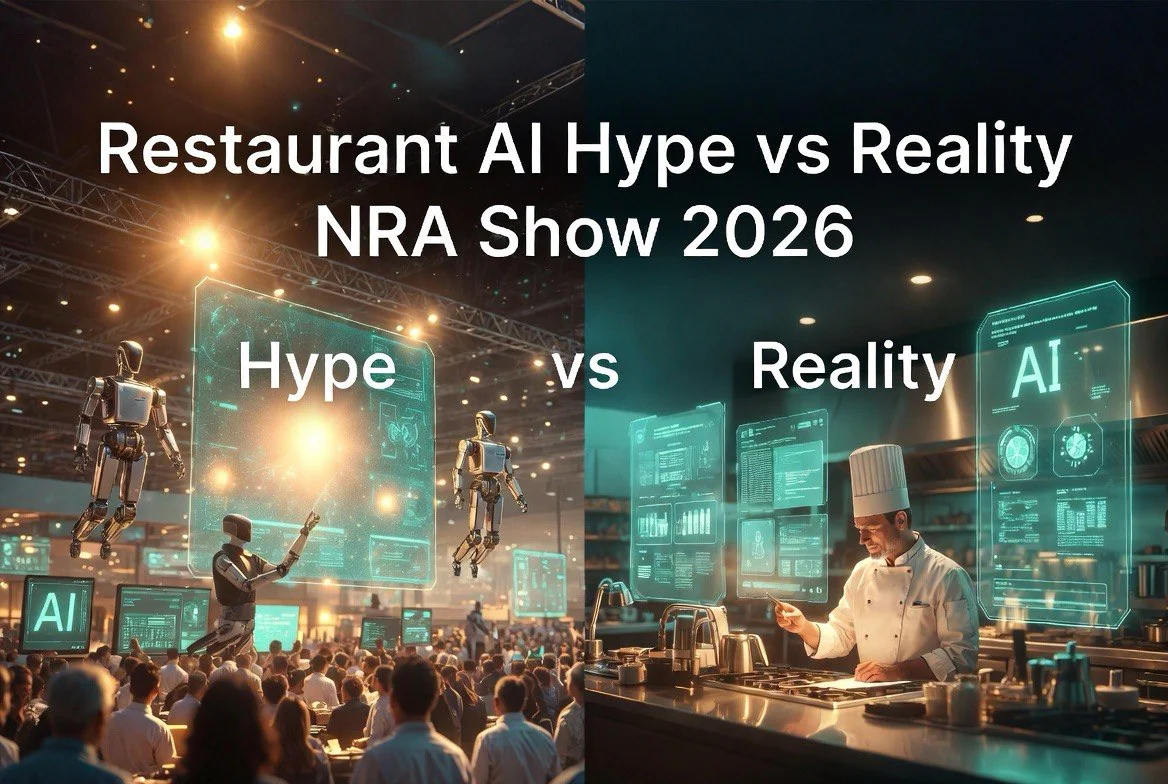
The 2026 National Restaurant Association Show in Chicago was the most AI-heavy event in the show’s history. Robotics vendors occupied the largest exhibition space ever devoted to automation. AI phone agent companies competed for attention with elaborate booths and celebrity endorsements. Every POS vendor announced new AI features. But the conversations happening among the 60,000 attending independent operators told a different story than the exhibition floor.
Independent operators who have been through multiple technology hype cycles — QR code menus in 2020, NFT dining in 2022, blockchain supply chain tracking in 2023 — have developed a healthy skepticism toward technology promises. The operators who were actually writing checks for AI tools at the NRA Show were not buying the robotics or the flashy demonstrations. They were buying tools that solve specific, measurable problems: answering phones, managing inventory, and scheduling staff.
The Deloitte 2026 Restaurant Technology Outlook, released during the show, confirmed what operators were saying on the floor. When asked which AI tools they planned to deploy in the next 12 months, independent operator responses were heavily weighted toward practical, low-disruption tools: AI phone agents (52%), AI inventory management (48%), and AI labor scheduling (44%). Robotics ranked ninth on the list at 12%.
AI Phone Agents: The #1 Tool Operators Are Actually Buying
AI phone agents dominated the real purchasing decisions at the NRA Show. Slang AI, Relay, and SnapMenu all reported record sales during the show, collectively signing up over 1,200 new restaurant locations over the five-day event. The reason for the surge is straightforward: the ROI of AI phone agents is immediate and measurable.
The Intouch Insight 2026 study published during the show found that AI phone agents reduce the cost of missed calls by 67% on average. For a restaurant receiving 50 calls per day with an average order value of $35, that translates to $62,000-128,000 in recaptured annual revenue per location against a tool cost of $149-199 per month. Operators do not need to believe in AI’s future potential — they can see the missed call revenue recovery in their first monthly report.
The National Restaurant Association’s 2026 technology survey showed that 34% of US independent restaurants now use AI phone agents, up from 18% in 2025. The tool category that operators were most skeptical about two years ago has become the fastest-adopted AI tool in restaurant history.
AI Inventory Management: The Quiet Winner
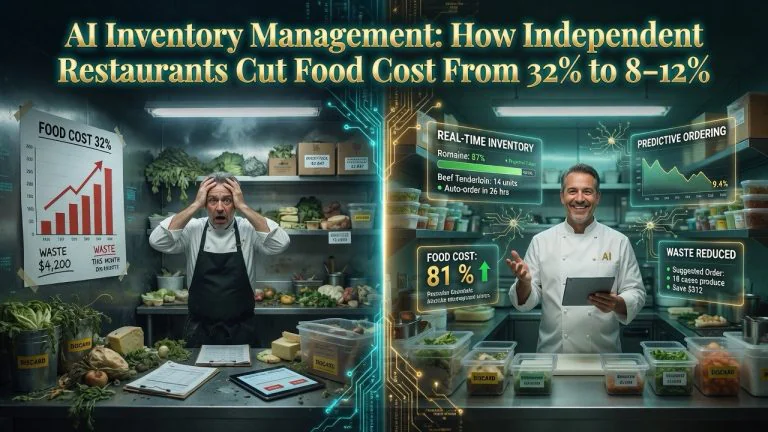
While AI phone agents get the most attention, AI inventory management is actually the tool category with the highest user satisfaction among operators who have deployed it. The NRA Show’s operator panels consistently rated AI inventory tools as having the strongest ROI of any AI category, driven by the direct impact on food cost — the single largest expense for most independent restaurants.
The US Bureau of Labor Statistics reports that food cost accounts for 28-35% of revenue at the average independent restaurant. A 2-percentage-point reduction in food cost through AI inventory management adds $10,000-17,500 per $500,000 in revenue. That is a direct improvement to the bottom line that no other AI tool category can match.
The operators on NRA Show panels who were using AI inventory tools shared specific, verifiable results. A pizza chain operator reported a 3.1 percentage point reduction in food cost within 60 days of deploying MarketMan. A casual dining operator using XtraChef reported identifying $2,400 per month in supplier overcharges within the first week. These specific, credible stories resonated with other operators far more than the theoretical promises coming from robotics booths.
AI Labor Scheduling: Solving the Staffing Crisis
The third category of AI tools that independent operators are actually buying is AI labor scheduling. The persistent labor shortage — 1.2 million unfilled restaurant positions in 2026, according to BLS data — means that operators cannot simply hire their way out of scheduling problems. They need to make better use of the staff they have.
AI labor scheduling tools analyze historical sales data, weather forecasts, local events, and staffing availability to generate optimized schedules that match labor supply to projected demand more accurately than manual scheduling. The tools also monitor real-time sales and alert operators when actual volume is diverging from projections, allowing for same-day schedule adjustments that prevent both understaffing and costly overtime.
Operator testimonials at the NRA Show consistently mentioned overtime reduction as the primary ROI driver for AI labor scheduling. A burger bar operator reported reducing overtime from $1,800 per month to $600 per month using 7shifts AI scheduling — a $14,400 annual savings against a $79 monthly tool cost. A casual dining operator using ScheduleFly AI reported similar results, with overtime dropping from $2,100 to $750 per month during the first 90 days of deployment.
What Operators Are NOT Buying
The tools that operators are NOT buying at the NRA Show are just as revealing as the tools they are buying. Robotics, despite dominating the exhibition hall, generated minimal purchasing activity among independent operators. The $25,000-50,000 upfront cost plus $1,000-2,000 monthly subscription fees for robotics systems are prohibitive for most independent operators, and the peak-hour reliability concerns documented in the Deloitte study add further hesitation.
Fully automated ordering systems that eliminate the human entirely also received tepid interest from operators. The consensus among operator panels was that AI should augment human workers, not replace them. The tools operators are actually buying — phone agents, inventory management, labor scheduling — all work in the background or handle transactional tasks while keeping humans in customer-facing roles.
Another category that generated minimal operator interest was AI marketing tools that require significant content creation and ongoing management. Multiple operators on panels reported that automated social media and email marketing tools created more work than they saved, because the AI-generated content required heavy human editing and review before posting. The operators who were satisfied with AI marketing tools were those using purpose-built restaurant marketing platforms that integrate directly with their POS data rather than general-purpose AI content generation tools that require manual data entry and output review.
How to Evaluate AI Tools Like a Skeptical Operator
The most valuable lesson from the NRA Show operator panels was the evaluation framework that experienced operators use when assessing AI tools. Operators who have been burned by previous technology hype cycles follow a consistent decision-making process that independent owners should adopt before signing any AI subscription.
The framework has four questions. First, does this tool solve a problem I can quantify right now? If you cannot state your current missed call rate, food cost percentage, or overtime as a percentage of payroll in a single number, you do not have a baseline for measuring AI ROI. Second, what is the payback period? Tools that take longer than 90 days to pay for themselves in measurable savings or revenue recovery are not worth the implementation effort for most independent operations. Third, what happens if I cancel? Tools that require long-term contracts, physical hardware installation, or irreversible process changes carry risk that the monthly subscription price does not capture. Fourth, does this tool replace or augment my staff? The operator panels were unanimous: tools that augment staff outperform tools that replace staff, every single time.
The National Restaurant Association recommends that operators apply this four-question framework to every AI tool before requesting a demo, not after. Operators who pre-screen vendors through the framework before engaging with sales teams report 60% higher satisfaction with their eventual AI tool selection, because the framework eliminates tools that sound impressive in a demo but fail the practical test of real restaurant operations.
An additional consideration that experienced operators flagged at the NRA Show is the exit strategy question. AI tools that store critical restaurant data — menu configurations, customer ordering history, pricing rules — in proprietary formats that cannot be exported represent a long-term lock-in risk. Operators should confirm, before signing any agreement, that all data can be exported in standard formats like CSV or JSON if they decide to switch vendors after the trial period.
Frequently Asked Questions
What AI tools are independent restaurant operators actually buying in 2026?
Independent operators are buying AI phone agents (52% plan to deploy), AI inventory management (48%), and AI labor scheduling (44%), according to the Deloitte 2026 Restaurant Technology Outlook. Robotics ranks ninth at 12%. Practical, low-disruption tools that deliver measurable ROI within 30-60 days are what operators are actually investing in.
Why are independent operators not buying restaurant robotics?
The primary barriers are cost ($25,000-50,000 upfront), peak-hour reliability concerns (67% average reliability during busy periods), and uncertain ROI. The Deloitte study found that operators who deployed robotics as augmentation saved 8% on labor, while those who reduced headcount based on robot capacity saw net costs increase 12%.
How much do practical AI tools cost for independent restaurants?
The three AI tools operators are actually buying cost $357-377 per month combined: AI phone agent ($149-199), AI inventory management ($79-99), and AI labor scheduling ($79-99). Against typical savings of $5,000-10,000 per month in recaptured revenue, reduced waste, and lower overtime, the payback period is under one week.
How quickly do practical AI tools deliver ROI?
AI phone agents show recaptured revenue within the first month. AI inventory management identifies savings opportunities within the first week. AI labor scheduling reduces overtime in the first pay cycle. Operators at the NRA Show reported that all three tools together paid for themselves within 2-4 weeks of deployment.
Is the AI hype at trade shows misleading operators?
The hype at trade shows focuses on the most visually impressive technology — robotics, automated kitchens, holographic menus — which often has the longest path to practical ROI. The tools that actually get deployed are less flashy but more effective: software-based AI that handles specific operational problems. The vendors of these practical tools tend to have smaller booths but higher conversion rates with operator buyers.
Should I skip the NRA Show if I’m just looking for practical AI tools?
No. The NRA Show is still the best place to evaluate AI tools side by side. The key is to skip the robotics demonstrations and focus on the software AI vendors. Most operators recommend spending the majority of show time talking to vendors whose tools cost under $200 per month — those are the tools with the shortest path to positive ROI for independent operators.

About Barak Schurr
Barak Schurr built and exited a major ticketing platform, ran global operations at Eventbrite, and now focuses on one question: which AI tools actually help independent restaurant owners run leaner and grow faster. He writes from the operator’s perspective — no vendor spin, no theory, just what’s real in 2026.
Email: [email protected]
More AI Resources