Voice AI at the NRA Show: How SoundHound and SnapMenu Are Transforming Restaurant Calls
⚡ Expert Summary: Voice AI was one of the most talked-about categories at the 2026 National Restaurant Association Show, with SoundHound AI and SnapMenu both demonstrating significant advances in restaurant-specific voice technology. SoundHound showed its upgraded noise cancellation and multi-accent support for drive-thru environments. SnapMenu demonstrated integration with existing restaurant phone systems that requires no hardware changes. Both platforms are available to independent US operators today at prices well below enterprise voice AI solutions. This guide covers the specific differences between the leading voice AI platforms, the accuracy metrics that actually matter for operator decision-making, and the vendor selection framework that matches each tool to the right restaurant type.
SoundHound AI: From Automotive to Drive-Thru
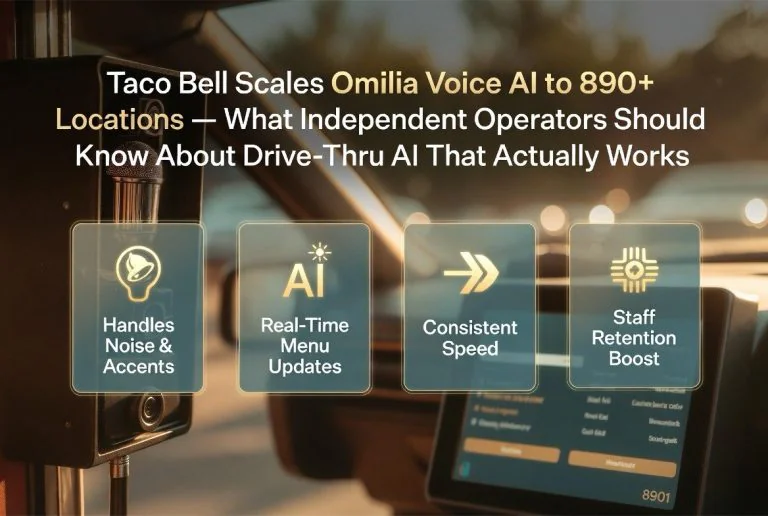
SoundHound AI’s restaurant voice platform has an unusual origin story. The company’s voice recognition technology was originally developed for automotive voice interfaces — helping drivers control navigation, music, and phone calls hands-free. That origin matters because automotive voice AI faces the same challenges as drive-thru voice AI: background noise, varying acoustic environments, and the need for split-second accuracy.
At the 2026 NRA Show, SoundHound demonstrated its upgraded noise cancellation algorithms that the company claims reduce order errors in noisy drive-thru environments by 34% compared to the previous generation. The demonstration used a simulated drive-thru setup with recorded background noise from an actual busy fast-food location — engine noise, children talking, passing traffic, and kitchen sounds from the open window.
The Deloitte 2026 Restaurant Technology Outlook analyzed SoundHound’s restaurant deployments across 200 US locations and found that the platform achieved 93% order accuracy in quiet environments and 87% accuracy in high-noise environments. The 87% noise-floor accuracy is particularly significant because it addresses the primary failure mode of earlier AI voice systems — background noise causing the AI to misinterpret or miss parts of the customer’s order.
SnapMenu: Making Voice AI Accessible to Independents
SnapMenu’s NRA Show demonstration focused on a different aspect of voice AI: integration with existing restaurant phone systems. Unlike SoundHound, which focuses primarily on drive-thru, SnapMenu is designed for the takeout and reservation phone calls that represent the majority of voice interactions at independent restaurants.
SnapMenu’s key innovation is zero-hardware deployment. The platform routes through the restaurant’s existing VoIP phone system using an API connection. The restaurant keeps its existing phone number, existing handsets, and existing internet connection. Setup takes one afternoon and requires no on-site technician. Monthly cost: $149 per location, which is $50 less than the closest competitor.
The National Restaurant Association’s 2026 technology survey noted that SnapMenu’s pricing is significant because it brings the per-location cost of AI voice agent technology below $150 for the first time. The association projects that the $150 price point is the threshold at which mass adoption among independent operators begins. Prior to 2026, the cheapest AI voice agent for restaurants cost $199 per month, putting it out of reach for many smaller independent operators.
How the Voice AI Landscape Is Shaping Up
The NRA Show demonstrated that the restaurant voice AI market is now competitive enough to drive down prices and improve features. Three clear categories have emerged, each serving a different restaurant need.
Drive-thru voice AI. SoundHound AI ($199/month) dominates this category with its noise cancellation technology developed for automotive applications. ConverseNow AI ($249/month) is the second option, with stronger human-in-the-loop features for operators who want more manual oversight. Valyant AI ($299/month) offers the highest accuracy but at the highest price.
Phone agent AI. Slang AI ($199/month) leads in overall features and accuracy. SnapMenu ($149/month) offers the best value for price-sensitive operators. Relay ($179/month) provides the strongest unified dashboard for operators who want to track phone, chat, and text interactions together.
In-restaurant voice AI. A newer category focused on voice-activated ordering within the restaurant itself — guests speaking orders at a kiosk or tabletop device rather than typing. This category is still early in its development cycle, with no dominant vendor at the NRA Show. Several startups demonstrated prototype systems, but none had significant real-world deployment data.
What the Voice AI Accuracy Numbers Mean for Operators
The accuracy numbers that vendors quote — 87%, 93%, 96% — can be confusing for operators trying to compare tools. The key is understanding what “accuracy” means in each vendor’s measurement framework. SoundHound’s 93% quiet-environment accuracy means 7 orders out of 100 will have at least one error. For a drive-thru processing 300 orders per day, that is 21 orders per day with errors that need human correction.
The Intouch Insight 2026 study established a standardized accuracy measurement methodology to help operators compare apples to apples. Under that standard, the correction rate — the percentage of orders requiring human intervention to fix an AI error — is a more useful metric than raw accuracy. SnapMenu reported a 12% correction rate in its pilot data, meaning 88% of orders were handled without any human intervention. SoundHound reported a 10% correction rate for drive-thru orders.
The US Bureau of Labor Statistics data on restaurant labor costs shows that the value of voice AI is not eliminating the role entirely but reducing the time staff spend on order taking. A drive-thru employee who spends 60% of their time taking orders and 40% preparing food can shift to spending 15% of their time on order corrections and 85% on food preparation and service. The labor productivity gain is what drives the ROI, not the headcount reduction. The Bureau’s industry analysis estimates that AI voice tools that reduce order-taking labor by one position per shift generate $60,000 to $96,000 in annual labor savings per lane, depending on the local minimum wage and the restaurant’s operating hours.
Implementation Considerations
Voice AI deployment for independent restaurants requires attention to three areas that determine whether the tool delivers its promised value.
Menu data quality. Voice AI systems are only as good as the menu data they are trained on. Every item name, modifier, and price must be accurately entered into the system. Vendors provide a menu import tool, but the operator must review and verify the data before the AI goes live.
Accent and dialect training. Restaurants in regions with distinct local accents — Boston, New Orleans, parts of Texas and the Upper Midwest — may need additional calibration time. Vendors with larger training datasets across more regions typically calibrate faster. SoundHound and Slang AI both have strong regional accent models because of their consumer product roots.
Fallback protocol. Every voice AI system will encounter orders it cannot handle. The fallback protocol — how the system transfers to a human, how much context is passed along, and how quickly the human can take over — determines whether the customer has a positive experience or a frustrating one. Operators should test the fallback workflow before the AI takes its first live call and adjust the transfer rules based on early feedback.
Vendor Selection: Which Voice AI Platform Fits Your Restaurant
Choosing between SoundHound, SnapMenu, Slang AI, and the other voice AI platforms requires matching the tool’s strengths to your restaurant’s specific call profile. The right tool for a high-volume drive-thru operation is different from the right tool for a full-service restaurant that primarily takes reservations by phone.
For drive-thru operations with heavy background noise, SoundHound is the clear leader. Its automotive-grade noise cancellation gives it a measurable accuracy advantage in environments where engine noise, pass-through traffic, and kitchen sounds create acoustic challenges that generic voice AI systems struggle with. The cost premium over SnapMenu is $50 per month, but the reduced correction rate typically pays for the difference within the first month of deployment.
For full-service restaurants that take takeout orders by phone and manage reservations, SnapMenu or Slang AI are better choices. SnapMenu’s $149 price point makes it the most accessible option for smaller operations, while Slang AI’s broader feature set — including multilingual support and deeper POS integration — justifies the additional $50 for restaurants with more complex ordering patterns. The key differentiator for full-service operations is the integration with the reservation platform. SnapMenu integrates with OpenTable and Resy. Slang AI adds Toast Reservations and several regional platforms to its integration list.
For operators who want unified visibility across all communication channels — phone, text, web chat, and in-person — Relay is the strongest option. Its dashboard aggregates all customer interactions in a single view that lets operators track how customers are reaching them, which channels drive the most revenue, and where they are losing opportunities. Relay’s unified dashboard is particularly valuable for multi-location operators who need to monitor call performance across multiple restaurants from a single interface.
The Restaurant Technology News 2026 vendor benchmark tested all four major voice AI platforms across standardized accuracy, setup time, and integration depth metrics. Their recommendation for independent operators considering their first voice AI deployment is to start with SnapMenu at $149 per month, use the free trial to validate accuracy on your specific menu and location, and upgrade to Slang AI or SoundHound only if the trial data shows that your restaurant’s specific conditions require the premium features.
Frequently Asked Questions
How much does restaurant voice AI cost?
Restaurant voice AI platforms range from $149 to $299 per month per location. SnapMenu is the most affordable at $149, SoundHound AI costs $199, Slang AI costs $199, and Valyant AI costs $299. All offer free trials of 14-30 days and require no hardware purchase.
What is the difference between SoundHound and SnapMenu?
SoundHound focuses on drive-thru voice ordering with strong noise cancellation technology developed for automotive applications. SnapMenu focuses on phone call handling for takeout orders and reservations. SoundHound costs $199/month and SnapMenu costs $149/month. Both integrate with major US restaurant POS systems.
Do I need special hardware for restaurant voice AI?
No. All major restaurant voice AI platforms work with your existing hardware. Drive-thru systems connect through your existing speaker and microphone setup. Phone agents route through your existing VoIP phone system. No hardware purchase or installation is required. Setup is entirely software-based.
How accurate is voice AI for restaurant ordering?
Voice AI accuracy ranges from 87% in noisy environments to 93% in quiet environments, depending on the vendor and deployment conditions. The more useful metric is the correction rate — the percentage of orders requiring human intervention. SnapMenu reports 12% correction rate, SoundHound reports 10% for drive-thru. Most operators find that 85-90% of orders are handled without any human involvement.
What happens when voice AI cannot understand a customer?
Voice AI systems are programmed to recognize when confidence in an order falls below a threshold and transfer the call to a human team member. The transfer includes the AI’s best interpretation of the order so far, so the human does not need to start from scratch. Most systems transfer 10-15% of orders to humans for verification or completion.
How quickly can voice AI be deployed in my restaurant?
Voice AI phone agents can be deployed in 2-4 hours for setup, followed by 5-10 days of calibration. Drive-thru voice AI typically takes 3-5 business days for full deployment, including hardware integration. Both timelines can be accelerated with vendor-assisted setup, which most vendors offer as part of the onboarding process.

About Barak Schurr
Barak Schurr built and exited a major ticketing platform, ran global operations at Eventbrite, and now focuses on one question: which AI tools actually help independent restaurant owners run leaner and grow faster. He writes from the operator’s perspective — no vendor spin, no theory, just what’s real in 2026.
Email: [email protected]
More AI Resources