Get the AI Restaurant Quick-Start Guide — Free
The 5 AI tools independent US restaurant owners are using right now to cut labor costs and answer every call.
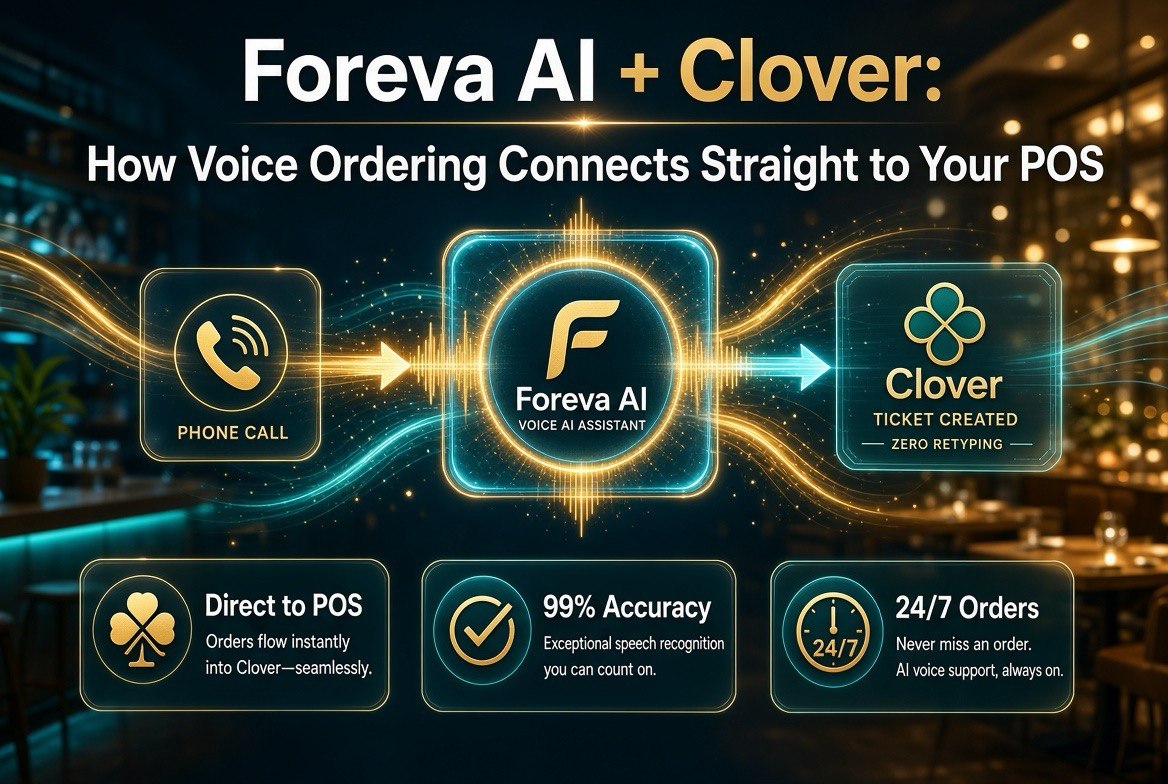
Foreva AI + Clover: How Voice Ordering Connects Straight to Your POS
Foreva AI (Eva) now connects voice ordering directly to Clover POS — your phone orders land as standard Clover tickets with zero new hardware and no menu re-entry. If you run a Clover point-of-sale and still answer your own phone during service, this integration closes the loop on missed calls and after-hours orders. Here is what changes for an independent restaurant, what it costs, and whether it is worth it for your operation.
⚡ Expert Summary: Foreva AI is a restaurant-specialized voice AI that answers your phone 24/7 and writes orders directly into Clover as standard tickets. It connects with a one-click OAuth — no passwords, no developers, no new hardware. Menu syncs automatically in about 5 minutes, orders hit your existing Clover dashboard, and you keep your current payment processing and reporting. Foreva reports roughly 99% order accuracy, multilingual support, 30%+ growth in phone orders in some cases, and 20+ hours a month of staff time back. It starts around $250/month and also works with Square, with more POS systems on the way.
Independent restaurants run on thin margins, and labor runs 28-35% of revenue for most operations. Every phone call you miss during a Friday rush is a ticket that goes to a competitor. Every order you take by hand is time a server or manager could spend on the floor. Foreva AI is built to take that phone away from your team — and with the Clover integration, it does not just take the order; it puts the ticket in the same system your staff already uses. No separate tablet. No retyping orders into Clover. No double entry.
This is a practical tool for operators, not a tech pitch. Let’s break down exactly what the Foreva + Clover connection does, what it costs, and where it makes sense for a US independent restaurant.
What Foreva AI Actually Does
Foreva AI (the assistant is called Eva) is a voice AI purpose-built for restaurants. It answers inbound phone calls, takes orders using your real menu, and handles the conversation the way a well-trained host or order-taker would. It is not a generic chatbot bolted onto a phone line — it is trained on restaurant ordering workflows, including modifiers, variations, and availability.
When a customer calls, Eva greets them, walks them through the menu, confirms modifiers and special requests, and completes the order. Because it integrates with your POS, it can pull live availability so it does not offer items that are sold out. The order is then written directly into Clover as a standard ticket — complete with customer details, items, modifiers, and payment information.
For US restaurant owners reading this, the practical win is simple: you stop losing phone orders. A study-level reality of the industry is that missed and abandoned calls are a quiet revenue leak — a call that rings out during service is a cover you never turned. Foreva answers those calls 24/7, including the overnight window and the after-lunch lull when nobody is at the host stand.
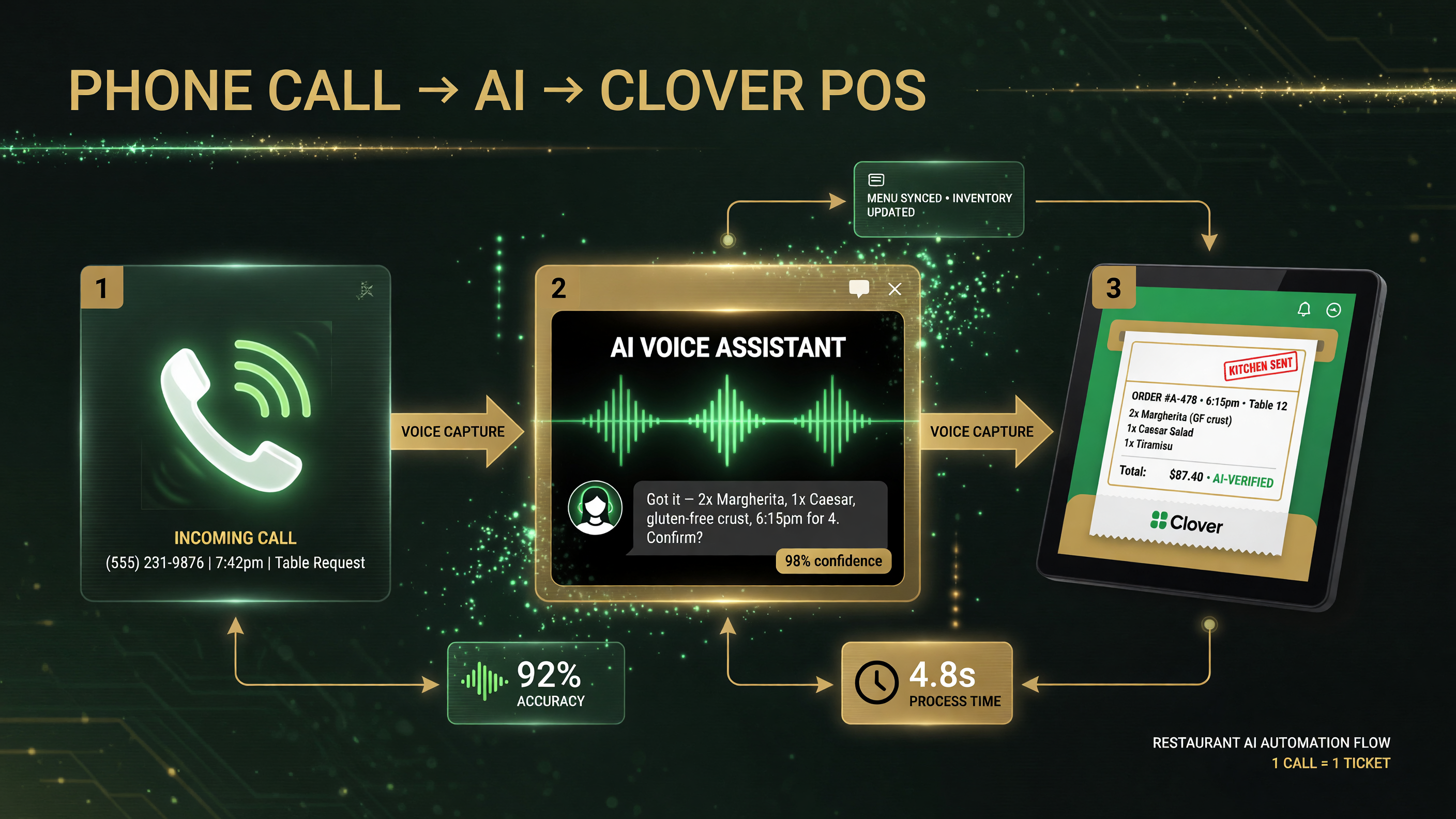
A missed phone call becomes a standard Clover ticket — no retyping, no separate tablet. This flow is why the integration pays for itself.
How the Clover Integration Works
The Clover connection is the piece that makes Foreva worth a serious look for operators already on Clover. The setup is a one-click OAuth handshake — there are no passwords exchanged, no developer work, and no new hardware to install. You connect your Clover account, and Foreva handles the rest.
Here is what happens on connection:
- Full menu import: Foreva pulls your items, prices, modifiers, variations, and availability straight from Clover. Updates you make in Clover sync to the AI within minutes, so the phone agent is always quoting current prices and offerings.
- Orders land as Clover tickets: A phone order becomes a standard ticket in your existing Clover dashboard — not a separate feed your staff has to watch. Your team sees the order the same way they see a counter or delivery order.
- Your payment and reporting are unchanged: Orders flow through your existing Clover payment processing, rates, deposits, and analytics. No change to how you reconcile at the end of the night.
- Setup speed: POS-connected users can typically go live in about five minutes; standalone setup runs closer to 48 hours. No staff training required.
This matters because the #1 objection operators have to AI phone ordering is friction — “I don’t want to retype orders,” or “I don’t want another system my staff has to learn.” The Clover integration removes both objections. The order lands where your staff already works.
What It Handles Well — and the Real Numbers
Foreva reports strong operational numbers, and the brand publishes these publicly rather than burying them:
- ~99% order accuracy on complex orders, including modifiers and custom requests.
- Multilingual support — the assistant can handle conversations in multiple languages, which matters for restaurants serving diverse communities in US metros.
- 30%+ growth in phone orders in some reported cases, driven by capturing calls that previously went unanswered.
- 20+ hours a month of staff time back by removing manual phone handling.
For an independent operator, the framing that matters is not “AI is cool.” It is: a phone order that used to ring out at 2:00 pm or 9:30 pm now becomes a ticket — and a ticket is revenue. Multiply that by every missed call in a month and the math is straightforward.
Foreva is also not locked to Clover. Square integration is available, with more POS systems noted as coming. That makes it a reasonable bet for operators who are on a mainstream US POS but want an AI phone agent without committing to a proprietary hardware stack.
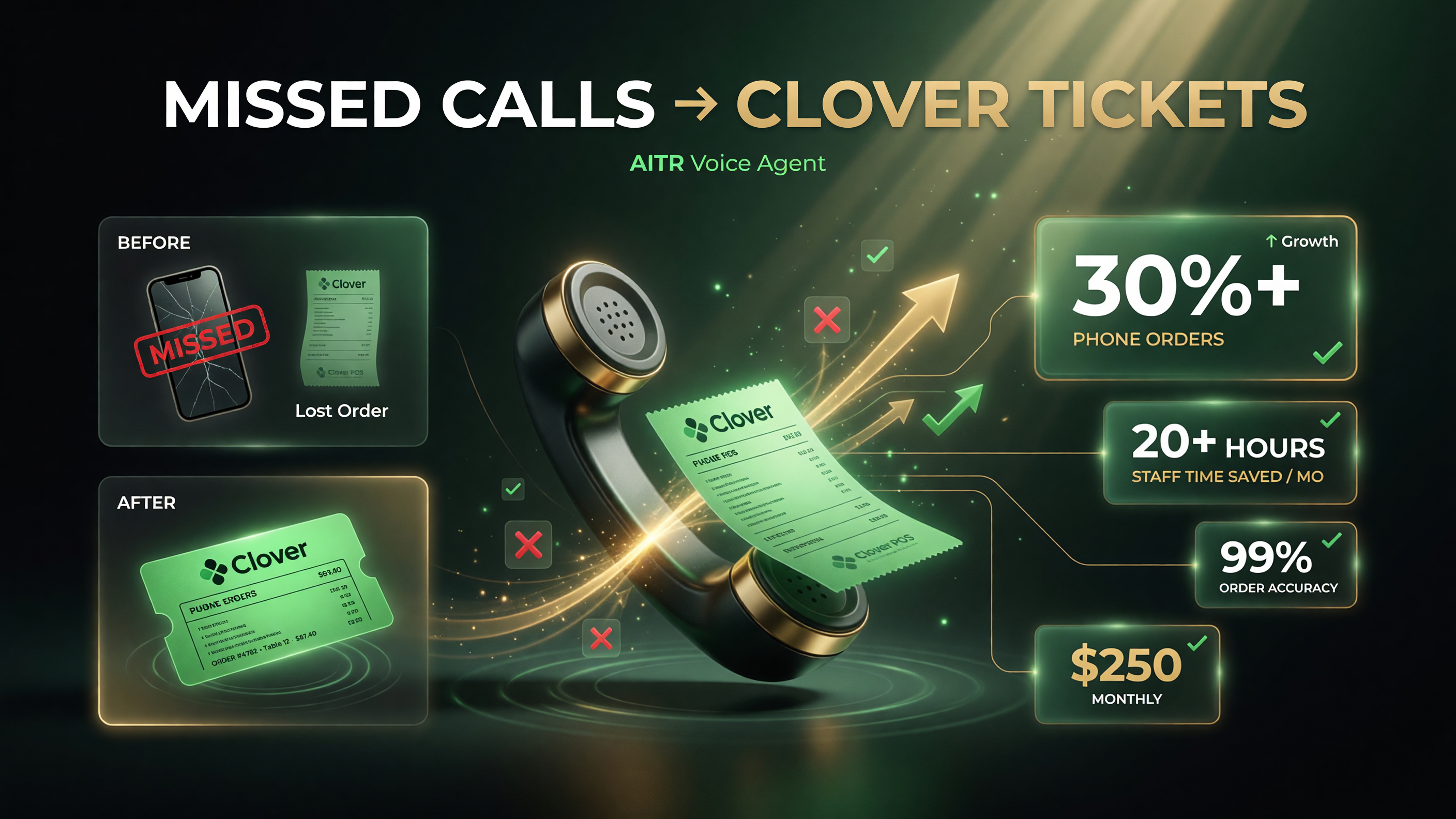
The reported payoff: ~99% order accuracy, 30%+ phone-order growth, and 20+ staff hours back each month at roughly $250/month.
What It Costs
Foreva starts around $250/month depending on the plan. For a restaurant that picks up even a handful of extra catering or takeout orders a month, that pays for itself quickly — one missed catering order can exceed a month of the subscription.
The cost framing for US independents: a part-time host to answer phones runs far more than $250/month once you count payroll, taxes, and scheduling. If Foreva captures even a few real orders a month you would otherwise have lost, it nets positive. The risk to watch is call volume — if your phone barely rings, the ROI is weaker. This is a tool for operators with genuine incoming-order volume and a Clover (or Square) POS to ground it in.
Foreva vs. Answering the Phone Yourself
This is not really a Foreva-vs-competitor question for most independents. It is Foreva-vs-the-status-quo of hand-answering. Here is the comparison that matters:
| Consideration | Phone answered by hand | Foreva + Clover |
|---|---|---|
| Calls during a rush | Go to voicemail or ring out | Answered, order taken, ticket created |
| After-hours orders | Missed entirely | Taken 24/7, lands in Clover |
| Ticket entry | Staff retype into Clover | Automatic, no retyping |
| Menu accuracy | Depends on memory and speed | Live sync from Clover |
| Staff time | Hours spent on the phone | 20+ hours/month back |
| Languages | Limited to staff skills | Multilingual |
The downside to be honest about: a human can handle complex, emotionally charged calls — an upset customer, a special request that does not fit the menu, a regular who wants to chat. Foreva is built for ordering efficiency, not relationship management. If your phone volume is heavy on requests, not orders, keep a human on it.
The Missed-Call Math Most Owners Don’t Do
The easiest way to know whether a voice AI phone agent is worth it is to count the calls you actually lose. Most independent operators cannot — because nobody tracks a call that never connects. The phone rings, nobody is free, it goes to voicemail, and by the time anyone checks the message the customer has already called the place down the street.
Here is the exercise worth running before you spend a dollar on Foreva or anything else. For one full week, make a mark next to the host stand every time the phone rings out or goes to voicemail during service. At the end of the week, estimate what a fraction of those became real orders. In a takeout-heavy US restaurant, even four to six lost calls a night is not unusual during dinner rush — and two of those are often orders worth $30 to $60. Over a month, that is a real, recurring number that you are currently leaving on the table.
The reason this matters for the Foreva decision specifically is that it converts a missed call into a ticket you can see. Because the order lands in Clover as a standard ticket, you get visibility into phone revenue you were previously blind to. You can see exactly how many phone orders the AI captured, what they were worth, and whether the subscription pays for itself. That is the difference between buying an AI tool on faith and buying one on numbers.
A Typical Night With Foreva + Clover
Let’s walk through a real scenario so the integration is concrete, not abstract. It is a Tuesday, 2:15 pm — between lunch and prep. Your front-of-house manager is on the floor, your one other FOH staffer is refilling and the host stand is empty. The phone rings.
Eva answers. It recognizes the caller’s area code, greets them, and asks if they want pickup or delivery. The customer orders two large pizzas plus a salad with dressing on the side and no olives — a request with enough modifiers to frustrate a rushed human in the middle of a busy afternoon. Eva confirms each modifier, reads back the total using your live Clover prices, takes payment, and tells them the pickup time. A ticket appears in Clover, ready for the kitchen. You never touched the phone.
Now the same Tuesday at 9:45 pm, thirty minutes before close. A catering-style call comes in — a local office wants fifty boxed lunches for Wednesday. In a hand-answered shop, this call often rings out after closing or gets handed off awkwardly. With Foreva, it is taken, the quantity and menu items are captured against your live menu, and the ticket is in Clover when you open the next morning. That one call can pay for the year.
These are not exaggerated scenarios. They are the exact calls restaurants lose every week — the after-lunch gap, the pre-close window, the moment the phone is the last thing anyone has time for. Foreva’s whole job is to be there for those.
Staff Time: The Hidden Second Benefit
Beyond capturing revenue, the second benefit is staff focus. It is common for a manager or senior server to be the de facto phone answerer — pulling them off the floor, away from guests, and out of their actual job. Foreva reports freeing 20+ hours a month of that time. For a single location that is the equivalent of reclaiming multiple full shifts for floor work, upselling, or simply letting staff do their jobs without the phone interrupting at the worst possible moment.
That number is worth stress-testing against your own operation. If your team handles a steady stream of phone orders and questions, 20 hours is conservative. If your phone barely rings, it is closer to zero — which is why the missed-call exercise above matters before you commit.
Who Should Consider Foreva + Clover
This integration is a fit for a specific profile of independent restaurant:
- Clover or Square shops with genuine phone-order volume — takeout, catering, call-ahead orders.
- Understaffed front of house where the phone is a distraction during service.
- Operators chasing after-hours revenue who currently miss overnight and post-rush calls.
- Multi-location groups that want consistent phone ordering across sites without hiring per-location order-takers.
It is a weaker fit if your phone barely rings, if most calls are questions rather than orders, or if you run a POS that Foreva does not yet support. Start with a trial and track how many calls actually convert to tickets before committing to the annual rate.
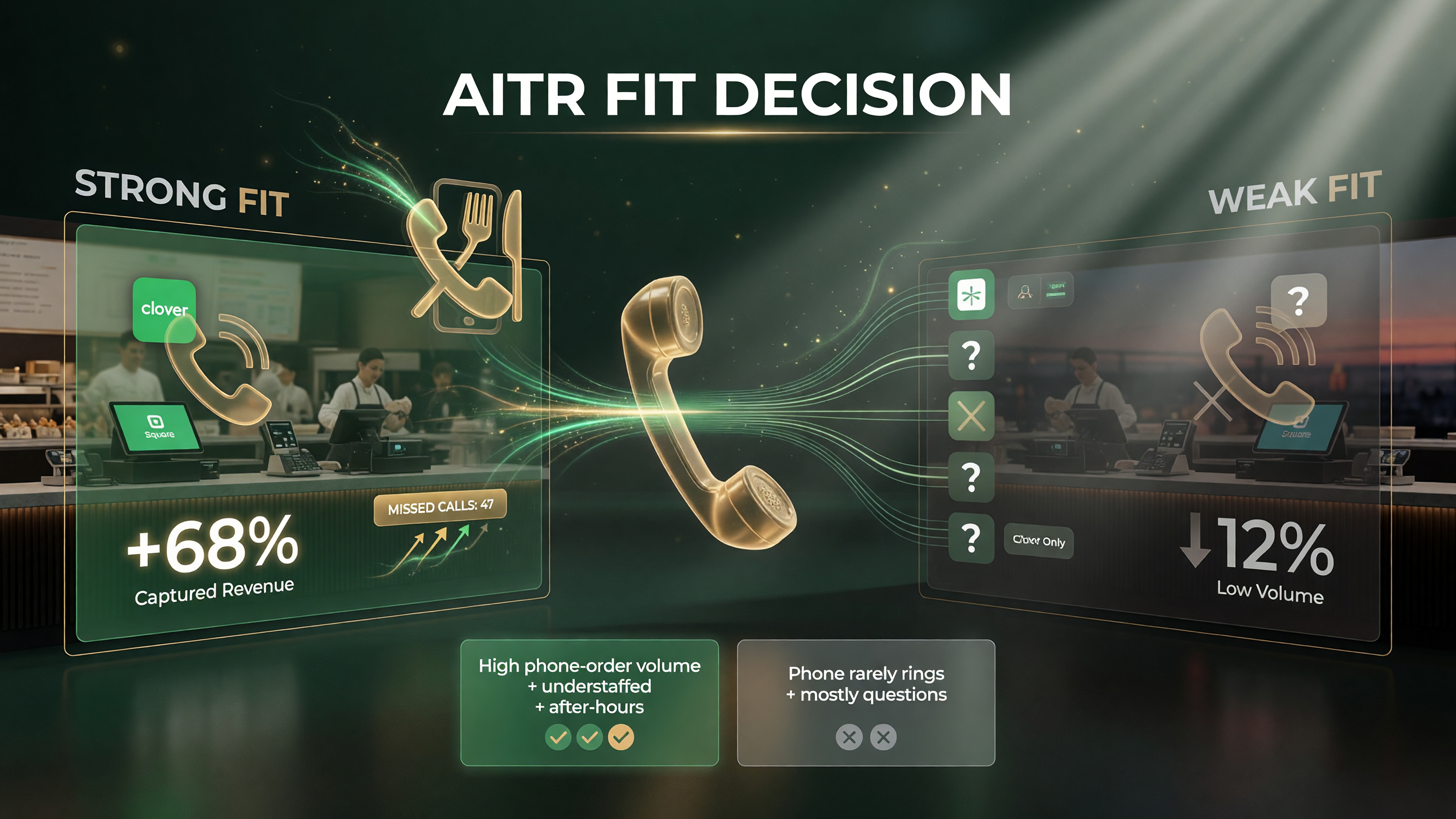
Best fit: Clover/Square shops with real phone-order volume and understaffed front of house. Weaker fit: phone barely rings or calls are mostly questions.
Frequently Asked Questions
Does Foreva AI work with Clover POS?
Yes. Foreva AI connects to Clover via a one-click OAuth handshake with no passwords or developers needed. Voice orders land in your existing Clover dashboard as standard tickets.
How long does it take to set up Foreva with Clover?
POS-connected users can typically be live in about five minutes. Standalone setup runs closer to 48 hours. The Clover connection imports your full menu automatically.
What does Foreva AI cost for a restaurant?
Foreva starts around $250/month depending on the plan. The cost is offset by capturing phone orders that would otherwise be missed and freeing staff time.
Does Foreva handle modifiers and special requests?
Yes. Foreva is trained on restaurant ordering workflows and reports about 99% accuracy on complex orders, including modifiers, variations, and multilingual conversations.
Which POS systems does Foreva support?
Foreva currently supports Clover and Square, with more POS systems noted as coming. Orders use your existing POS payment processing and reporting.
Will Foreva replace my staff?
No — it replaces the phone-handling task, not your people. It frees front-of-house staff for floor work. It is not built for relationship-heavy or emotional calls, so keep a human for those.

About Barak Schurr
Barak Schurr built and exited a major ticketing platform, ran global operations at Eventbrite, and now focuses on one question: which AI tools actually help independent restaurant owners run leaner and grow faster. He writes from the operator’s perspective — no vendor spin, no theory, just what’s real in 2026.
Email: [email protected]
More Resources for Restaurant Operators