Get the AI Restaurant Quick-Start Guide — Free
The 5 AI tools independent US restaurant owners are using right now to cut labor costs and answer every call.
Loman AI Now Works With Your POS — All 24 of Them
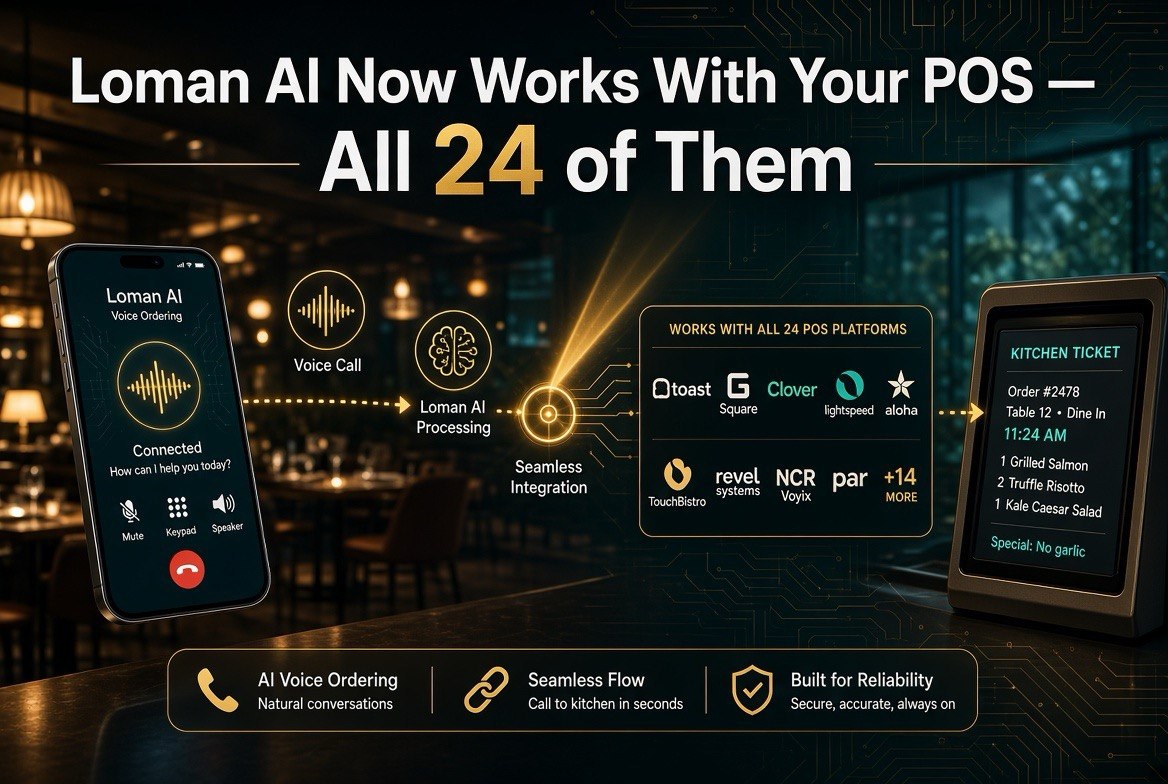
⚡ Expert Summary: Loman AI has expanded from a single-POS voice assistant to one that natively connects with roughly two dozen restaurant POS platforms — Toast, Square, Clover, SpotOn, Revel, Shift4 Dine, SkyTab, NCR Aloha, Olo, and more. Orders taken over the phone flow straight into your existing POS and kitchen display, with no tablets and no re-keying. For an owner who already runs a covered POS, the practical payoff is capturing phone business that otherwise rings out, raising average order value, and getting a real 24/7 front-of-house without adding labour.
Loman AI, the voice AI that answers your restaurant’s phone and takes orders, just expanded to work with roughly two dozen of the top POS systems — including Toast, Square, Clover, SpotOn, and Shift4 Dine. For an independent owner, this is the detail that decides whether voice ordering is practical for your kitchen or just another thing that doesn’t fit. Here is what the expansion actually means, which systems are covered, and how to tell if Loman belongs in your operation.
If you have spent any time looking at restaurant AI, you have seen the pattern: a tool that sounds great in a demo and then falls apart because it does not talk to the system you already run. Every owner has had the version of that. The phone AI category has been especially bad about it — a bot answers, takes the order in a vacuum, and then someone on the floor has to retype it into the POS by hand, defeating the whole point.
Loman is trying to be the exception. Instead of selling you a new standalone device, it connects directly to the POS you already use. That is what changed in 2026: it went from covering a couple of systems to covering nearly two dozen, which takes it from “works with a lucky few” to “probably works with whatever you run.” That is the difference between a novelty and a tool that earns its keep on a busy Friday.
What Loman AI Actually Does
Loman is a voice AI receptionist designed for restaurants. It answers the phone 24/7, talks to callers conversationally, and handles the things that eat a host’s or a manager’s time during service. That includes taking phone orders, booking reservations, and answering the recurring questions every restaurant gets — hours, location, whether the kitchen is still open, what is on special.
The reason restaurant owners care about it, specifically, is phone orders. That call that comes in during the dinner rush, when the host is seating a party and the manager is on the expo line, is exactly the call that used to go to voicemail or ring out. With Loman, that call gets answered, the order gets taken accurately, and it lands in your workflow without anyone having to write it down on a ticket and then type it in afterward.
Because it connects natively to the POS, the AI operates less like an external tool and more like another staff member inside your existing tech stack. It reads your live menu, understands what is in stock, and places orders the same way your counter staff would — through the system you already trust, into the kitchen display you already read.
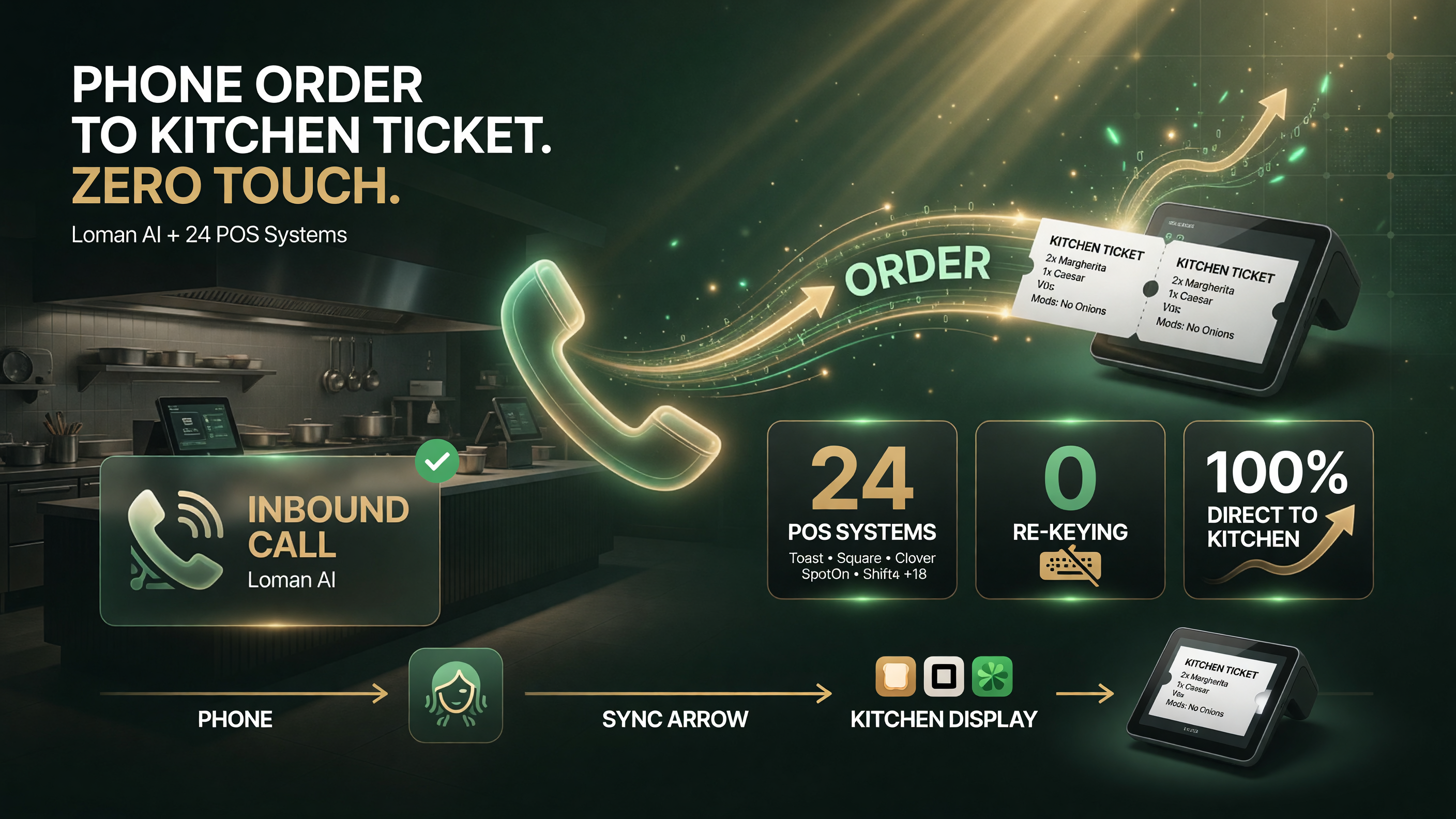
The full loop: Loman answers the call, takes the order, and lands it as a standard ticket in your POS and kitchen display — no re-keying.
The Two-Dozen POS Expansion
The headline change is the breadth. By early 2026, Loman had expanded from supporting a handful of systems to integrating with approximately two dozen of the top restaurant POS platforms. When a report in February 2026 flagged the expansion, the additions included SpotOn joining the lineup alongside Toast, and the momentum has continued since — Shift4 Dine came on in June, and the Toast ecosystem work continued through mid-2026.
Here is the current coverage picture in plain terms:
- Toast — native integration; phone orders flow directly into existing Toast workflows. This is the one most independent owners will check first, and it is covered.
- Square and Clover — both among the most common POS systems at independent shops; both supported.
- SpotOn — added in early 2026, opening up the systems that serve a lot of full-service and multi-location operations.
- Revel and Shift4 Dine — the Shift4 partnership, announced in June 2026, brings it into the Shift4 ecosystem.
- SkyTab, NCR Aloha, Olo, Stream, OpenTable, and more — together bringing the total to roughly two dozen platforms.
That coverage matters for one practical reason: it removes the “sorry, we don’t support your system” wall that kills most AI adoption in restaurants. If you already run a covered POS, the setup is about connecting the two — not about replacing the hardware and software you have invested in.
| POS System | Integration | What It Covers | Best Fit |
|---|---|---|---|
| Toast | Native | Orders flow into existing Toast workflows, incl. kitchen display | Most independents; check here first |
| Square / Clover | Supported | Phone orders land as standard tickets | Common at independent shops and small chains |
| SpotOn | Added early 2026 | Orders sync into POS without re-keying | Full-service and multi-location operations |
| Revel / Shift4 Dine | Shift4 partnership June 2026 | Access to the full Shift4 ecosystem | Operators already on Shift4 platforms |
| SkyTab, NCR Aloha, Olo, Stream, OpenTable, more | In the ~2 dozen covered | Broad coverage of the top restaurant POS platforms | Owners on any major system |
Where Loman plugs into your POS stack and what each integration covers.
What “Deep Integration” Means for Your Kitchen
There is a meaningful difference between a service that just takes an order and one that is actually connected. Loman’s pitch is the deep kind, and it shows up in the details an owner would notice:
- Live menu data — items, pricing, modifiers, and variations sync so the AI is not guessing at what you sell or what it costs.
- Inventory awareness — it knows when something is out of stock and can tell the caller instead of taking an order you then have to void.
- Reservation handling — it can book tables in the flow, not just take takeout orders.
- Order syncing — phone orders land in your POS and hit the kitchen display, so the line sees it like any other ticket.
This is the part that saves labour dollars. The whole point is that a phone order should not require a person to be the bridge between the caller and the kitchen. When the AI can write the ticket directly, you do not need someone to answer, someone to retype, or someone to relay the special instructions. It is the difference between automation that merely answers and automation that actually closes the loop.
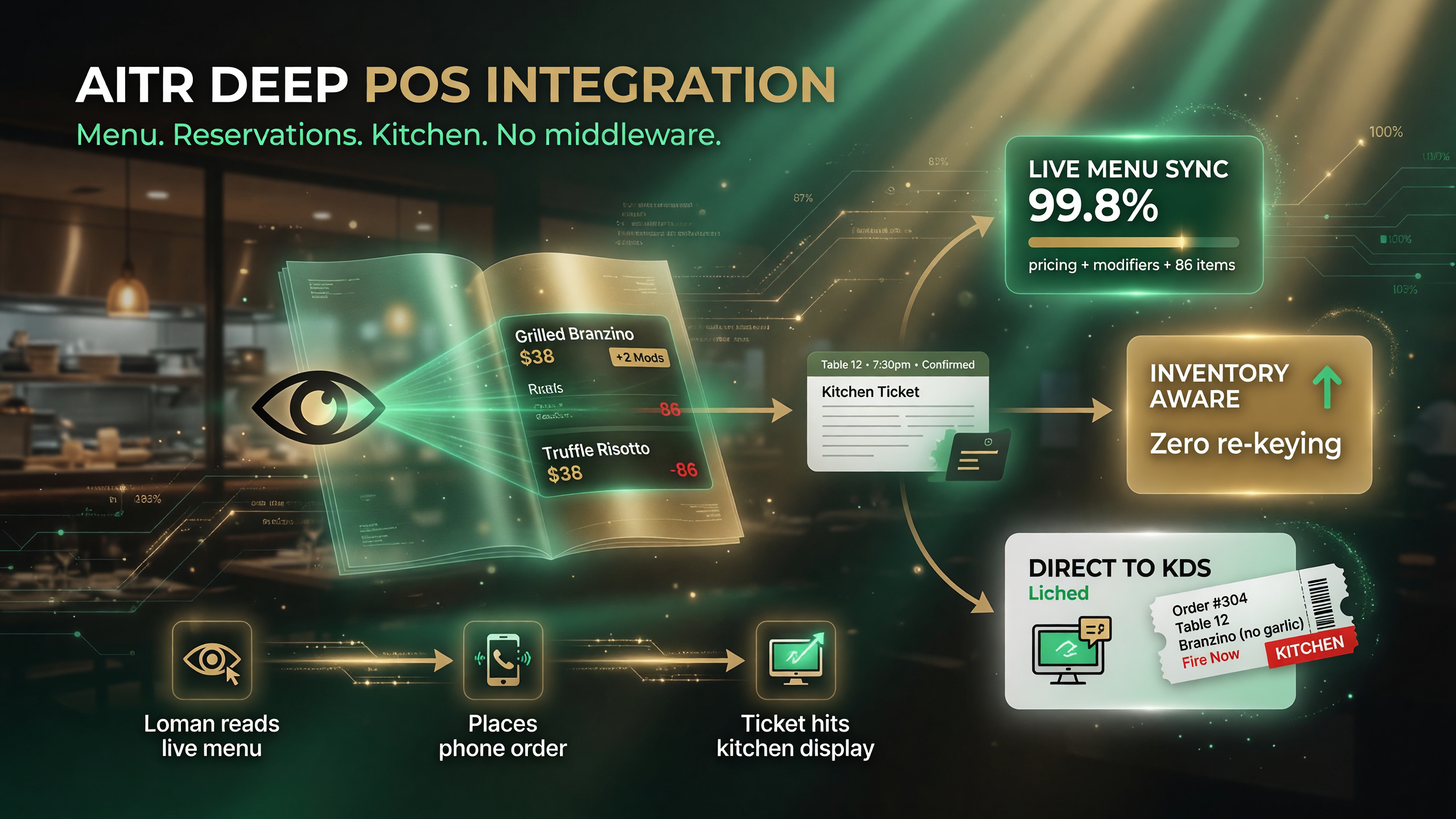
Deep integration reads your live menu and inventory, so the AI does not take an order for something out of stock — it syncs like another staff member.
Why Phone Orders Are Worth Recovering
Here is the number that usually gets an owner’s attention: phone orders tend to carry a higher average order value than online orders. There are a few reasons. A caller is usually ordering for a household or a group, not just grabbing a single meal. And over the phone, a good order-taker can suggest an appetizer, an extra side, an upsell — the same skills a server uses at the table, applied to the phone call.
It is also a channel the big chains have quietly leaned on for years. The ordering line, the call center, the dedicated phone number on every ad — that is not an accident. Phone is the place where a customer who is already hungry becomes a customer who commits to a larger order in one conversation. The independent restaurant that does not have anyone to consistently staff that conversation is leaving that lift on the table.
For years, that revenue has quietly leaked out of independent restaurants. Callers hit a busy signal or a voicemail that never gets returned, and they order from a delivery app instead — which takes a cut and puts the interaction and the data on someone else’s platform. A reliable phone AI is a way to keep that direct channel alive, capture the higher-value call, and do it without hiring another person to sit near the phone during service.
Loman’s early traction reflects the appetite for exactly this. The company was only in its second year of business as of early 2026, yet it reported momentum in the range of hundreds to nearly a thousand new customers. That kind of adoption in a category that usually moves slowly suggests the phone-revenue pain point is real and widespread.
Is Loman Right for Your Restaurant?
Loman makes the most sense when a few things are true about your operation:
- You run a covered POS. This is the single biggest factor. If your system is in the two-dozen list, the deep integration is available. If it is not, the value drops sharply.
- Your phone actually rings. Takeout, to-go, or call-ahead volume is the fuel. A shop where every order comes through an app or in person will not see much benefit from a phone AI.
- Phone calls hurt during service. If calls during the rush go unanswered or eat a manager’s time, this directly solves that pain.
- You want to grow direct orders. Owning the phone channel means keeping the higher order values and the customer relationship instead of handing them to a delivery platform.
It is a weaker fit if your phone rarely rings, if your POS is outside the supported list, or if your operation is built almost entirely around dine-in with no meaningful to-go or takeout business. The tool earns its keep by converting calls you would otherwise lose — if there is no call volume, there is not much to convert.
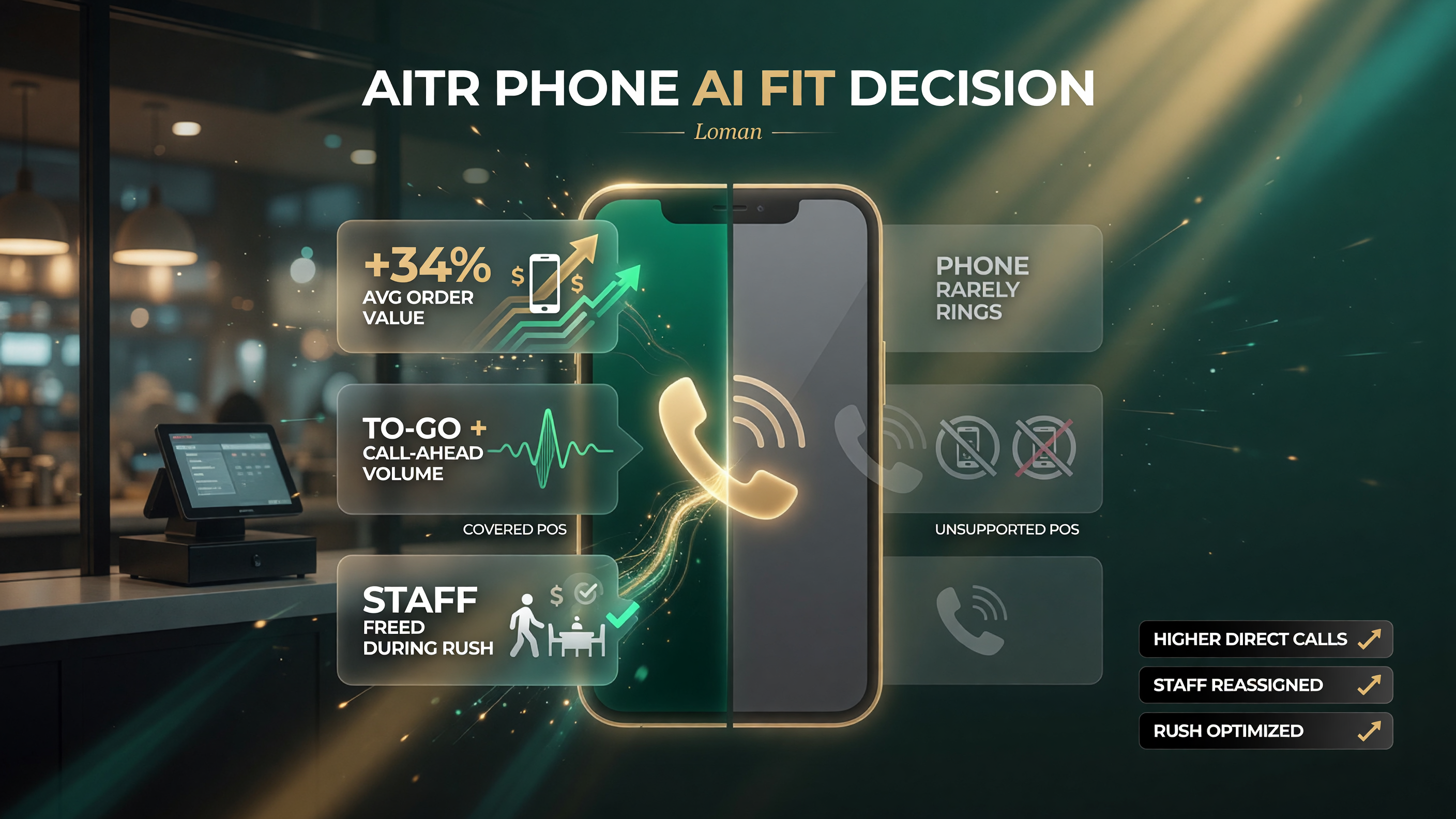
The fit check: covered POS, real phone volume, and to-go or call-ahead business make Loman a strong call — otherwise the value drops fast.
What It Costs and the Setup Tradeoff
Loman sits in the now-familiar restaurant AI price band — you are paying a monthly subscription for the voice assistant service, and the POS connection is the thing that makes it worth that recurring cost. Because it plugs into the system you already run, you are not buying new hardware, paying for tablet rental, or retraining your floor on a second ordering flow. The staff sees the order appear on the same kitchen display they already work from.
That is the setup tradeoff in one line: the real investment is not the money, it is trusting the AI with your phone line on a busy night. The way to de-risk it is what any owner would do with a new hire — run it in parallel, listen to a few handled calls, and watch whether tickets are coming through correctly before you let it carry real volume.
Once it is running, the ongoing return shows up in two places. The first is the phone orders you were already losing — calls that used to bounce to voicemail now become tickets, and those tickets carry the higher average order value of a direct phone order. The second is the front-of-house time it frees up. When the host is not tied to the phone during the rush, that person is seating parties, checking on tables, and handling the guests who are already in the room — which is exactly where staff attention earns the most money per minute in the restaurant.
None of that shows up as a single dramatic line item. It compounds across a week of Friday-night calls that get answered, a month of reservations booked without a manager interrupted, a season of to-go orders that did not leak to a third-party app. That steady accumulation is the real argument for a tool like this — not a headline, but the small, repeated wins that add up to a healthier operation by the end of the quarter.
Frequently Asked Questions
What POS systems does Loman AI support?
Loman integrates with roughly two dozen top restaurant POS platforms, including Toast, Square, Clover, SpotOn, Revel, Shift4 Dine, SkyTab, NCR Aloha, Olo, Stream, and OpenTable.
How does Loman AI take a phone order?
Loman answers inbound calls, talks to the caller conversationally, takes the order, and pushes it directly into your POS so it appears in the kitchen display — with no re-keying, no tablets, and no manual step in between.
Does Loman work with my existing POS?
If you run a covered system such as Toast, Square, Clover, SpotOn, Revel, or Shift4 Dine, Loman connects natively. If your POS is outside the supported list, the deep integration is not available, so check coverage first.
Is a phone AI worth it for a small restaurant?
It depends on phone volume. Restaurants with real to-go or call-ahead business benefit most, because phone orders tend to carry higher average order value, and the AI captures calls that would otherwise ring out during the rush.
Does Loman replace my staff?
No — it handles the phone-ordering and reservation workload that competes with seating, expo, and service. It frees existing staff from the phone so they can focus on the guests in front of them, rather than replacing the people on your floor.

About Barak Schurr
Barak Schurr built and exited a major ticketing platform, ran global operations at Eventbrite, and now focuses on one question: which AI tools actually help independent restaurant owners run leaner and grow faster. He writes from the operator’s perspective — no vendor spin, no theory, just what’s real in 2026.
Email: [email protected]
More Resources for Restaurant Operators