Get the AI Restaurant Quick-Start Guide — Free
The 5 AI tools independent US restaurant owners are using right now to cut labor costs and answer every call.
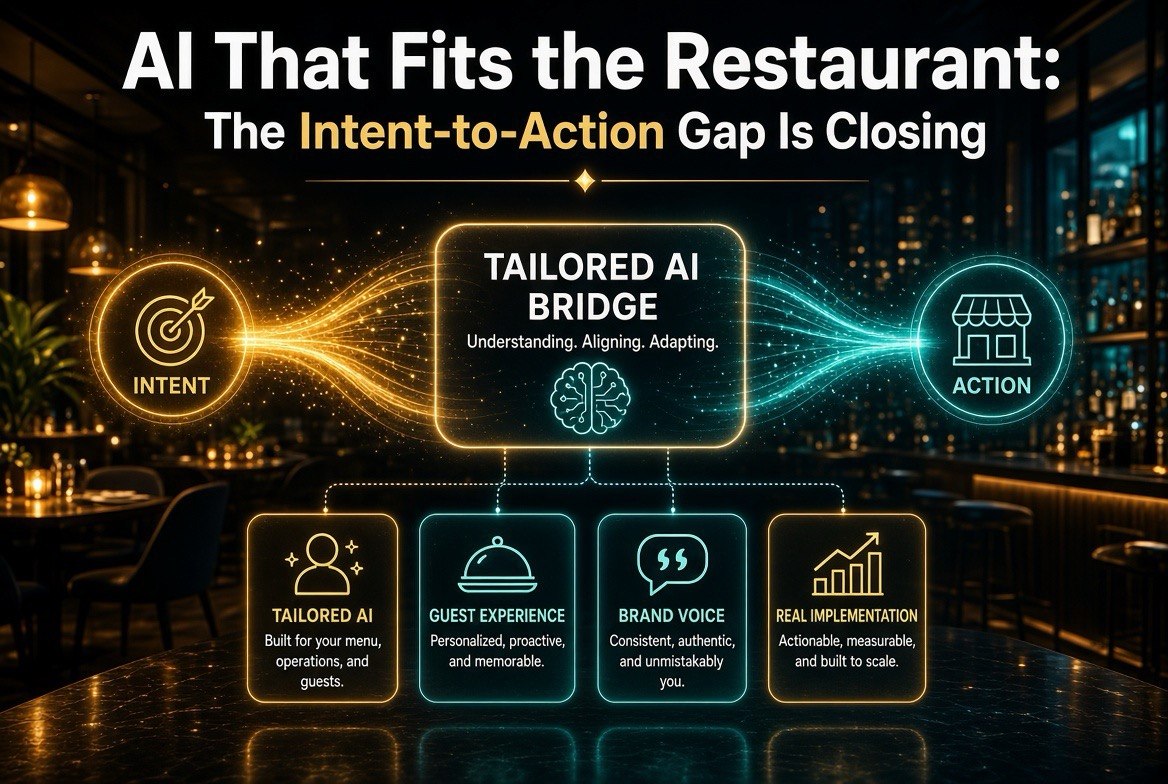
AI That Fits the Restaurant: The Intent-to-Action Gap Is Closing
⚡ Expert Summary: Restaurant operators have stopped asking “should we use AI?” and started asking “how do we make it fit our place?” The data backs it up: Toast’s 2025 survey of more than 700 decision-makers found 86% are comfortable using AI, and a Deloitte study shows 82% of operators plan to increase their AI investment — with 84% of those already investing reporting a strong impact on customer experience. The intent-to-action gap is closing. For an independent owner, that means the winning move is no longer adopting AI — it is implementing it in a way that protects your brand voice and your hospitality, not the generic plug-and-play that screams “we bought a chatbot.”
The Question Has Changed for Restaurant Operators
Walk the floor of any industry event in 2026 and the conversation has shifted. A few years ago, restaurant owners were asking whether AI was a fad or a real tool for a thin-margin business. That question is settled. Today the conversation is entirely different: owners are asking which tools fit their specific operation, how to deploy them without wrecking the guest experience, and how to get a return on the money they are already spending.
That shift is the intent-to-action gap closing. Saying you believe in AI is cheap. Wiring it into a Friday-night service without breaking your rhythm is the actual work. And the operators who figured that out first are the ones pulling ahead of their competitors.
The Numbers That Prove the Gap Is Closing
Let me put real data in front of you, because this industry runs on numbers, not vibes. The adoption story is no longer about early adopters and skeptics — it is about what already-invested operators are doing next.
| Data Point | Source | What It Tells You |
|---|---|---|
| 86% of operators comfortable using AI | Toast 2025 survey, 700+ decision-makers | Resistance is no longer the main barrier; confidence is |
| 82% plan to increase AI investment | Deloitte 2025 study | Operators are doubling down, not retreating |
| 84% of invested operators report CX impact | Deloitte 2025 study | The tools are producing guest-facing results, not just back-office savings |
Read that third row carefully. It is the one that matters most for a restaurant owner. AI is not just cutting admin costs anymore — it is moving the needle on the thing you actually sell: the guest experience. When the majority of already-invested operators say their customers feel the difference, that is not hype, that is a competitive signal.
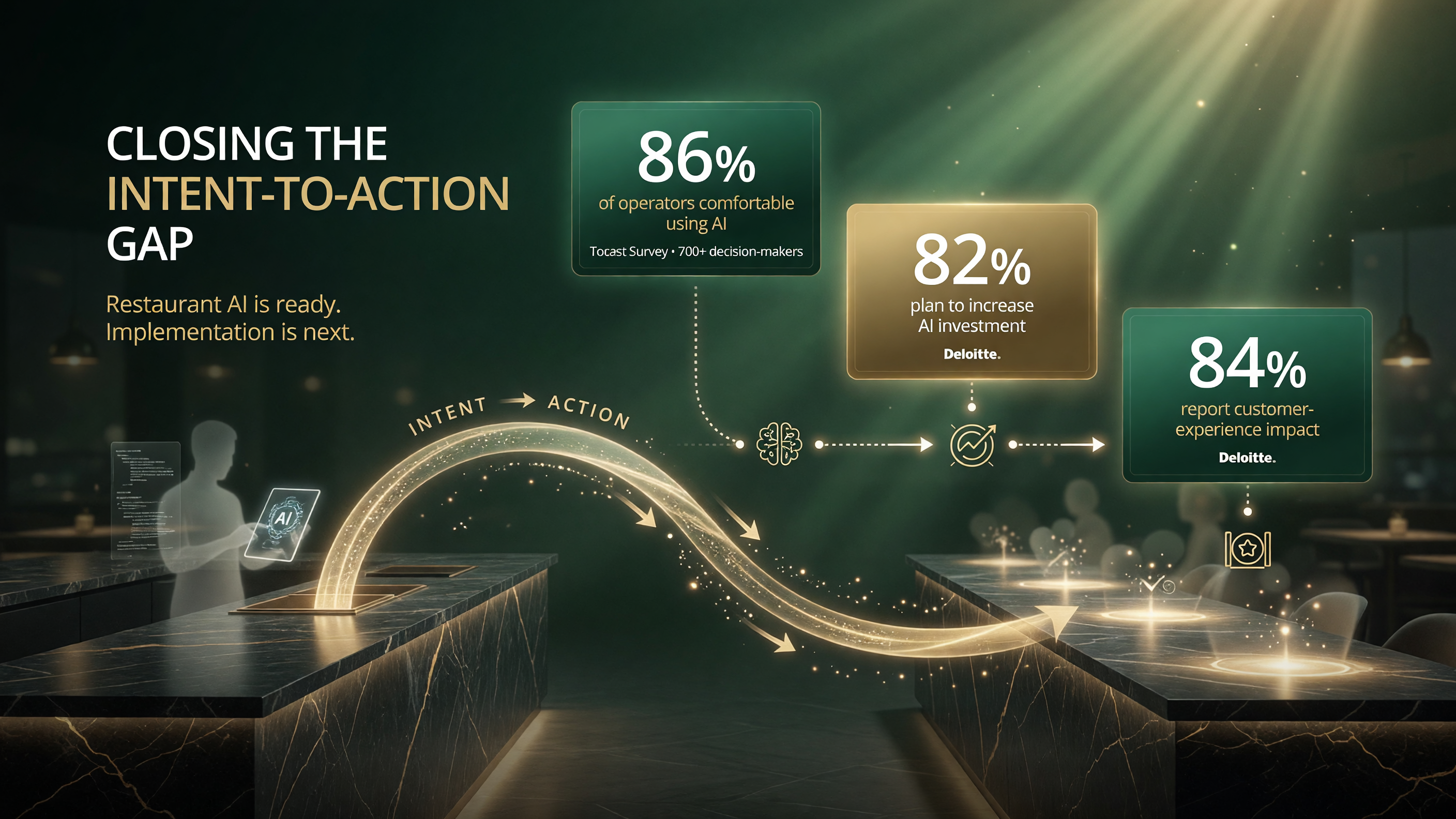
Restaurant AI intent-to-action gap: 86% of operators comfortable using AI, 82% planning to invest more, and 84% reporting customer-experience impact.
What “Tailored Implementation” Actually Means
The phrase you will hear over and over in 2026 is tailored implementation. It sounds like consultant talk, but it is a real and practical idea. The old failure mode was buying a generic AI product, bolting it onto your POS, and expecting magic. The new approach starts with your restaurant’s identity — your menu, your service style, your regulars — and builds the AI around that, not the other way around.
Here is the concrete difference. A chain can roll out the same chatbot to a thousand locations because the brand voice is standardised. An independent restaurant cannot. Your follow-up text, your tone on a customer review, your specials messaging — that is what makes you you. If the AI is not speaking in your voice, the guest feels the disconnect and it costs you trust. Tailored implementation means setting the guardrails so the AI amplifies your hospitality instead of flattening it.
Providers like SpotOn are leaning into this exact need, building tools that bring sophisticated data insights to smaller operators so they can focus on local creativity and personal connections. The point is not to replace the human element with a script. It is to use AI to handle the repetition — the review triage, the reservation follow-up, the routine scheduling — so your people have more time for the face-to-face work that keeps customers coming back.
Where the ROI Actually Shows Up for Independents
Let me get practical, because “closing the gap” means nothing until it shows up in your weekly numbers. From what operators and providers report, the return concentrates in a few clear places.
First, the data gap. This is the biggest structural advantage chains have over independents: they have data teams and budgets. AI is the equaliser. Tools that read your sales, reviews, and reservations from your POS and turn them into plain-language answers put that analytical power in the hands of a one-location owner. You finally see which menu items are underperforming, which hours are bleeding labour, and what your reviews are really saying.
Second, the marketing and admin load. Independent operators are drowning in social posts, content, and follow-ups they do not have staff to handle. AI marketing stacks and review-response tools automate the busywork. AITR has covered how review-response AI saves operators around 15 hours a week; the same logic applies to content and ordering coordination.
Third, the guest side of the equation. When the AI frees up your team’s attention, service gets tighter. Hosts are not buried in a phone queue. Managers are not copying reservation data at midnight. The cumulative effect is a smoother, more personal guest experience — which is exactly the metric those 84% of operators say is improving.
Platforms Built for the Independent Operator
The tooling ecosystem has caught up with the reality that most restaurants are not chains. You no longer need to buy an enterprise suite and hire someone to run it. A growing set of platforms is built specifically for one-location or small-group operators, with owner-approval workflows so nothing goes out without your sign-off.
Platforms like Semperi coordinate your website, ordering, reviews, and content in one place, with approval workflows so the owner stays in control of the brand. The model is straightforward: the system drafts, aggregates, and suggests; you review and approve before anything touches the guest. That is the “fits your restaurant” version of automation — you are never handing the brand keys to a black box.
The takeaway is not to rush out and buy every tool. The takeaway is that the tools now exist at a price and complexity level an independent operator can actually use — and that the market has moved past the either/or of “human or AI” toward “human sets the standard, AI handles the volume.”
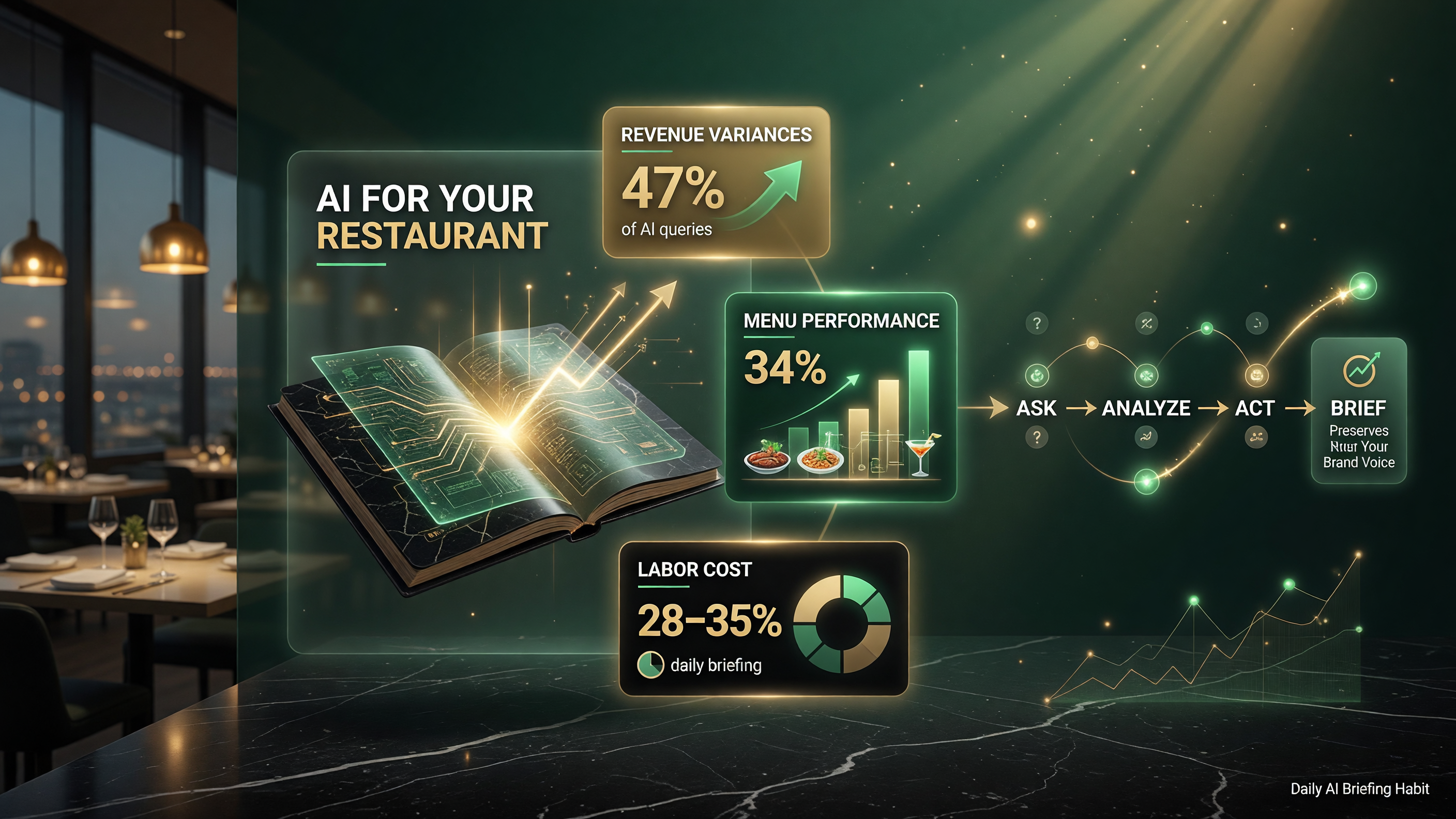
The high-value questions operators use AI for: revenue variances (47% of queries), menu performance (34%), and labor cost as a share of sales.
How to Close Your Own Intent-to-Action Gap
You have read the industry headlines. Now here is a road map for your own restaurant, in plain steps that do not require a tech degree or a big budget.
Start small and pick one operational pain point. Do not try to automate your entire operation at once — that is how projects stall and money gets wasted. Choose the single task that eats the most of your week, whether that is answering the phone, responding to reviews, or building your schedule.
Match the tool to your size. If you are one location, you do not need an enterprise rollout. Look for platforms designed for independents with straightforward pricing and approval workflows that keep you in control of your brand.
Protect your voice. Set the tone, the scripts, the do-not-say list. Whether it is a phone agent, a review responder, or a reservation assistant, make sure it sounds like your restaurant, not your software vendor. This is the single most important guardrail for an independent operator.
Measure it in covers and labour, not in feature lists. Before you deploy, write down what success looks like: faster pickup times, fewer missed calls, lower no-show rate, more review responses out. Track it for a month and decide based on what the numbers say, not what the sales demo promised.
The Risk of Getting It Wrong — And How to Avoid It
For every success story in 2026, there is a cautionary tale of an operator who bought a flashy tool, turned it on, and watched it backfire in front of the guests. The failure mode is rarely the technology. It is the deployment. A voice agent that cannot handle a loud, late Friday call. A review responder that sounds nothing like the owner. A scheduling tool that forgets your prep cook’s availability. These are not exotic problems; they are the mundane ways sloppy AI adoption costs you trust and money.
The industry’s own leaders have been warning against overdependence, and those warnings are worth heeding. The tools are at their best in tightly defined roles, not as a replacement for judgment. The operators who succeed treat AI as a force multiplier for well-run processes, never as a bandage for a broken one. If your phone queue is already a disaster, a voice agent will just handle more calls badly. Fix the process first, then automate it.
The other failure mode is the silent erosion of hospitality. Guests do not leave a review saying “the reservation software felt impersonal” — they leave one saying “it didn’t feel like they cared.” That is often the same thing. When the AI takes over every touchpoint and no human is setting the tone, the warm, personal feeling that separates a good independent restaurant from a chain gets sanded away. Guard against that by keeping human approval in the loop on anything customer-facing and by setting the voice, the scripts, and the do-not-say list yourself.
The final risk is buyer’s remorse from a tool that sounded great in the demo but cannot work with how your place actually runs. This is why the modern platforms built for independents stress owner-approval workflows and realistic onboarding. You should be able to try a tool on one real operational lane — one location, one shift, one function — before you commit your whole operation to it. That discipline turns a risky bet into a measured decision, and it is the difference between closing your gap and opening a new wound.
Why Waiting Is the Expensive Move
Here is the uncomfortable truth for the operator who is still on the fence. The data shows the doubters are already a shrinking minority, and the operators who invested early are reporting guest-facing results. That is the definition of a widening moat. Every month you wait, a competitor in your market is closing their own gap — routing reviews, responding to every reservation late at night, and using the freed-up time to work on the guest experience instead of the busywork.
You do not need to be the most aggressive AI adopter in town. You need to be deliberate. And deliberate in 2026 means making a plan, starting with one task, protecting your voice, and measuring the return. The intent-to-action gap is closing across the industry. The only question left is whether it closes for you or for your competitors first.
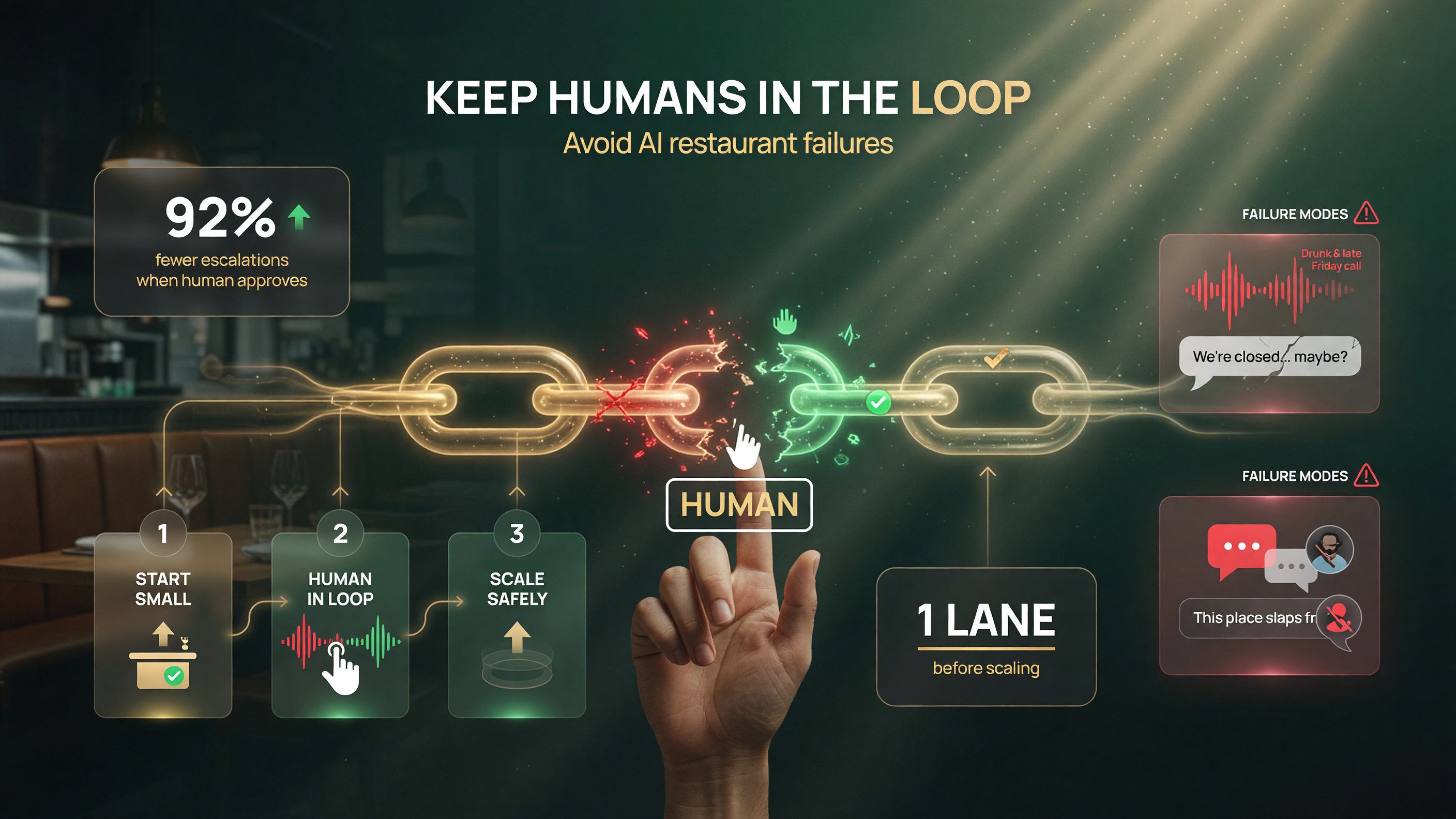
Guardrails that keep restaurant AI on track: a human approval step, a single operational lane first, and a brand voice worth protecting.
Frequently Asked Questions
Is AI really being adopted by independent restaurants, or just chains?
Independents are closing the gap fast. Data from Toast and Deloitte shows most operators are now comfortable using AI, and a growing number of platforms are built specifically for one-location and small-group operators — not just big chains with enterprise budgets.
What does “tailored implementation” mean for my restaurant?
It means building the AI around your menu, service style, and brand voice instead of bolting on a generic product. The goal is to handle repetitive work with AI while protecting the hospitality and personal touch that make your restaurant distinct.
Will AI replace my staff?
No. The point is to automate repetition — review triage, reservation follow-up, scheduling — so your team has more time for face-to-face hospitality. The human element stays central; AI handles the volume around it.
Where does the return on investment actually show up?
Independents typically see ROI in three places: closing the data gap with chains, cutting marketing and admin busywork, and improving the guest experience — which 84% of already-invested operators report.
How do I start without a big budget or tech staff?
Pick one operational pain point, match the tool to your size, protect your brand voice with approval workflows, and measure results in covers and labour rather than feature lists. Start with a single task, not a full rollout.
How much is AI adoption growing in restaurants?
Adoption is rising steadily through 2026, with the majority of already-invested operators planning to increase their investment and reporting customer-experience impact. The intent-to-action gap between wanting AI and deploying it effectively is closing.

About Barak Schurr
Barak Schurr built and exited a major ticketing platform, ran global operations at Eventbrite, and now focuses on one question: which AI tools actually help independent restaurant owners run leaner and grow faster. He writes from the operator’s perspective — no vendor spin, no theory, just what’s real in 2026.
Email: [email protected]
More Resources for Restaurant Operators